
Text and jpegs by courtesy of hathitrust.org www.hathitrust.org, compiled by motorracinghistory.com
Motor Age, Vol. XLIII (43), No. 23, June 7, 1923
Future of the Motor Speedway in Doubt
Unwelcome News Comes After Successful Contest With 122 cu. in. Engines.
Need of Further Tryouts of Small Machines Is Apparent.
Comments on Biggest of All International Sweepstakes
By CLYDE JENNINGS
Indianapolis, May 31. – THE race which Tommy Milton won yesterday may be the last of the International Sweepstakes. It is reasonably certain that if there is another race, it will be under different management.
It developed today that the Speedway property has been on the market for some time and today Carl G. Fisher announced that a meeting had been called of car manufacturers and others to decide whether or not the Speedway should continue. He said in this announcement that the objective of building the speedway was entirely secondary at that time and would be in the consideration of the future. If the manufacturers really wanted the big practical testing laboratory, it would be continued. If they did not, it would be sold for other purposes.
It is known that Fisher wants to dispose of his interest and go east for a rest. He has disposed of his other interests and built a home on Long Island. His associates, James A. Allison and Arthur C. Newby, are not anxious to continue in the business.
The announcement given out said that the time had come to work over the plant, both grandstands and track. The work needed is estimated at $200,000. Before this is undertaken the owners want some assurance of the future. The recent legislative attack on the track may have something to do with the future.
It was notable this year, that instead of running editorials on the Memorial Day feature of the race, the Indianapolis newspapers commented on the amount of money spent by visitors, the engineering side of the race and generally approved of the Speedway and the race. The close call for the abolishment of the biggest Indianapolis event appears to have awakened many persons heretofore critical of it.
The Indianapolis Motor Speedway’s annual International Sweepstake is a great spectacle and has become a fixture in the lives of many people, although the race run yesterday was only the eleventh of its kind. In that time many speedways have come and some of them have gone. There was comment yesterday that other speedway races are more exciting, that you can see more of the actual racing and that the shorter distance races are more interesting. Despite these facts, it remains that this speedway does not appear to have a real competitor.
There does not seem to be a sporting event in this country that quite compares with this one in the matter of attendance and in the uninteresting character of the performance to the average spectator.
The unofficial announcements place the attendance yesterday at about 150,000. It is impossible to gage the accuracy of that figure, as the crowd is scattered over a 420-acre plot. The grandstands seat 42,000 and after that you have no accurate check on the crowds. It is quite impossible to check the number of people to an acre of parked automobiles. It is. estimated the government got more than $45,000 from the Memorial Day event.
The management said that this crowd ran fully 15,000 ahead of last year. That is easy of belief. It was the first time that there have been no grandstand seats on sale in this city during the days just before the race. This year, for the first time, the speculators got in their work. Many people did not come because they heard rightly that seats were unobtainable.
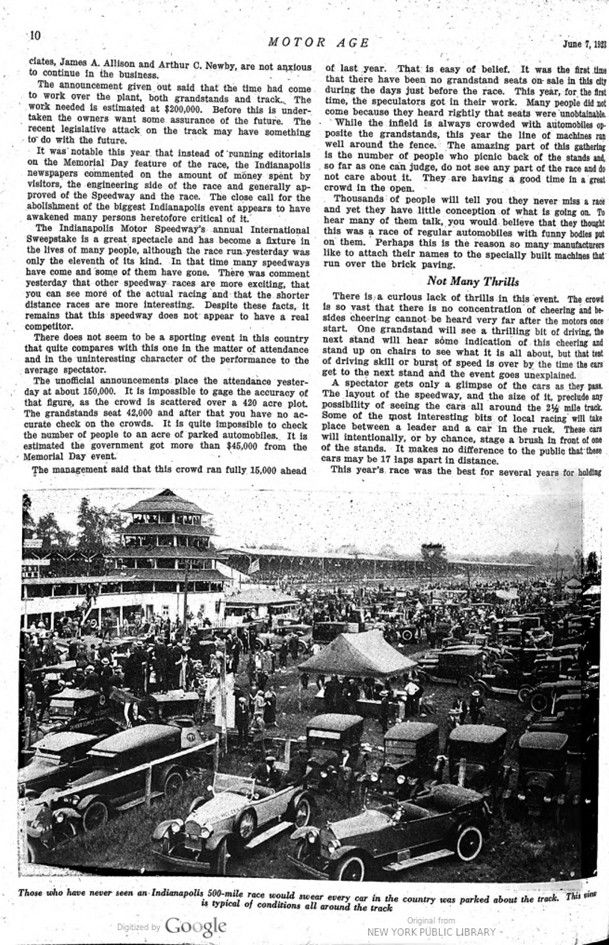
While the infield is always crowded with automobiles opposite the grandstands, this year the line of machines ran well around the fence. The amazing part of this gathering is the number of people who picnic back of the stands and, so far as one can judge, do not see any part of the race and do not care about it. They are having a good time in a great crowd in the open. Thousands of people will tell you they never miss a race and yet they have little conception of what is going on. To hear many of them talk, you would believe that they thought this was a race of regular automobiles with funny bodies put on them. Perhaps this is the reason so many manufacturers like to attach their names to the specially built machines that run over the brick paving
Not Many Thrills
There is a curious lack of thrills in this event. The crowd is so vast that there is no concentration of cheering and be- sides cheering cannot be heard very far after the motors once start. One grandstand will see a thrilling bit of driving, the next stand will hear some indication of this cheering and stand up on chairs to see what it is all about, but that test of driving skill or burst of speed is over by the time the cars get to the next stand and the event goes unexplained.
A spectator gets only a glimpse of the cars as they pass. The layout of the speedway, and the size of it, preclude any possibility of seeing the cars all around the 2½ mile track. Some of the most interesting bits of local racing will take place between a leader and a car in the ruck. These cars will intentionally, or by chance, stage a brush in front of one of the stands. It makes no difference to the public that these cars may be 17 laps apart in distance.
This year’s race was the best for several years for holding the leaders within a lap of each other. But even with the first five cars on the same lap, it was not often that the spectators could see two of them at the same time.
Driver Skill
The skill of the race driver is not the same that the average motorist knows as skill. There is little of the good handling of a car, stopping and starting to avoid crashes and worming into a traffic line. The speed is too great for any fancy touches of that kind and the cars are seldom bunched in a way that requires anything of the sort. Safety is one precaution that keeps the racers out of groups.
There is the question of endurance, for the race driver who sticks to his car must drive more than five hours at a terrific speed and the vibration of these lightly built cars over rough brick pavement is terrific when compared with a passenger car, such as is usually associated with driving. Steering wheels are hard to control and of course the nervous strain is great.
Yesterday there were 23 changes of drivers, an unusual number. Some of this was due to the fact that in giving so much attention to the power plants, to meet the new requirements, the designers had overlooked the springs. The springs that were fairly satisfactory for the heavier race cars in the past not at all satisfactory for the lighter cars. Shock absorbers were used and gave a good account of themselves.
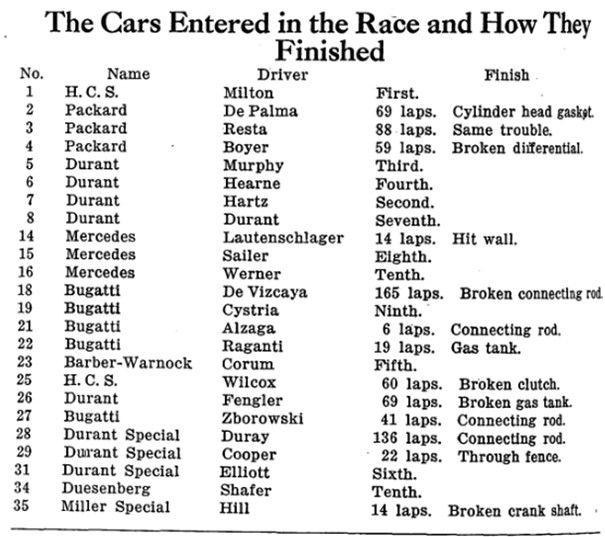
Milton drove almost the entire race. He vacated once when he came to the pit to get his hands bandaged. They were badly blistered by his grip on the wheel and he went to the hospital and had them bandaged and then went back in the race. Hartz, Corum and Murphy alone drove the entire race. Three of 24 starters!
Wilcox had one curious experience. He lost the cap of his gasoline tank and tried to make the pit gang understand what was the trouble by signs but was unable to do so. He came into the pits and rags were stuffed into the tank opening, the car went back on the track, while the cap from the other H.C.S. was obtained and put on the tank when it drew up again.
This incident illustrates what is meant by driving skill in a 500-mile race. The driver must keep his eyes and attention to the front and at the same time know exactly what is the matter with his car. That is where the mechanic riding with him formerly came in handy. When the car stopped, both the driver and the mechanic could get to work without a loss of time. This year the driver had to explain what he wanted when he came in. Spark plug changes, universal joint weakness or any other cause of trouble must be sensed by the driver while in the race unless he impairs his standing while a search is made for the trouble.
German Driving Bad
The German Sailer gave an illustration of driver versatility when his car caught fire at the pits. Some gasoline was spilled on the tail of the car in filling the tank and when he started the car this caught fire from backfire. Sailer showed how quickly a driver can stop the car and get out of the small pit in which he rides.
The Germans showed an unfamiliarity with American race practice in many ways. They did not at any time seem to get the exact hang of driving on the track that is partly straightaway and partly banked. Neither did they seem to have any team strategy. Their pit work was not up to the Speedway standards. They were probably much surprised at the speed with which the American mechanics changed wheels on a car drawn up to the pit.
The Mercedes cars attracted full attention and there appeared to be no prejudice against them, even when they appeared to have a prospect of winning. The extraordinary noise made by these cars was the subject of much comment.
The Baggatti team also suffered some because of a lack of familiarity with the track and American practices, but not to the extent of the Germans.
The Ford a Favorite
The Barber-Warnock entry, the Ford that was revised by Art Chevrolet, was a great favorite. The consistent performance of the two amended Fords in last year’s race was remembered and when this year’s entry started so well, nearly everyone wanted it to finish well up in the race. The fact that it was fifth pleased everyone, except the adherents of those cars that came in later.
This Ford was a consistent performer: It did not change tires nor drivers and maintained an even pace. Really the other cars seemed to slip back of it, rather than Corum getting ahead of them. To make the entire distance with the same driver and tires was quite a feat in this race and Chevrolet was much congratulated.
All of the old timers took a great satisfaction in the performance of Fred Duesenberg’s entry. Duesenberg overcame many difficulties. His first design was changed entirely because he could not get the roller bearing data that he wanted. In three weeks he built three cars and two days before the race the many experts who visited his shop predicted that he would not be in the race at all. They said it was impossible.
The car that qualified was sent out of the shop Tuesday evening and qualified Wednesday morning by special arrangement. The two other cars had been assembled during the night and were on the way to the track but they were caught in the traffic jam in the early morning and could not get into the grounds until the track was closed. When the ruling was given to close the track to cars, Duesenberg’s entries were only a mile away but could not exert their potential speed.
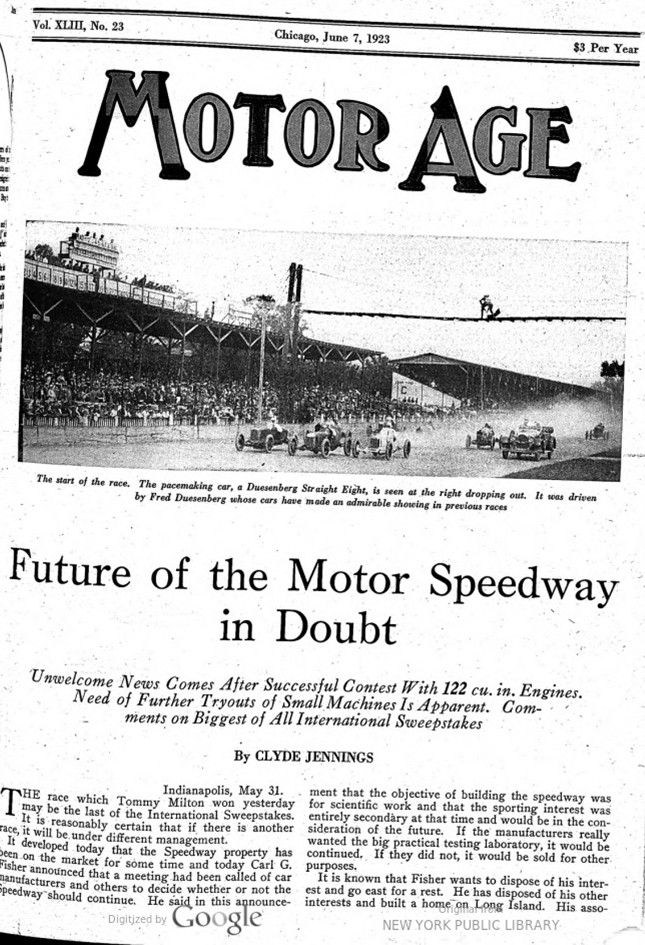
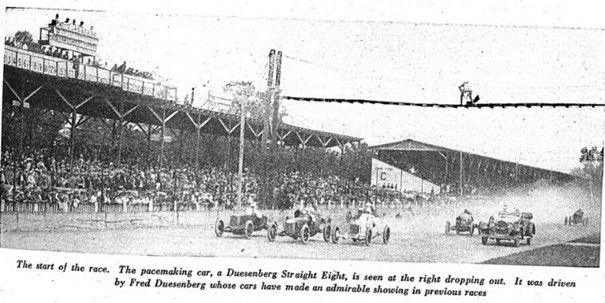
Duesenberg drove the pacemaker this year. The pacemaker was the Duesenberg car that made the 3,100-mile non-stop record on the speedway a few weeks ago. When the Duesenberg left the track in front of the grandstand, to permit the racers to go ahead, it was hit- ting near the 70-mile mark.
Effect of Lap Prizes
This race started at a greater speed than last year’s and raised high hopes for a new record. But after 250 miles Old the average began to drop back. race observers blame this showing on the lap prizes. These prizes, given by Indianapolis merchants and automotive manufacturers, are bunched in the early laps. This stirs a lot of the drivers who lack confidence in the staying powers of their machines to rush oute arly to pick up a few hundred dollars.
Some of the best friends of racing would like to see fewer lap prizes and these offered later in the race. About the middle of the distance there is always a lull in interest and performance. Prizes here might make things more exciting, is the view.
The Social Side
This race, like the national shows, has a great social standing in the automotive world. Among the thousands gathered is a considerable portion of automotive men. It is a regular „Old Timers“ reunion and all of the new timers come here to meet the old ones. „Have you seen —— ?“ is the most frequent question heard.
Most of these reunions, it appears, take place in the press stands where it is supposed one can see the race best. This is not true for two reasons; one that the best observation point was taken for the grandstands, and the other being that the place is too crowded to see anything but some other fellow’s back. How so many men who have nothing to do but get in the way of people who are trying to work and keep on the move constantly become press men for a day is a mystery. From the conversation heard and the questions asked, it would seem that a good many of these men had never read a newspaper.
Photos.
Page 9. The start of the race. The pacemaking car, a Duesenberg Straight Eight, is seen at the right dropping out. It was driven by Fred Duesenberg whose cars have made an admirable showing in previous races.
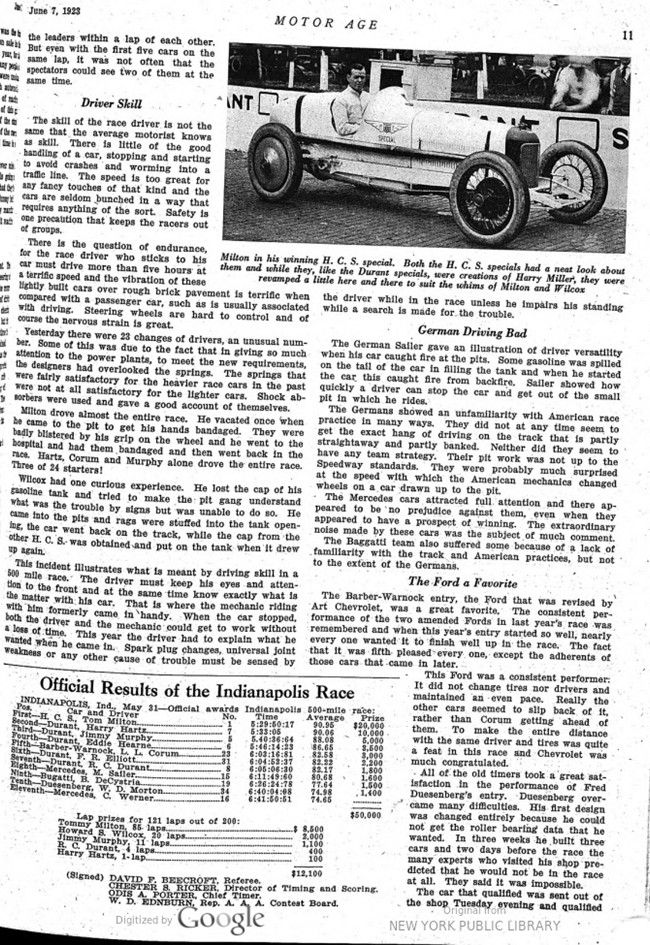
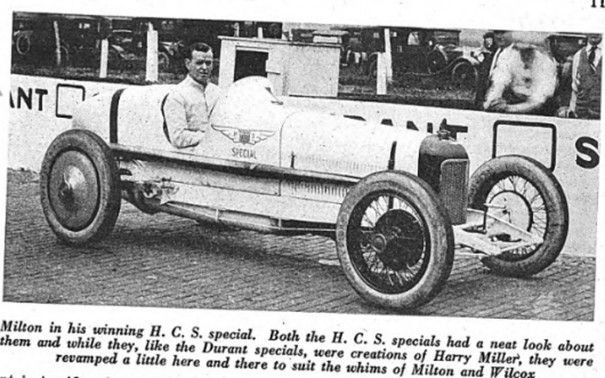
Page 11. Milton in his winning H. C. S. special. Both the H. C. S. specials had a neat look about them and while they, like the Durant specials, were creations of Harry Miller, they were revamped a little here and there to suit the whims of Milton and Wilcox.
Queer Accessories
Here in Indianapolis where reporting Speedway races should be a science one rather expects intelligent work. But a local newspaper prints an article under a headline that „Good accessories helped Milton to win.“ On reading the articles you find that the accessories were such things as tires, ignition system, gasoline and lubrication parts. One cannot but help wonder what a Hoosier newspaper man expects as regular equipment on a car.
There was a good deal of distress among the older racing men that Tom Alley was hurt. Alley is quite popular and after the accident there were constant rumors that he had been killed. As a matter of fact, the German mechanic who was injured when a Mercedes car. went against the wall was more seriously hurt than Alley. The throttle stuck on Alley’s car and he got off the track trying to pass other cars on the banks at full speed ahead. One boy struck by Alley’s car was killed and two others injured. They were knot hole spectators and were struck after the car went through the fence.
As to Information
The announcements of car withdrawals always causes confusion later. The information bureau in an effort to satisfy curosity and demand for news gives out the best information obtainable through the telephone system that extends over the entire speedway grounds. Later this information is checked and often revisions are given out, but they never catch up with first reports.
Handling the Crowd
Indianapolis handles the Speedway crowd very well. There would be no chance of accommodating a crowd like this in a city of this size if it was not for the nature of the gathering. Practically all of the early arrivals at the Speedway are campers and this year the greatest traffic congestion was when the campers made a grand rush to the Speedway to get the best positions along the fence in the free space.
The Speedway organization is a good deal of a marvel when it is considered that this event happens only once a year. Apparently most of the men handling traffic and doing police duty are members of militia companies and they certainly keep automobile traffic moving within the grounds and the city responds by making the chief streets leading to the Speed- way one way streets. Motorcycle policemen move along the route calling to drivers to „double up“ and to „speed up.“ It is a habit in many mid-western cities to drive in single file regardless of the width of the street.
Some arrangements show thought given to the intent of coming. This year the occupants of a large car brought their own grandstand knocked down, with them, and erected it. It consisted of a trestle to go over the hood of the car, on which was placed boards and an automobile cushion. It was sufficiently elevated to see over the persons who stood in front of the car or even over another car.
A man who associated much with the mechanics and drivers at the track in the days before the race said that most of their idle time was spent in discussing flat rate and kindred maintenance shop topics. Most of these men own shops and are active in them except when on race duty. No anxiety was expressed by any person present as to the It is very generally accepted that the 122 cu. in. engine will suffice for additional races. There is a lot of work to be done on this engine and its chassis before the experimental books are closed on it.
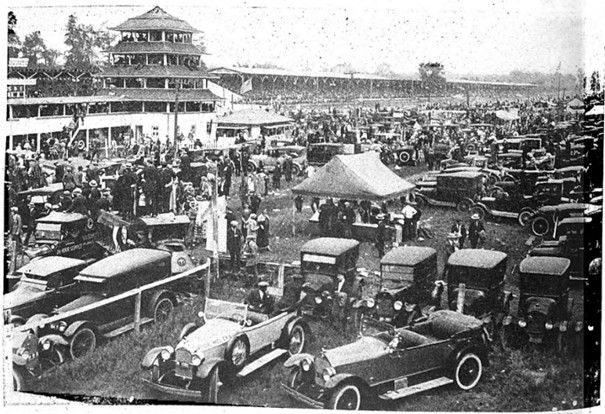
Photos. Page 10: Those who have never seen an Indianapolis 500-mile race would swear every car in the country was parked about the track. This view is typical of conditions all around the track.