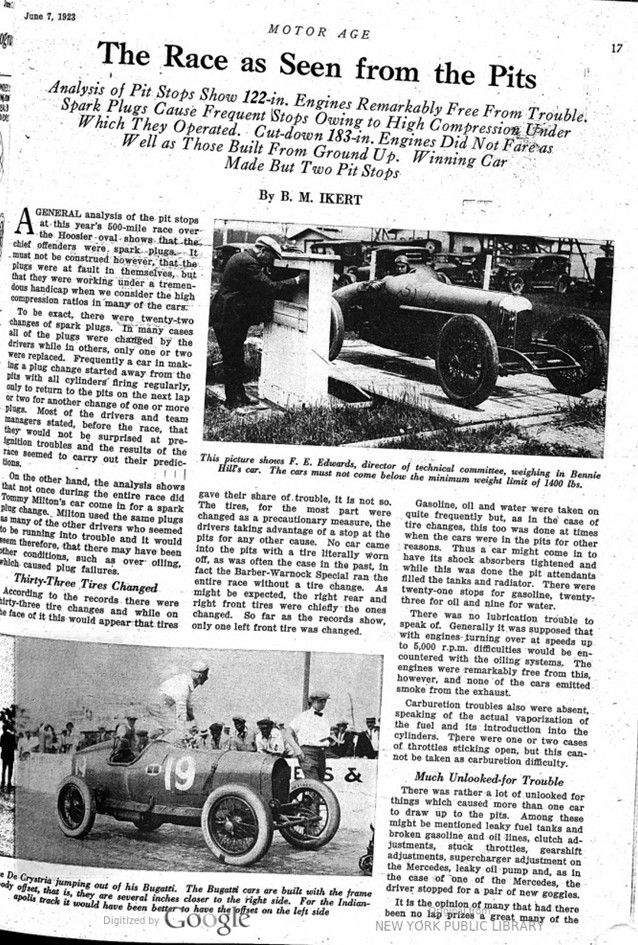
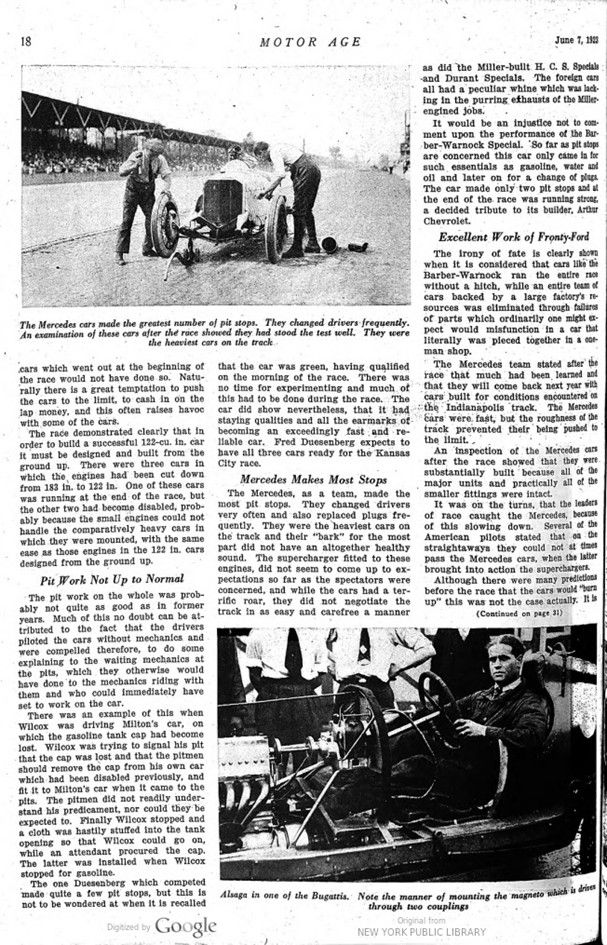
Text and jpegs by courtesy of hathitrust.org www.hathitrust.org, compiled by motorracinghistory.com
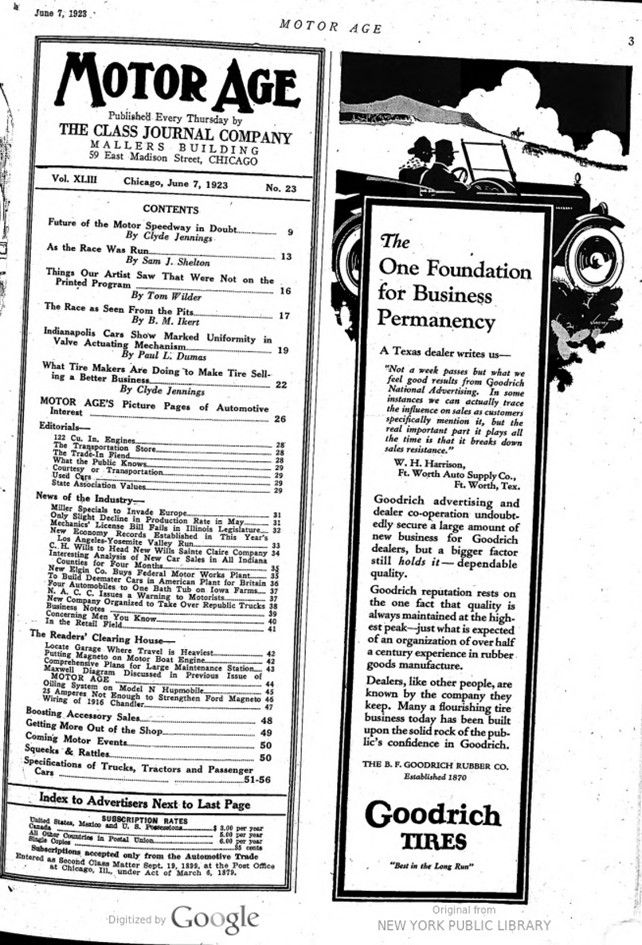
Motor Age, Vol. XLIII (43), No. 23, June 7, 1923
The Race as Seen from the Pits
Analysis of Pit Stops Show 122-in. Engines Remarkably Free From Trouble. – Spark Plugs Cause Frequent Stops Owing to High Compression Under Which They Operated. – Cut-down 183-in. Engines Did Not Fare as Well as Those Built From Ground Up. – Winning Car Made But Two Pit Stops
By B. M. IKERT
GENERAL analysis of the pit stops at this year’s 500-mile race over the Hoosier oval shows that the chief offenders were spark plugs. It must not be construed however, that the plugs were at fault in themselves, but that they were working under a tremendous handicap when we consider the high compression ratios in many of the cars.
To be exact, there were twenty-two changes of spark plugs. all of the plugs were changed by the many cases drivers while in others, only one or two were replaced. Frequently a car in making a plug change started away from the pits with all cylinders firing regularly, only to return to the pits on the next lap or two for another change of one or more plugs. Most of the drivers and team managers stated, before the race, that they would not be surprised at pre- ignition troubles and the results of the race seemed to carry out their predictions.
On the other hand, the analysis shows that not once during the entire race did Tommy Milton’s car come in for a spark plug change. Milton used the same plugs as many of the other drivers who seemed to be running into trouble and it would seem therefore, that there may have been other conditions, such as over oiling, which caused plug failures.
Thirty-Three Tires Changed
According to the records there were thirty-three tire changes and while on the face of it this would appear that tires gave their share of trouble, it is not so. The tires, for the most part were changed as a precautionary measure, the drivers taking advantage of a stop at the pits for any other cause. into the pits with a tire literally worn off, as was often the case in the past, in fact the Barber-Warnock Special ran the entire race without a tire change. As might be expected, the right rear and right front tires were chiefly the ones changed. So far as the records show, only one left front tire was changed.
Gasoline, oil and water were taken on quite frequently but, as in the case of tire changes, this too was done at times when the cars were in the pits for other reasons. Thus a car might come in to have its shock absorbers tightened and while this was done the pit attendants filled the tanks and radiator. There were twenty-one stops for gasoline, twenty-three for oil and nine for water.
There was no lubrication trouble to speak of. Generally, it was supposed that with engines turning over at speeds up to 5,000 r.p.m. difficulties would be encountered with the oiling systems. The engines were remarkably free from this, however, and none of the cars emitted smoke from the exhaust.
Carburetion troubles also were absent, speaking of the actual vaporization of the fuel and its introduction into the cylinders. There were one or two cases of throttles sticking open, but this cannot be taken as carburetion difficulty.
Much Unlooked-for Trouble
There was rather a lot of unlooked for things which caused more than one car to draw up to the pits. Among these might be mentioned leaky fuel tanks and broken gasoline and oil lines, clutch adjustments, stuck throttles, gearshift adjustments, supercharger adjustment on the Mercedes, leaky oil pump and, as in the case of one of the Mercedes, the driver stopped for a pair of new goggles.
It is the opinion of many that had there been no lap prizes a great many of the cars which went out at the beginning of the race would not have done so. Naturally there is a great temptation to push the cars to the limit, to cash in on the lap money, and this often raises havoc with some of the cars.
The race demonstrated clearly that in order to build a successful 122-cu. in. car it must be designed and built from the There were three cars in ground up. which the engines had been cut down from 183 in. to 122 in. One of these cars was running at the end of the race, but the other two had become disabled, prob- ably because the small engines could not handle the comparatively heavy cars in which they were mounted, with the same ease as those engines in the 122 in. cars designed from the ground up.
Pit Work Not Up to Normal
The pit work on the whole was probably not quite as good as in former years. Much of this no doubt can be attributed to the fact that the drivers piloted the cars without mechanics and were compelled therefore, to do some explaining to the waiting mechanics at the pits, which they otherwise would have done to the mechanics riding with them and who could immediately have set to work on the car.
There was an example of this when Wilcox was driving Milton’s car, which the gasoline tank cap had become lost. Wilcox was trying to signal his pit that the cap was lost and that the pitmen should remove the cap from his own car which had been disabled previously and fit it to Milton’s car when it came to the pits. The pitmen did not readily understand his predicament, nor could they be expected to. Finally, Wilcox stopped and a cloth was hastily stuffed into the tank opening so that Wilcox could go on, while an attendant procured the cap. The latter was installed when Wilcox stopped for gasoline.
The one Duesenberg which competed made quite a few pit stops, but this is not to be wondered at when it is recalled that the car was green, having qualified on the morning of the race. There was no time for experimenting and much of this had to be done during the race. The car did show nevertheless that it had staying qualities and all the earmarks Sof becoming an exceedingly fast and reliable car. Fred Duesenberg expects to have all three cars ready for the Kansas City race.
Mercedes Makes Most Stops
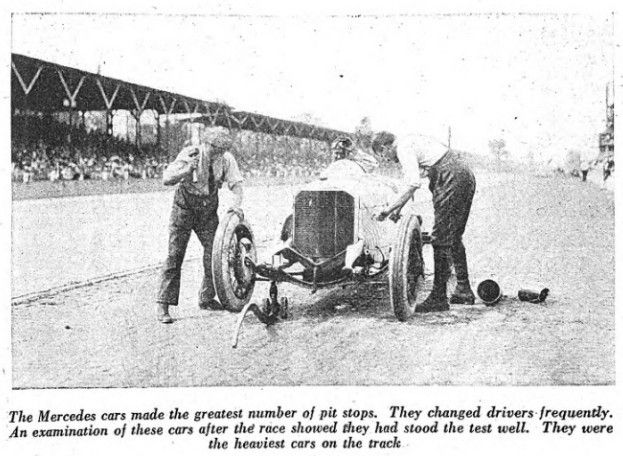
The Mercedes, as a team, made the most pit stops. They changed drivers very often and also replaced plugs frequently. They were the heaviest cars on the track and their “bark” for the most part did not have an altogether healthy sound. The supercharger fitted to these engines, did not seem to come up to expectations so far as the spectators were concerned, and while the cars had a terrific roar, they did not negotiate the track in as easy and carefree a manner as did the Miller-built H.C.S. Specials and Durant Specials. The foreign cars all had a peculiar whine which was lacking in the purring exhausts of the Miller-engined jobs.
It would be an injustice not to comment upon the performance of the Barber-Warnock Special. So far as pit stops are concerned this car only came in for such essentials as gasoline, water and oil and later on for a change of plugs. The car made only two pit stops and at the end of the race was running strong, a decided tribute to its builder, Arthur Chevrolet.
Excellent Work of Fronty-Ford
The irony of fate is clearly shown when it is considered that cars like the Barber-Warnock ran the entire race without a hitch, while an entire team of cars backed by a large factory’s resources was eliminated through failures of parts which ordinarily one might expect would misfunction in a car that literally was pieced together in a one-man shop.
The Mercedes team stated after the race that much had been learned and that they will come back next year with cars built for conditions encountered on the Indianapolis track. The Mercedes cars were fast, but the roughness of the track prevented their being pushed to the limit.
An inspection of the Mercedes cars after the race showed that they were. substantially built because all of the major units and practically all of the smaller fittings were intact.
It was on the turns, that the leaders of race caught the Mercedes, because of this slowing down. Several of the American pilots stated that on the straightaways they could not at times pass the Mercedes cars, when the latter brought into action the superchargers.
Although there were many predictions before the race that the cars would “burn up” this was not the case actually. It is (Continued on page 31) (Continued from page 18) true that there were some failures of connecting rods and in the case of one of the cut down 183 in. jobs, a broken crankshaft, but it is equally true that for the most part these small, high-speed engines gave a wonderful account of themselves. There was no difficulty with carburetion nor lubrication of the small engines in those cars which were contenders for final honors. Many had said that with the small engines lubrication, carburetion and ignition would become increasingly more difficult, owing to the great speeds at which these engines must turn over to develop the power necessary for the car speed desired.
The increased engine speed, speaking of the 122 in. cars designed and built from the ground up, for the most part, was not responsible for car or engine failure. More often the cause of failure was due to things which might have been remedied before the race, and which applies to such things as broken fuel lines, leaky tanks and so on.
Ball bearings were used to great extent in many of the cars which competed and one of the outstanding facts of the race is the service these bearings gave. Not a bearing failure was reported, and it was not so long ago that many said a ball bearing crankshaft, for instance, was not practical. There was a copious use of ball bearings on the front wheels.
Altogether the 122-in. engine made a showing of which it may be justly proud. Last year many predicted that if the cars did not burn up, they at least would not travel nearly so fast as the 183 in. cars of last year. True, the winner this year did not quite equal last year’s record, but he came close enough to it that we might look for the accomplishment next year. By that time the cars will have had all the “bugs” taken out of them, just as many of the successful cars of to-day are the perfection of yesterday’s efforts on the part of the designers and builders.
Photos.
Page 17.
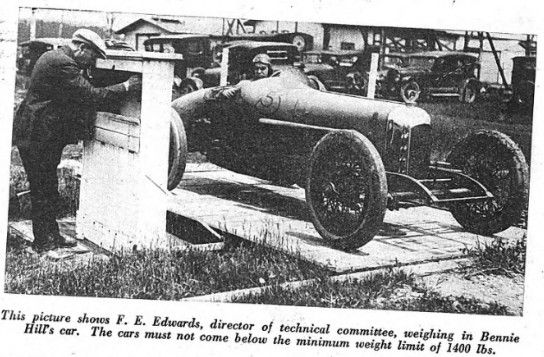
This picture shows F. E. Edwards, director of technical committee, weighing in Bennie Hill’s car. The cars must not come below the minimum weight limit of 1400 lbs.
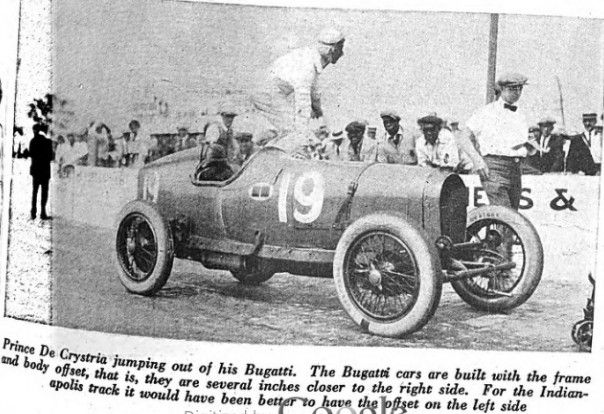
Prince De Crystria jumping out of his Bugatti. The Bugatti cars are built with the frame and body offset, that is, they are several inches closer to the right side. For the Indianapolis track it would have been better to have the offset on the left side.
Page 18.
The Mercedes cars made the greatest number of pit stops. They changed drivers frequently. An examination of these cars after the race showed they had stood the test well. They were the heaviest cars on the track.
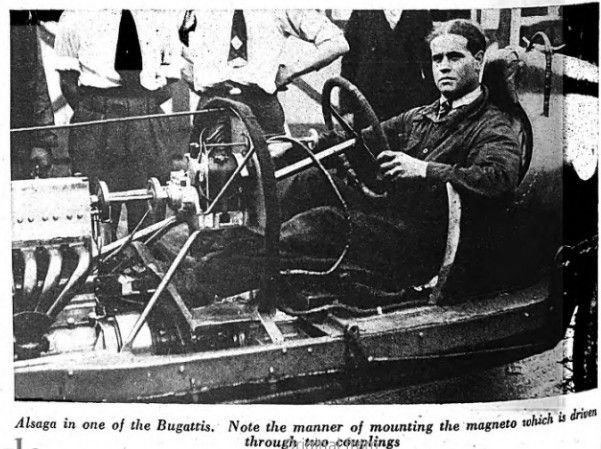
Alsaga in one of the Bugattis. Note the manner of mounting the magneto which is driven through two couplings.
—————————————————-