

Text and jpegs by courtesy of hathitrust.org www.hathitrust.org, compiled by motorracinghistory.com
MOTOR – THE NATIONAL MAGAZINE OF MOTORING, Vol. 22, No. 3, June 1914
1914 International Sweepstakes
Cars and Drivers that Made the Fourth Annual 500-Mile Race the Most Notable of the Series. Something About Past Performances in This Indianapolis Motor Car Classic.
WHAT the Derby is to horse racing and the Diamond Sculls to rowing, the annual International Sweepstakes at the Indianapolis Speedway has come to be to motor racing. Ambitious in its inception, the event has steadily grown in interest and importance, until to-day it is beyond question the premier motor track contest of the world.
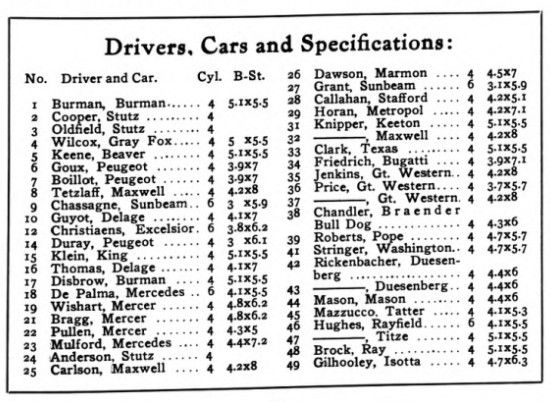
The 1914 renewal of this motor classic breaks all records, both for number of entrants and for that mysterious something, sportingly known as “class.” Forty-four cars were entered, comprising the very pick of the speed machines of France, England, Italy, Belgium, Germany and America. Possibly our French friends sent over the most dangerous combination in their Peugeots, driven by those masters of track skill and strategy, Goux, Boillot and Duray, and their Delages, piloted by Guyot and Thomas. But our cousins of England made a strong bid for premier honors with their two Sunbeams, driven by Chassagne, the record breaker of Brooklands, and our own Harry Grant, with two Vanderbilt wins to his credit. Christiaens in the Belgian Excelsior was by no means an outsider. Italy sent us an Isotta and Germany entered its Mercedes team, under the skillful guidance of De Palma and Mulford. Nor must we forget the German car with the Italian name, the Bugatti, which Friederich brought over.
Undoubtedly the foreigners were a classy lot, but the Stars and Stripes countered with a team that was well able to hold its own in any company. Bob Burman, holder of the world’s mile record, drove a car of his own design and bearing his name. Cooper, Oldfield and Anderson had the mounts on three Stutz cars, winners of a hundred speed contests. Wilcox on the Gray Fox, Keen on the Beaver, Klein on the King, Horan on the Metropol, Clark on the Texas, Jenkins and Price on the Great Westerns, Chandler on the Braender Bull Dog, Stringer on the Washington, Mazzucco on the Tatter, Hughes on the Rayfield, Brock on the Ray, Callahan on the Stafford, were piloting mounts new to speedway contests, but by all accounts dangerous none the less. Tetzlaff and Carlson, with an unknown, drove a team of Maxwells, new to the racing world, but reported Jehus for speed. Wishart, Bragg and Pullen were the well-tried pilots of the Mercer team, tried and found true in a dozen score of hard-fought speed contests. And then there was Joe Dawson, winner of the 1912 contest, back at the game on a Marmon, lineal descendant of the famous “Wasp” of that ilk, victor in the first Sweepstakes back in 1911. Let us not forget Roberts in the veteran Pope, Rickenbacher and an unknown in Deusenbergs, which formerly raced as Masons, nor Mason in a Mason. Then to fill out the team there was a newcomer, the Titze, and the Keeton, both driven by unknowns.
Oh, no, our guests from across the sea did not have everything their own way in the Hoosier capital on Memorial Day in the year of Our Lord 1914.
The International Sweepstakes has always developed good sport. The first race was held in 1911 and a field of forty-six cars faced the starter. This was before the rule limiting the contestants to thirty was passed. Ray Harroun in the Marmon “Wasp” was returned winner in six hours, forty-two minutes and eight seconds, which made his average 74.62 miles per hour. The “Wasp” was a specially constructed car, seating only the driver, no provision for a mechanic being made. In 1912 a rule was passed that all entrants must carry a mechanic.
The 1912 Sweepstakes witnessed one of the most dramatic incidents in the history of motor racing. Ralph De Palma in a Mercedes led at the 495th mile, shortly after which a broken piston forced him out of the running, and Joe Dawson leapt into fame and fortune as he piloted his National into first place. De Palma, however, won an eternal place in the hall of good losers, as he shrugged his shoulders and remarked: “Oh, well, it’s all in the game. Next time I may have the luck.” Dawson’s average of 78.72 miles per hour is still the Sweepstakes record.
With the 1913 Sweepstakes, a decided awakening of interest abroad began to be apparent. The Peugeot people were interested enough to send a team of two cars, driven by Goux, who eventually won the race, and Zucarelli, killed a short time after his return from America while practicing for the French. Grand Prix. Guyot, the famous French driver, brought over an English Sunbeam, as a little private speculation and took fourth place. And then there was a Mercedes, a Mercedes-Knight and an Isotta team. Goux, with consummate skill, pushed the nose of his Peugeot past the judges in first place. Bob Burman, matchless in sprint races, attempted to pull sprint tactics in this long grind, with the inevitable result. He burned up the brick track for the first hundred miles and incidentally numerous tires and finally forced himself out of the race. Goux, cool and cunning, bided his time, found that he had just a little the legs of his field. He pushed his car into a lead of two laps and consistently maintained that advantage to the end, sometimes speeding up a little to make time for a replenishment of water or gasoline or a change of tires.
One of the interesting features of the great race is the number of subsidiary prizes that have been offered by the various big manufacturing concerns. It would have been possible for the winner, by a judicious selection of his accessory equipment, to pull down considerably more than a thousand dollars in these extra awards. The most unusual of these extra offers was the Waltham efficiency prize, a $500 watch in a silver box, to the driver among the first three home who should spend the least time at the pits. This incentive for steadiness was quite in accord with the modern interpretation. of the importance of consistency in the motor car.
The Indianapolis Speedway management has never had any occasion to complain of the attendance at previous sweepstakes, but the 1914 event broke all records for number of spectators. Even before the race, the reservations indicated that previous records would be far distanced, and race day proved the truth of all that had been claimed. Several of the big European sporting papers had personal representatives on hand.
The Race In Brief.
Entrants were limited to 450 cubic inches of piston displacement.
First Prize $20,000; second prize $10,000; third prize $5,000; fourth prize $3,000; fifth prize $2,500; sixth prize $2,000; seventh prize $1,500; eighth prize $1,400; ninth prize $1,300; tenth prize $1,200; eleventh prize $1,100; twelfth prize $1,000. In addition to these, special prizes have been offered by various manufacturers, the total value being more than $9,000. Details in regard to these subsidiary prizes will be found on another page.
Contestants represented six countries, England, France, Belgium, Italy, Germany and the United States.
The car having the smallest piston displacement was the Peugeot driven by Duray, 183 cubic inches being the figures. The largest cars have a rating of 449.4, just under the limit. The total number of entrants was forty-four, reduced to thirty by elimination trials, held for the three days preceding the race.
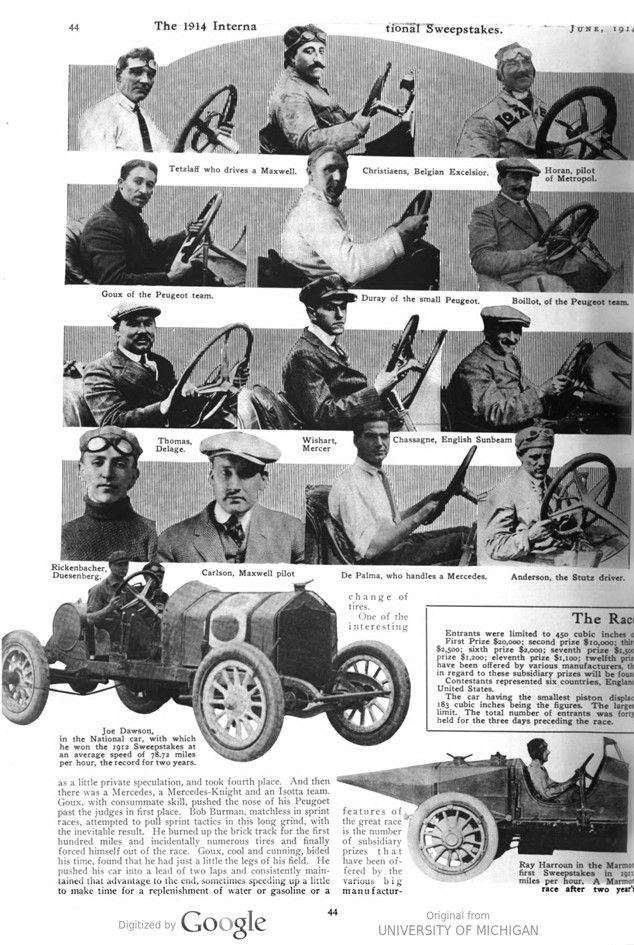
The 1914 International Sweepstakes.
Tetzlaff who drives a Maxwell. – Christiaens, Belgian Excelsior. – Horan, pilot of Metropol.
Goux of the Peugeot team. – Duray of the small Peugeot. – Boillot, of the Peugeot team.
Thomas, Delage. – Wishart, Mercer. – Chassagne, English Sunbeam.
Rickenbacher, Duesenberg. – Carlson, Maxwell pilot.
De Palma, who handles a Mercedes. – Anderson, the Stutz driver.
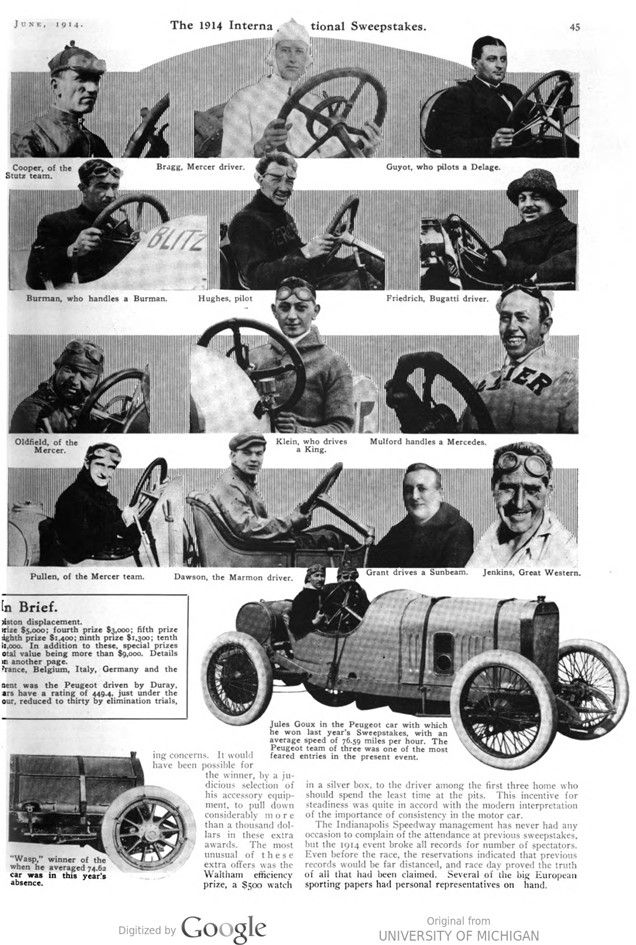
Cooper, of the Stutz team. – Bragg, Mercer driver. – Guyot, who pilots a Delage.
Burman, who handles a Burman. – Hughes, pilot. – Friedrich, Bugatti driver.
Oldfield, of the Mercer. – Klein, who drives a King. – Mulford handles a Mercedes.
Pullen, of the Mercer team. – Dawson, the Marmon driver. – Grant drives a Sunbeam. Jenkins, Great Western.
Joe Dawson, in the National car, with which he won the 1912 Sweepstakes at an average speed of 78.72 miles per hour, the record for two years.
Ray Harroun in the Marmon “Wasp,” winner of the first Sweepstakes in 1911, when he averaged 74.62 miles per hour. A Marmon car was in this year’s race after two year’s absence.
Jules Goux in the Peugeot car with which he won last year’s Sweepstakes, with an average speed of 76.59 miles per hour. The Peugeot team of three was one of the most feared entries in the present event.