Already after three years since its introduction, the Sweepstakes coud enjoy a huge publical interest. That must have been one of the reasons for The Horseless Age to write such an extensive preview for the 1914 Indianapolis Sweepstakes, Therefore, it’s best to post the article here in two parts. Here now is part 1 of the preview, introducing the foreign and the American cars and drivers, as well as race and racetrack specifics, prizes for drivers and, not to forget, for spectators.
Text and jpegs by courtesy of hathitrust.org www.hathitrust.org, compiled by motorracinghistory.com
THE HORSELESS AGE Vol. XXXIII (33), No. 20, May 20, 1914
Tuning Up for the Fourth 500 Mile Race.
Practice Commences for the Great Indianapolis Motor Speedway Event of May 30-45 Cars Nominated and 30 Fastest to Start-Six Nations Represented- Record Breaking at Practice Indicates Sensational Speed in Actual Contest.
By Jerome T. Shaw.
Thousands of automobile race enthusiasts throughout the world are now centering their attention on the Indianapolis Motor Speedway where active preparations are being made by more than two score of the stellar motor race pilots of America and Europe for the fourth running of the world-renowned 500-mile race on the thirtieth of this month. Previous five century grinds have held the undivided attention of the motoring world, but the forthcoming race, with its strong international flavor in the form of foreign cars and pilots who have won distinction for themselves in contests abroad, is creating more discussion than any other automobile contest held in this country since the early days of the Vanderbilt Cup races on Long Island.
Land pilots who have scored successes at the wheels of high-powered racing cars in Europe will vie with a representative field of American drivers for a share in the glory and rich prize money that is offered for success in the great Indianapolis event. Remembering the victory scored by one of the foreign delegation in the race of last year more serious consideration will be given to their chances of defeating the drivers of this country. Last year marked the first invasion of foreigners in the Hoosier classic, and their success has been an incentive for several more joining the move to again place a victory to the credit of a foreign car and driver.
Not since the first 500-mile race in 1911 has there been such a large entry list as that which is in hand for the Decoration Day contest. When the last entry was received on May 1, the closing day, no less than forty-five cars had been nominated to participate in the long battle of cylinders on the brick course and this number was only one less than the record list of 46 in 1911.
However, the limitation of the field of starters to thirty cars will develop an interesting contest in itself for, according to the rules of the race, only the fastest of the 45 nominations will be included in the starters. The speed tests that have formerly preceded the start of the race will this year really be elimination tests, and desperate efforts are being made by the drivers to have their mounts capable of their highest speed on May 27 and 28, when these trials will be held. Each driver is determined not to be forced out of the race for a fortune, and when he is sent over a lap of the 2½ mile track in the time trial he is certain to let nothing prevent him from getting all there is possible in the way of speed out of his car.
In the previous time trials, all that was necessary for eligibility was for a driver to maintain a speed of 75 miles an hour for one circuit of the course. There were very few indeed who were eliminated through this test. The large entry list this year has compelled more stringent requirements and in the event that there are more than 30 cars left after the three car teams have been reduced to two cars each it will be the 30 fastest cars in the speed trial that will face the starter.
PROSPECTS OF A STIRRING CONTEST.
Not only is the field larger this year, but the class of entrants is of a higher order than that which marked the 1913 race, and those who have been close followers of motor car racing are strong in their predictions that the race this month will be harder fought and more sensational than last year’s event. In the 1913 race there were but one or two cars that could make a showing against the speed produced by the French Peugeot handled by Jules Goux, the eventual winner, but it is expected that this year the foreigners will find more competition from the American made machines. The American cars and drivers will not find it easy sledding to score a victory, for the European delegation is a representative one and includes cars and drivers who have been well schooled in battles of endurance and speed.
SIX NATIONS REPRESENTED.
It will truly be an international race, for automobile manufacturers of five countries on the other side of the Atlantic will be represented by cars. France presents the most formidable appearance with the nomination of three Peugeots and two Delage’s, the former make of cars holding the racing championship of Europe. Germany is represented by two Mercedes, handled by American drivers, and a Bugatti, which will be manned by Ernst Friedrich, a newcomer in the ranks of German pilots. Two English Sunbeam cars, an Excelsior, of Belgian manufacture, and an Italian Isotta-Fraschini complete the foreign nominations.
GOUX AND BOILLOT STRONG CONTENDERS.
Not only is France strong in the lineup of its cars, but it has sent over a quintet of drivers that stand out as the foremost speed pilots of the world. Jules Goux and Albert Guyot will be well remembered by those who witnessed the running of the last 500-mile race when these drivers pulled down first and fourth prizes, respectively. In that race Goux displayed some of the driving qualities that have placed him as the runner-up to the champion of Europe, but in the forthcoming contest the spectators will have an opportunity of observing the great George Boillot, the premier race driver of France, in action for the first time in this country. Boillot and Goux are practically invincible in European contests and are considered the greatest combination of team racing drivers produced in France in some years.
Rene Thomas, another of the French pilots, has always given a good account of himself while at the wheel in races abroad, and is also competing in this country for the first time. Chassagne is a French driver, but he will be seen at the wheel of an English Sunbeam, a car of the make with which he established a number of world’s speed records on the Brooklands course in England. Arthur Duray, who will pilot the Peugeot entered by J. Meunier, the Swiss chocolate king, is alleged to be an American and a resident of France since youth. Christiaens, the Belgian, will be seen at the wheel of the sensationally fast Excelsior, a product of Belgium, and the other truly foreign nomination is the little Bugatti which will be handled by Friedrich. Car and driver come from Germany.
NEW RECORD MAY BE EXPECTED.
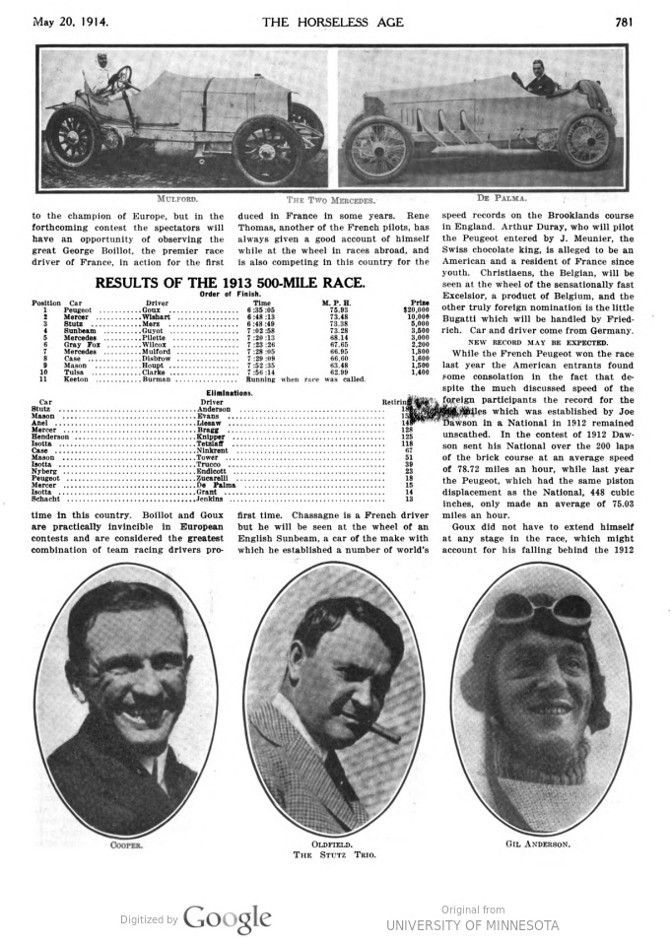
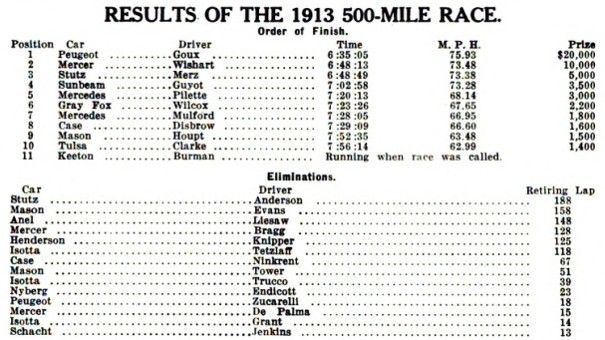
While the French Peugeot won the race last year the American entrants found some consolation in the fact that despite the much discussed speed of the foreign participants the record for the 500 miles which was established by Joe Dawson in a National in 1912 remained unscathed. In the contest of 1912 Dawson sent his National over the 200 laps of the brick course at an average speed of 78.72 miles an hour, while last year the Peugeot, which had the same piston displacement as the National, 448 cubic inches, only made an average of 75.03 miles an hour.
Goux did not have to extend himself at any stage in the race, which might account for his falling behind the 1912 mark, but in the forthcoming event there is likely to be keener competition not only from the American machines but also from the foreign cars and drivers, who have been determined rivals on the speed courses of Europe. With the most stringent restrictions which will be enforced it is safe to say that practically none of the starters will be incapable of setting a pace of at least 85 miles an hour, while several of the cars are said to have shown speeds of above 100 miles an hour. With these conditions prevailing there is every indication that the mark of 78.72 m. p. h. will be surpassed, and the record placed at about 80 m. p. h.
TRACK RECORD SMASHED DURING PRACTICE.
That the forthcoming race will indeed be a sensational speed fest has been further proven during the first few days of active practice on the course. During the last week the Speedway record has been broken twice by the men putting their cars in shape for the grind on May 30. All of the drivers now at the course have been turning up sensational speed, the covering of a lap of the 2½ mile track in 1:40 or less being nothing unusual. On May 15 Joe Dawson displayed the speed capabilities of his Marmon when he traveled a lap in 1:36 4-5, which clipped 1-5 of a second from the previous record for the course. Dawson’s time was caught by three watches.
Dawson did not hold the record long, for two days later Georges Boillot, one of the trio of Peugeot pilots, tired of having the American drivers drive circles around him and considered himself familiar enough with the course to let his Peugeot out. The result was that the champion speed car of Europe covered the 2½ miles in 1 minute 35 4-5 seconds. or at the rate of over 94 miles an hour. From that time on the railbird’s interest in the foreign cars became more intensified. Spencer Wishart’s Mercer has been showing great speed also and on one lap he was timed in 1:38 4-5. Wishart provided a thrill for the spectators on one of his trial spins when one of his tires blew out while his Mercer was travelling down the home stretch at a 100 miles an hour gait. Wishart displayed great skill in handling his car under these trying conditions and succeeded in bringing it to a stop before any damage was done.
A number of the drivers have been holding in their mounts satisfying them- selves with steady and consistent trials over the track. These drivers are confident, however, that when the time comes, they will be able to show great speed. The Maxwell crew is predicting that the Maxwells, when let out, will be able to do a lap in 1:32. Bob Burman is also confident that his Burman centipedes will also turn up a like speed. Barney Oldfield was forced out of practice for a day or two on account of an injury to his hand caused by a knife slipping when he was slicing off a piece of tire.
ALL FOREIGN DRIVERS HERE BUT FRIEDRICH.
All of the foreign drivers with the exception of Ernest Friedrich who is scheduled to drive the Bugatti have arrived in this country and are now either at the course or heading in that direction. Goux and Boillot have been here for over a week, but the rest of the delegation came in on the La Provence from Havre late last Saturday night. They spent Sunday in New York and started for Indianapolis on Monday.
CASH PRIZES CLOSE TO $60,000.
There is considerable glory attached to the winning of the 500-mile race, but it is the more substantial cash prizes that provide the real magnet for the contestants. Until the promotion of this contest a prize of $50,000 was never heard of in connection with an automobile event, but this is the sum offered by the management of the speedway to the entrants of the first ten cars to finish the 200 laps. For some time the foreign race drivers were skeptical about this enormous money prize being awarded to the winners and it remained for Jules Goux’s victory last year to assure them that this was actually the case. The $50,000 offered by the speedway management is not the only incentive for the drivers to go out to win, for in addition to this sum close to $10,000 is offered by various accessory manufacturers for those who score success with their product.
A FORTUNE FOR THE WINNER.
A medium sized fortune will be presented to the driver who is the first to pilot his car across the finish line. He will receive no less than $20,000 for his day’s work, a sum equivalent to the salary drawn by many a bank president for a year’s service. In addition, he will most likely share in the accessory prizes to the extent of several thousand dollars. All in all, it will be a most profitable race for the fortunate pilot who is the first to receive the checkered flag. The second and third men to finish the race will not fare badly either; they receiving $10,000 and $5,000 respectively as their share of the purse.
As was the case last year the remainder of the purse will be divided among the next eight men to finish, as follows: Fourth, $3,500; fifth, $3,000; sixth, $2,200; seventh, $1,800; eighth, $1,600; ninth, $1,500, and tenth, $1,400.
It will be the first three men who will share in the prizes offered by the accessory manufacturers, which this year total $10,225. If the first driver finishes the race with a new record to his credit, he I will receive a bonus of $500 from the Bosch Magneto Co., provided his car carries a Bosch magneto and Bosch plugs. This concern also offers $1,300 additional for distribution among the first three drivers if they use its product. The other accessory manufacturers who are offering prizes and the amounts they offer are as follows: Longuemare Carburetor Co., $1,600; Findeisen & Kropf (Rayfield carburetor), $1,500; J. B. Carburetor Co. (J. B. carburetor), $1,500; Wheeler & Schebler (Schebler carburetor), $1,600; Standard Roller Bearing Co. (Rudge-Whitworth wire wheels, $875, the Emil Grossman Co. (Red Head spark plugs), $850 and Champion Ignition Co. (Champion Spark Plugs), $500.
TROPHIES FOR LEADERS AT INTERMEDIATE DISTANCES.
Not only will the successful drivers be given cash prizes, but as a special incentive for record-breaking speed, the management has also put up as prizes several well-known motor contest trophies which will be awarded to the leaders at the various intermediate distances in the race. Last year these trophies were given to the leaders at 200, 300 and 400 miles, but the conditions governing this year’s race provide for trophies to the leaders at each century. The G. & J. trophy, which has been out of competition for several years, will be given to the leader at 100 miles. To the entrant of the car that is leading at 200 miles the Remy Grand Trophy will be awarded; to the driver of the car leading at 200 miles the Remy Grand Brassard will be awarded. If the car carries Remy ignition the Remy Electric Co. will pay the driver $50 for twenty consecutive weeks. The Prest-O-Lite Trophy will be awarded to the entrant of the car first at 300 miles and for the first car completing 400 miles the Wheeler-Schebler Cup will be awarded to the entrant. If the car is equipped with Schebler carburetor the driver will receive $1,000 in gold from F. H. Wheeler. These trophies will not be awarded to entrants or drivers unless the 500 miles are completed. All these trophies are returnable to their donors on demand. The plan is to offer them on the speedway every year. Between races they will naturally be allowed to remain in the custody of the driver who captures them, so that he may use them for exhibition and display purposes.
INDIANAPOLIS A MOTORISTS’ MECCA.
There is probably no event in the his- tory of sports that does so much for the promotion of interest in a city as does the 500-mile race for Indianapolis. There are very few of the thousands of automobile owners and drivers in this country who do not take an interest in the race, and among the crowds at the course on the day of the grind may be found people from every section of the country. With the increased attention given the event by the foreign manufacturers and drivers interest has naturally increased in other parts of the world. An idea of the consideration given this race may be gained when it is known that one of the leading sporting papers of Paris devoted no less than a full page to a description of the victory scored by Goux last year.
The race annually makes Indianapolis a motorists’ mecca, and thousands journey to that city by every mode of travel. Although the race is more than a week away a number of the more rabid fans are already encamped at the course and enthusing over the thrills produced by the drivers in tuning up their mounts. The severe qualification requirements this year will make the practice and speed trials more interesting than ever, and many are timing themselves to reach the Hoosier metropolis so as to take in these tests. By next Friday, however, the real influx of visitors in Indianapolis will commence and within twenty-four hours the population of that city will be increased by some 30 per cent.
EXPECT 100,000 WILL WITNESS RACE.
The first three races drew attendances of close to 80,000, but the management expects that the 1914 race with its galaxy of foreign drivers and cars will be witnessed by a crowd of more than 100,000. The sale of tickets commenced in January and there has been a heavy demand for accommodations from all over the country. A number of automobile organizations and concerns identified with the industry have purchased blocks of tickets, and special trains will run to Indianapolis from various sections of the country. From Detroit, the center of the automobile industry in America, there will go two special trains. One will be conducted by the Wolverine Automobile Club, which organization has secured a block of 500 tickets for the main grandstand.
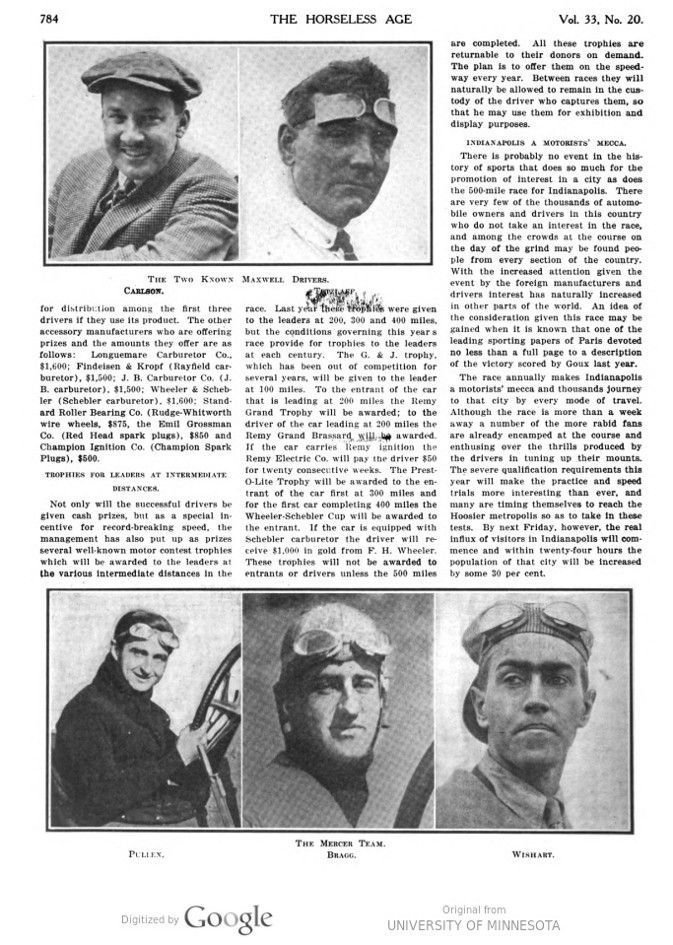
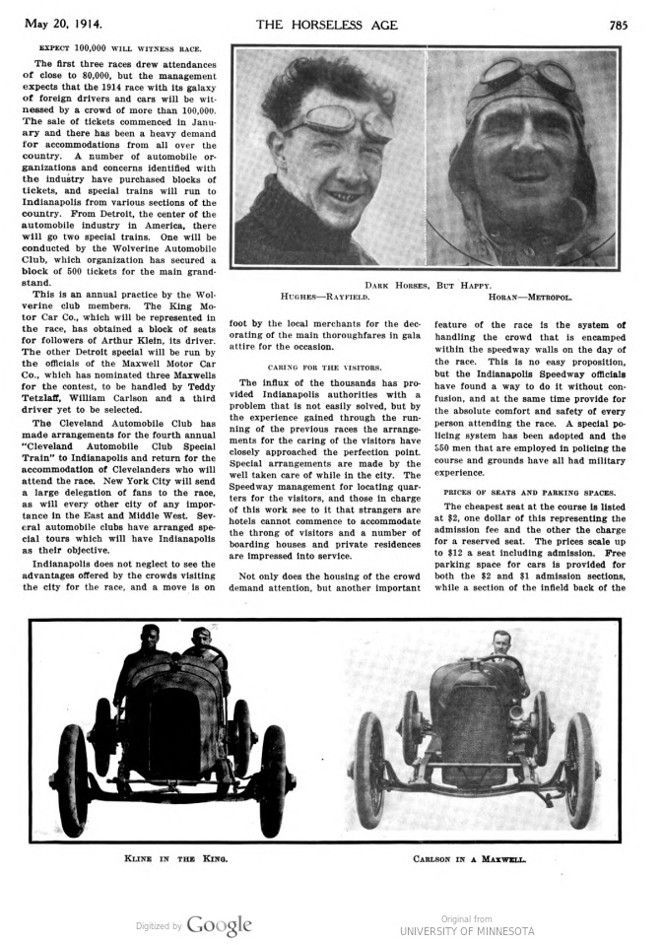
This is an annual practice by the Wolverine club members. The King Motor Car Co., which will be represented in the race, has obtained a block of seats for followers of Arthur Klein, its driver. The other Detroit special will be run by the officials of the Maxwell Motor Car Co., which has nominated three Maxwells for the contest, to be handled by Teddy Tetzlaff, William Carlson and a third driver yet to be selected.
The Cleveland Automobile Club has made arrangements for the fourth annual “Cleveland Automobile Club Special Train” to Indianapolis and return for the accommodation of Clevelanders who will attend the race. New York City will send a large delegation of fans to the race, as will every other city of any importance in the East and Middle West. Several automobile clubs have arranged special tours which will have Indianapolis as their objective.
Indianapolis does not neglect to see the advantages offered by the crowds visiting the city for the race, and a move is on foot by the local merchants for the decorating of the main thoroughfares in gala attire for the occasion.
CARING FOR THE VISITORS.
The influx of the thousands has provided Indianapolis authorities with a problem that is not easily solved, but by the experience gained through the running of the previous races the arrangements for the caring of the visitors have closely approached the perfection point. Special arrangements are made by the well taken care of while in the city. The Speedway management for locating quarters for the visitors, and those in charge of this work see to it that strangers are hotels cannot commence to accommodate the throng of visitors and a number of boarding houses and private residences are impressed into service.
Not only does the housing of the crowd demand attention, but another important feature of the race is the system of handling the crowd that is encamped within the speedway walls on the day of the race. This is no easy proposition, but the Indianapolis Speedway officials have found a way to do it without confusion, and at the same time provide for the absolute comfort and safety of every person attending the race. A special policing system has been adopted and the 350 men that are employed in policing the course and grounds have all had military experience.
PRICES OF SEATS AND PARKING SPACES.
The cheapest seat at the course is listed at $2, one dollar of this representing the admission fee and the other the charge for a reserved seat. The prices scale up to $12 a seat including admission. Free parking space for cars is provided for both the $2 and $1 admission sections, while a section of the infield back of the pits has been reserved and is let out for $25 per car. In addition each occupant of the car is charged a $2 admission fee.
KEEPING IN TOUCH WITH THE RACE.
With close to eighty thousand people watching the cars as they circle the course, it is absolutely necessary that adequate provisions be made for the proper dissemination of information concerning the progress of the competing cars and the relative standing of the various leaders in the race. Miles of telephone and telegraph wires are located in the grounds. Special telegraph and telephone wires connect the speedway with Indianapolis and the principal cities of the United States. These wires, together with the wires for the timer and ‘phone systems at the quarter mile, half mile, kilometer and mile posts, as well as wires to team score boards on the backstretch and score boards in the main and bleacher sections of the grounds, are all carried in underground conduits. Thirty sets of telegraph instruments are installed in the press stands for the convenience of press operators, while telephone and telegraph service is also provided near the main grandstand for public use.
The detail work attached to the conduct of an event of the size and importance of the 500-mile race is enormous, and the visitors to the previous races were amazed at the perfection attained, considering the numerous opportunities that are offered for the making of errors. It is next to impossible for spectators to keep a record of the progress of the race without the aid of score boards, and in this respect the speedway management has made elaborate preparations. There are six score boards on the speedway, located so that every spectators may have a clear view of them.
Last year there were about 500 lineal feet of score boards on the grounds and about 100 men were required to operate them. The staff which gave out the information to the spectators consisted of 100 score board operators, twenty telephone men, six callers, five adding ma- chine experts, six expert scorers, fifteen announcers and ten sheet writers, making a total of 175 men. There were approximately 2,000 persons at the Speedway working to carry out the details of the race. This included racing teams, accessory teams, concession employees, guards, scorers and all other employees of the Speedway.
Photos.
Page 780c.
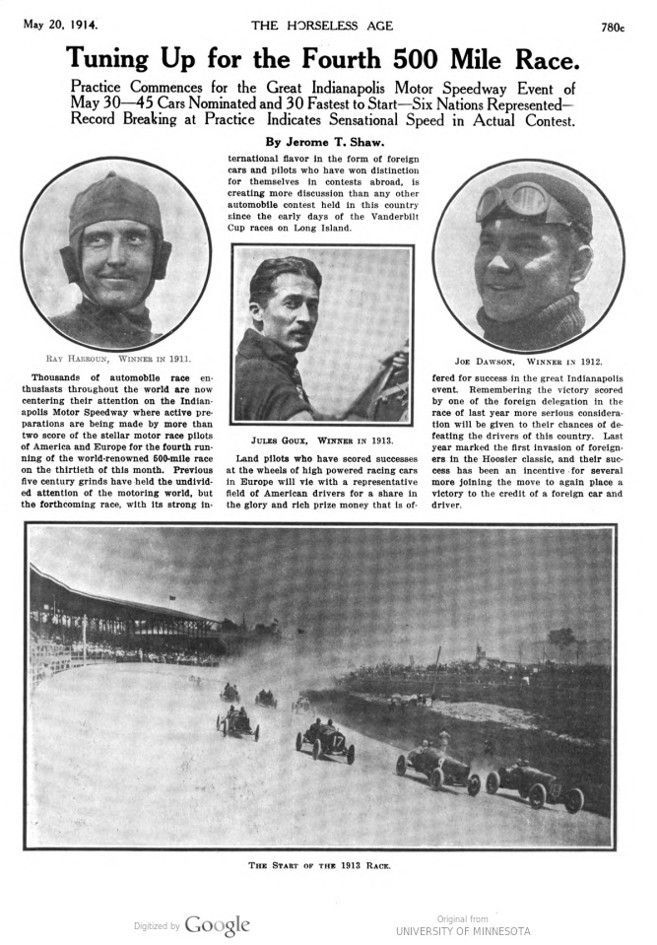
RAY HARROUN, WINNER IN 1911. – JOE DAWSON, WINNER IN 1912. – JULES GOUX, WINNER IN 1913. – THE START OF THE 1913 RACE.
Page 780d.
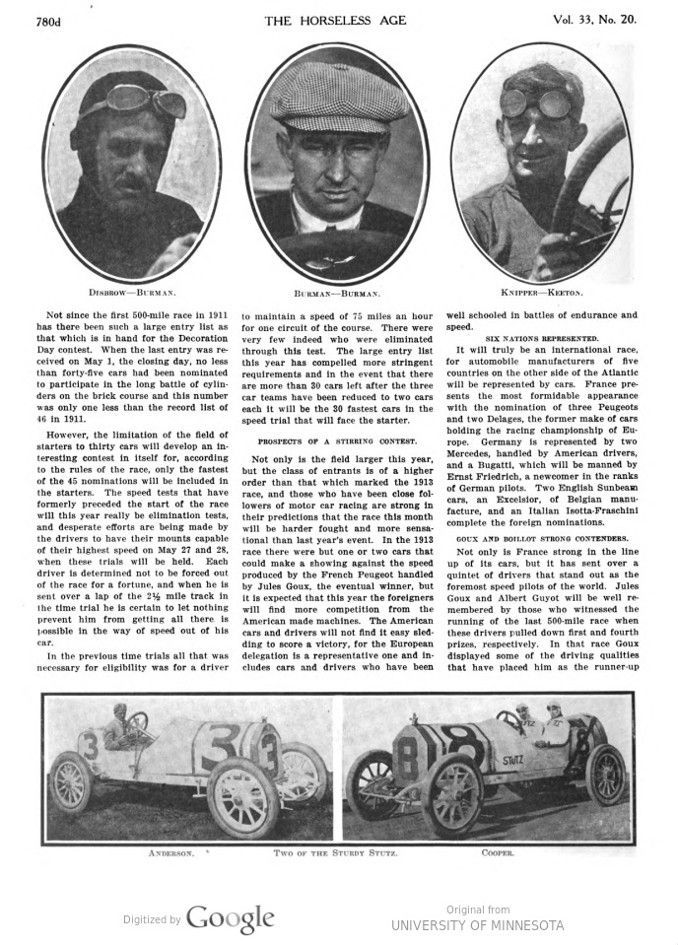
DISBROW-BURMAN. / BURMAN-BURMAN. / KNIPPER-KEETON.
Two OF THE STURDY STUTZ: ANDERSON – COOPER.
Page 781.
THE TWO MERCEDES: MULFORD – DE PALMA.
THE STUTZ TRIO: COOPER – OLDFIELD – GIL ANDERSON.
Page 782.
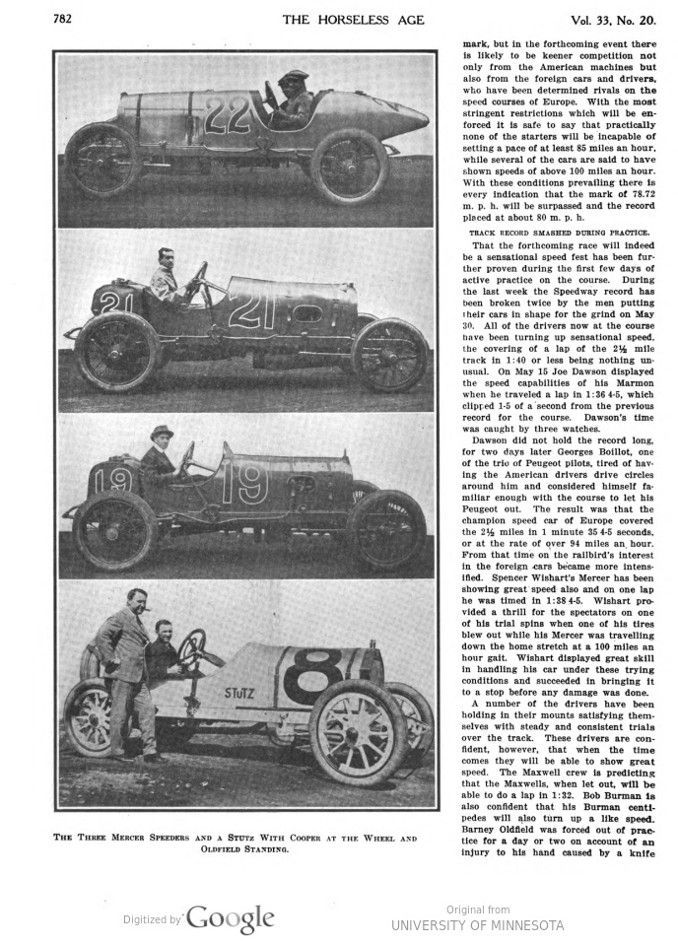
THE THREE MERCER SPEEDERS AND A STUTZ WITH COOPER AT THE WHEEL AND OLDFIELD STANDING.
Page 783.
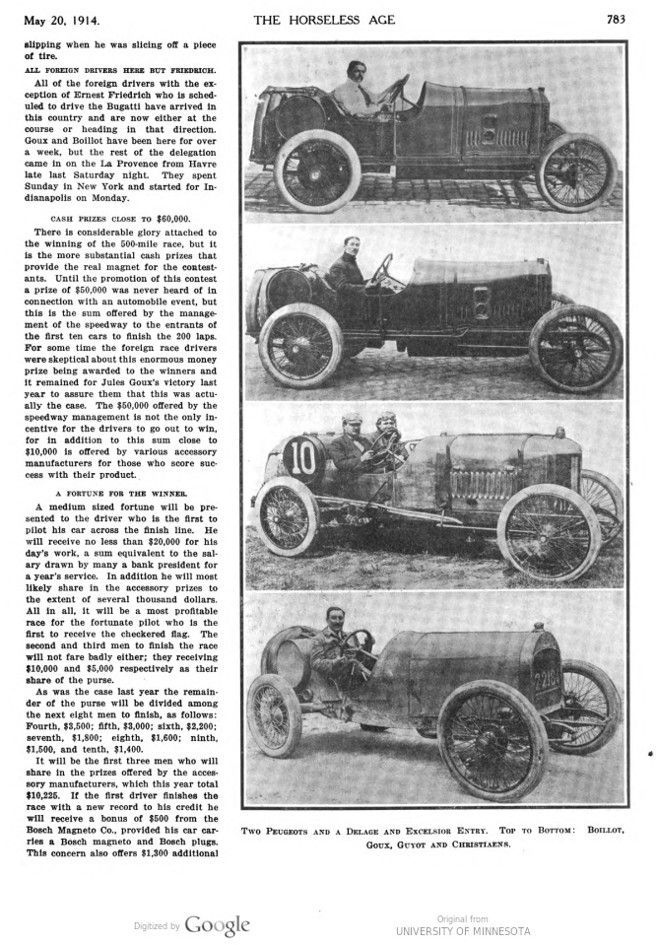
Two PEUGEOTS AND A DELAGE AND EXCELSIOR ENTRY.
Top to Bottom: BOILLOT, GOUX, GUYOT AND CHRISTIAENS.
Page 784.
THE TWO KNOWN MAXWELL DRIVERS: CARLSON – TETZLAFF.
THE MERCER TEAM: PULLEN – BRAGG – WISHART.
Page 785:
DARK HORSES, BUT HAPPY. HUGHES-RAYFIELD. HORAN-METROPOL.
KLINE IN THE KING. – CARLSON IN A MAXWELL.