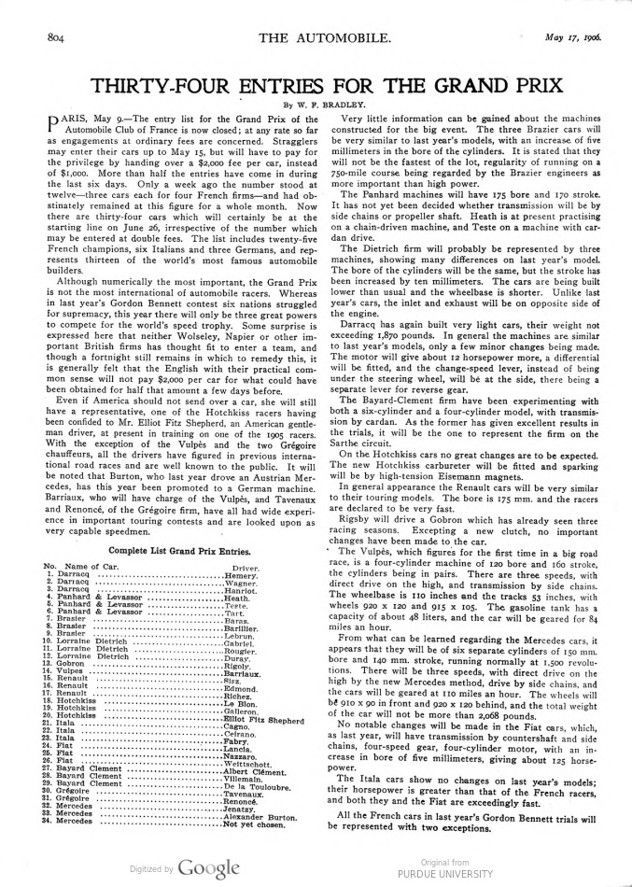
About a week before the Grand Prix, the long-time experienced journalist William F. Bradley gave a survey of all the final entrants for the first ever Grand Prix de l’ACF. After a shrt introduction, all French cars are briefly described, as are the Mercedes, the Fiat and the Itala racing cars.
With permission of hathitrust hathitrust.org == Text and fotos compiled by motorracinghistory
THE AUTOMOBILE — Volume 14, No. 20, May 17, 1906
THIRTY-FOUR ENTRIES FOR THE FOR THE GRAND PRIX
By W. F. BRADLEY.
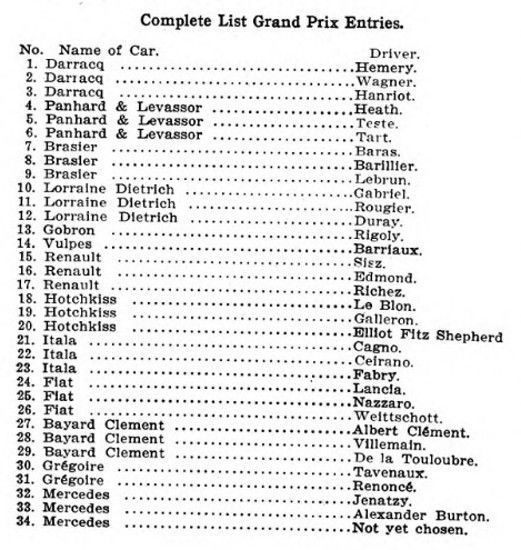
PARIS, May 9. – The entry list for the Grand Prix of the Automobile Club of France is now closed; at any rate so far as engagements at ordinary fees are concerned. Stragglers may enter their cars up to May 15, but will have to pay for the privilege by handing over a $2,000 fee per car, instead of $1,000. More than half the entries have come in during the last six days. Only a week ago the number stood at twelve-three cars each for four French firms – and had obstinately remained at this figure for a whole month. Now there are thirty-four cars which will certainly be at the starting line on June 26, irrespective of the number which may be entered at double fees. The list includes twenty-five French champions, six Italians and three Germans, and represents thirteen of the world’s most famous automobile builders.
Although numerically the most important, the Grand Prix is not the most international of automobile racers. Whereas in last year’s Gordon Bennett contest six nations struggled for supremacy, this year there will only be three great powers to compete for the world’s speed trophy. Some surprise is expressed here that neither Wolseley, Napier or other important British firms has thought fit to enter a team, and though a fortnight still remains in which to remedy this, it is generally felt that the English with their practical common sense will not pay $2,000 per car for what could have been obtained for half that amount a few days before.
Even if America should not send over a car, she will still have a representative, one of the Hotchkiss racers having been confided to Mr. Elliot Fitz Shepherd, an American gentleman driver, at present in training on one of the 1905 racers. With the exception of the Vulpès and the two Grégoire chauffeurs, all the drivers have figured in previous international road races and are well known to the public. It will be noted that Burton, who last year drove an Austrian Mercedes, has this year been promoted to a German machine. Barriaux, who will have charge of the Vulpès, and Tavenaux and Renoncé, of the Grégoire firm, have all had wide experience in important touring contests and are looked upon as very capable speedmen.
Very little information can be gained about the machines constructed for the big event.
The three Brazier carswill be very similar to last year’s models, with an increase of five millimeters in the bore of the cylinders. It is stated that they will not be the fastest of the lot, regularity of running on a 750-mile course being regarded by the Brazier engineers as more important than high power.
The Panhard machines will have 175 bore and 170 stroke. It has not yet been decided whether transmission will be by side chains or propeller shaft. Heath is at present practising on a chain-driven machine, and Teste on a machine with cardan drive.
The Dietrich firm will probably be represented by three machines, showing many differences on last year’s model. The bore of the cylinders will be the same, but the stroke has been increased by ten millimeters. The cars are being built lower than usual and the wheelbase is shorter. Unlike last year’s cars, the inlet and exhaust will be on opposite side of the engine.
Darracq has again built very light cars, their weight not exceeding 1,870 pounds. In general the machines are similar to last year’s models, only a few minor changes being made. The motor will give about 12 horsepower more, a differential will be fitted, and the change-speed lever, instead of being under the steering wheel, will be at the side, there being a separate lever for reverse gear.
The Bayard-Clement firm have been experimenting with both a six-cylinder and a four-cylinder model, with transmission by cardan. As the former has given excellent results in the trials, it will be the one to represent the firm on the Sarthe circuit.
On the Hotchkiss cars no great changes are to be expected. The new Hotchkiss carbureter will be fitted and sparking will be by high-tension Eisemann magnets.
In general appearance the Renault cars will be very similar to their touring models. The bore is 175 mm. and the racers are declared to be very fast.
Rigsby will drive a Gobron which has already seen three racing seasons. Excepting a new clutch, no important changes have been made to the car.
The Vulpès, which figures for the first time in a big road race, is a four-cylinder machine of 120 bore and 160 stroke, the cylinders being in pairs. There are three speeds, with direct drive on the high, and transmission by side chains. The wheelbase is 110 inches and the tracks 53 inches, with wheels 920 X 120 and 915 x 105. The gasoline tank has a capacity of about 48 liters, and the car will be geared for 84 miles an hour.
From what can be learned regarding the Mercedes cars, it appears that they will be of six separate cylinders of 150 mm. bore and 140 mm. stroke, running normally at 1,500 revolutions. There will be three speeds, with direct drive on the high by the new Mercedes method, drive by side chains, and the cars will be geared at 110 miles an hour. The wheels will be 910 x 90 in front and 920 x 120 behind, and the total weight of the car will not be more than 2,068 pounds.
No notable changes will be made in the Fiat cars, which, as last year, will have transmission by countershaft and side chains, four-speed gear, four-cylinder motor, with an increase in bore of five millimeters, giving about 125 horsepower.
The Itala cars show no changes on last year’s models; their horsepower is greater than that of the French racers, and both they and the Fiat are exceedingly fast.
All the French cars in last year’s Gordon Bennett trials will be represented with two exceptions.