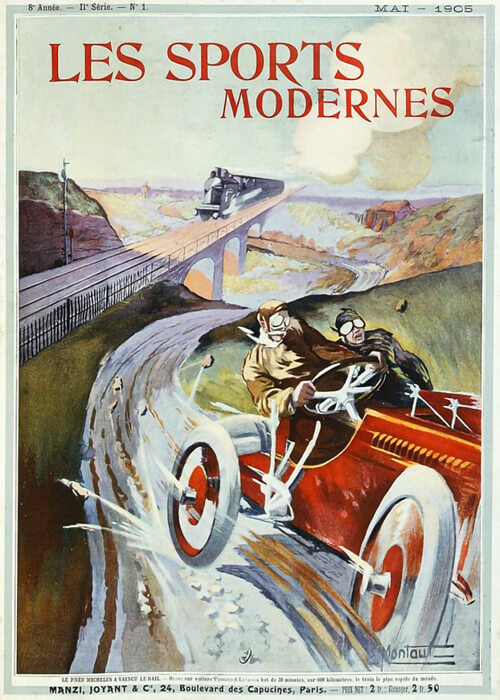
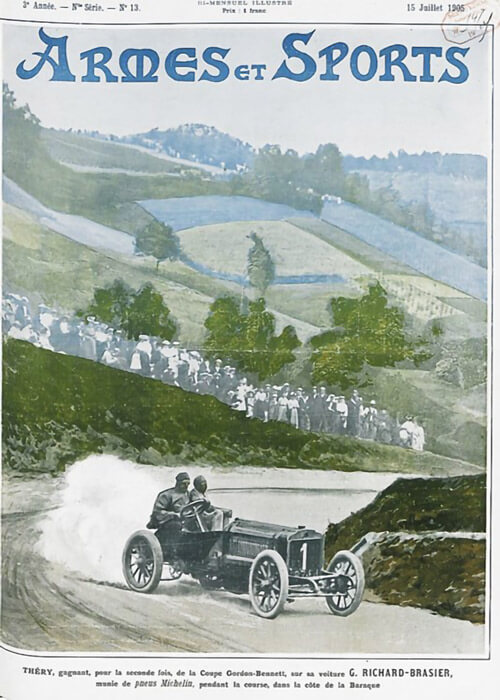
Introduction on the title is on it’s way.
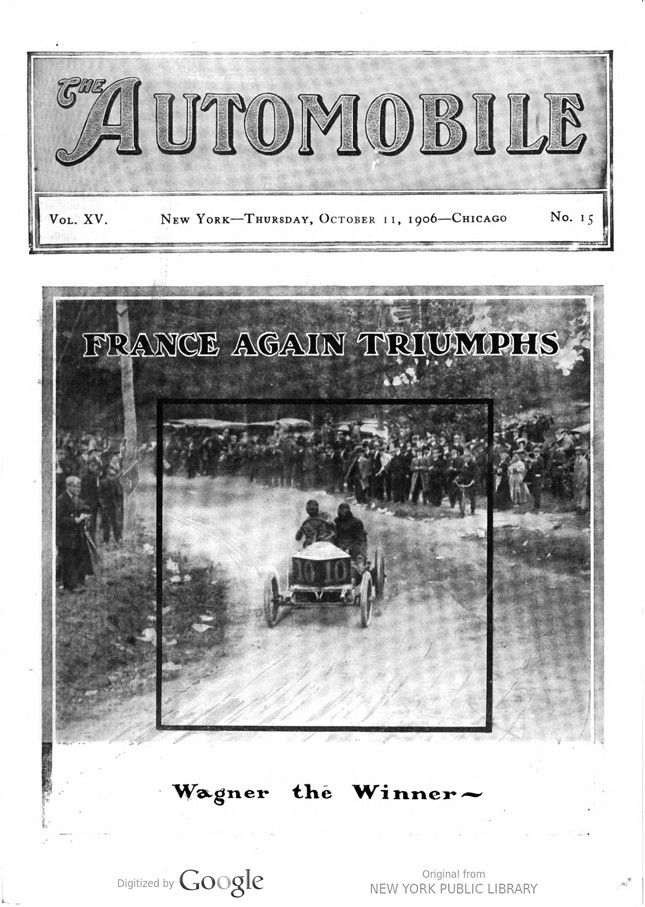
With permission of hathitrust hathitrust.org == Text and fotos compiled by motorracinghistory
THE AUTOMOBILE — Volume XV, No. 15, October 11, 1906
HOW A GREAT RACE WAS RUN AND WON
Wagner Assumed the Lead and Fought Off Lancia, Duray, Clement and L Jenatzy, All of Whom Were Dangerous at Times
BY A. G. BATCHELDER.
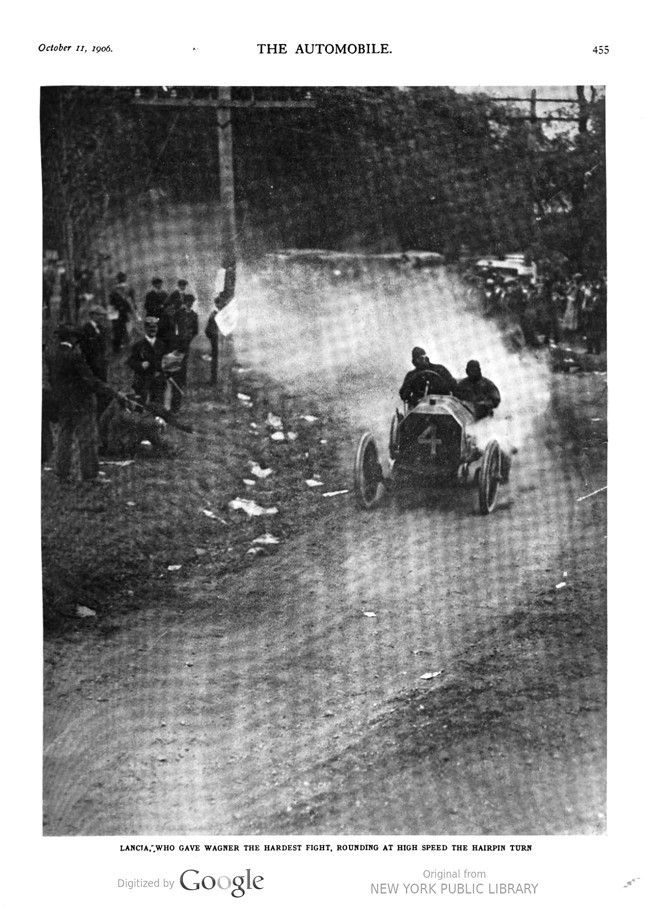
LANCIA, the dashing, nonchalant son of Italy, had made a tempestuous, noisy swirl past the cheering grandstand, waving a token of recognition to the excited throng that believed him the winner of the Cup.
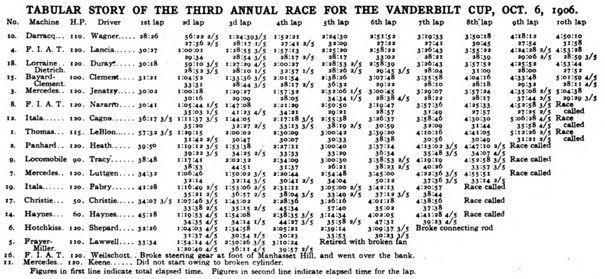
Wagner, who, despite his name, hailed from France, had last been heard from at Bull’s Head, nearly a score of miles away and stranded with a damaged tire. Six minutes and sixteen seconds was the advantage which he possessed at the completion of the ninth round.
Strangely meager information came over the telephone line that entwined the 29.71 miles of road with its eleven turns, several of which tried the skill of the most experienced. Slowly the minutes wore away, and gradually the impression grew that Italy, not France, had triumphed in the great American Automobile Derby.
A bugle’s blast cut through the keen October air; far up the turnpike an uneven chain of flagmen began to flaunt their red pieces of cloth. “Car coming!” echoed down the oil-stained road. ‘Twas Wagner, the missing, and in an instant the multitude knew that the victor was seated at the helm of that squat, homely thing on wheels that hurtled onward with startling speed, prow-pointed, and giving it the appearance of a terrifying projectile that carried in its course death and disaster to all that confronted its marvelous flight.
Fearful that his rival had reached the goal in advance, the bearer of the tri-color drove his throbbing monster as one might expect a madman to do were a demented being at the wheel. Nothing like the coming of Wagner had been seen on that eventful Saturday morning, prolific of incident and accident, for the Darracq pilot knew not that he had three minutes and more to spare. Like the transit of a meteor was the fugitive passing of that low-built, sputtering fiend, which jumped by and at the humans who had overspread the road. They ran in all directions and nothing short of a miracle saved their lives. But Wagner held his brute in check and soon had it in leash beyond power to do harm to the fools that had invaded its course.
And from the break of day, though the motor craft were supposed to have the right of way, those who guided them around the circuit had been obliged to plow their route through living lanes of wildly curious humanity. One more careless or luckless than the rest had gotten in the way of Shepard’s swift-moving racer and had paid the penalty with his life; another, a boy, had placed himself in the path of Tracy’s skidding car; Weillschott had swerved into a bunch with fortunate escapes for several. Little Johnny Brooks will remember all his days his narrow squeeze underneath that muttering Fiat, for it passed over him completely. Carried into a nearby house, Johnny soon recovered from his fright and shortly reappeared on the scene as an interested observer of a fistic contention between a deputy sheriff and a colored man who insisted upon taking chances with the flying autos that bounded up the Manhasset hills.
That there were no more casualties than those enumerated was a source of surprise and congratulation to the Cup Commission, which saw with exasperation its wire fences laid low, its special officers laughed at, and all its efforts to guard the course nullified by the eager crowds which knew no law other than the insane gratification to surge out on the road and feel the wind of the racers as they perilously tore around the course with its fringe of humanity.
Of course, there will be no race on Long Island next year under the same conditions; in fact, there will be no race at all unless it is over privately owned road, of which there is a possibility. The directors of the American Automobile Association have appointed a special committee to look into several projects that have been born since it became apparent that the national body could ill afford to have its Racing Board identified with any more road racing under the circumstances that existed October 6, even if the supervisors of any county could be prevailed upon to give the necessary permission.
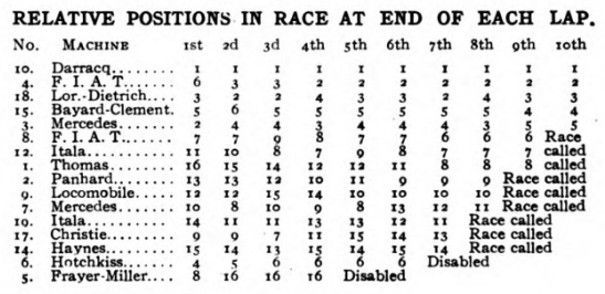
But the struggle of Saturday was a grand one, though it must be said that the victor had the lead from the outset and never relinquished the ascendency throughout the ten circuits of the tortuous course, which Albert Clement characterized as annoying rather than dangerous. Lancia fought courageously, tenaciously, but the other seemed to have something on him in point of mobility with a short wheel-based machine. Then there came forth a story that the Italian had misunderstood the information that was given to him about his time in the ninth round; but at this the Wagnerites smile and make no other comment.
Duray, the Ardennes winner, did not follow in the footsteps of the two previous winners of the Belgium race. In two circuits he pursued the flying Wagner, and then alternated between third and fourth, ending at the heels of Lancia, and awfully close, too. Clement had one particularly poor round because of tire difficulties, then he settled down to consistent running, but the others had accumulated too much of a lead to be overhauled.
At one stage of the proceedings it looked not unlikely that the old warhorse, Jenatzy, would be a factor in the winning of the Cup. With the vim and rush that characterized his historic Irish win he went at his task, hung to Wagner on the opening ground, was in third place on the eighth whirl, and then lost his chance by a defective tire valve in the ninth. Naturally the good-natured Belgian driving the German machine owned by an American was a sadly disappointed man.
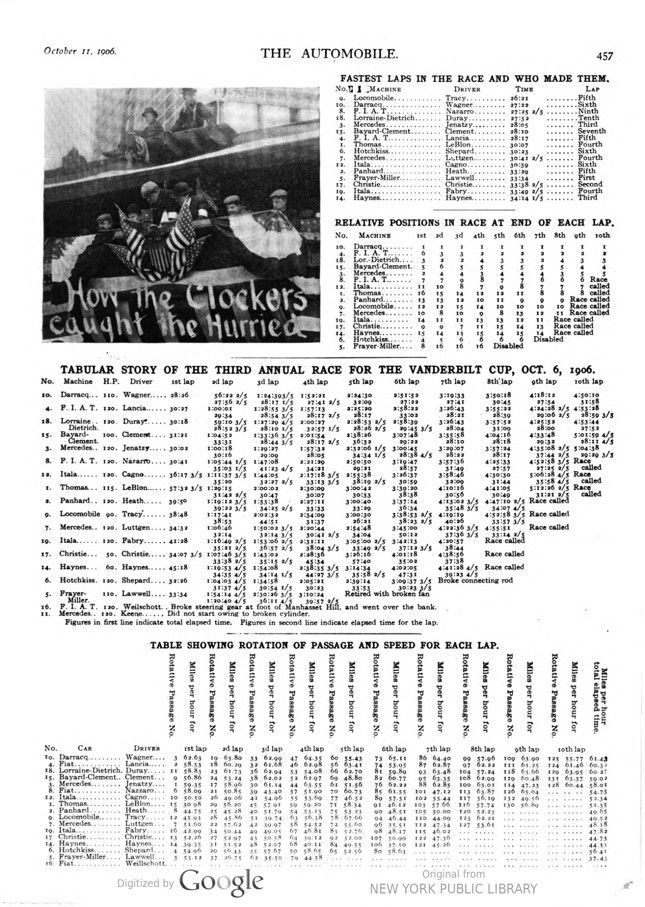
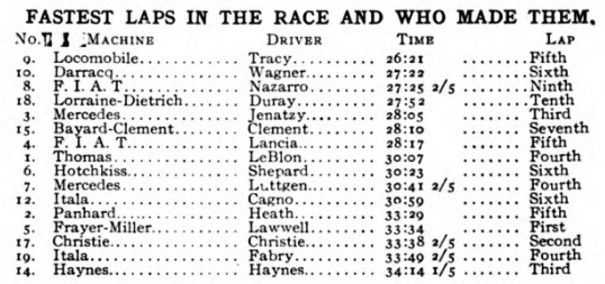
Tracy held the center of the stage on the fifth round, which he traveled in 26:21, a speed of about 67 1-2 miles an hour. It is estimated that during this circuit the Locomobile moved in excess of a hundred miles an hour. After his first round, Tracy stopped at the grandstand and complained of the crowds that overran the course, and then it was that Referee Vanderbilt personally warned the spectators that the race would be called if they did not keep off the road. Tracy’s tire troubles were not few, and then to cap the climax he had to run into the boy at East Norwich. Altogether the leading American candidate had an unfortunate inning.
Le Blon persisted to the end, despite a bad beginning, that contained several tire punctures. A broken fan wound up the career of the Frayer-Miller in the fifth round, but the Christie and Haynes were still running when the race was declared at an end.
Since France officially had nothing to do with the race thru its automobile club, it is assured that the next contention for the will not Vanderbilt Cup take place in that country. With Italy second in the summary, it may mean that the next contest will be under Italian auspices. Then, again, Long Island may see the fourth running for the “Cup of Cups.”
THE WINNER
Wagner, the winner, is no stranger in America, as he will be remembered as the teammate of Hemery in the last Vanderbilt Cup race, which was won by the latter with a Darracq car, and his pleasing and amiable disposition made friends for him with all with whom he came in contact. After driving three rounds in that contest at a record clip – exceeding the time made by Hemery-he was forced to retire, owing to an accident.
Abroad he is one of the best-known and popular drivers of fast cars and is accredited with a larger string of victories in road and speed contests than attained by any other individual.
Owing to Wagner’s youth the Darracq company at first entrusted him with only their light- and middle-weight racers, with the result that during the first few years of the present decade he broke all existing records in his class, the most notable being the winning of the 298 kilometer race for light cars, run over the historic Belgium Circuit des Ardennes course, June 23, 1903, covering the distance in 3 hours 55 minutes 22 1-2 seconds, or 32 minutes ahead of his nearest competitor. In the same fall he also won the French Château-Thiery and Gaillon races, which were run up a steady incline, with many rocks and sharp turns that taxed the nerves and skill of the drivers to the utmost.
During the greater part of the year 1904 Wagner spent his time in the French army, but by securing special furloughs he participated in several speed contests with such remarkable success that the Darracq company selected him to drive one of their powerful heavy-weight cars for 1905 in the Vanderbilt race. Wagner’s record for 1905 was one continuous series of successes. That his promotion to driving big cars was a shrewd move on the part of the Darracq company is borne out by the fact that he won first place in the speed contests held in 1905 at Ostend, Doulens, Scheveningen and Liege with a heavy-weight car. In the same year he also drove a light-weight car in two races and won both events for that class, namely, the Circuit des Ardennes and at the Liege meeting. At the Ostend meeting he won the 10-kilometer event in 4:08, or at the rate of 90.44 miles an hour, over a common dirt road.
It was, however, in the elimination trials over the French Auvergne course in June, 1905, that Wagner’s name was made known throughout the world as one of the most clever and daring drivers in long-road contests. With an 80-horsepower Darracq he was well in the lead up to 500 kilometers (310 miles), and when this distance had been attained he was as much as 35 minutes ahead of Thery, the eventual winner of the race. Unfortunately for the dashing young Darracq driver, he lost nearly an hour’s time during the last 50 kilometers (31 miles) of the contest repairing punctures due to broken glass and sharp stones having cut his tires. Notwithstanding this fact, he finished fourth, only thirteen minutes after the winner. In retrospect it is now easy to see that had he not encountered any tire troubles he would have won by the largest margin ever attained in a great road race.
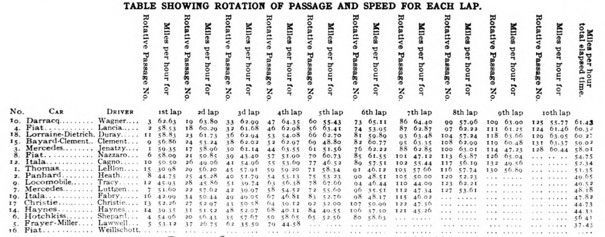
In the classic Circuit des Ardennes road race, August 7, 1905, he created a new world’s record for 100 kilometers (62.14 miles), traveling the distance in 55:18, an average speed of 67.3 miles an hour, breaking the former record of 57:51. No car of any other make up to that time had ever attained such a rate of speed over a common country road.
As if to emphasize his great victory of last year, he entered the 1906 Ardennes race, held August 13, with the pick of the powerful European cars pitted against his new 100-horsepower Darracq, and won the 100-kilometer race in handy fashion, covering the distance this time in 52:49, an average of 113 1-2 kilometers, or 72 miles an hour, the fastest time ever made in any European road race. Wagner also made the fastest round of the circuit. Wagner is a sturdy-built Frenchman with wonderful self-control, due in part to the severe military training of his early youth. He knows no English, and anyone desirous of engaging him in conversation must speak French or through an interpreter. His muscles, like his nerves, are of steel, and he controls the great machine he drives with perfect ease and self-confidence. Wagner has always been considered a veritable daredevil.
Photos. October 11, 1906.
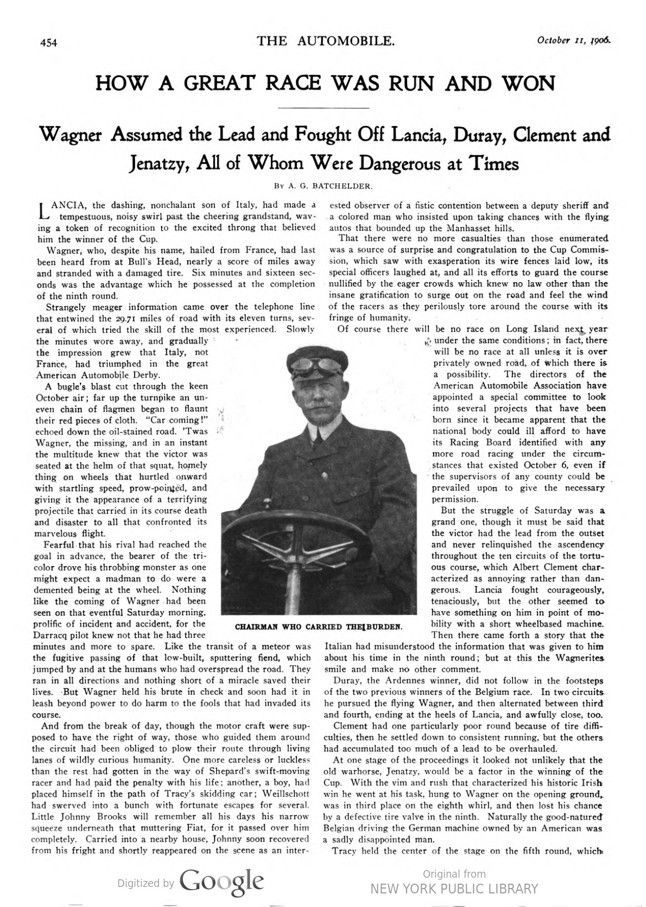
Page 454. CHAIRMAN WHO CARRIED THE BURDEN
Page 455 THE AUTOMOBILE. 4 LANCIA, WHO GAVE WAGNER THE HARDEST FIGHT, ROUNDING AT HIGH SPEED THE HAIRPIN TURN
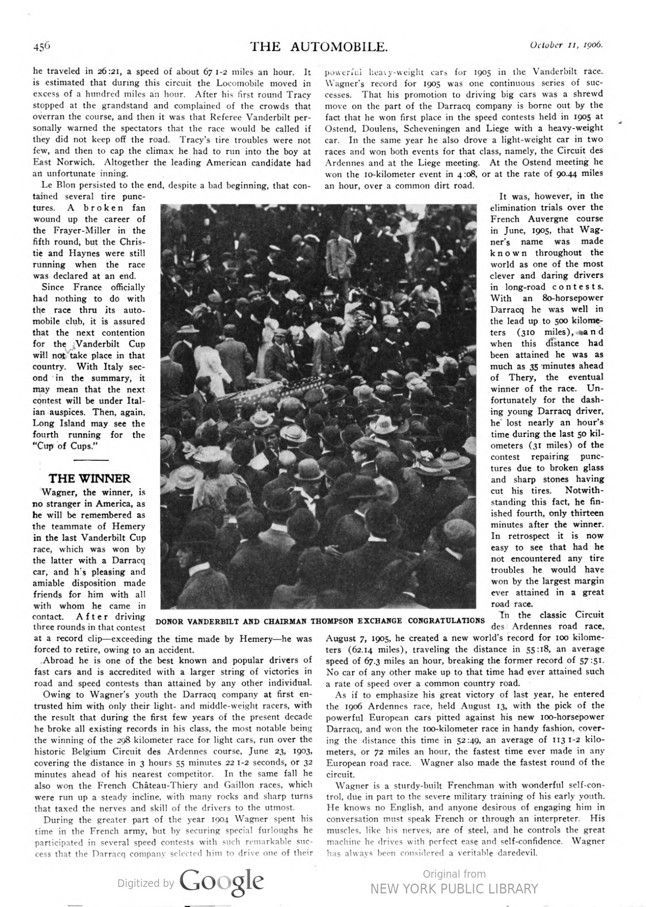
Page 456. DONOR VANDERBILT AND CHAIRMAN THOMPSON EXCHANGE CONGRATULATIONS