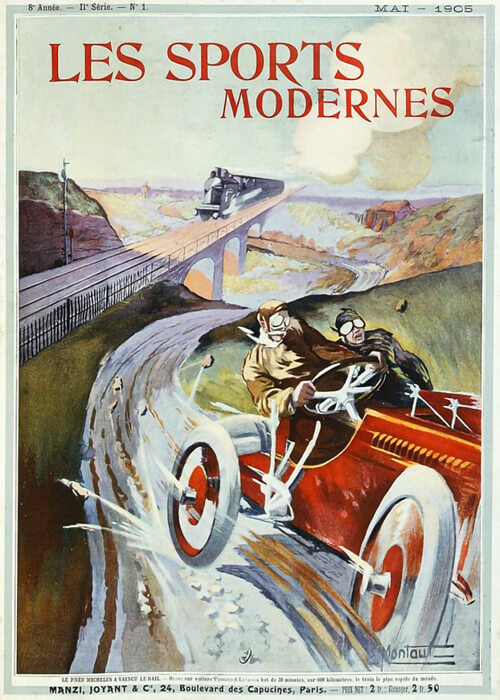
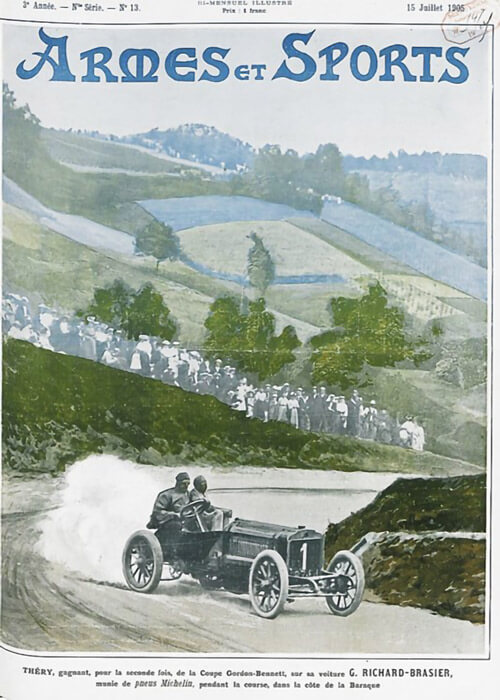
A survey of already entered cars plus drivers, as well as an estimate of the cars and drivers that would enter in the coming days in this early April 1906. Then, an overview of this year’s Grand Prix regulations, of which the event data were set on 26 and 27 June 1906.
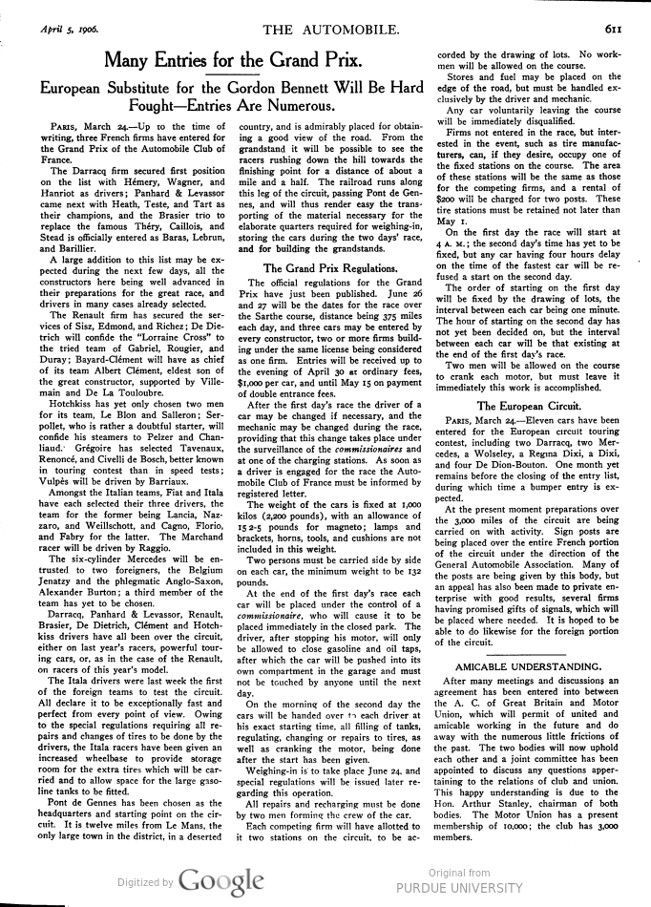
With permission of hathitrust hathitrust.org == Text and fotos compiled by motorracinghistory
THE AUTOMOBILE — Volume 14, No. 14, April 5, 1906
Many Entries for the Grand Prix.
European Substitute for the Gordon Bennett Will Be Hard Fought – Entries Are Numerous
PARIS, March 24 – Up to the time of writing, three French firms have entered for the Grand Prix of the Automobile Club of France.
The Darracq firm secured first position on the list with Hémery, Wagner, and Hanriot as drivers; Panhard & Levassor came next with Heath, Teste, and Tart as their champions, and the Brasier trio to replace the famous Théry, Caillois, and Stead is officially entered as Baras, Lebrun, and Barillier.
A large addition to this list may be expected during the next few days, all the constructors here being well advanced in their preparations for the great race, and drivers in many cases already selected.
The Renault firm has secured the services of Sisz, Edmond, and Richez; De Dietrich will confide the “Lorraine Cross” to the tried team of Gabriel, Rougier, and Duray; Bayard-Clément will have as chief of its team Albert Clément, eldest son of the great constructor, supported by Villemain and De La Touloubre.
Hotchkiss has yet only chosen two men for its team, Le Blon and Salleron; Serpollet, who is rather a doubtful starter, will confide his steamers to Pelzer and Chanliaud. Grégoire has selected Tavenaux, Renoncé, and Civelli de Bosch, better known in touring contest than in speed tests; Vulpes will be driven by Barriaux.
Amongst the Italian teams, Fiat and Itala have each selected their three drivers, the team for the former being Lancia, Nazzaro, and Weillschott, and Cagno, Florio, and Fabry for the latter. The Marchand racer will be driven by Raggio.
The six-cylinder Mercedes will be entrusted to two foreigners, the Belgium Jenatzy and the phlegmatic Anglo-Saxon, Alexander Burton; a third member of the team has yet to be chosen.
Darracq, Panhard & Levassor, Renault, Brasier, De Dietrich, Clément and Hotchkiss drivers have all been over the circuit, either on last year’s racers, powerful touring cars, or, as in the case of the Renault, on racers of this year’s model.
The Itala drivers were last week the first of the foreign teams to test the circuit. All declare it to be exceptionally fast and perfect from every point of view. Owing to the special regulations requiring all re- pairs and changes of tires to be done by the drivers, the Itala racers have been given an increased wheelbase to provide storage room for the extra tires which will be carried and to allow space for the large gaso- line tanks to be fitted.
Pont de Gennes has been chosen as the headquarters and starting point on the circuit. It is twelve miles from Le Mans, the only large town in the district, in a deserted country, and is admirably placed for obtaining a good view of the road. From the grandstand it will be possible to see the racers rushing down the hill towards the finishing point for a distance of about a mile and a half. The railroad runs along this leg of the circuit, passing Pont de Gennes, and will thus render easy the trans- porting of the material necessary for the elaborate quarters required for weighing-in, storing the cars during the two days’ race, and for building the grandstands.
The Grand Prix Regulations.
The official regulations for the Grand Prix have just been published. June 26 and 27 will be the dates for the race over the Sarthe course, distance being 375 miles each day, and three cars may be entered by every constructor, two or more firms building under the same license being considered as one firm. Entries will be received up to the evening of April 30 at ordinary fees, $1,000 per car, and until May 15 on payment of double entrance fees.
After the first day’s race the driver of a car may be changed if necessary, and the mechanic may be changed during the race, providing that this change takes place under the surveillance of the commissionaires and at one of the charging stations. As soon as a driver is engaged for the race the Automobile Club of France must be informed by registered letter.
The weight of the cars is fixed at 1,000 kilos (2,200 pounds), with an allowance of 15 2-5 pounds for magneto; lamps and brackets, horns, tools, and cushions are not included in this weight. Two persons must be carried side by side on each car, the minimum weight to be 132 pounds.
At the end of the first day’s race each car will be placed under the control of a commissionaire, who will cause it to be placed immediately in the closed park. The driver, after stopping his motor, will only be allowed to close gasoline and oil taps, after which the car will be pushed into its own compartment in the garage and must not be touched by anyone until the next day.
On the morning of the second day the cars will be handed over to each driver at his exact starting time, all filling of tanks, regulating, changing or repairs to tires, as well as cranking the motor, being done after the start has been given.
Weighing-in is to take place June 24, and special regulations will be issued later regarding this operation.
All repairs and recharging must be done by two men forming the crew of the car.
Each competing firm will have allotted to it two stations on the circuit, to be accorded by the drawing of lots. No workmen will be allowed on the course.
Stores and fuel may be placed on the edge of the road, but must be handled exclusively by the driver and mechanic. Any car voluntarily leaving the course will be immediately disqualified.
Firms not entered in the race, but interested in the event, such as tire manufacturers, can, if they desire, occupy one of the fixed stations on the course. The area of these stations will be the same as those for the competing firms, and a rental of $200 will be charged for two posts. These tire stations must be retained not later than May 1.
On the first day the race will start at 4 A. M.; the second day’s time has yet to be fixed, but any car having four hours delay on the time of the fastest car will be refused a start on the second day.
The order of starting on the first day will be fixed by the drawing of lots, the interval between each car being one minute. The hour of starting on the second day has not yet been decided on, but the interval between each car will be that existing at the end of the first day’s race. Two men will be allowed on the course to crank each motor, but must leave it immediately this work is accomplished.