Text and jpegs by courtesy of hathitrust.org www.hathitrust.org,
compiled by motorracinghistory.com
The Automobile, Vol. XIV (14), No. 22, May 31, 1906
THE RACING CAR OF THIS AND NEXT YEAR
BY GEORGES DUPUY
Those makers who are going to participate in the international competitions this year and the next, if they hope for success, must have cars that will perform best over exceedingly fast circuits, level and smooth, with few turns and few hills. The two important courses of 1906 are those for the Automobile Club of France Grand Prix race, to be run on the famous La Sarthe Circuit, June 26 and 27, and the great American event, the Vanderbilt Cup race, October 6. Undoubtedly the efforts of the European builder, in constructing his fast-racing monsters for 1906, were dictated chiefly by the configuration of these two racing grounds.
Very different were the conditions of last year from those now prevailing. Compelled to build a vehicle susceptible of facing the Circuit d’Auvergne, with its terrific up and down quarters of miles, its dangerous double turns bordered with precipices, the constructor sent to the starting line a much shorter and lower type, with medium wheel base, reliable clutch, powerful gear box, very carefully fitted brakes, and a motor of a non-exaggerated power. At the same time the vehicle was relatively light.
If we take into account the fact that this year the Automobile Market of the world is mainly interested in two racing events-and both are to be contested over comparatively smooth courses- we come to the conclusion that early this season the European builder formulated a theory as to what particular type of car he was going to establish. And what shall be, we next ask, the car of 1907? Will the actual engine improve every year, or is it likely to stand with its acquired stage of perfection for a certain period?
First of all, we know that all the vehicles qualified in the international events must not exceed the weight of 2,240 pounds (15 pounds in excess being allowed for the magneto). We are aware that there is no incentive whatever to go under this limit. In fact, the power utilized at the rim is limited by the adherence of the driving wheels to the road, and this adherence is the „function of the weight.“ If the motive power exceeds the traction of the tires the wheels do not bite but slip excessively – that is, when they run faster the speed of the car does not increase and the excess of power is transformed into heat, which is prejudicial in every respect, especially to the tires. Then, to obtain more utilizable power there must be more adherence, consequently more weight, particularly on the driving wheels.
Modify Lines of the 1907 Car.
This leads us to somewhat modify the lines of the 1907 racing car. Its weight – empty – Is 2,240 pounds; for the complete starting weight we must add that of two men, tools, fittings, tires, gasoline, oil, etc., which is about 600 pounds more. Total, 2,800 pounds, gross weight.
On the 2,240 pounds „empty weight of the car“ one generally admits 1,300 pounds for the front axle and 900 for the rear axle. It is of advantage to put the supplementary 600 on the rear; that result is obtained by placing the two men right over the rear axle and by disposing the tank and all fittings be- hind them. We might approximately suppose, in all that follows, that the rear load is 1,500 pounds. Under such conditions, if we admit 0.66 as the proper value of the coefficient friction on a nice smooth road, the adherence of the vehicle will have an average value of
1,500 X 0.66 =998 pounds.
Suppose now that the builder wishes to establish a vehicle capable of racing on a straight line at an average gait of 160 kilometers (100 miles) an hour, that is to say about 41 meters a second, we must look out for the resistances the car will have to overcome. In the first place there is the friction resistance which can be assumed to be equal to 25 pounds per ton, and which is sensibly independent of the speed. On the other hand there is the air resistance which, as we know, increases as the square of the speed, so that if „R“ is the total resistance to be overcome, and „S“ the speed in meters by second, we can write the following equation:
R = (12 X 1.3) + KS2 = 15.6+ KS2.
The proportional coefficient „K“ varies according to the forms of the car. It is of the greatest importance to diminish this and consequently to give to the vehicle appropriate lines.
An important provision would be to place underneath the car a large sheath, assuming the form of a boat hull, in order to avoid the retarding air eddies; also the builder should suppress as much as possible projections of the body, and reduce the whole rear portion of the machine as much as he can. We are justified in assuming under these conditions that the builder will get for „K“ a value of 0.06, so that there would be as a total value of the resistance (at the needed speed of 41 meters-50 yards-a second)
R = 15.6 + 0.06 X 41 X31 = 116 about
value notably inferior to that of the adherence and our wheels will not slip excessively.
What Shall Be Power of Motor?
Now, what shall be the power of the motor? The power to be transmitted to the rims is, as we know, the product of the resistance by the speed of the displacement – that is to say:
116 X 41 = 4.756 kilogrammeters-second (by the metric system)
or 4.756 / 75 = 63 horsepower about.
In admitting an efficiency of 60 per cent. for the ensemble of the transmission the motor should develop a power of
63 / .06 = 105 M. P.
These figures are somewhat less than those we are accustomed to. The great difference comes solely from the quantity adopted for „K,“ which demonstrates the value of taking into account that important factor – the air resistance.
With a view to meeting the unforeseen, it would be prudent to take a motive power slightly superior. It goes without saying that if we would attain a speed higher than 160 kilometers (100 miles) an hour, we should have to increase the motive power. Thus, we would see, by working a similar calculation, that for
A speed of 94 miles (150 km.) an hour we need an engine of 105 M.P.
———— 100 ——–160 ——————————————- 120 M. P.
———— 106 ——–170 ——————————————- 145 M. P.
———— 112 ——–180 ——————————————- 220 M. P.
———— 125 ——–200 ——————————————- 280 M. P.
But when the power increases the weight of the motor and that of the different organs of transmission increases also, and we are aware that the constructor must not go beyond the allowed weight limit. We have, however, a certain margin in the matter of weight, of which we are going to recognize the utility. We know that Darracq has been able to place a 200 M. P. engine on a 2,200-pound car. However, I don’t think there is any use in going over 120 horsepower as a maximum, strictly on account of the necessary weight margin referred to above. One may as well note, before going any further, that a constant speed of 150 kilometers an hour will, save in case of accident, permit the driver to realize on a course like the Circuit de la Sarthe – which has only three „slowing points“ each lap – an average of 75 to 78 miles.
From the fact that the motor will work at full admission, so to speak, from start to finish, it must be exceptionally robust. Our builder will be compelled, perhaps, to increase the value of the coefficients of safety usually employed; particularly as far as the compression chambers and the connecting rods are concerned. He will also perfect his cooling system and his exhaust valves.
The clutch has become an element sufficiently perfected, and we shall not lose time in a dissertation upon it. But what about the gear box? I think that in 1907 we should have but three speeds with high direct. As far as the Circuit de la Sarthe and the Vanderbilt Cup are concerned, two perhaps might be sufficient, as the shifting can be operated rather fast. (The new Darracq 140 M. P. has only two and the reverse.)
Concerning the Form of Transmission.
Now what shall be the transmission? I am personally an apostle of the cardan shaft. I believe that it gives better results than the chain. One may perhaps object that the non-suspended weight is more considerable and thus the wear upon the tires may be larger. I will some day try to explain my reasons for preferring the cardan shaft on the racing machine.
What Is Needed in Tires.
Now let us face the tire question, which is of so much interest, since in the A. C. F. Grand Prix race the repairs to and changing of the shoes have to be made from the supplies and with the tools carried on board the cars. My opinion is that both in la Sarthe and the Vanderbilt race there will be very few punctures, as both courses will be in the most perfect state. The chances of bursting tires, on the contrary, are numerous, for the envelopes are going to be subjected to an enormous peripheric speed and will be exposed to tearing away because of their being heavy. I believe, however, that the manufacturers of standard tires are capable of making shoes light and strong, if they only put in them enough canvas and also a sufficient number of safety bolts on the rims. I also would lean toward wheels of large diame ter-910 x 90 mm. in front and 920 x 120 mm. at the rear.
As a conclusion, I think that this season and the next, in France and in America, the winning car, equipped with a motor of 110 to 125 M. P., will have averaged a speed of 75 miles; 78 to 80 miles may be realized on certain laps.
Photos.
Page 875.
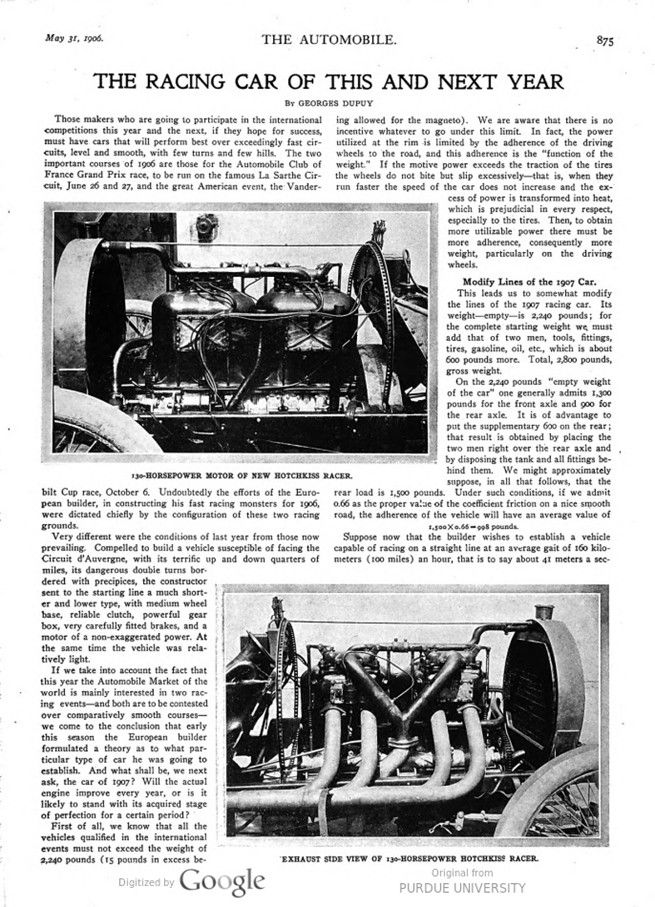
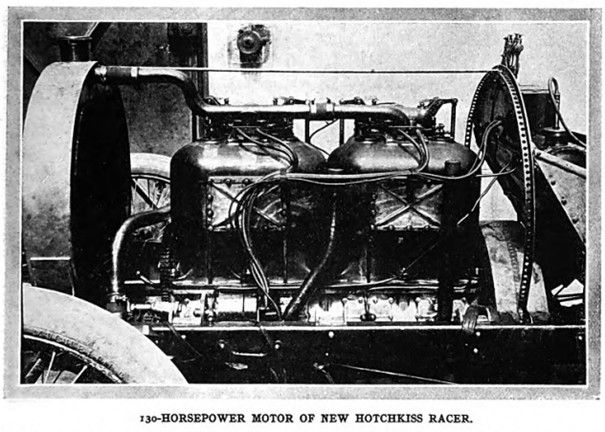
130-HORSEPOWER MOTOR OF NEW HOTCHKISS RACER.
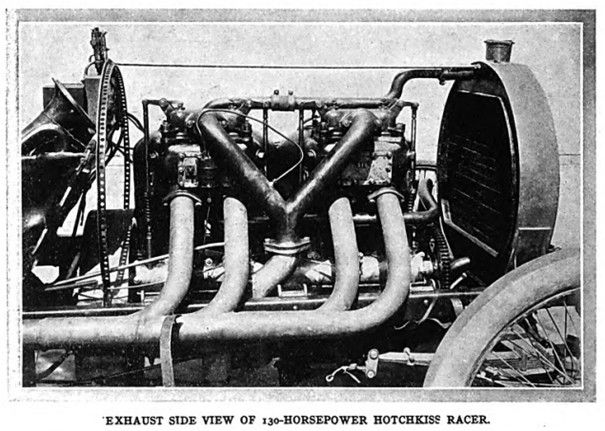
EXHAUST SIDE VIEW OF 130-HORSEPOWER HOTCHKISS RACER. Page 876.
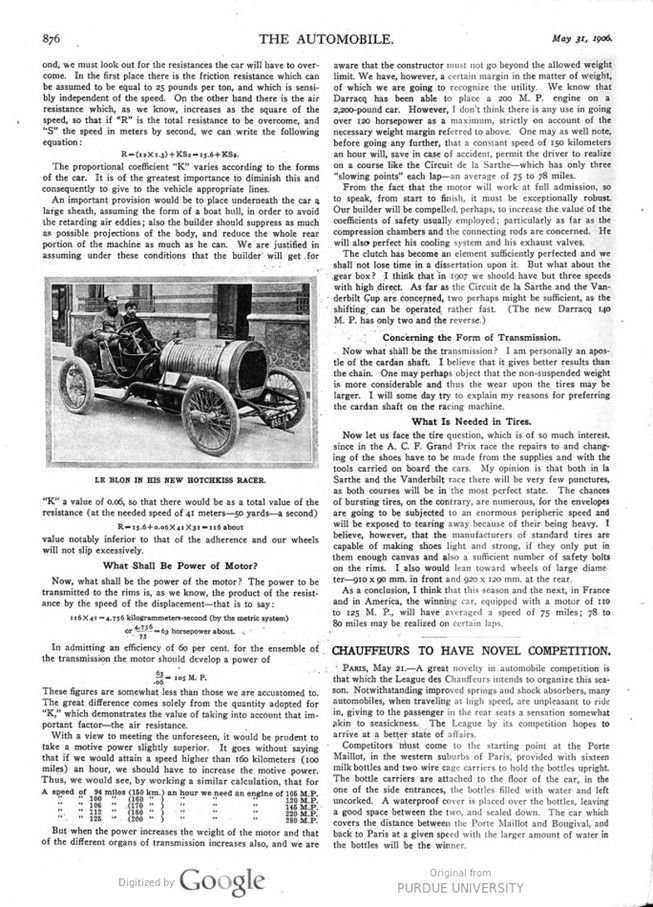
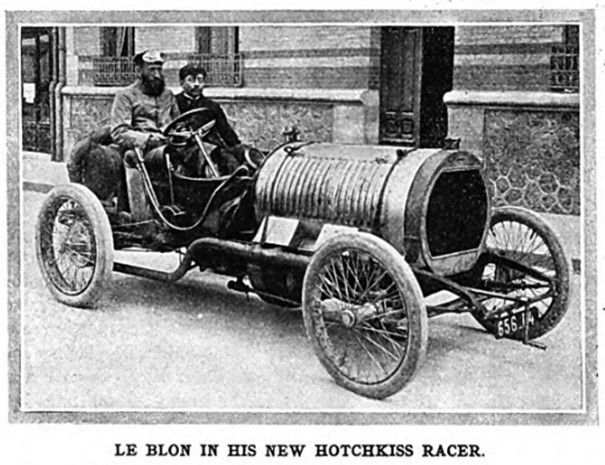
LE BLON IN HIS NEW HOTCHKISS RACER