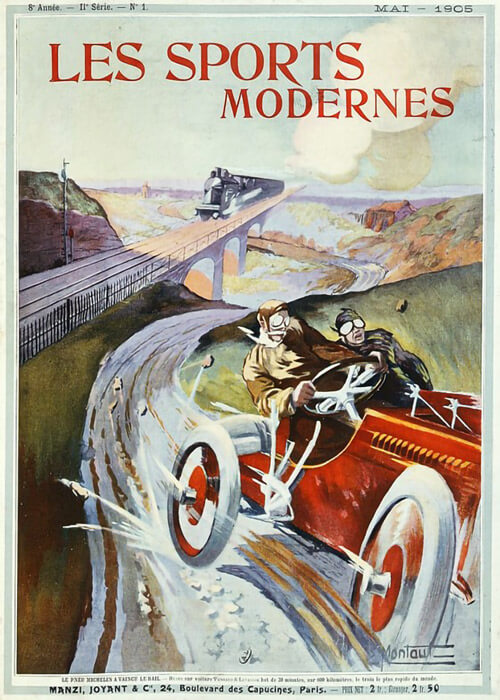
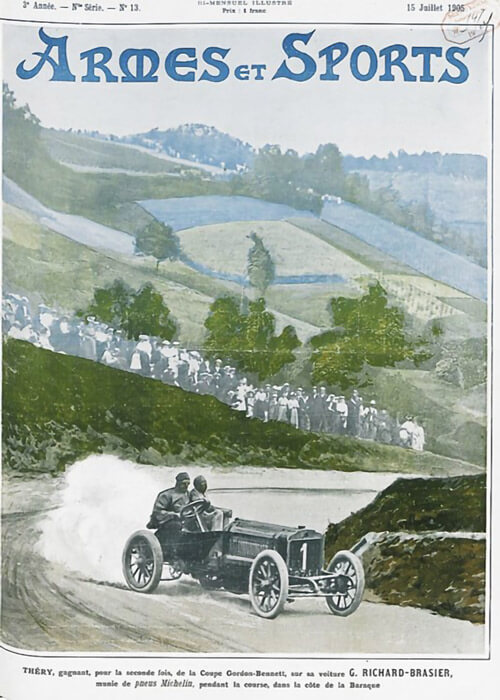
The first ever French Grand Prix on the la Sarthe circuit was a two-day event, covering 26 and 27 June 1901. The time each car set on the first day determined the time they set off on the second day, The weather was not nice to be honest; it reigned a supressive heat over the race course. The race in itsels was far from existing; probably because of the main three long straights of which the triangular circuit mainly consisted. Sisz was first at the end of the first day and he would remain first on the second day, driving faster than any other car. His total time at the finish was 12 hours, 12 minutes and some seconds, rendering an average of just some more than 100 kmh. He is believed tohave attained a top speed on the straight of about 150 kmh. More than half an hour later, the Italian driver Nazzaro finished second, followed three minutes later by Clément. Not only speed, but also the first-ever application of the „jantes amovibles“ or „detachable- or removable rims“ contributed much to his victory. The issues of „jantes amovibles“ can be read else in this website-category „Man&Machine“.
Text and photos with permission of the Bibliothèque nationale de France- gallica.bnf.fr https://www.bnf.fr/fr
Compiled by motorracinghistory.com. Translation by DeepL.com
La Vie Illustrée, Vol. 9, No. 403, July 6, 1906
The A.C.F. Grand Prix
SO here it is at last, held for the first time: this famous Automobile Club Grand Prix that we have been waiting for for two years, replacing the Gordon-Bennett Cup, which was definitively laid to rest at Pont-de-Gennes on the eve of the first day of racing. For we were threatened, at England’s request, with the revival of the Cup. This move by the Automobile Club of Great Britain was truly surprising in its inconsistency. It is well known, in fact, that this club, which governs motor racing in England, decided last year to no longer participate in speed races. And it is, supposedly for this reason, that the English competitors failed to show up at the A.C.F. Grand Prix. One would truly have to be blind not to see, in all this, the tip of the iceberg. So no one was fooled, and the foreign delegates, who had come to Le Mans to attend the Grand Prix and to participate in the conference at the same time, decided, plain and simple, that the cup, which was not contested in 1906, would not be contested in 1907 either. It is a first-class funeral. Since the Bennett Cup is no more, let’s talk about the Grand Prix.
Overall, it was a huge success; in detail, it was riddled with organizational flaws that made the Le Mans circuit infinitely less interesting than last year’s Auvergne circuit. But the main thing for us is that victory went to us once again. And this victory by a Hungarian — at the risk of making you smile — is truly a great French victory, for it was achieved by a French car, equipped with French parts that contributed to the success of the Renault brothers’ car.
In this regard, we must express our regret that the regulations of the Gordon Bennett Cup were not strictly enforced, as they required that the tires, like the rest of the vehicle, be of domestic manufacture. The aim is to encourage — or better yet, to defend — the country’s industry; it is therefore unacceptable that French cars, as was the case with the Brasiers, could be fitted with German tires, which, incidentally, were the cause of their inferiority — a point we will return to later in this article.
At the start, the race was thrilling. The Italian Lancia, the unfortunate hero of the last cup, who started second, took the lead. It was an unpleasant surprise. Fortunately, it was short-lived, for immediately after him came Sisz, who started 90 seconds later and passed with a gap of only 51 seconds. But it was even more reassuring for us when Baras, fifth at the start, passed in third place, having himself made up 44 seconds on Sisz. On the second lap, Baras, continuing his fantastic run, had overtaken everyone. We realized at that moment, while doing the time calculations, that he was closely followed by his “teammate,” Pierry. And since Barillier was seventh as well, on Brasier, we had the very distinct impression that the famous cars were racing to victory, for the third time. But Brasier, for his part, was more concerned, and when he saw Baras pass by at breakneck speed, he uttered this telling phrase: “The beast is going too fast!” Brasier was not mistaken; we soon had confirmation of this, for his driver dropped back to third place on the next lap and gradually disappeared from the leading group. Brasier was defeated, but he had managed to give us the impression that, if driven sensibly and equipped with tires that, alas, should never have gone flat — as was the case for one of the three cars, up to nineteen times — his machines could still win.
Sisz was much more prudent; he drove at a steady pace and, although he took the lead by the third lap, he never set the fastest lap time. He rightly preferred to drive his car consistently, without sudden movements that could damage the mechanics of even the finest machine. It is worth noting, moreover, that the top positions went to the most prudent drivers.
The table below will prove to our readers the accuracy of this assertion. This table summarizes the race of the top three on the first day. There is no need to compile one for the second day, since the field had already been narrowed down.
Sisz: 1st lap, 3rd; — 2nd lap, 4th; — 3rd lap, 1st; — 4th lap, 1st; — 5th lap, 1st; — 6th lap, 1st.
Clément: 1st lap, 10th; — 2nd lap, 8th; — 3rd lap, 6th; — 4th lap, 7th; 5th lap, 2nd; — 6th lap, 2nd.
Nazzaro: 1st lap, 14th; — 2nd lap, 11th; — 3rd lap, 7th; 4th lap, 5th; 6th lap, 3rd.
Here, considering each lap as a separate race, are the successive rankings of the same drivers:
Sisz: 1st lap, 3rd, 53 min. 3 sec.; — 2nd lap, 11th, 57 min., 14 sec.; — 3rd lap, 3rd, 57 min., 34 sec.; — 4th lap, 3rd, 56 min. 13 sec.; — 5th lap, 3rd, 57 min. 21 sec.; — 6th lap, 4th, 1 hr. 5 min. 2 sec.
Clément: 1st lap, 10th, 56 min. 31 sec.; — 2nd lap, 9th, 57 min.; — 3rd lap, 9th, 1 hr. 8 min. 9 sec.; — 4th lap, 8th, 1 hr. 0 min. 21 sec.; — 5th lap, 5th, 1 hr. 6 min. 1 sec.; — 6th lap, 7th, 1 hr. 3 min. 38 sec.
Nazzaro: 1st lap, 14th, 58 min. 7 sec.; — 2nd lap, 15th, 1 hr. 2 min. 53 sec.; — 3rd lap, 7th, 1 hr. 2 min.; — 4th lap, 2nd, 55 min. 58 sec.; — 5th lap, 12th, 1 hr. 18 min. 22 sec.; — 6th lap, 6th, 1 hr. 9 min. 33 sec.
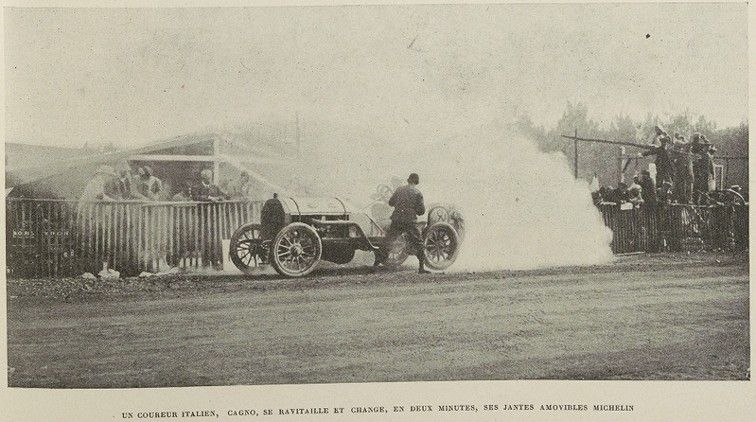
The slight variations in lap times observed among these three competitors stem from tire changes or unavoidable minor repairs. The performance of Sisz’s Renault is particularly remarkable. One might wonder how its driver managed to achieve this, given that this time, the tire change had to be performed using only the tools available on board. That is when we realized the marvelous simplicity of the detachable rim. We take pride in having been among the first to report on this new invention a few days before the Paris Motor Show. We had sensed the full potential of this innovation, which needed only a conclusive test to prove its extreme usefulness. We got it, and you’ll see what the result was.
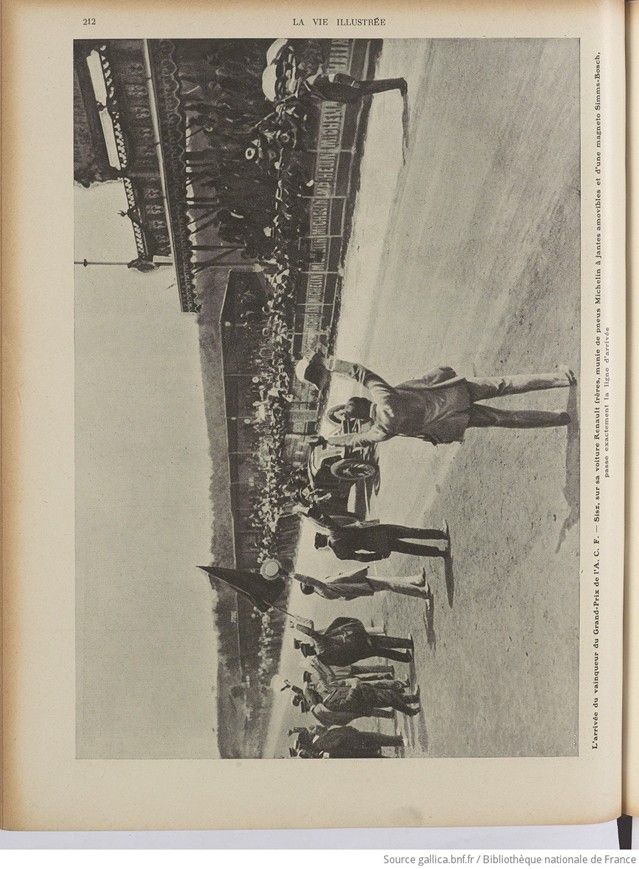
When, at the start of the race, Baras was driving at his breakneck pace, we were well aware of the moment when the tide began to turn against him. In fact, Sisz, simply as a precaution, changed his large 135 Michelin tires — which were still in perfect condition — right in front of us as early as the second lap. It took him three and a half minutes! It was a marvel to everyone. Baras, on the other hand, never caught up. He was already struggling with his German tires.
The same was true for all the competitors, depending on whether or not they had equipped their wheels with Michelin tires on removable rims. The former didn’t wait until their tires were reduced to shapeless rags; they changed them every two laps, even without immediate need, and set off again two or three minutes later before an absolutely thrilled crowd. The others waited until the last minute, even driving on the rim if necessary, which put a strain on their cars, and, no matter how skilled they were, took a good fifteen minutes — which is quite impressive — to change a standard tire. That is what cost Albert Clément second place. Little by little, Nazzaro, who also had removable rims, made up time on him and beat him by three minutes over 1,200 kilometers. It’s more than a success; it’s a triumph for Michelin, the man to whom we owe all the improvements in the tire.
But what can be said of the Bayard-Clément, which managed to deliver a remarkable race despite the disadvantage I have just explained to you. There are certainly few engines that can compare to the Bayard, and there are no cars better established than those coming out of the great factories in Levallois. Along with the great manufacturer, we are also pleased to congratulate his son, Albert Clément, that courageous and modest teenager who already has a glorious history.
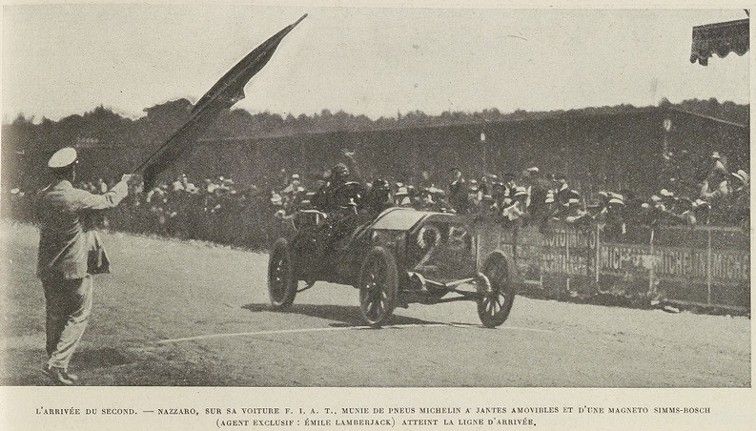
The foreign contingent was more than brilliantly represented by the Fiat team, with Nazzaro finishing second and Lancia fifth.
What pleases us most about the magnificent performance of the queen of Italian cars is the way it was achieved.
“The Fiats,” people said, “will be wonderful for five hundred kilometers, but after that, no one will speak of them anymore.” And it was just the opposite that happened. They started off so quietly that no one paid them any attention at first. They gradually improved their positions; Nazzaro finished third on the first day and Lancia only ninth.
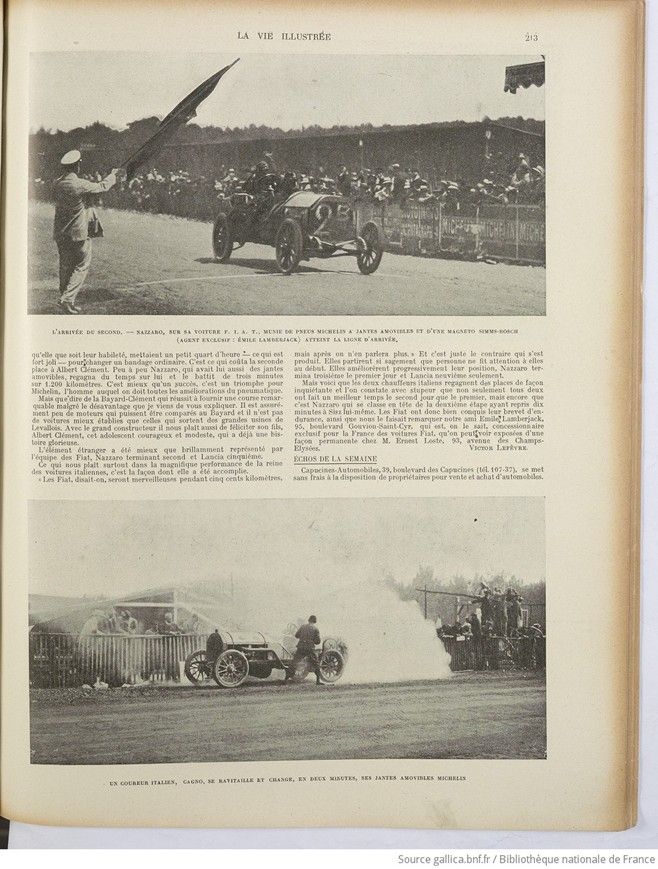
But then the two Italian drivers began gaining places at an alarming rate, and we were astonished to see that not only did both set a better time on the second day than on the first, but also that it was Nazzaro who led the second stage, having gained ten minutes on Sisz himself.
The Fiats have thus truly earned their endurance credentials, as our friend Emile Lamberjack, 95 Boulevard Gouvion-Saint-Cyr, pointed out to us. He is, as we know, the exclusive dealer for Fiat cars in France, which can be viewed on permanent display at Mr. Ernest Loste’s, 93 Avenue des Champs-Elysées.
Victor Lefèvre.
Photos.
Page 0.
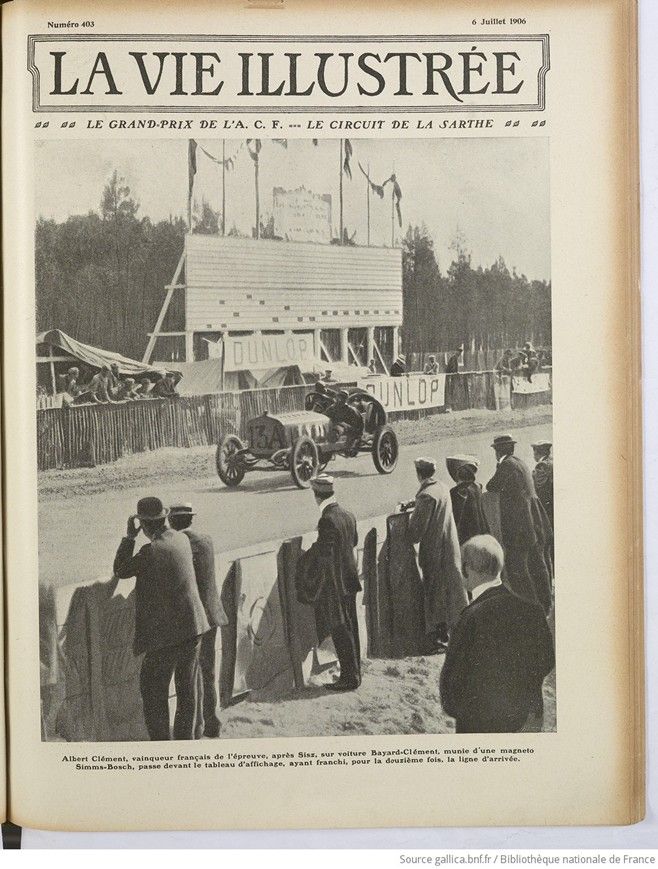
THE A.C.F. GRAND PRIX = THE SARTHE CIRCUIT
Albert Clément, the French winner of the race, in a Bayard-Clément car equipped with a Simms-Bosch magneto, passes the scoreboard after crossing the finish line for the twelfth time.
Page 210.
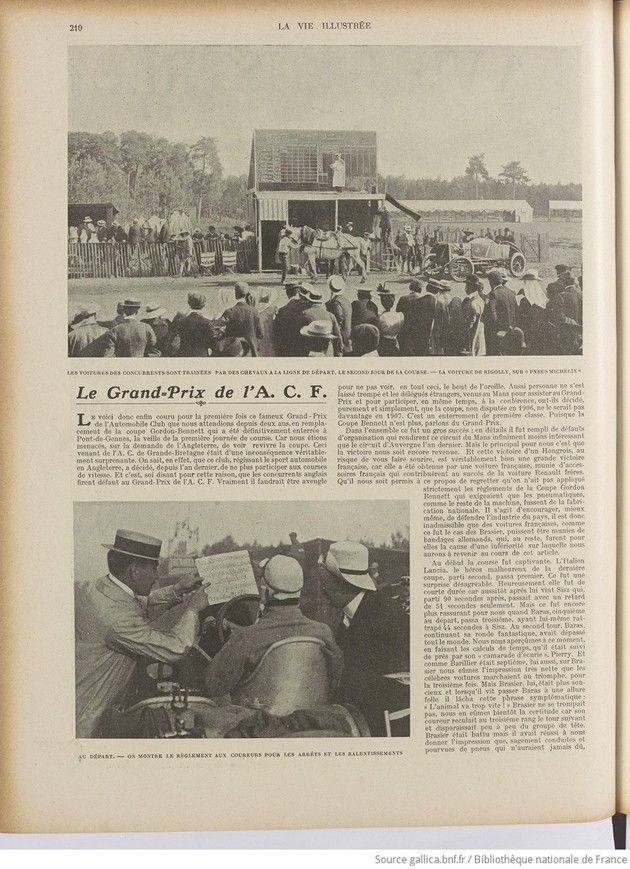
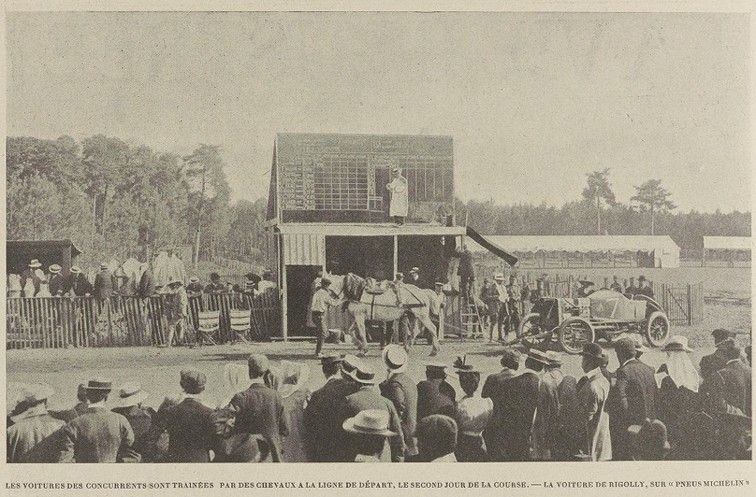
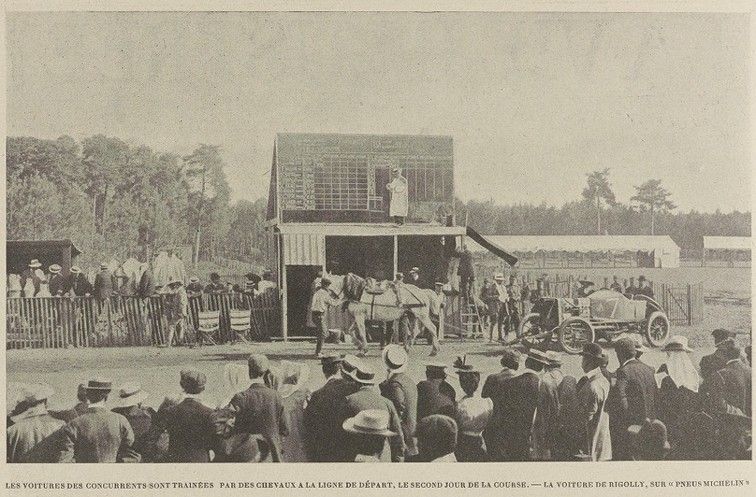
THE COMPETITORS’ CARS ARE PULLED BY HORSES TO THE START LINE ON THE SECOND DAY OF THE RACE. — RIGOLLY’S CAR, ON “MICHELIN TIRES »
AT THE START, THE RULES FOR STOPPING AND SLOWING DOWN ARE SHOWN TO THE RACERS
Page 211.
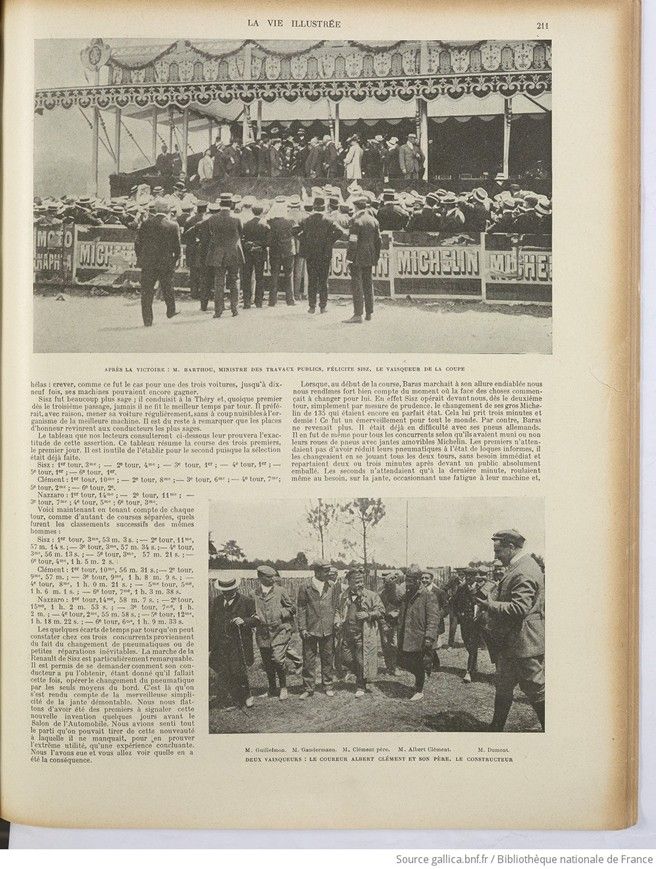
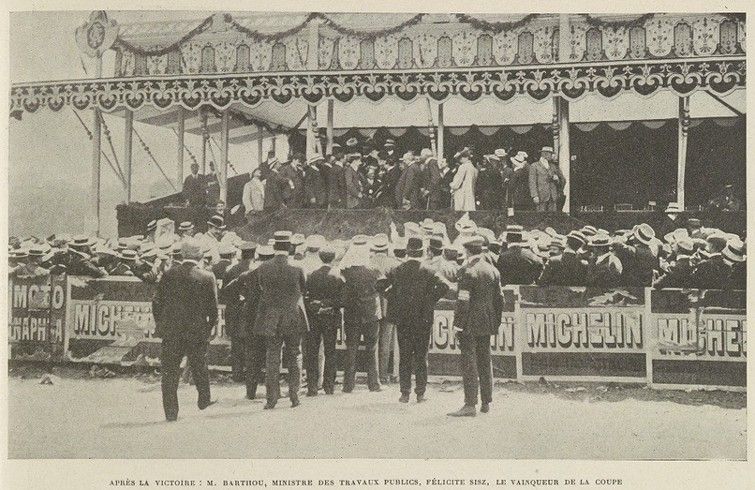
AFTER THE VICTORY: MR. BARTHOU, MINISTER OF PUBLIC WORKS, CONGRATULATES SISZ, THE WINNER OF THE CUP
Mr. Guillelmon. – Mr. Gaudermann. – Mr. Clément Sr. – Mr. Albert Clément. – Mr. Dumont.
TWO WINNERS: RACER ALBERT CLÉMENT AND HIS FATHER, THE CAR MANUFACTURER
Page 212.
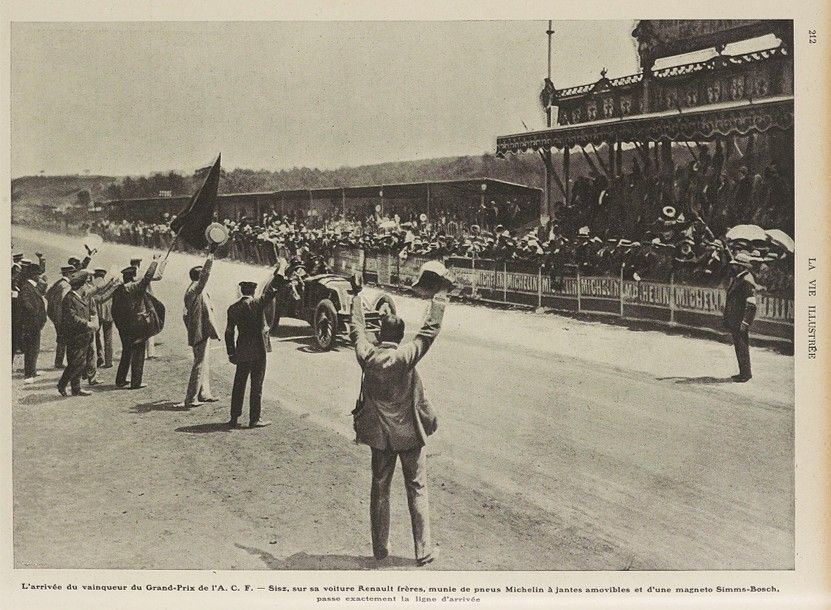
The arrival of the winner of the A.C.F. Grand Prix—Sisz, in his Renault frères car, equipped with Michelin tires on removable rims and a Simms-Bosch magneto, crosses the finish line exactly.
Page 213.
THE ARRIVAL OF THE SECOND-PLACE FINISHER. — NAZZARO, IN HIS F.I.A.T. CAR, EQUIPPED WITH MICHELIN TIRES WITH REMOVABLE RIMS AND A SIMMS-BOSCH MAGNETO
(EXCLUSIVE AGENT: ÉMILE LAMBERJACK) REACHES THE FINISH LINE. AN ITALIAN RACER, CAGNO, REFUELS AND CHANGES HIS MICHELIN REMOVABLE RIMS IN TWO MINUTES