The American journalist-expert William Bradley was stationed in Paris for many, many years. He reported a.o. for The Automobile in technical matters as well as motorracing. As such, he meticously followed the developments of the European automotive industry and racing. This large report covers that first-ever Grand Prix de l’A. C. F. of 1906. Here, he sketches the whole around and during the Grand Prix, like in a storytelling history tale. Go through the story and You’ll find as if You were a whitness to the race; from beginning to the end of the second day.
Text and jpegs by courtesy of hathitrust.org www.hathitrust.org, compiled by motorracinghistory.com
The Automobile, Vol. XV, July 12, 1906
HOW THE GRAND PRIX WAS RUN AND WON
By W. F. BRADLEY.
LE MANS, FRANCE, June 27. — The ground over which the greatest automobile race the world has ever seen – despite the absence of two Anglo-Saxon nations whose presence had been hoped for, is an equilateral triangle with the town of Le Mans hanging on to its western corner, Saint Calais on its eastern end; and the sleepy old-world town of La Ferté-Bernard standing guard over its most northern point. Nature has been kind and has held back none of the requisites for a perfect road race. The Commission Sportive – to give the exact French title of the body fulfilling the duties of the racing board – has come to the aid of nature and together they have created a course which has never yet been equaled in the history of the sport of automobile road racing. When Chairman Thompson congratulated M. René de Knyff, the chairman of the Commission Sportive, on the wonderful organization, the businesslike chevalier received the compliment quite naturally, and said, „You see we have been so long at this sort of thing that we ought to do it well now.“
How the Great Race Was Started.
A long file of cars, the continued shrieking of wierd sirens, the thundering of open exhausts on touring would-be racing cars, clouds of dust and a cold breeze are the recollections of the run out from Le Mans to the grandstands in the morning to witness the Grand Prix. The atmosphere of a race turns the head of most chauffeurs the world over, and on going to the course the owner of a wheezy single cylinder endeavors to imitate the racing man as much as does the lordly possessor of a 60-horsepower Mercedes or Panhard. Arriving at the center of activity at the foot of La Belle Inutile, the cars big and little are hustled into the large, sandy, heather-covered enclosure which serves as an open-air garage. It is surprising how much beauty can be hidden away under the most hideous automobile garb and how quickly the unshapely bundle of cloth rolling about in the tonneau or reclining in the corner of a limousine can be transformed into a creation worthy of the President’s day at Longchamps, or the afternoon stroll in the Bois de Boulogne.
Promptly at five o’clock, access to the course was cut off, and half an hour later the road in front of the stands was clear except for a busy body of much be badged officials and still busier individuals with black mounted boxes who appeared to be on a continuous track for game. Five forty-five, and even the newspaper men have been unceremoniously hustled off the track by the now all-important gendarmes, while the black box fraternity, having no shelter of refuge, climb to the top of the barrier, hold on with one hand and ply their instrument with the other.
Racing Monsters Enter Upon the Scene.
A few minutes later and, as if the matter was a well-rehearsed play, the radiator of an automobile was seen peeping out of the enclosure opposing the stand, and close by the side of the timer’s box. Gabriel’s big De Dietrich came slowly round the corner, being dragged over the heavy sand by blue-jacketed mechanics. With quick movement the two men allowed on the course to crank each car got the engine running, the timer counted off the seconds, and Gabriel shot over the line and rushed down the road, leaving behind him a cloud of dust and smoke. In the meantime, Lancia had come out with his Fiat and had his engine running when the first man left. An interval of only 90 seconds existed between the start of each car, and there was consequently no time for wasting words. It was noted with interest that Lancia’s car was fitted with patent dismountable rim, and the three spare tires which he carried in the rear were already inflated and mounted on their rims. Lancia went off in good style and Szisz claimed the attention of the public. The Renault was also fitted with patent rims and the car in outward appearance differed entirely from last year’s racer. The type of radiator and bonnet used on the flyer was similar to those used on the touring cars, except that the side and front of the bonnet had been cut out and filled with wire gauze. This did not add to its beauty, and as the low-built car shook and trembled under the throb of the powerful motor, unfavorable comment was made by the onlookers. Szisz adjusted his goggles, placed a reserve pair on his head and shot over the line immediately his start was given. Hemery, with his 4A, a beautifully finished little car, painted in light blue with black V-shaped radiator in front, engine exposed showing nickeled and highly polished feed pipes and exhausts, spare tires well strapped on behind, compressed air chambers hung on the side frame and an engine that ran without the least vibration, received a cheer from the French section of the crowd as he went over the line. He responded with a military salute and the mechanic gave a wave of the hand.
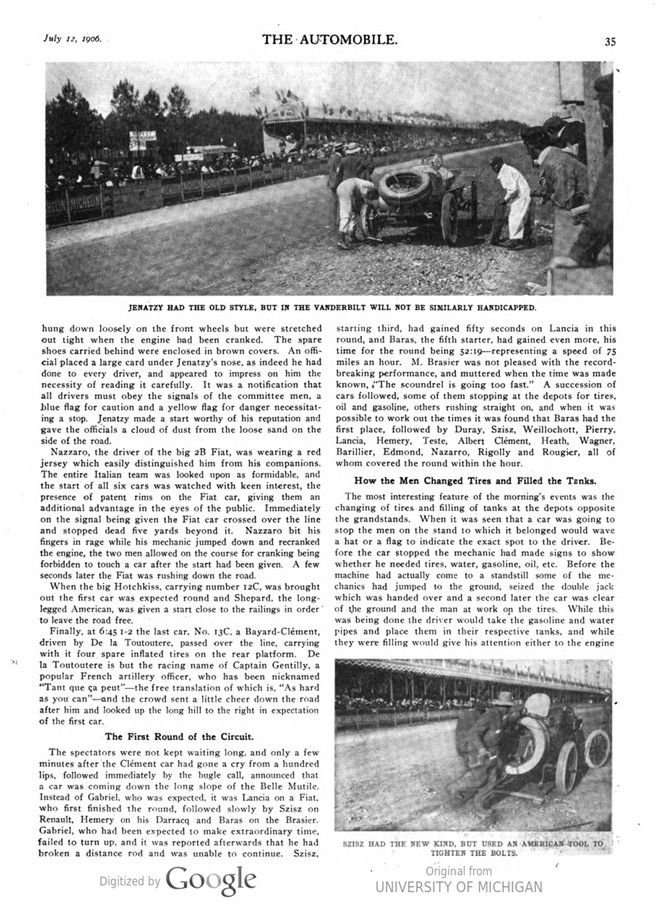
The first Brasier car, driven by Baras and bearing the number 5A, was carefully examined by M. Brasier, who walked all-round the machine, feeling a part here and there, lifted up the bonnet and looked at the engine and gave final instructions to his driver. As soon as the Brasier had gone the first Mercedes racer, number 6A, with Jenatzy at the wheel, took its place. Driver and mechanic were dressed in white, and the car was painted in the same color. As mud guards the German champion had wide bands of brown canvas which hung down loosely on the front wheels but were stretched out tight when the engine had been cranked. The spare shoes carried behind were enclosed in brown covers. An official placed a large card under Jenatzy’s nose, as indeed, he had done to every driver and appeared to impress on him the necessity of reading it carefully. It was a notification that all drivers must obey the signals of the committee men, a blue flag for caution and a yellow flag for danger necessitating a stop. Jenatzy made a start worthy of his reputation and gave the officials a cloud of dust from the loose sand on the side of the road.
Nazzaro, the driver of the big 2B Fiat, was wearing a red jersey which easily distinguished him from his companions. The entire Italian team was looked upon as formidable, and the start of all six cars was watched with keen interest, the presence of patent rims on the Fiat car, giving them an additional advantage in the eyes of the public. Immediately on the signal being given the Fiat car crossed over the line and stopped dead five yards beyond it. Nazzaro bit his fingers in rage while his mechanic jumped down and recranked the engine, the two men allowed on the course for cranking being forbidden to touch a car after the start had been given. A few seconds later the Fiat was rushing down the road.
When the big Hotchkiss, carrying number 12C, was brought out the first car was expected round and Shepard, the long-legged American, was given a start close to the railings in order to leave the road free. Finally, at 6:45 1-2 the last car, No. 13C, a Bayard-Clément, driven by De la Toutoutere, passed over the line, carrying with it four spare inflated tires on the rear platform. De la Toutoutere is but the racing name of Captain Gentilly, a popular French artillery officer, who has been nicknamed „Tant que ça peut“ – the free translation of which is, “As hard as you can“ – and the crowd sent a little cheer down the road after him and looked up the long hill to the right in expectation of the first car.
The First Round of the Circuit.
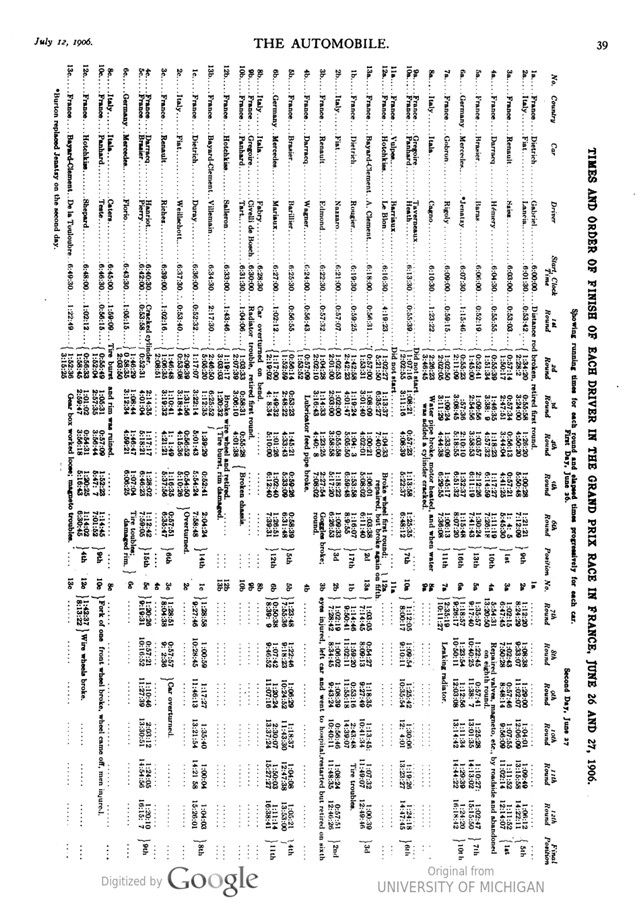
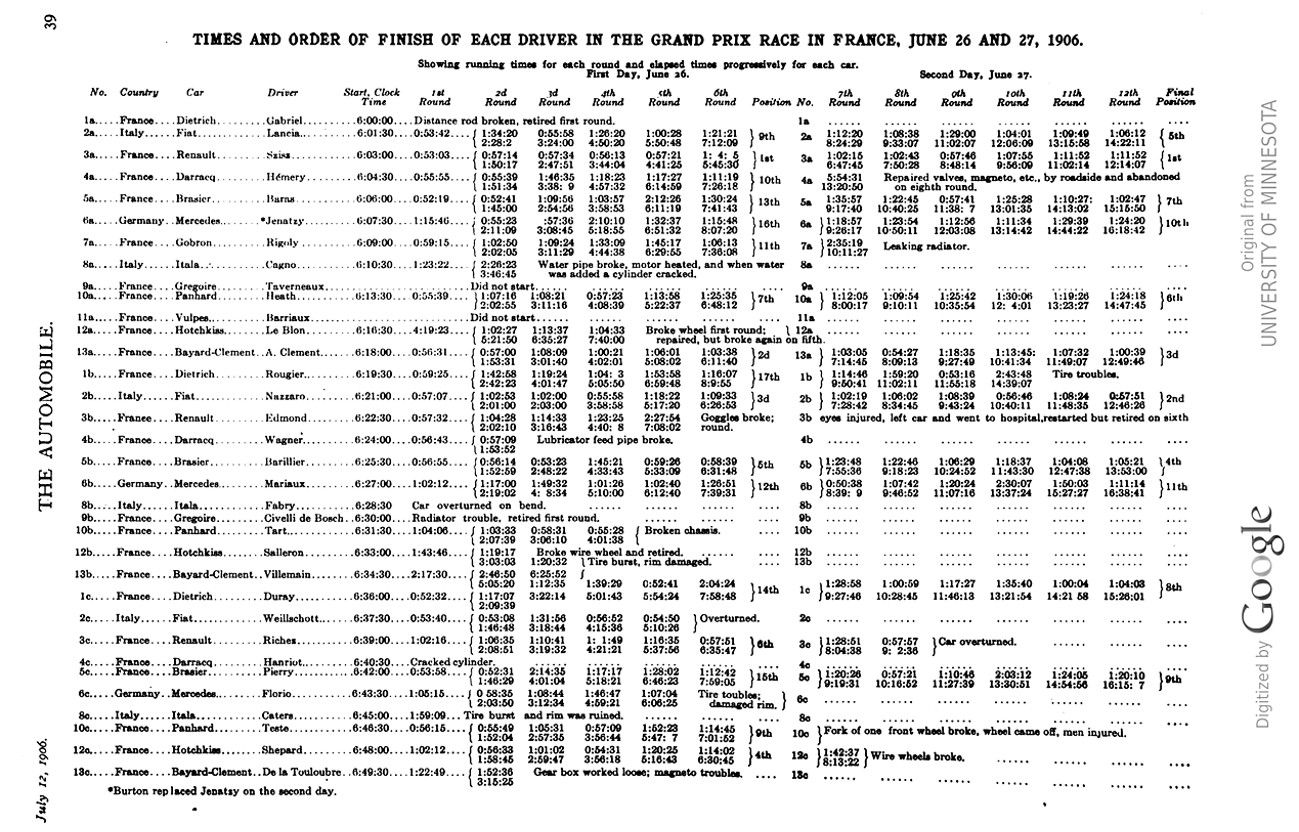
The spectators were not kept waiting long, and only a few minutes after the Clément car had gone a cry from a hundred lips, followed immediately by the bugle call, announced that a car was coming down the long slope of the Belle Mutile. Instead of Gabriel, who was expected, it was Lancia on a Fiat, who first finished the round, followed slowly by Szisz on Renault, Hemery on his Darracq and Baras on the Brasier. Gabriel, who had been expected to make extraordinary time, failed to turn up, and it was reported afterwards that he had broken a distance rod and was unable to continue. Szisz, starting third, had gained fifty seconds on Lancia in this round, and Baras, the fifth starter, had gained even more, his time for the round being 52:19 – representing a speed of 75 miles an hour. M. Brasier was not pleased with the record-breaking performance, and muttered when the time was made known, „The scoundrel is going too fast.“ A succession of cars followed, some of them stopping at the depots for tires, oil and gasoline, others rushing straight on, and when it was possible to work out the times it was found that Baras had the first place, followed by Duray, Szisz, Weillochott, Pierry, Lancia, Hemery, Teste, Albert Clément, Heath, Wagner, Barillier, Edmond, Nazarro, Rigolly and Rougier, all of whom covered the round within the hour.
How the Men Changed Tires and Filled the Tanks.
The most interesting feature of the morning’s events was the changing of tires and filling of tanks at the depots opposite the grandstands. When it was seen that a car was going to stop the men on the stand to which it belonged would wave a hat or a flag to indicate the exact spot to the driver. Before the car stopped the mechanic had made signs to show whether he needed tires, water, gasoline, oil, etc. Before the machine had actually come to a standstill some of the mechanics had jumped to the ground, seized the double jack of the ground and the man at work on the tires. While this which was handed over and a second later the car was clear pipes and place them in their respective tanks, and while was being done the driver would take the gasoline and water they were filling would give his attention either to the engine or the tires. The liveliest interest was displayed by the public in the changing of tires by the ordinary method and with the patent rims. Frequently two cars would come in together, one with ordinary and the other with mobile rims, and a comparison of the times in each car was made by the spectators. The Renault cars had mobile rims on the rear wheels and fixed rims on the front wheels, and every two rounds changed the latter, whether burst or not. On one occasion two rear tires were changed, tanks filled and the lubricator adjusted in 4 1/2 minutes. The change of a single front tire never occupied less than seven minutes.
Szisz Forges to the Front and Stays There.
Of the thirty-two starters nine were entirely out of the running when the third round finished, and it was then seen that Szisz with the 3A Renault had a decided lead, followed by Albert Clément, Nazzaro on the Fiat, Shepard on the Hotchkiss, Duray on the Dietrich, Baras and Barillier of the Brasier team, Richez on the Renault, Heath and Tart on Pan- hard machines and Florio on the Mercedes. Jenatzy was still well placed on the scoring board, but Mariaux had fallen low through loss of time on the second round.
Before eleven o’clock Szisz ran away on his last round and, barring accidents, there was no doubt as to the first day’s winner. Albert Clément was the nearest to him but was still too far off to seriously menace the Renault driver’s position. With the possibility of the early arrival of the winner interest in the event began to revive and the grandstands filled again. Down the hill rushed the red Renault, past the yellow flag, waved to indicate the termination of the course, and flew along to the clearing, a mile further down, made for the cars to turn in, and a few minutes later was back before the stand with a committee man on board and was taken to the garage reserved for it. The arrival of Albert Clément second created more enthusiasm than the coming in of the winner, for the young driver was a general favorite, while the Renault car had not been looked upon as the most important. When Nazzaro had conquered third position all interest in the race vanished, for though the Brasier, the Panhard and Mr. Shepard’s Hotchkiss were all running well, it was still impossible to foretell their final position; as to the rest, they could not be expected to arrive until late in the afternoon.
FEATURES OF THE SECOND DAY.
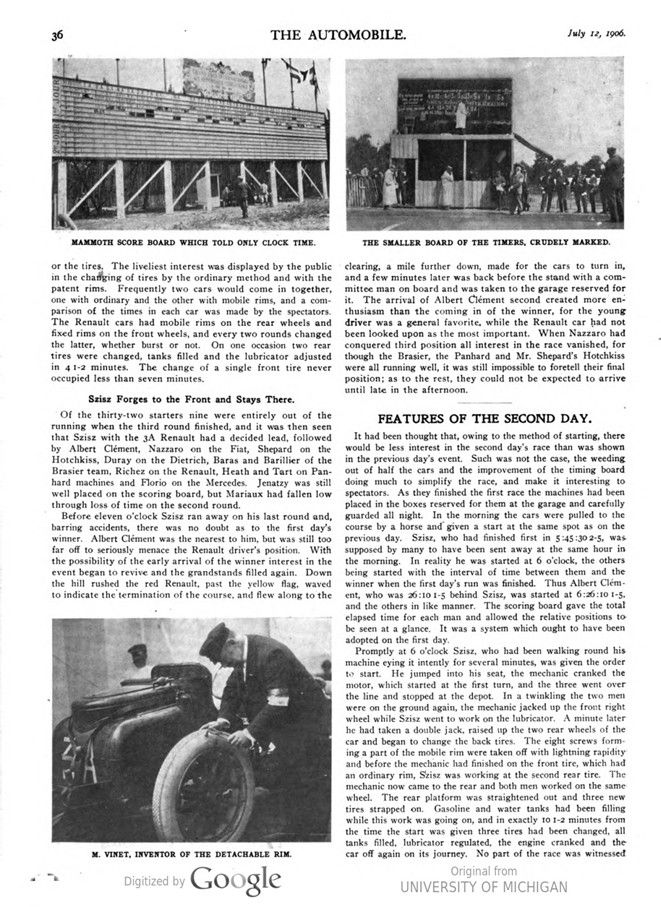
It had been thought that, owing to the method of starting, there would be less interest in the second day’s race than was shown in the previous day’s event. Such was not the case, the weeding out of half the cars and the improvement of the timing board doing much to simplify the race, and make it interesting to spectators. As they finished the first race the machines had been placed in the boxes reserved for them at the garage and carefully guarded all night. In the morning the cars were pulled to the course by a horse and given a start at the same spot as on the previous day. Szisz, who had finished first in 5:45:30 2-5, was supposed by many to have been sent away at the same hour in the morning. In reality he was started at 6 o’clock, the others being started with the interval of time between them and the winner when the first day’s run was finished. Thus Albert Clément, who was 26:10 1-5 behind Szisz, was started at 6:26:10 1-5, and the others in like manner. The scoring board gave the total elapsed time for each man and allowed the relative positions to be seen at a glance. It was a system which ought to have been adopted on the first day.
Promptly at 6 o’clock Szisz, who had been walking round his machine, eying it intently for several minutes, was given the order to start. He jumped into his seat, the mechanic cranked the motor, which started at the first turn, and the three went over the line and stopped at the depot. In a twinkling the two men were on the ground again, the mechanic jacked up the front right wheel while Szisz went to work on the lubricator. A minute later he had taken a double jack, raised up the two rear wheels of the car and began to change the back tires. The eight screws forming a part of the mobile rim were taken off with lightning rapidity and before the mechanic had finished on the front tire, which had an ordinary rim, Szisz was working at the second rear tire. The mechanic now came to the rear and both men worked on the same wheel. The rear platform was straightened out and three new tires strapped on. Gasoline and water tanks had been filling while this work was going on, and in exactly 10 1-2 minutes from the time the start was given three tires had been changed, all tanks filled, lubricator regulated, the engine cranked and the car off again on its journey. No part of the race was witnessed with more interest than this event, and admiration for the new method of changing tires was unbounded.
How Clément, Nazzaro, Shepard and Others Got Away.
Szisz had only just gone when Albert Clément’s car was dragged to the starting line, the young driver, his mechanic, Venus and M. Clément senior walking round the machine, evidently discussing what should be done at the start. On the word „Go!“ Albert leaped into his seat and diminutive Venus grabbed the handle. Three or four turns were given, but the motor refused to respond. „Start on the accumulator!“ yelled Clément, now as excited as he was cool a few minutes before. A roar of the exhaust followed, the car went over the line and stopped at the depot a few yards down. Four inflated tires were put on the rear platform by the young driver himself, who used both his hands and his head in the lifting of them; they were strapped up and the little Frenchman jumped on to the top of the car to look at the tanks. Evidently the gasoline was not flowing fast enough through the feed pipe, for he shouted for cans to be handed to him. This was done and the contents of several three-gallon cans with big mouths emptied into the tank. A quantity was spilled over the car and the empty tins were flung to the ground with an impetuosity that revealed a determination to win or die. Two compressed air tanks were taken on board and the car was restarted.
Nazzaro, of the Fiat team, still dressed in his red jersey, started his motor on the first turn of the handle and went away without stopping at the depot. As there was but an interval of fourteen minutes between the Italian’s and the Frenchman’s start, and the latter had lost about eleven minutes in cranking and filling up at the depot, he was close pressed by his rival on the first round. Fitz Shepard, who was smoking a cigarette when his start was given, had the left rear tire of his Hotchkiss burst and had to stop to change at the depot. Barillier, who started 63 seconds later, had a slack chain and had to stop to tighten it, while his mechanic crawled under the machine to effect some repairs. Richez was not in running condition either and pulled up at the Renault station for repairs. Heath came out next and was kept well to the roadside to allow Szisz to pass, for his arrival was expected at any moment. Heath indeed had just started his motor when the Renault rushed by at a terrible speed and a second later had disappeared from view. Tire troubles caused the American to stop at the depot, and there was the interesting sight of four cars laid up by the roadside for repairs. Heath appeared to become very nervous while at work, and savagely bit a twig which he had been carrying in his mouth. He was, however, the first to get away, followed 30 seconds later by his countryman, Shepard. Teste and Richez were now by the roadside, the latter working at a front tire, and the former, after some attention to his tires, started away as Lancia was given the order to go. The Fiat had just gone over the line when the motor stalled, and Lancia’s mechanic had to run round to the front to recrank. At the first turn of the handle the motor restarted, but Lancia was too excited and in too big a hurry to allow his man time to regain his seat, and to avoid being run over he seized hold of the top of the radiator and was carried down to the repair depot in this position. While Lancia was changing his tires Albert Clément rushed past without stopping, having finished his seventh round. Hemery’s brilliant little Darracq could not be started and had to be pushed down the road to the depot, where extensive repairs were commenced on the valves. Rigoly came out and went off with his Gobron whilst Hemery was still at work. Mariaux started his Mercedes and flew away without a stop. Baras, whose tires were in good condition, took fuel and went away immediately. Barillier (Brasier) and Richez (Renault) each finished a round, Duray (De Dietrich), Pierry (Brasier), Burton (Mercedes), replacing Jenatzy, and Rougier (De Dietrich) were all started, and still Hemery worked at his motor in a despairing manner.
The passage of cars became frequent while the last three were being sent away, and the interest of the spectators was fully maintained from 6 to 8.30 A M. in the repairing operations and arrival of the first starters. About nine o’clock a telegram was received by M. René de Knyff, of the Panhard firm, announcing an accident to Teste. After going round the bend at La Fourche the fork of one of the front wheels snapped, both wheels came off and the front of the car dug into the ground. Both men were thrown out, Teste sustaining a broken thigh; his hand also was laid bare to the bone, and he complained of internal pains. From the commencement there had been little doubt of Szisz winning the race, and when, a little after nine o’clock he finished his ninth round, still well ahead of all competitors, he was freely spoken of as the winner. Before starting on his tenth round Szisz filled up with gasoline and water and changed his two rear tires as a precautionary measure. About the same time Hemery cranked his engine and ran it for some ten minutes, firing badly, and finally went away for his first round on the second day.
A Brilliant Race for Second Place.
With Szisz’s position practically secure, the attention of the spectators was directed toward Albert Clément and Nazzaro, who were running a neck-and-neck race round the course. At the end of the ninth round the young Frenchman had a lead, of 16 minutes on the Italian. On the tenth round the difference between the two had been reduced to one minute. Albert Clément, however, had to stop to take gasoline and oil on board, load up with tires and change the compressed air tanks. In his excitement he rushed past the station and had to come back on reverse gear. The feed pipe was too slow for filling the gasoline tank, and Albert ordered the big cans to be handed up to him, and emptied their contents into the tank in such a reckless manner that the car was in serious danger of catching fire. Never was a car loaded up so quickly; the young driver appeared to be endowed with the strength of a lion and the agility of a monkey, and in an incredibly short space of time he was rushing wildly down the road with Nazzaro in hot pursuit a mile in the rear. On the eleventh round Nazzaro gained about a minute and a half, placing himself thirty-two seconds ahead of Clément. Intense excitement prevailed as the two cars went away for the last round, which was to decide which of them should secure second place. All the morning the sport had been keen and fast. Heath, who was doing fast time, had pulled up at the station in a terribly excited condition, took two new tires behind, gave one to his mechanic to hold between his legs, and went away quickly. He had evidently seen and brought in news of the accident to Teste.
At the end of the tenth round Nazzaro came in with his left rear tire burst and had to change at the depot. Clément passed while he was there and signaled that he had punctured, but rushed through without stopping. Mariaux had lost a shoe while coming down the hill toward the grandstand, and when he pulled up at the stand had so injured his rim that he was for some time unable to start. The Brasier team, too, signaled that they had suffered from punctures.
Szisz Wins Easily with a Strong Lead.
Soon after twelve o’clock all were on the lookout for Szisz on his last round, and though it was noon, and only a trifle cooler than on the previous day, none thought of food or shade in their eagerness to greet the winner. Lancia had just gone by on his tenth round at a furious pace, when a cry of „He is coming!“ followed immediately by a bugle call, announced the arrival of the winner. Two minutes later Szisz came tearing along and whizzed down the road to the turning point provided a couple of miles away. When he came back he was carried in triumph to the grandstands and presented to the Minister of Public Works, who publicly congratulated him on his performance. Compared with some demonstrations on similar occasions, the greeting was, on the whole, of a rather sober nature.
Nazzaro Wrests Second Place from Clément.
After Szisz had been carried to the firm’s headquarters shoulder high the arrival of the second and third men was looked for. Nazzaro had a slight advantage at the beginning of the last round, but Albert Clément was the favorite, and all faces were turned towards La Belle Inutile in the hope of seeing him arrive first. Down the hill tore the red-jersied Nazzaro, and before he was well out of sight Clément thundered after him, having lost second place by a little more than three minutes. For six rounds the two young men had run neck-and-neck, and the finish was one of the most exciting ever seen in a motor race. Nazzaro and his mechanic were presented to the Minister, and when Albert Clément came back to the grandstand he, too, was officially presented and publicly congratulated.
Photos.
Page 33,
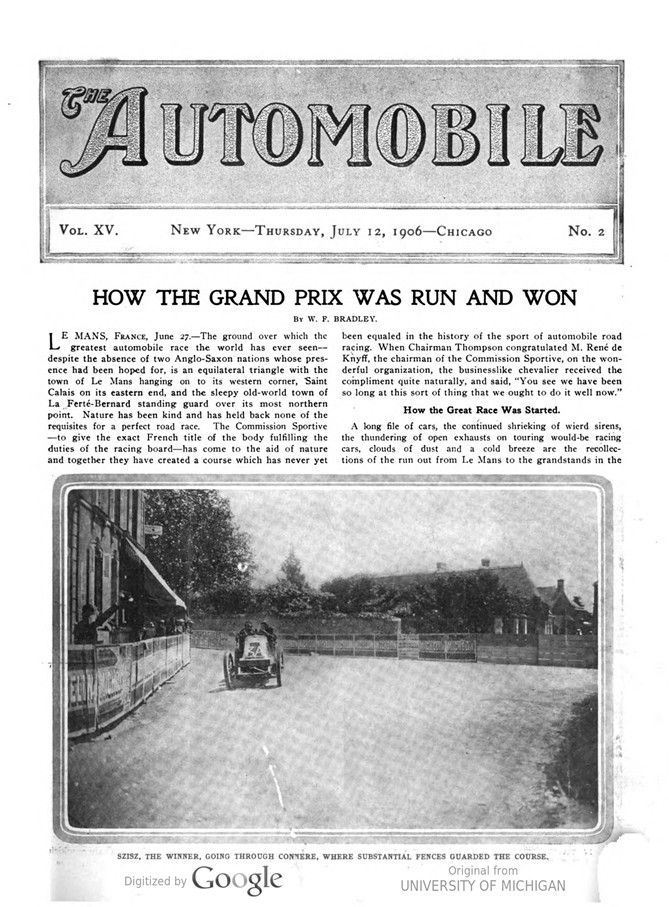
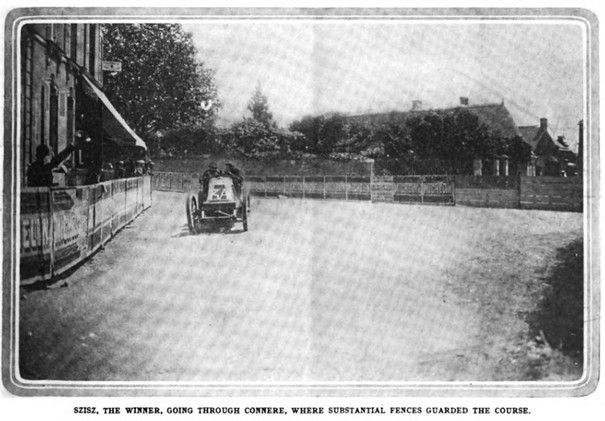
SZISZ, THE WINNER, GOING THROUGH CONNERE, WHERE SUBSTANTIAL FENCES GUARDED THE COURSE.
Page 34.
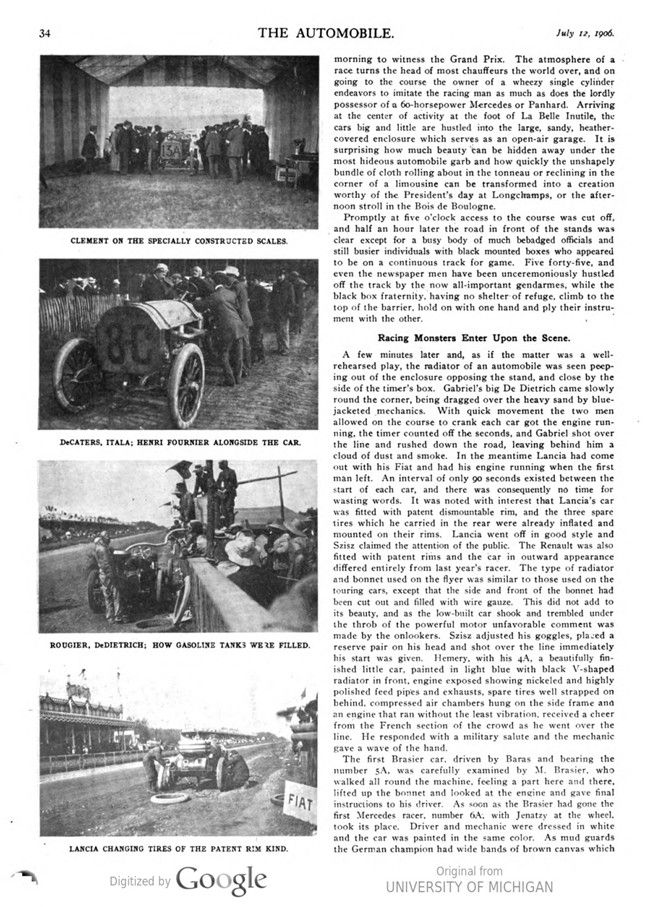
CLEMENT ON THE SPECIALLY CONSTRUCTED SCALES.
DeCATERS, ITALA; HENRI FOURNIER ALONGSIDE THE CAR.
ROUGIER, DeDIETRICH; HOW GASOLINE TANKS WERE FILLED.
LANCIA CHANGING TIRES OF THE PATENT RIM KIND.
Page 35.
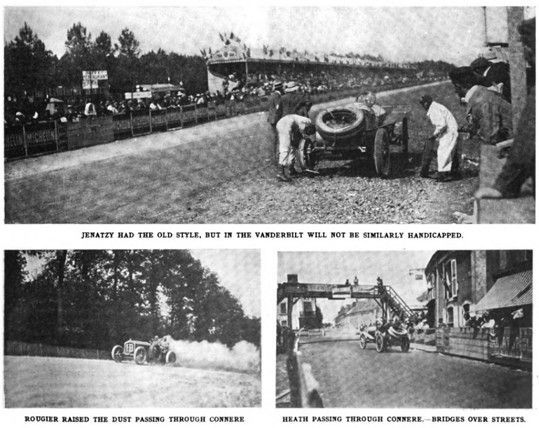
JENATZY HAD THE OLD STYLE, BUT IN THE VANDERBILT WILL NOT BE SIMILARLY HANDICAPPED. (RESTAURANT – HELIN – MICHELIN)
Page 36.
MAMMOTH SCORE BOARD WHICH TOLD ONLY CLOCK TIME.
M. VINET, INVENTOR OF THE DETACHABLE RIM.
THE SMALLER BOARD OF THE TIMERS, CRUDELY MARKED.
Page 37.
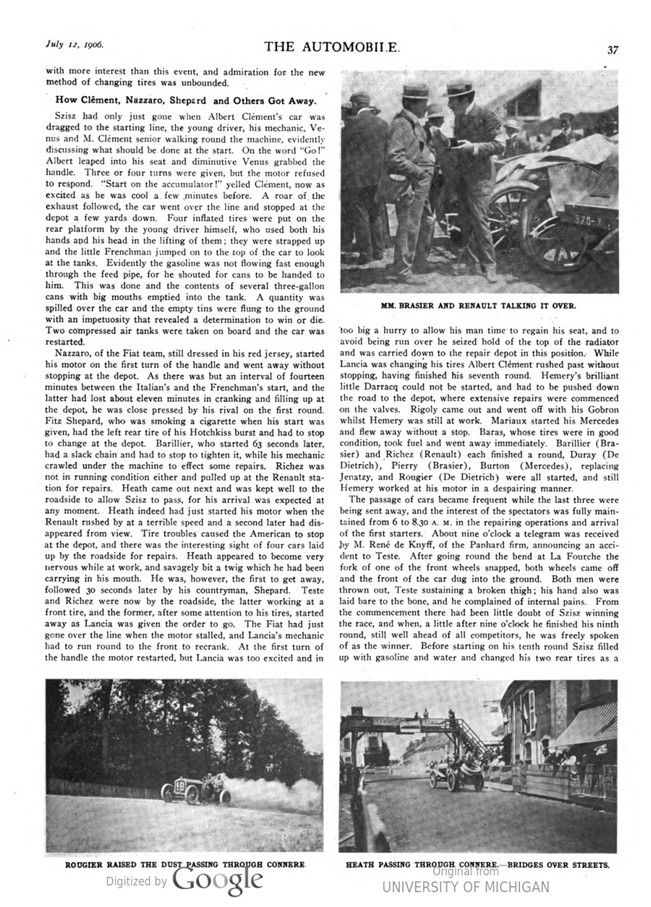
MM. BRASIER AND RENAULT TALKING IT OVER.
ROUGIER RAISED THE DUST PASSING THROUGH CONNERE. HEATH PASSING THROUGH CONNERE. BRIDGES OVER STREETS.
Page 38.
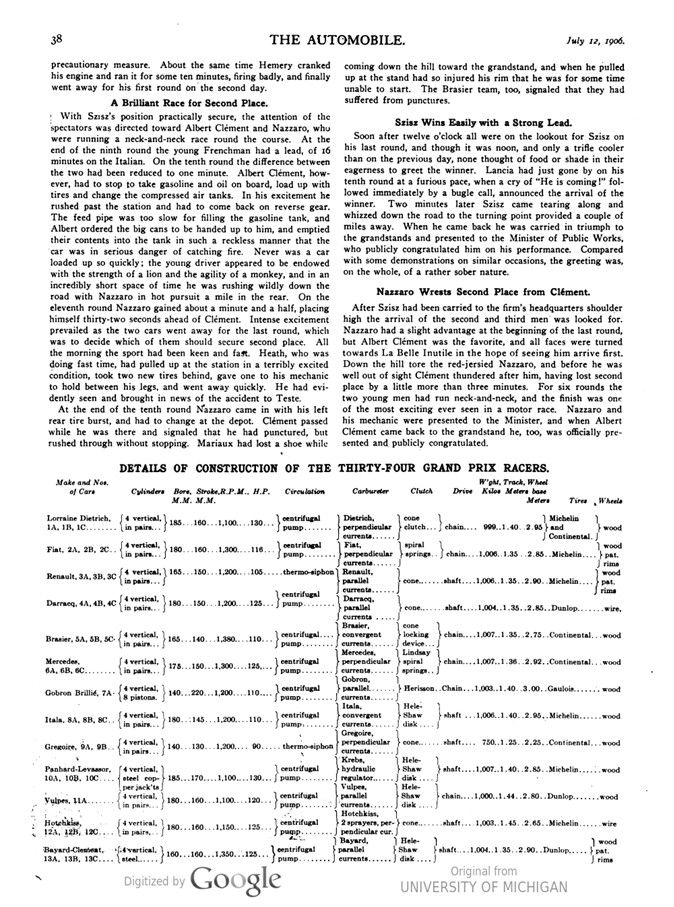
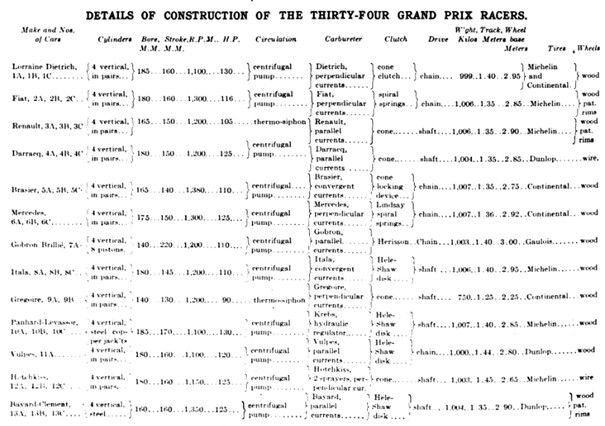
DETAILS OF CONSTRUCTION OF THE THIRTY-FOUR GRAND PRIX RACERS.