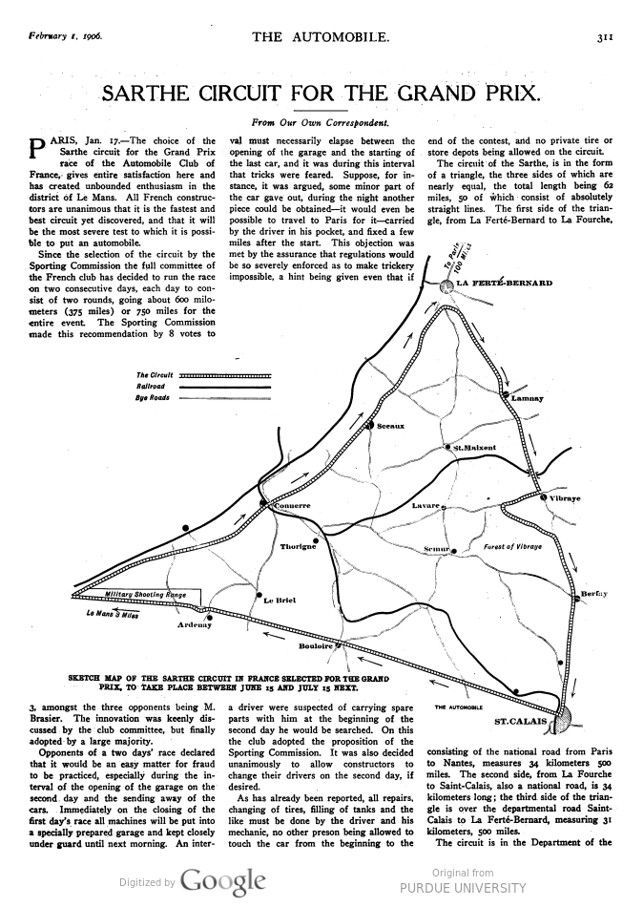
The choice for a circuit of the first Grand Prix de l’ACF stood firm already by mid January. Here, the correspondent for The Automobile, I presume W.F. Bradley, gave a fine summary of the circuit as well as a description of the surroundings. The circuit basically consisted of three long straight, triangular oriented East from le Mans.
With permission of hathitrust hathitrust.org == Text and fotos compiled by motorracinghistory
THE AUTOMOBILE — Volume 14, No. 5, February 1, 1906
SARTHE CIRCUIT FOR THE GRAND PRIX.
From Our Own Correspondent.
PARIS, Jan. 17. – The choice of the Sarthe circuit for the Grand Prix race of the Automobile Club of France, gives entire satisfaction here and has created unbounded enthusiasm in the district of Le Mans. All French constructors are unanimous that it is the fastest and best circuit yet discovered, and that it will be the most severe test to which it is possible to put an automobile.
Since the selection of the circuit by the Sporting Commission the full committee of the French club has decided to run the race on two consecutive days, each day to consist of two rounds, going about 600 kilometers (375 miles) or 750 miles for the entire event. The Sporting Commission made this recommendation by 8 votes to 3, amongst the three opponents being M. Brasier. The innovation was keenly discussed by the club committee, but finally adopted by a large majority.
Opponents of a two days’ race declared that it would be an easy matter for fraud to be practiced, especially during the interval of the opening of the garage on the second day and the sending away of the cars. Immediately on the closing of the first day’s race all machines will be put into a specially prepared garage and kept closely under guard until next morning. An interval must necessarily elapse between the opening of the garage and the starting of the last car, and it was during this interval that tricks were feared. Suppose, for instance, it was argued, some minor part of the car gave out, during the night another piece could be obtained – it would even be possible to travel to Paris for it – carried by the driver in his pocket, and fixed a few miles after the start. This objection was met by the assurance that regulations would be so severely enforced as to make trickery impossible, a hint being given even that if a driver were suspected of carrying spare parts with him at the beginning of the second da,y he would be searched. On this the club adopted the proposition of the Sporting Commission. It was also decided unanimously to allow constructors to change their drivers on the second day, if desired.
As has already been reported, all repairs, changing of tires, filling of tanks and the like must be done by the driver and his mechanic, no other person being allowed to touch the car from the beginning to the end of the contest, and no private tire or store depots being allowed on the circuit.
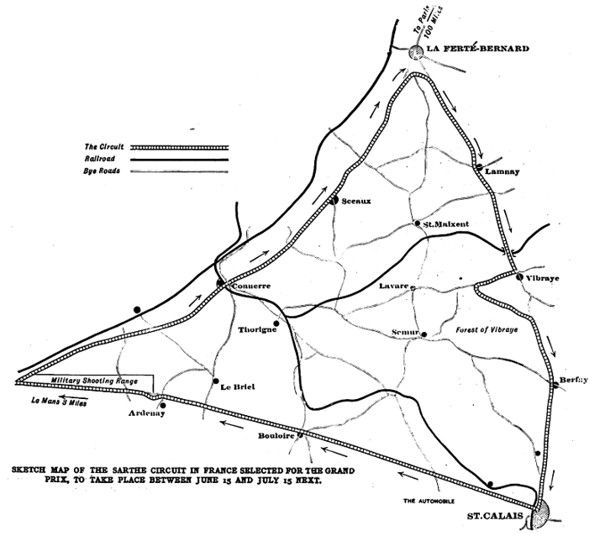
The circuit of the Sarthe, is in the form of a triangle, the three sides of which are nearly equal, the total length being 62 miles, 50 of which consist of absolutely straight lines. The first side of the triangle, from La Ferté-Bernard to La Fourche, consisting of the national road from Paris to Nantes, measures 34 kilometers 500 miles. The second side, from La Fourche to Saint-Calais, also a national road, is 34 kilometers long; the third side of the triangle is over the departmental road Saint- Calais to La Ferté-Bernard, measuring 31 kilometers, 500 miles.
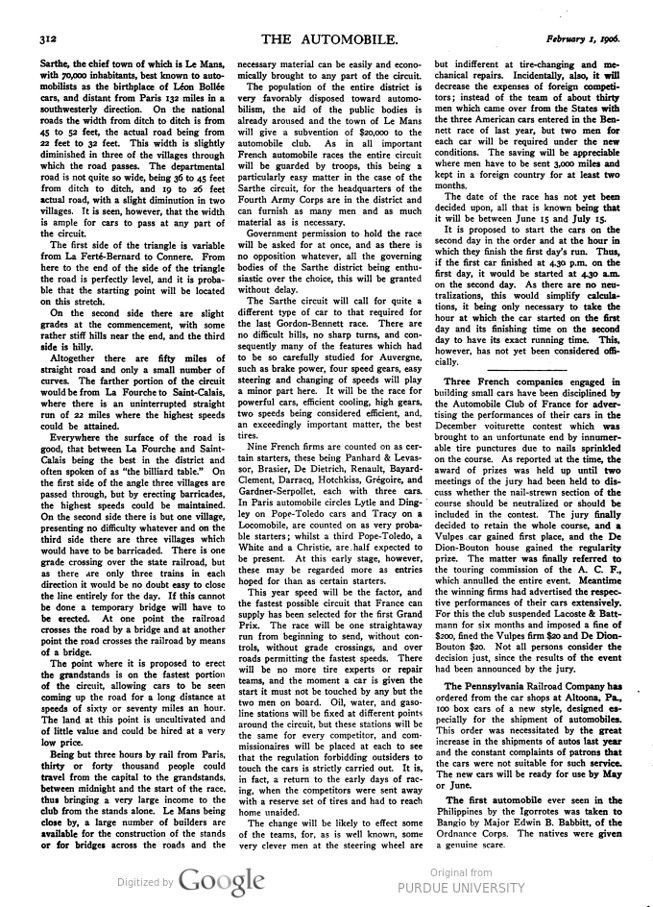
The circuit is in the Department of the Sarthe, the chief town of which is Le Mans, with 70,000 inhabitants, best known to automobilists as the birthplace of Léon Bollée cars, and distant from Paris 132 miles in a southwesterly direction. On the national roads the width from ditch to ditch is from 45 to 52 feet, the actual road being from 22 feet to 32 feet. This width is slightly diminished in three of the villages through which the road passes. The departmental road is not quite so wide, being 36 to 45 feet from ditch to ditch, and 19 to 26 feet actual road, with a slight diminution in two villages. It is seen, however, that the width is ample for cars to pass at any part of the circuit.
The first side of the triangle is variable from La Ferté-Bernard to Connere. From here to the end of the side of the triangle the road is perfectly level, and it is probable that the starting point will be located on this stretch.
On the second side there are slight grades at the commencement, with some rather stiff hills near the end, and the third side is hilly.
Altogether there are fifty miles of straight road and only a small number of curves. The farther portion of the circuit would be from La Fourche to Saint-Calais, where there is an uninterrupted straight run of 22 miles where the highest speeds could be attained.
Everywhere the surface of the road is good, that between La Fourche and Saint-Calais being the best in the district and often spoken of as “the billiard table.” On the first side of the angle three villages are passed through, but by erecting barricades, the highest speeds could be maintained. On the second side there is but one village, presenting no difficulty whatever and on the third side there are three villages which would have to be barricaded. There is one grade crossing over the state railroad, but as there are only three trains in each direction it would be no doubt easy to close the line entirely for the day. If this cannot be done a temporary bridge will have to be erected. At one point the railroad crosses the road by a bridge and at another point the road crosses the railroad by means of a bridge.
The point where it is proposed to erect the grandstands is on the fastest portion of the circuit, allowing cars to be seen coming up the road for a long distance at speeds of sixty or seventy miles an hour. The land at this point is uncultivated and of little value and could be hired at a very low price. Being but three hours by rail from Paris, thirty or forty thousand people could travel from the capital to the grandstands, between midnight and the start of the race, thus bringing a very large income to the club from the stands alone. Le Mans being close by, a large number of builders are available for the construction of the stands or for bridges across the roads and the necessary material can be easily and economically brought to any part of the circuit.
The population of the entire district is very favorably disposed toward automobilism, the aid of the public bodies is already aroused and the town of Le Mans will give a subvention of $20,000 to the automobile club. As in all important French automobile races the entire circuit will be guarded by troops, this being a particularly easy matter in the case of the Sarthe circuit, for the headquarters of the Fourth Army Corps are in the district and can furnish as many men and as much material as is necessary.
Government permission to hold the race will be asked for at once, and as there is no opposition whatever, all the governing bodies of the Sarthe district being enthusiastic over the choice, this will be granted without delay.
The Sarthe circuit will call for quite a different type of car to that required for the last Gordon-Bennett race. There are no difficult hills, no sharp turns, and consequently many of the features which had to be so carefully studied for Auvergne, such as brake power, four speed gears, easy steering and changing of speeds will play a minor part here. It will be the race for powerful cars, efficient cooling, high gears, two speeds being considered efficient, and, an exceedingly important matter, the best tires.
Nine French firms are counted on as certain starters, these being Panhard & Levassor, Brasier, De Dietrich, Renault, Bayard- Clement, Darracq, Hotchkiss, Grégoire, and Gardner-Serpollet, each with three cars. In Paris automobile circles Lytle and Ding- ley on Pope-Toledo cars and Tracy on a Locomobile, are counted on as very proba- ble starters; whilst a third Pope-Toledo, a White and a Christie, are half expected to be present. At this early stage, however, these may be regarded more as entries hoped for than as certain starters.
This year speed will be the factor, and the fastest possible circuit that France can supply has been selected for the first Grand Prix. The race will be one straightaway run from beginning to send, without controls, without grade crossings, and over roads permitting the fastest speeds. There will be no more tire experts or repair teams, and the moment a car is given the start it must not be touched by any but the two men on board. Oil, water, and gasoline stations will be fixed at different points around the circuit, but these stations will be the same for every competitor, and commissionaires will be placed at each to see that the regulation forbidding outsiders to touch the cars is strictly carried out. It is, in fact, a return to the early days of racing, when the competitors were sent away with a reserve set of tires and had to reach home unaided.
The change will be likely to effect some of the teams, for, as is well known, some very clever men at the steering wheel are but indifferent at tire-changing and mechanical repairs. Incidentally, also, it will decrease the expenses of foreign competitors; instead of the team of about thirty men which came over from the States with the three American cars entered in the Bennett race of last year, but two men for each car will be required under the new conditions. The saving will be appreciable where men have to be sent 3,000 miles and kept in a foreign country for at least two months.
The date of the race has not yet been decided upon, all that is known being that it will be between June 15 and July 15.
It is proposed to start the cars on the second day in the order and at the hour in which they finish the first day’s run. Thus, if the first car finished at 4.30 p.m. on the first day, it would be started at 4.30 a.m. on the second day. As there are no neutralizations, this would simplify calculations, it being only necessary to take the hour at which the car started on the first day and its finishing time on the second day to have its exact running time. This, however, has not yet been considered officially.
Photos.
Page 311.
SKETCH MAP OF THE SARTHE CIRCUIT IN FRANCE SELECTED FOR THE GRAND PRIX, TO TAKE PLACE BETWEEN JUNE 15 AND JULY 15 NEXT.
The Circuit – Railroad – Bye Roads – Military Shooting Range – Le Mans 3 Miles – To Paris 100 Miles – LA FERTÉ-BERNARD – Connerre – Sceaux Lamnay Vibraye Forest of Vibraye Berfay St.Calais Bouloire Ardenay( Lavare St.Maixent Thorigne Semur Le Briel)