Again, two short articles of The Automobile that were published prior to the Grand Prix. Some notes on organisational issues and a description of some what-ifs, should American competitors were to particpate in the Grand Prix.
With permission of hathitrust hathitrust.org == Text and fotos compiled by motorracinghistory
THE AUTOMOBILE — Volume 14, No. 8, February 22, 1906
Grand Prix of the A. C. F.
PARIS, Feb. 9. – The complete regulations governing the long-distance road race known as the Grand Prix are at present undergoing a final revision and will be published officially within a week. No change will be made in the main features of the contest, already described in THE AUTOMOBILE. The race will be held on two consecutive days, probably Tuesday, June 26, and Wednesday, June 27, six rounds of the circuit being covered each day, giving a total distance of 1,260 kilometers (787 miles). There will be no controls on the circuit, and no workmen will be allowed on the road, other than those at the fixed store stations under the control of a commissionaire. Thus the driver and his mechanic will have to attend to all repairs of tires, filling of tanks, or repairs to machine, quite unaided. Entrance fees will doubtless be fixed at $1,000 per car, and the maximum. number of entries will be three for each firm or group of firms where several construct under the same license.
It is probable that the racers will be started on the first day with one-minute intervals, and on the second day they will be sent off in the order of their arrival on the previous day, and at exactly the same time. Thus, if the first three cars finished the race at respectively 5.00, 5.02 and 5.15, they would be started the next morning at 5.00, 5.02 and 5.15. By this means the calculation of time will be exceedingly simple, and the two days’ event will be followed by the public as readily as a one day’s straightaway run. Any car which has hopelessly lost its position in the race will be called upon to withdraw; a loss of three hours on the leading machine will probably be the limit fixed.
European Circuit Hanging Fire.
The 3,000 miles reliability trial through Europe brought forward by the Marquis de Dion and adopted by the Automobile Club of France as one of their big events during 1906, has up to the present failed to arouse a great amount of enthusiasm. Although the tour does not commence until the end of July, entries close on April 15. At the time of writing only two engagements have been officially received, both being Darracq cars. It would be unfortunate if the event lacked interest owing to scarcity of entries, for a 3,000-mile tour through the different countries of Europe is bound to be an interesting sporting event and to secure no small amount of benefit to the firms whose cars successfully accomplish the run. Entrance fees are fixed at $200, $300, $400, and $500, according to the four classes into which the competitors are divided.
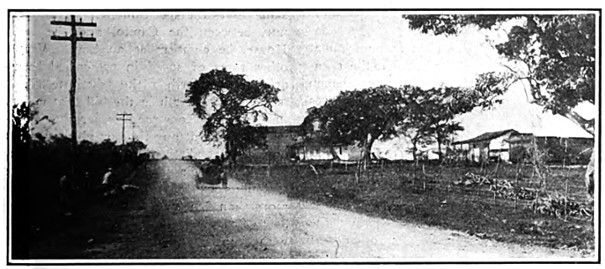
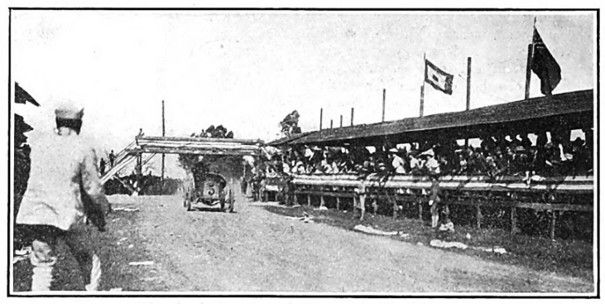
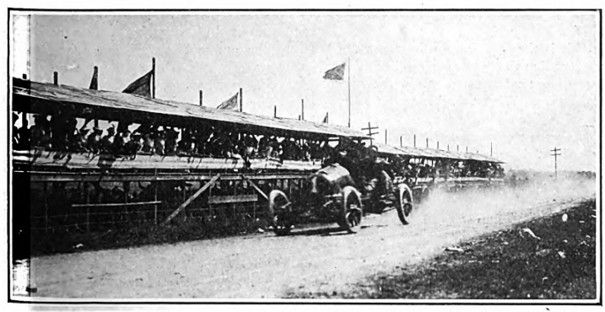
Photos. Page 413.
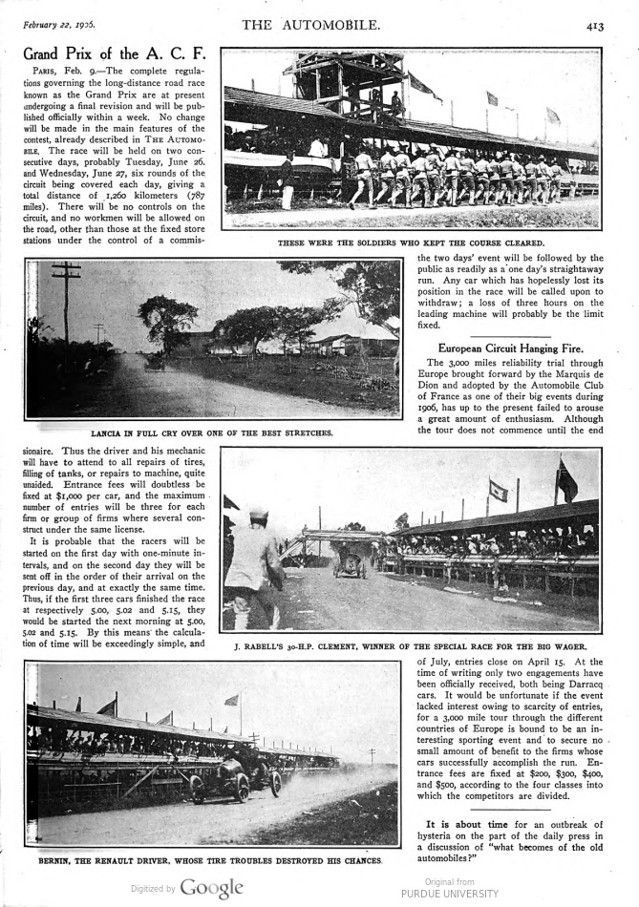
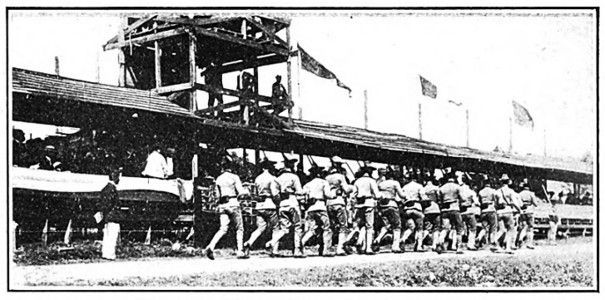
THESE WERE THE SOLDIERS WHO KEPT THE COURSE CLEARED. -//- LANCIA IN FULL CRY OVER ONE OF THE BEST STRETCHES. -//- J. RABELL’S 30-H.P. CLEMENT, WINNER OF THE SPECIAL RACE FOR THE BIG WAGER. -//- BERNIN, THE RENAULT DRIVER, WHOSE TIRE TROUBLES DESTROYED HIS CHANCES.
With permission of hathitrust hathitrust.org == Text and fotos compiled by motorracinghistory
THE AUTOMOBILE — Volume 14, No. 15, April 12, 1906
THE GRAND PRIX DE FRANCE.
PARIS, April 2. – there is much satisfaction in Paris automobile circles at the news which was made known to-day that cable messages were passing between W. S. Hogan, representative of the Automobile Club of America in Paris, and the officials of the Automobile Club of France, with a view to the entry of an American team for the Grand Prix race.
Should American drivers be sent over, at least six nations will be represented in the race, namely, France, Germany, England, Italy, Austria and America. Belgium and Switzerland are doubtful starters. No foreign entries have yet been received, and the French cars engaged stand at twelve, being three each from Brasier, Panhard, Darracq and De Dietrich factories. The entry list, however, does not close until April 30 at ordinary fees ($1,000 per car) and on May 15 at double fees, and there is thus no hurry, more especially as owing to the recent fall of the government permission has not yet been officially received to hold the race. It is for this reason that actual work has not yet been commenced on the circuit, though all preparations have been made for recharging the road; erecting stands and fixing up stations, and as soon as the decree has been signed large bodies of workmen will commence operations at spots already allotted to them.
As most of these villages are excessively dull in winter, a free moving-picture exhibition and lecture will be quite an event; it is thus reasonable to presume that all the little prejudices on the part of country folk against automobilists will be removed in advance, and that when the racing teams arrive on the spot they will find an enthusiastic population to greet them.
Work on the circuit will not be commenced until winter is quite over. Very few changes have to be made, the road being already in such perfect condition. The erection of grandstands and the making of two loop roads will be quickly accomplished when fine weather arrives. A meeting of the Sporting Commission will be held in a few days, when it is expected that the exact date of the race will be fixed
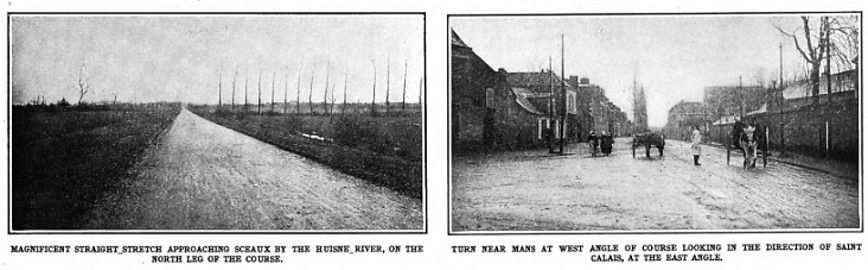
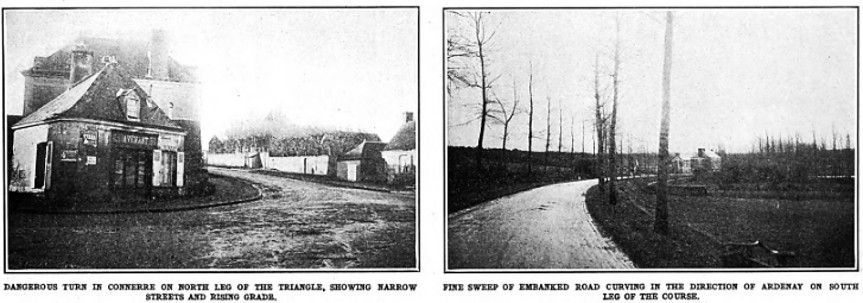
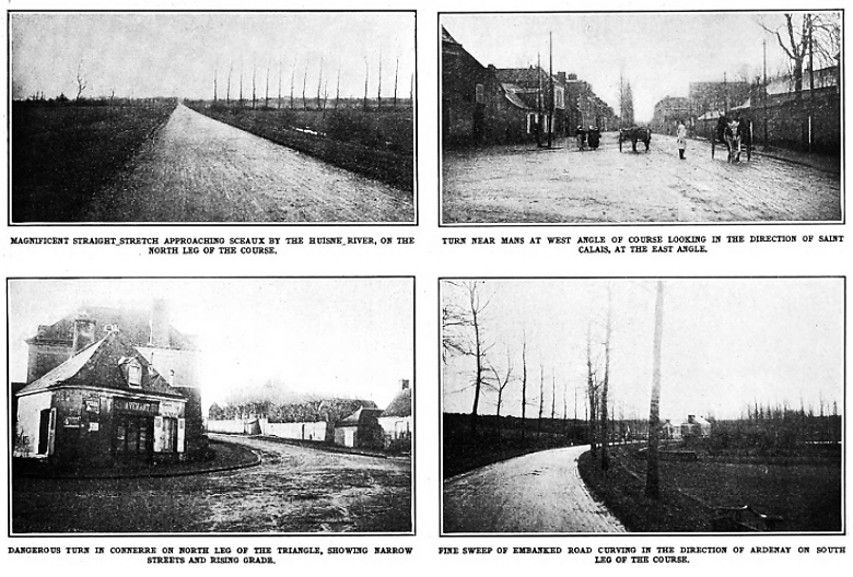
In view of the possibility of American starters, the distinctive features of this race may be pointed out, in order that cars totally unfitted for the circuit may not be sent over, as was the case in the last European race in which the United States was represented. French builders, who know the circuit “as they know their own pockets” – as the native idiom has it – appear to have decided on 110 to 120 horsepower as the force re quired to get round the circuit in the least possible time. Exceedingly fast cars, with low center of gravity, are being constructed, for the twenty miles straightaway level runs will allow of the highest speeds.
Cooling apparatus is receiving special attention, and extra large fuel tanks are being fitted in order that there may be few or no stops for refilling tanks. Special provision will be made on the French racers for carrying spare tires; in some cases an increase of wheelbase is given in order to give carrying room.
Further, the driver and his assistant must be both expert mechanics and skillful tire repairers, for no one but the two engaged to drive the car will be allowed to approach it for any reason whatever from start to finish. Although the circuit for the most part consists of straight stretches of road, there are a few difficult turns, and foreign teams should therefore arrive on the ground sufficiently early to leave ample time for practicing on the course.
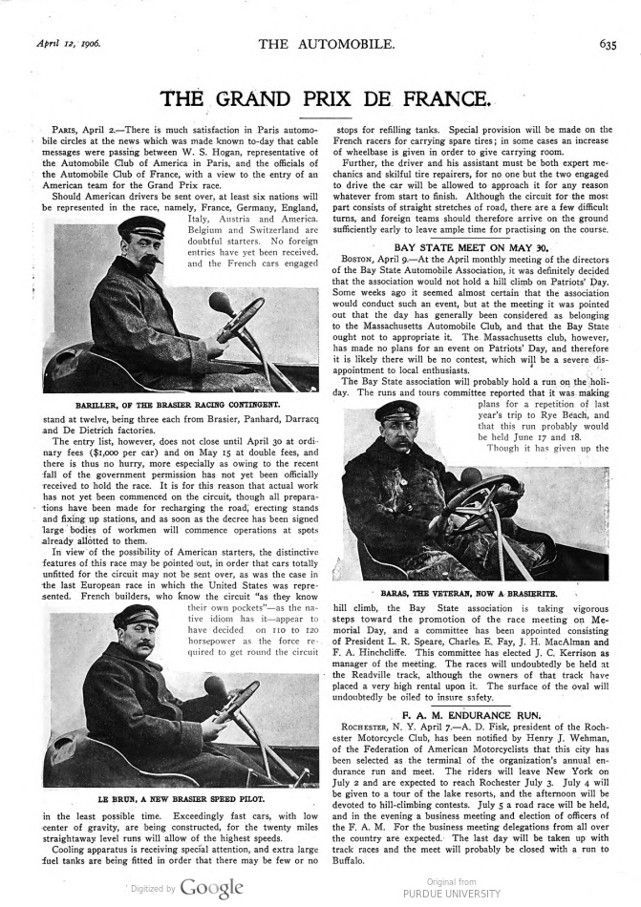
Photos. Page 635.
BARILLER, OF THE BRASIER RACING CONTINGENT. -//- LE BRUN, A NEW BRASIER SPEED PILOT -//- BARAS, THE VETERAN, NOW A BRASIERITE.