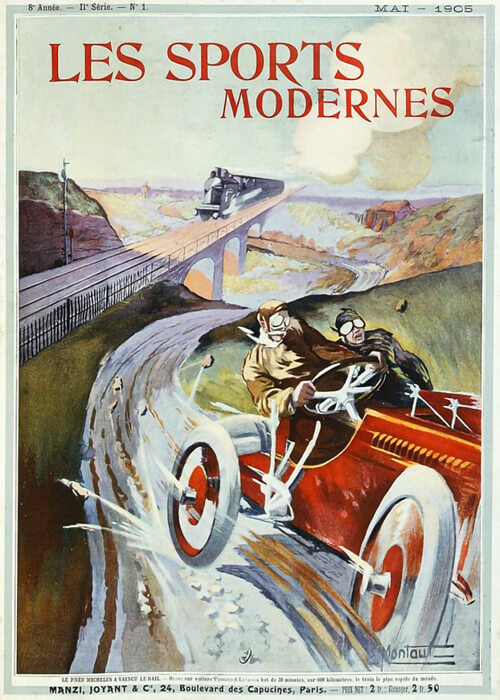
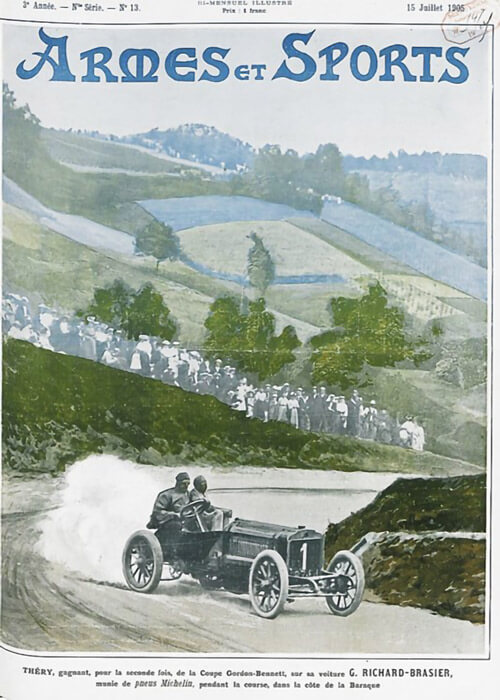
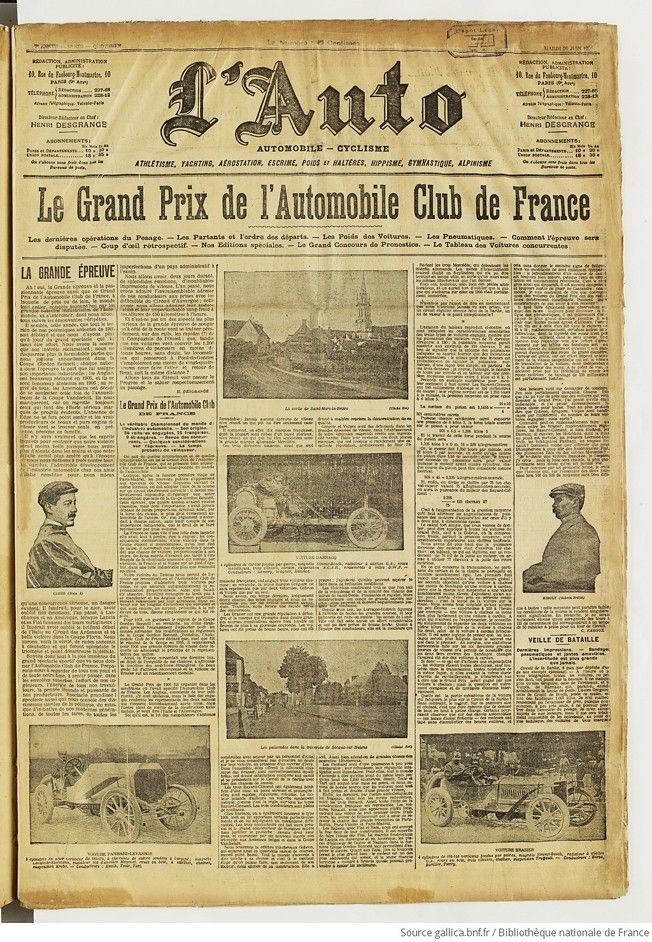
In those days, L’Auto was one of the, if not thé leading daily newspapers that reported on almost all sport events, but especially regarding “Automobilisme et Cyclisme”. Here, one of the many issues on the 1906 French and first Grand Prix at the circuit de la Sarthe near Le Mans. No one less than Henri Desgrange, the Directeur-Rédacteur en Chef himself, writes the introduction on the race. Charles Faroux follows suit with the main report, first some history and then describing specifications of the participating cars. A principal calculation example on how engine power can be estimated on bore x stroke dimensions completes that. Only page 1 of the 26 June issue of l’Auto is shown here to limit the contents of one website-page. Page 2 of the issue will be separately posted.
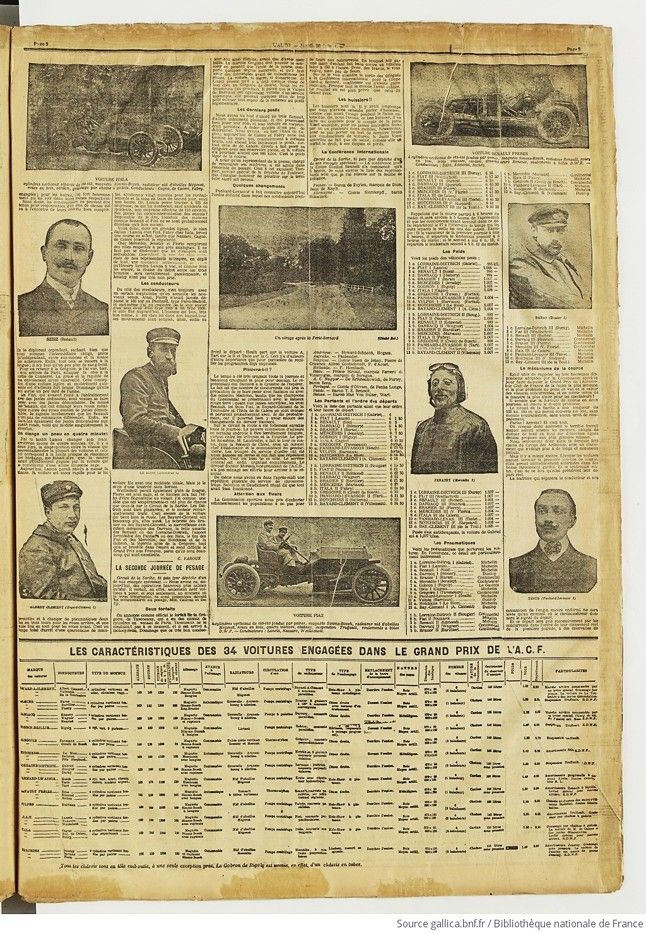

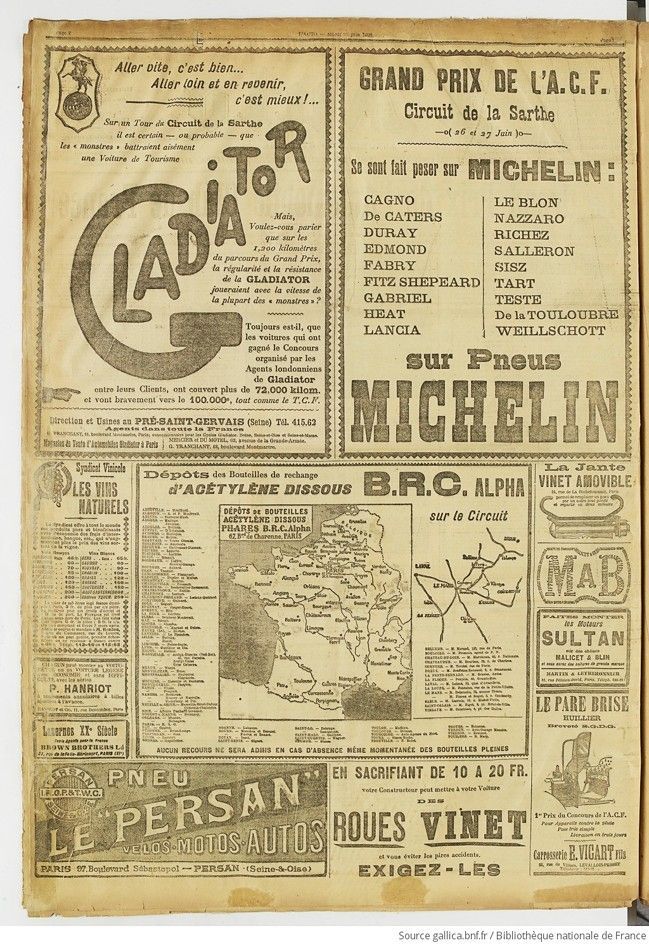
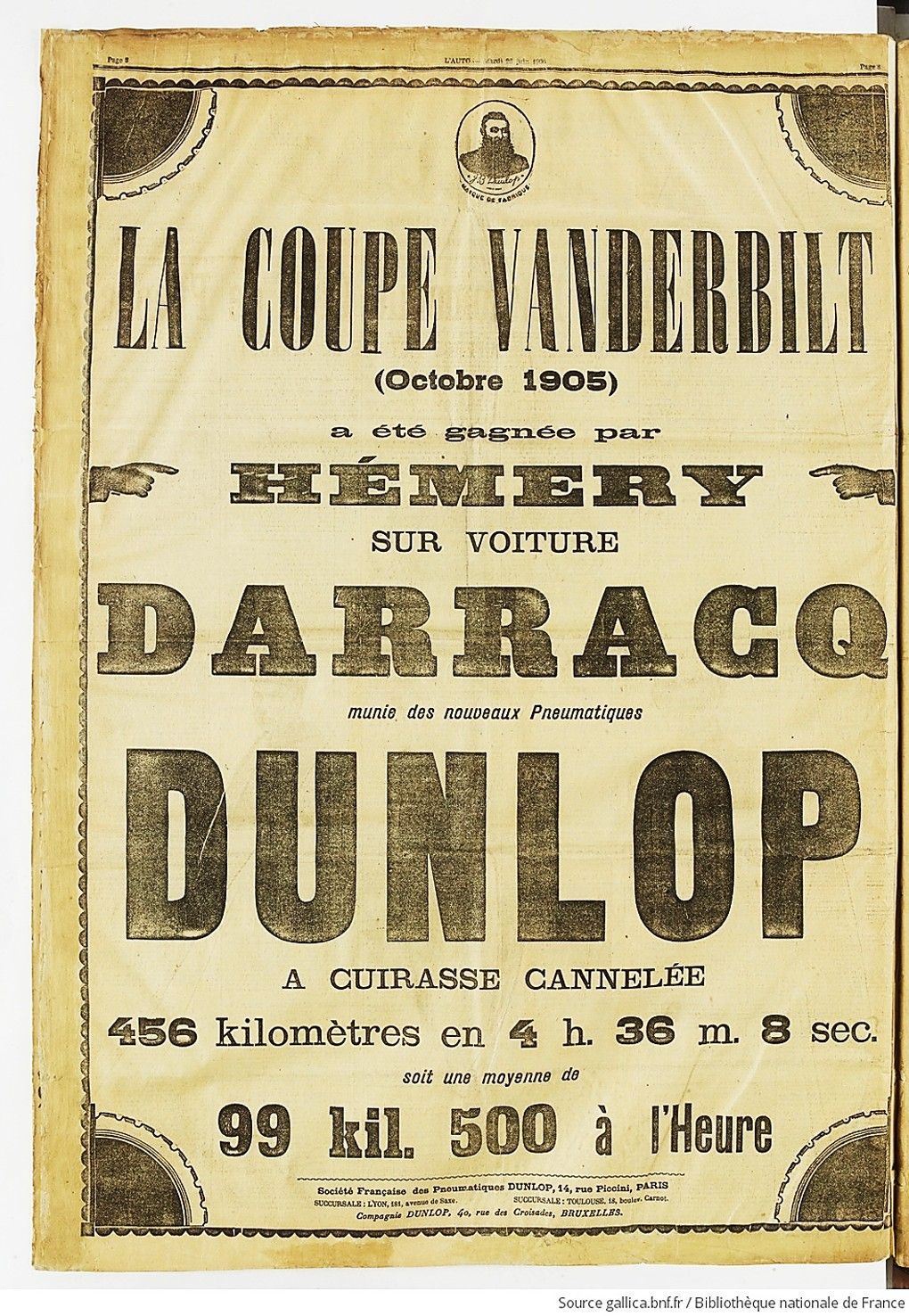
With permission of the Bibliothèque national francais gallica.bnf.fr
Text and photos compiled by motorracinghistory, Translation by DeepL deepl.com
L’Auto — 7e Year, No. 2079, Tuesday, June 26, 1906, PAGE 1
The Grand Prix of the Automobile Club of France
Final Weigh-In Procedures. — The Entrants and Starting Order. — Car Weights. — Tires. — How the Race Will Be Conducted. — A Look Back. — Our Special Editions. — The Grand Prediction Contest. — List of Competing Cars
THE GREAT RACE
Ah, yes, the Great Race—and what a thrilling event this Grand Prix of the Automobile Club of France is! The entire world, now captivated by the great industrial battles in the automotive industry, will take an interest in it, whether from near or far, and we will all follow its exciting twists and turns.
It seems that this year, all the ground for our heated controversies of 1905 has been cleared, and that all that remains is for us to enjoy the great spectacle that is about to be presented to us. We have the race that our interests demanded; we will no longer risk the formidable contest we used to play out annually in the Gordon Bennett Cup; each nation has in the event the role assigned to it by its industrial stature; the British demanded a great deal in 1905, and they held back considerably in 1906; much to everyone’s regret, the Americans have decided to settle this time for the annual lesson of the Vanderbilt Cup. We will miss them, for one always regrets the absence of those who make serious efforts marked by obvious progress. Edge’s absence will not be felt, and the true producers of beautiful, pure racing machines will find themselves alone in the competition, almost like family. Only the anxious-minded would argue that our victory would be less impressive simply because we hold more cards in our hands, or that our defeat would be more bitter than when we were fighting three against all. Moreover, the remarkable growth of the automotive industry among our Italian friends represents for us more than just serious competition—it is a clear danger. To deny this, one would have to have forgotten our emotions last year at Laschamps and in America, when Lancia and Fiat were pulling off dizzying feats; one would have to have forgotten Italy’s brilliant debut at the Circuit des Ardennes and its fine victory in the Florio Cup. The truth is, we will have formidable enemies to face—enemies who will make triumph splendid and defeat far from disastrous.
Let us, then, give ourselves over entirely to the immense joy of the great sporting spectacle that the Automobile Club de France is about to present to us. Let us prepare to watch with all our eyes and with all our souls, to feel, in those superb bursts of speed, the effort of our engineers, the energy of all our workers, and the fertile and powerful vision of our manufacturers.
A magnificent spectacle! A spectacle, too, that—heaven knows—offers solace from the fruitless debates of politics, from the lack of initiative among our modern generations, and from all the flaws and imperfections of a country that is overly bureaucratic. For two days, we will experience splendid thrills and unforgettable sensations of speed. Last year, we marveled at the incredible skill of our drivers as they tackled the challenges of the Auvergne Circuit; this year, we will marvel at their calm daring and their unshakable composure as they race at speeds of 150 kilometers per hour.
And isn’t one of the most curious aspects of this great event to think that, right alongside the road, the “express” (?) trains of the Compagnie de l’Ouest will be trudging laboriously along the tracks; that, while our cars will cover the 1,200 kilometers of the route in less than twelve hours, no doubt, the locomotives passing through Pont-de-Gennes will take no less than twenty-four hours to make the round trip from Brest—the same distance?
Let’s all go to the Circuit to watch “Progrès” pass by and respectfully salute it as it goes.
H. DESGRANGE
——————-
The Grand Prix of the Automobile Club of France
The true world championship of the automotive industry. — Its origins. — 34 cars entered, 25 French, 9 foreign. — A look at the competitors. — Some thoughts on the race. — The winner’s probable time.
We know the circumstances and considerations that gave rise to the Grand Prix of the Automobile Club of France, which today stands as the true world championship of automobile racing.
When, after the disastrous first stage of the Paris-Madrid race, the authorities opposed speed races held under the same format, it became necessary to adopt the idea of a race on a closely monitored circuit; it became practically impossible to organize any competition other than the Gordon Bennett Cup. This event, which four years had made a classic but whose importance had never exceeded reasonable proportions, thus became, by necessity, the biggest automotive event of the year. However, its rules granted each nation—regardless of its industrial importance—only the right to be represented by three cars. France quickly grew weary of a contest in which it had everything to lose and nothing to gain; the commercial consequences of a victory in the Cup were so considerable that, in any case, it was only fair that each nation have a chance of winning proportional to what was at stake for it. Shrewd observers were quick to notice the glaring anomaly that placed, for example, France and Switzerland on an equal footing in a contest that was more industrial than truly sporting.
Our victory at the Taunus allowed us to voice these demands, and the Automobile Club de France proposed admitting three cars per manufacturer, which automatically ensured proportional representation. As was to be expected, hostility from abroad soon became apparent, and the English were particularly notable for their acrimony. Without revisiting the lengthy discussions that followed—which, moreover, are still fresh in everyone’s memory—let us simply state what was resolved.
For 1905, the Gordon Bennett Cup rules would remain in effect; however, the foreign clubs undertook to make changes to the Gordon Bennett Cup regulations for the following years. Nevertheless, the Automobile Club de France declared that, regardless of the outcome of the Cup in 1905, it would organize a major speed race for 1906 in which the principle of manufacturer representation would be adopted.
Thus, France agreed one last time—despite the unequal odds—to take on the coalition of foreign ambitions. This noble gesture was, moreover, rewarded, and Brasier’s victory made headlines around the world.
X
The 1906 Grand Prix was organized in accordance with the conditions specified by the Automobile Club de France. The British, aware of their inferiority, chose not to participate, but the list of entrants includes representatives from the two nations that follow immediately after us in the ideal ranking of automotive excellence—that is, Italy and Germany. As it stands, the field of competitors promises to be formidable; no other speed race has ever brought together a field that could even be compared to it.
It includes, in fact, ten French brands, most of which boast a glorious history; none of them can be compared to it—except perhaps the great German brand Mercedes.
These last three manufacturers, along with seven French ones, have entered three cars each; in contrast, the young Grégoire brand will be represented by only two vehicles, while Gobron and Vulpès by just one.
We have, in recent days, described each of the entered models at length and will not revisit these purely technical details. However, we will provide a brief overview of the competitors.
The Brasiers have a great reputation to uphold, and the brand that triumphed in four consecutive major races certainly hopes to add yet another jewel to its glorious crown. The cars were prepared well in advance; they were built with care by an elite team, and I would not advise you to doubt their victory—especially in the presence of a worker from Ivry. Overall, they feature the classic Brasier silhouette, are wonderfully balanced, performed flawlessly in testing, and arrive at the Circuit de la Sarthe with excellent chances of success.
The three Bayard-Cléments have also undergone thorough and extensive fine-tuning: they are fast, consistent, and robust. The engine, moreover, boasts superb performance, as is the norm for all Bayard-Clément models. The three drivers are brimming with confidence.
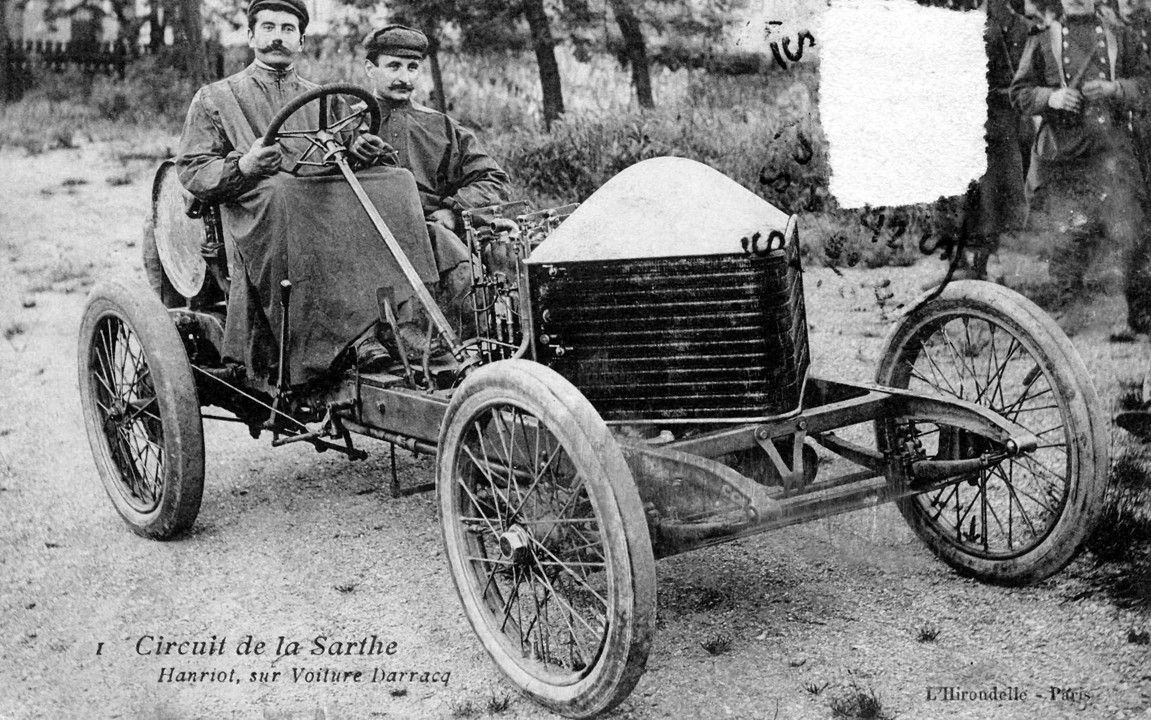
At Darracq, the 1905 model has also been retained, while incorporating certain improvements and adding a differential mechanism. The three drivers have proven themselves, and the major manufacturer from Suresnes certainly hopes to live up to the proverb: All good things come in threes, and to crown its triumphs in the Belgian Ardennes and the Vanderbilt Cup with yet another victory.
We’ll once again see the famous 110-chevaux Gobron, which is thus entering its fourth racing season, a record by no means trivial. Everyone agrees that it has a good chance, and that is the highest praise one can give—not only for its engine but also for its construction. It has repeatedly demonstrated its quality
Grégoir and Vulpès are newcomers to major speed events, but the design of their respective vehicles reveals bold ingenuity. In all modesty, these two young brands—which have so quickly earned an excellent reputation—aim to finish the race; I would add that they can hope to do so under brilliant conditions.
The Hotchkiss cars confirm everything we know about the sturdiness and quality of the chassis from the Saint-Denis factories. Powerful and fast, their manufacturers have pinned great hopes on them: they can and must consistently live up to that trust.
For the past three years, the Lorraine-Diétrichs have crossed the finish line in every major race, and their record is rich in successes: the Lunéville factory has made a considerable effort this year and was able to get everything ready in good time. As for the team of drivers, it is the best there is. Consequently, great things are expected from the new 130-horsepower models. The Panhards are roughly comparable in power; their sturdiness and tireless reliability are legendary. As for them, everyone agrees that they will maintain the same pace all the way to the end of the 1,200-kilometer race; Heath, Teste, and Tart have fine-tuned them, and we know from a reliable source that the cars are fully ready and capable of high speeds. Finally, last in alphabetical order among the French contingent, but by no means the least formidable, are the three Renaults. Thus, the entire elite of French automotive manufacturing is represented. The Renault cars, despite their rather frail appearance, conceal first-rate quality. Moreover, the Billancourt factories are determined to resume the string of great triumphs in the Paris-Berlin, Paris-Vienna, and Paris-Madrid races,
The Italians, with Fiat and Itala, have sent us the cream of their engineering. It goes without saying that the Fiats deserve high praise. Lancia’s meteoric rise in Auvergne and America, along with Cagno and Nazzaro’s top finishes in the most recent Gordon Bennett Cup, give them reason to hope for success. As for the Italas, I have always held them in the highest regard: the engine is one of the most appealing around, and the young Turin-based brand demonstrated in Brescia that it can compete with the very best.
That leaves the three Mercedes, which will represent Germany. The Interlinkheim (Untertürckheim, GrocerJack) factories had been developing a 6-cylinder engine that could not be completed in time, so they are racing with the same 120-horsepower engines as last year.
They have, however, undergone many minor improvements, and it would be wrong to forget that the bad luck that plagued them in 1905 was completely undeserved.
Wasn’t I right to say at the outset that we would never have seen such an exceptionally talented field competing on a standard circuit like the Circuit de la Sarthe?
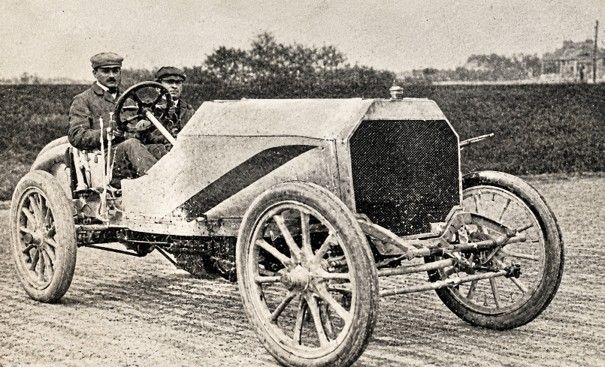
A review of the key specifications of the thirteen types of cars entered shows that engine power ranges from 75 chevaux (Grégoire) to 130; the average power appears to be around 110 chevaux. It is worth noting that the power figures listed can only provide approximate values: it is probably best for our readers to calculate the power themselves, in a very simple way, using these three pieces of data: stroke, bore, and revolutions per minute, and assuming an average pressure between 6 kilograms and 6.5 kilograms.
Let’s take a numerical example to show how to do this. The Bayard-Clément engines have a bore of 160 millimeters and a stroke of 160 millimeters; their normal speed is 1,350 revolutions per minute, and the average pressure is taken to be 6.5 kilograms.
The piston area is 3.1416 × (16 × 16) / 4 = 201 square centimeters.
Since each square centimeter withstands a pressure of 6.5 kilograms, the total force exerted on the piston is 201 × 6.5 = 1.306,5 kilograms
And the work done by this force during the piston’s stroke will be 1.306 kilograms × 0.16 meters = 209 kilogram-meters.
Now, the engine rotates at 1.350 revolutions per minute, or 22.5 revolutions per second, so that one piston stroke lasts 1/45 of a second; therefore, the work per second—or power—will be (since the engine has four cylinders, each piston stroke can be considered to contribute to power).
209 × 45 = 9.395 kilogram-meters per second.
Finally, if we divide this figure by 75 (since one horsepower equals 75 kilogram-meters per second), we obtain the power of the Bayard-Clément engine: 9.395 / 75 = 125.27 hp.
It is the increase in mean pressure that accounts for the increase in power of today’s engines compared to those of two years ago, assuming the same dimensions. The very simple calculation we have just provided can be applied to all Grand Prix cars, except for the Gobron, where the cold compression—and thus the mean pressure—are significantly higher than the usual figures.
We mentioned earlier that the average power output of the engines was approximately 110 h.p.; assuming—as is reasonable—a transmission efficiency of 70 0/0 from the wheel rim to the engine, this results in 77 h.p. being delivered to the rims of the drive wheels.
As for the drivetrain, supporters of the cardan shaft and the chain are divided into roughly equal numbers. The former argue for an increase in overall efficiency; the latter counter that a chain-driven car wears out its tires less than a cardan-driven car, because the unsprung load is significantly lower. I would add that another point deserves serious consideration: the car’s handling on the road. We have all observed that at somewhat high speeds—above 120 per hour, for example—a chain-driven car handles much more easily than a cardan-driven car. To those who haven’t had the chance to experience this, I would simply advise observing the two vehicles at high speed: the rear of the chain-driven car travels in a straight line, while that of the cardan-driven car wobbles. It stands to reason that the tires will wear out more quickly in the latter case than in the former. Furthermore, my own statistics from the last six major speed races show that about two-thirds of the tires replaced were on cars with a cardan shaft.
So if—which, incidentally, is impossible—all the cars were identical, except for their drivetrains, and all were driven in the same way, and if they had the same pit stop durations, I would not hesitate to say that the Grand Prix would be won by a chain-driven car; but the issue is far more complex, and many factors come into play
Which mechanical component of the car will suffer the most wear and tear on the Circuit de la Sarthe? Without a doubt, the engine. On this easy, flowing course, running at full throttle from start to finish is a grueling ordeal. Some might point out that on motorboats—those floating test benches—engines have run continuously for hours on end without showing the slightest sign of fatigue. But the conditions are by no means comparable: cooling for a motorboat engine is always well assured, since the circulating water is constantly renewed. That eliminates the biggest concern. It is often dangerous and always pointless to play the role of Cassandra; nevertheless, I am compelled to say that some of the Grand Prix cars have notoriously inadequate radiators. May their manufacturers not have to regret it! A note should also be made regarding the wheels: to minimize tire wear, it is advisable to use the largest possible diameter. It is clear that, all other things being equal, the wear on a 920 is to that of an 820 as 82 is to 92; unfortunately, certain other considerations—not least of which is the lightness of the wheels—work against this. A widespread misconception holds that the tear force on the tire beads is directly proportional to the diameter and that, therefore, it is dangerous to use large-diameter wheels. This is a serious error, since this force depends solely on the tangential velocity—which is the vehicle’s forward speed—and is thus independent of the size of the wheels. From this perspective, the decision made by Hotchkiss to equip the drive wheels with 135-millimeter tires is perfectly justified.
X
My readers will ask me to draw a conclusion. I am completely unable to do so. Every time I’ve been able to get a close look at one of the cars competing in the Grand Prix, I’ve thought it was unbeatable… and I’ve thought the same thing about each one in turn. At most, one might say that Gobron, Grégoire, and Vulpès are at a disadvantage due to the smaller number of cars they’ve entered; but so what?
How can one reasonably choose between the Brasier cars, with their relentless consistency; the Bayard-Clément cars, so well-engineered; the Darracq cars, so fast; the Hotchkiss cars, perfectly tuned; the sturdy Lorraine-Diétrich cars; the tireless Panhard cars; and the agile Renault cars? How can anyone even dare to claim that we will surely triumph over the lightning-fast Fiats, the powerful Italas, or the solid Mercedes?
I’m rooting for a French victory; I hope for it, I believe in it… but the competition will be fierce—undoubtedly the most thrilling we’ve ever seen.
To conclude with a firm prediction, I believe that the driver who averages 102 or 103 over the two days combined will be very hard to beat: this average may seem low, but the race conditions make it particularly significant. On the other hand, I wouldn’t be at all surprised if we saw laps averaging 125, which would correspond to a pace of barely 50 minutes per lap of the circuit.
C. FAROUX
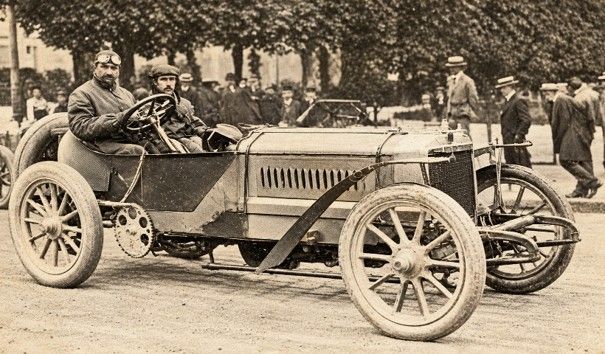
Photos page 1.
CAGNO (Itala I) – RIGOLY (Gobron-Brillié)
The exit from Saint-Mars-la-Brière (Photo by Rol)
The barriers at the Sceaux-sur-Huisne crossing (Photo by Rol)
PANHARD-LEVASSOR CAR
Vertical 6-cylinder 185-175 steel engine with silver-brazed copper liners; Lavalette-Eisemann magneto, Mégevet honeycomb radiator, wooden wheels, 4-speed transmission, chains, Krebs suspension. – Drivers: Heath, Teste, Tart.
DARRACQ CAR
Four 180-150 engines paired in sets, Sïmms-Bosch magneto, G.A. finned radiator, metal wheels, three-speed transmission, cardan shaft, A.C.A.R. suspension, D.W.F. ball bearings — Drivers: Hémery, Wagner, Hanriot.
BRASIER CAR
Two vertical 165-140 cc cylinders cast in pairs, Sïmms-Bosch magneto, G.A. finned radiator, wooden wheels, three-speed transmission, chains, Truffault suspension. — Drivers: Bars, Barillier, Pierrey.“