In 1908, three Targa Florio related races were organised. On May 18, the Targa Florio was run on the Large Madonie circuit; won by Vincenzo Trucco in an Isotta-Fraschini. On September 6, the Coppa Florio and a day later, the Coppa del Velocità, both on the Circuito di Bologna. The latter, won by Jean Porporato in a Berliet, is reported here.

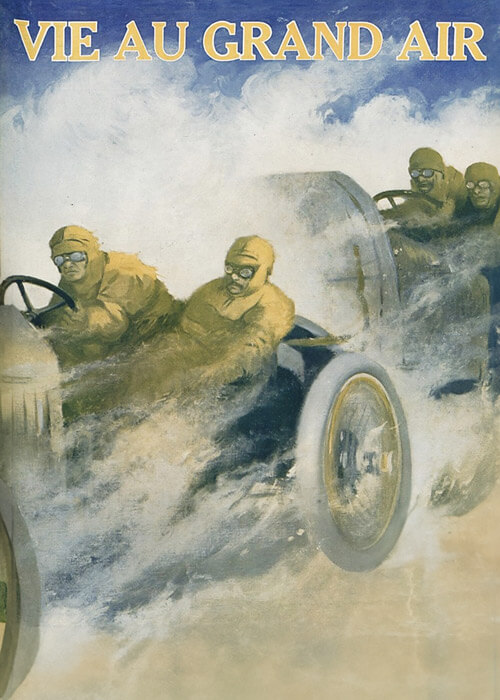
La Via au Grand Air. gallica.bnf.fr
By courtesy of hathitrust.org www.hathitrust.org, Text and jpegs compiled by motorracinghistory.
THE AUTOMOBILE Vol. XIX, No. 13, September 24, 1908
PORPORATO SCORES VICTORY IN TARGA BOLOGNA
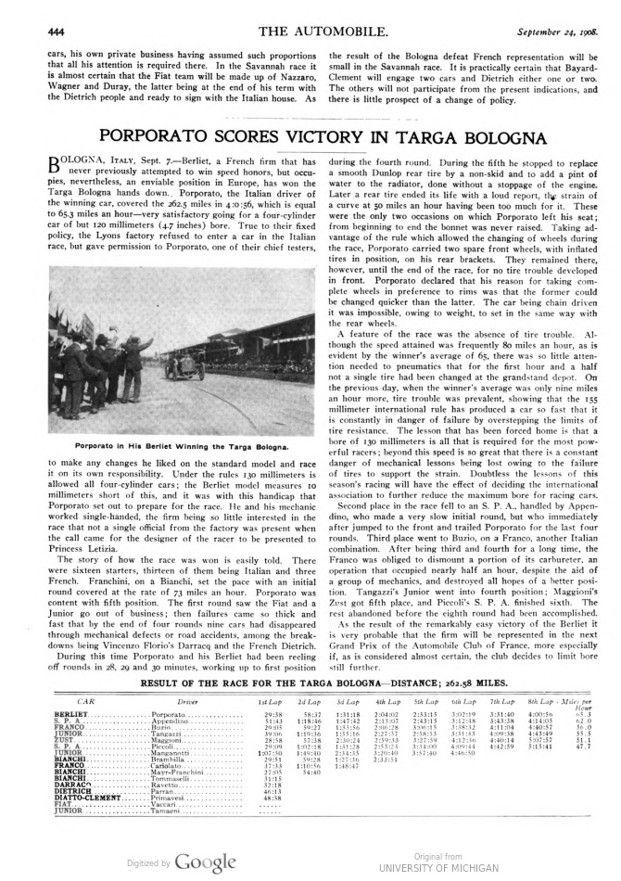
BOLOGNA, ITALY, Sept. 7. – Berliet, a French firm that has never previously attempted to win speed honors, but occupies, nevertheless, an enviable position in Europe, has won the Targa Bologna hands down. Porporato, the Italian driver of the winning car, covered the 262.5 miles in 4:0:56, which is equal to 65.3 miles an hour-very satisfactory going for a four-cylinder car of but 120 millimeters (4.7 inches) bore. True to their fixed policy, the Lyons factory refused to enter a car in the Italian race, but gave permission to Porporato, one of their chief testers, to make any changes he liked on the standard model and race it on its own responsibility. Under the rules 130 millimeters is allowed all four-cylinder cars; the Berliet model measures 10 millimeters short of this, and it was with this handicap that Porporato set out to prepare for the race. He and his mechanic worked single-handed, the firm being so little interested in the race that not a single official from the factory was present when the call came for the designer of the racer to be presented to Princess Letizia.
The story of how the race was won is easily told. There were sixteen starters, thirteen of them being Italian and three French. Franchini, on a Bianchi, set the pace with an initial round covered at the rate of 73 miles an hour. Porporato was content with fifth position. The first round saw the Fiat and a Junior go out of business; then failures came so thick and fast that by the end of four rounds nine cars had disappeared through mechanical defects or road accidents, among the breakdowns being Vincenzo Florio’s Darracq and the French Dietrich.
During this time Porporato and his Berliet had been reeling off rounds in 28, 29 and 30 minutes, working up to first position during the fourth round. During the fifth he stopped to replace a smooth Dunlop rear tire by a non-skid and to add a pint of water to the radiator, done without a stoppage of the engine. Later a rear tire ended its life with a loud report, the strain of a curve at 50 miles an hour having been too much for it. These were the only two occasions on which Porporato left his seat; from beginning to end the bonnet was never raised. Taking advantage of the rule which allowed the changing of wheels during the race, Porporato carried two spare front wheels, with inflated tires in position, on his rear brackets. They remained there, however, until the end of the race, for no tire trouble developed in front. Porporato declared that his reason for taking complete wheels in preference to rims was that the former could be changed quicker than the latter. The car being chain driven it was impossible, owing to weight, to set in the same way with the rear wheels.
A feature of the race was the absence of tire trouble. Although the speed attained was frequently 80 miles an hour, as is evident by the winner’s average of 65, there was so little attention needed to pneumatics that for the first hour and a half not a single tire had been changed at the grandstand depot. On the previous day, when the winner’s average was only nine miles an hour more, tire trouble was prevalent, showing that the 155 millimeter international rule has produced a car so fast that it is constantly in danger of failure by overstepping the limits of tire resistance. The lesson that has been forced home is that a bore of 130 millimeters is all that is required for the most powerful racers; beyond this speed is so great that there is a constant danger of mechanical lessons being lost owing to the failure of tires to support the strain. Doubtless the lessons of this season’s racing will have the effect of deciding the international association to further reduce the maximum bore for racing cars. Second place in the race fell to an S. P. A., handled by Appen- dino, who made a very slow initial round, but who immediately after jumped to the front and trailed Porporato for the last four rounds. Third place went to Buzio, on a Franco, another Italian combination. After being third and fourth for a long time, the Franco was obliged to dismount a portion of its carbureter, an operation that occupied nearly half an hour, despite the aid of a group of mechanics, and destroyed all hopes of a better position. Tangazzi’s Junior went into fourth position; Maggioni’s Zust got fifth place, and Piccoli’s S. P. A. finished sixth. The rest abandoned before the eighth round had been accomplished.
As the result of the remarkably easy victory of the Berliet it is very probable that the firm will be represented in the next Grand Prix of the Automobile Club of France, more especially if, as is considered almost certain, the club decides to limit bore still further.
Photos.
Page 444: Porporato in His Berliet Winning the Targa Bologna. – RESULT OF THE RACE FOR THE TARGA BOLOGNA — DISTANCE; 262.58 MILES.