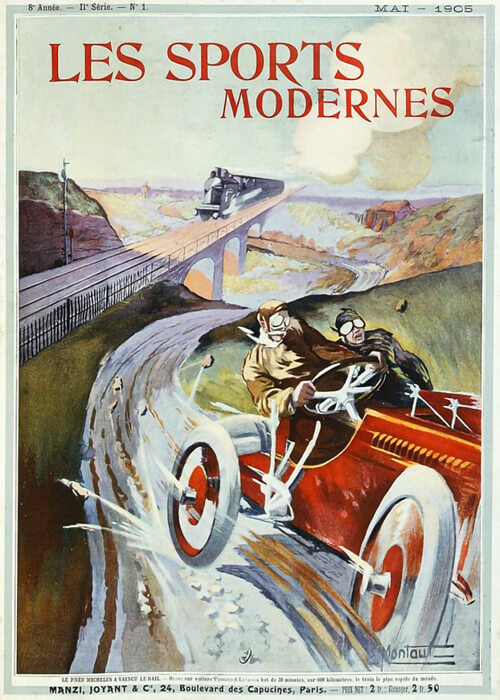
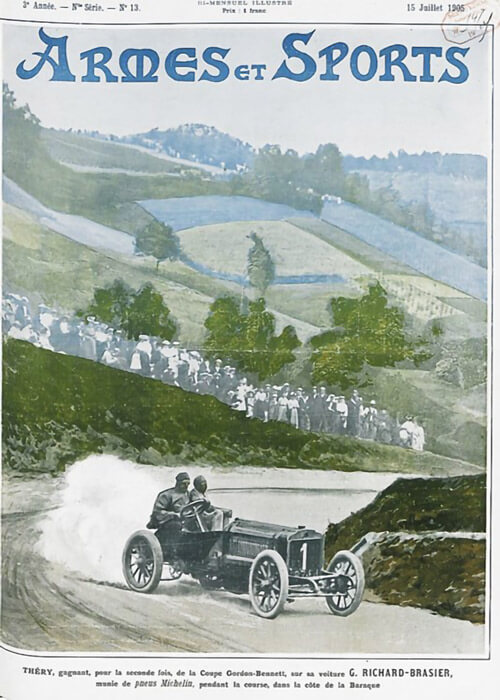
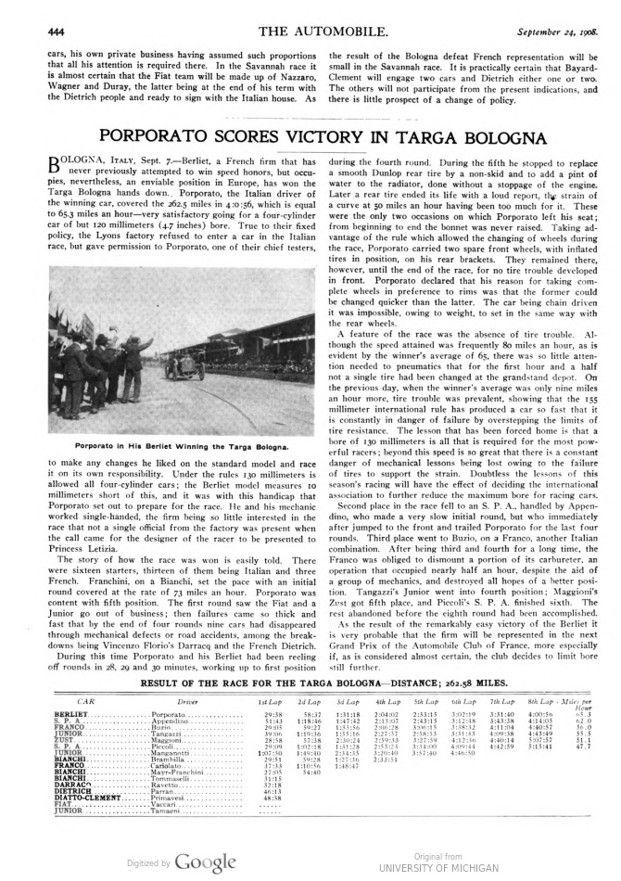
In 1908, three Targa Florio related races were organised. On May 18, the Targa Florio was run on the Large Madonie circuit; won by Vincenzo Trucco in an Isotta-Fraschini. On September 6, the Coppa Florio and a day later, the Coppa del Velocità, both on the Circuito da Bologna. The Coppa Florio is reported here.


By courtesy of hathitrust.org www.hathitrust.org, Text and jpegs compiled by motorracinghistory.
THE AUTOMOBILE Vol. XIX, No. 13, September 24, 1908
HOW NAZZARO BROKE RECORD IN THE TARGA FLORIO
BY W.F. Bradley
BOLOGNA, ITALY, Sept. 6. – Felice Nazzaro has abundantly proved that the setbacks of the opening part of the were but a temporary clouding of his brilliant career. By this Sunday morning’s performance on the flat course in the neighborhood of the old-world town of Bologna he has won the Florio Cup and the Coppa d’Italia for Fiat, the Cup of the Automobile Club of Genoa and the Targa Florio for himself. In addition to the quadrette of cups and the bag of gold to which he is entitled, Nazzaro has the satisfaction of beating all existing records for long-distance speed on roads. The 328.2 miles were covered to-day in 4:25:21, which is at the rate of 74.3 miles an hour. The previous record was 70.61 miles an hour, also established by Nazzaro, in the Grand Prix of 1906.

Not only was the race the fastest ever run, but it was one of the most interesting and keenly disputed that Europe has known. There were seventeen starters, representing two Italian firms and four French, all using the special 155-millimeter bore cars built for and run in the Grand Prix at Dieppe. Germany having kept out of the affair, the race resolved itself into a dual between the Fiats and Italas, which had failed to make a good exhibition in the earlier race, and the Lorraine-Dietrich, Bayard-Clement, Mors and Motobloc – all French – which had failed to hold the French trophy for the land of the tricolor. In their own exaggerated language, each was for “revenge”; it was Italy that finally got it, after a magnificent fight.
Duray, as irrepressible as ever, first shot over the line on his big blue Dietrich, regarded as a stout cham- pion for France. Gauderman, driving a Motobloc, failed to evoke a cheer, the best that was expected of him being a regularity display. Demogeot, the big cool-headed driver of the Mors, carrying No. 3, had plenty of partisans, though it was known that his car was two or three miles an hour slower than some of the others. Lancia, of course, evoked a roaring cheer as his Fiat shot away, followed a minute later by Gabriel on the Bayard-Clement, generally admitted to be the fastest car of the whole group. Cagno took No. 6, Itala; Minoia the No. 7, Dietrich, and Charles Faroux, ex-trolley car motorman in Milwaukee, at present Parisian journalist, took the wheel of No. 8, Motobloc – it was his first appearance in a pure speed test. After Garcet had gone on the second of the Mors cars, Nazzaro raised the cheer of the day when he and his Fiat started on the run of three hundred odd miles at a terrific pace.
Hautvast and his exceptionally long- stroke Bayard-Clement were looked upon by the French just as likely to win as the Italian favorite Nazzaro. Henry Fournier steered the Itala which had been tuned up to a slightly higher speed since the Dieppe race. Trucco, the Italian, took the last Dietrich, Landon the last Mors, and Wagner the French ex-Darracq champion had the third Fiat. America had her only representative in Elliot F. Shepard, driving No. 16 Bayard-Clement, which had been handed over to him but a couple of weeks before owing to an accident to Rigal. The American had the lightest car of the team and the heaviest mechanic, a man who on account of his enormous size and weight had naturally to be dubbed “Baby.” Piacenza closed the march with the third of the patriotically-named Italas, and then the race was on in good earnest.
Less than half an hour after the start, Duray had roared by again on his Dietrich, the time which was hoisted up on the board a minute later being 24:55 1-5, which for the 32-mile course works out at the merest fraction under 80 miles an hour. Lancia got ahead of both Gauderman and Demogeot on the first round, scoring 24:16, or just over 80 miles an hour. Gabriel maintained his position behind the Fiat and had just roared by when Gauderman’s failure to appear in position was explained by his arrival with the left front tire and rim missing. He stated that the rim, which was a new Vinet with some modification which had not been previously tested, had flown off on the straightaway. He was able to hold the car to the road, but had to retire immediately, for the fixed rim was flattened beyond repair.
The accident caused comment, for it was feared that there was going to be a repetition of the Dieppe rim accidents, against which, however, careful advance provision had been made. It was probably owing to this fear of rim failure that numerous changes had been made since the Dieppe race. The Michelin people had slightly modified their rim by the addition of a raised section opposite the valve, and a special pin to prevent the single locking turnbuckle getting out of vertical. It proved successful, not a single accident or mishap occurring. The Dunlop rim found a place on the rear wheels of several of the cars, but no driver would accept it for the front, the opinion being that it was too heavy, and that its powerful lock threw the wheel out of balance sufficiently to interfere with the steadiness of the car at highest speeds.
Minoia furnished the highest rate of speed on the initial round, his Dietrich getting round in 24:15 2-5 – over 80 miles an hour. Lancia came next, followed by Wagner, Gabriel, Duray and Elliot F. Shepard. Hautvast, the American’s teammate, failed to make the initial round with No. 11 Bayard-Clement. His own explanation was that the steel-studded tires refused to hold when he applied the brakes to make one of the right-angle turns. He skidded as if he were on soap, had to choose between the spectators and the ditch and went into the latter, his car broken, but without a scratch to himself or mechanic. Charles Faroux was unable to finish the initial round, one of the universals between the gearbox and the countershaft having developed weaknesses during the first ten miles.
Lancia jumped into second position during the second round, getting over the course in the record time of 23:24, or at the killing pace of 84.3. It delighted the spectators, nine-tenths of whom were Italians, and the sight was really terribly impressive, for the speed past the grandstand, on a perfect straightaway, with a very slight down grade, must have been close on go miles an hour. Wagner got second position, followed at three minutes by Henry Fournier, who had jumped in one round from ninth place. Nazzaro was maintaining a steady pace in fourth position, while Elliot F. Shepard was at the end of the list with Landon of the Mors team to keep him company in the same class.
Henry Fournier made a fine struggle with Lancia during the third and fourth rounds. On passing the grandstand at the end of the second round the Italian had a lead on the Frenchman of a fraction over three minutes. By the end of the second round Lancia and his Fiat had increased the distance from the Itala by exactly one minute. Fournier, however, was hard after him, and by some of the most dashing driving ever seen got past the Fiat and won first place. His triumph, however, did not last long enough to be officially recorded, for on arriving at the last bend before the grandstand straightaway he went into the ditch but a yard from Hautvast’s Bayard-Clement. Fournier was certainly going too fast; he failed to notice the slow sign until he was immediately under it, and was then handicapped by a cloud of dust raised by Cagno, who was just ahead. He thought he had got clear round, when the left rear wheel slipped off into the ditch, and it was all over. Fournier was slightly cut about the mouth and had bruises on various parts of the body; his mechanic escaped with just as little injury.
Duray on the Dietrich and Piacenza on the Itala had both failed to appear after the first round. The fate of the latter was not known until the end of the meet, when he drove in and explained that a disarrangement of the timing gears had obliged him to dismount the lower half of the crank case.

Source: heritage-print.com; mediastorehouse.co.uk

Source: heritage-print.com; mediastorehouse.co.uk
The mystery about Duray was explained, just when Nazzaro had worked into first position, by the slow arrival of Wagner’s Fiat with Duray and Mechanic hanging on behind. In the white jersey decorated with the Lorraine cross Duray had a portion of an exhaust valve which told the story of his undoing. One of the exhaust valves had broken, dropped into the cylinder and quickly done damage that was beyond a roadside repair. Wagner was also entirely out of the running, with a front axle that had broken exactly through the middle. It was an unusual mishap, that might have been due to crystallization or to an unusually severe shock when passing over a lump on the road, the car going up and dropping down on one wheel. The axle really looked as if it had been cut through with a hacksaw. Wagner made a temporary repair with a log of wood and a few lengths of rope.
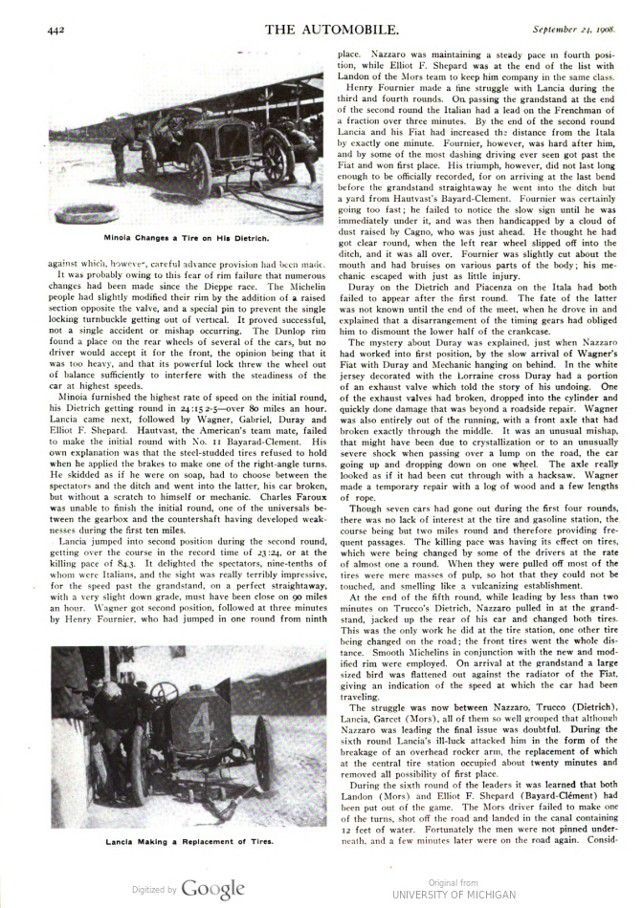
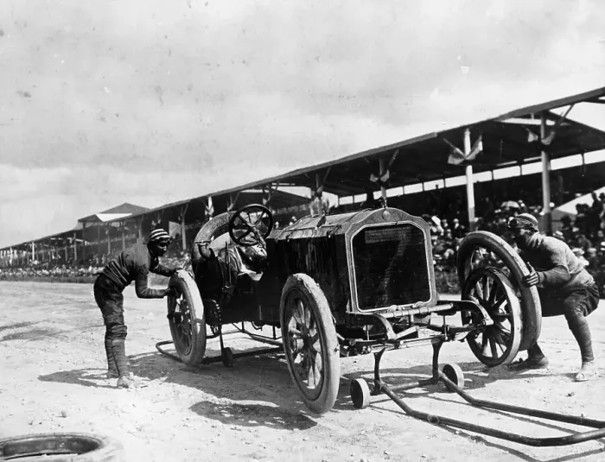
Though seven cars had gone out during the first four rounds, there was no lack of interest at the tire and gasoline station, the course being but two miles round and therefore providing frequent passages. The killing pace was having its effect on tires, which were being changed by some of the drivers at the rate of almost one a round. When they were pulled off most of the tires were mere masses of pulp, so hot that they could not be touched, and smelling like a vulcanizing establishment.
Duray on the Dietrich and Piacenza on the Itala had both failed to appear after the first round. The fate of the latter was not known until the end of the meet, when he drove in and explained that a disarrangement of the timing gears had obliged him to dismount the lower half of the crank case.
The mystery about Duray was explained, just when Nazzaro had worked into first position, by the slow arrival of Wagner’s Fiat with Duray and Mechanic hanging on behind. In the white jersey decorated with the Lorraine cross Duray had a portion of an exhaust valve which told the story of his undoing. One of the exhaust valves had broken, dropped into the cylinder and quickly done damage that was beyond a roadside repair. Wagner was also entirely out of the running, with a front axle that had broken exactly through the middle. It was an unusual mishap, that might have been due to crystallization or to an unusually severe shock when passing over a lump on the road, the car going up and dropping down on one wheel. The axle really looked as if it had been cut through with a hacksaw. Wagner made a temporary repair with a log of wood and a few lengths of rope.
Though seven cars had gone out during the first four rounds, there was no lack of interest at the tire and gasoline station, the course being but two miles round and therefore providing frequent passages. The killing pace was having its effect on tires, which were being changed by some of the drivers at the rate of almost one a round. When they were pulled off most of the tires were mere masses of pulp, so hot that they could not be touched, and smelling like a vulcanizing establishment.
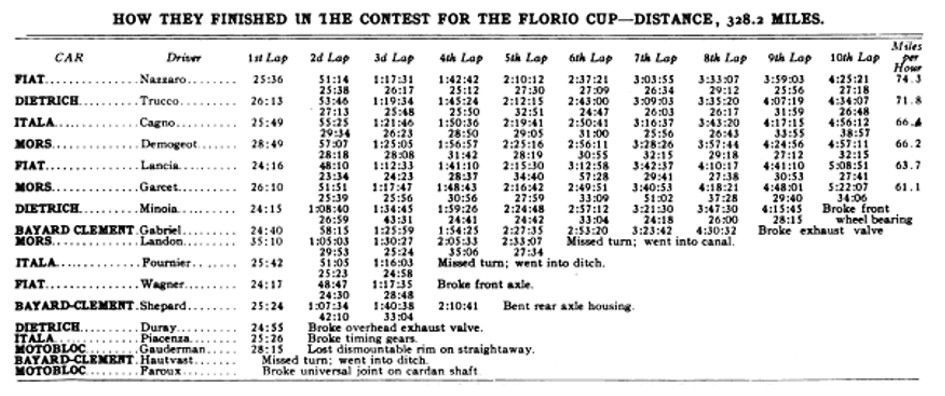
When the red No. 1o roared by on the last round, with victory certain for Nazzaro barring accidents, the cannon boomed and the grandstand got ready for a rousing reception. They were not disappointed, for 27 minutes later, with a margin of nine minutes in his favor, Nazzaro was the winner of the Florio cup, disputed for the third time. With one voice the grandstand roared: It was more than a national victory, it was the triumph of the favorite. Five minutes later the car had been run into the official garage, Nazzaro had spent half a minute in the ambulance tent to have the dust wiped out of his eyes and was being conducted across the road for the official presentation to the Princess Laetetia. This man, who had been driving at more than seventy miles an hour for over four hours, was as clean as on the morning he presented his dainty-looking car for the official inspection. While Nazzaro had been making sure of first place there had been a keen struggle between Cagno (Itala) and Minoia (Dietrich) for third position, second place already being assured to Trucco. The Dietrich would certainly have got third in addition to second place, but for the collapse of one of the front wheel bearings, on a curve ten miles from the finishing point. This gave Cagno his chance, and the Itala finished third, followed by Demogeot on the Mors at one minute’s interval. Lancia came in fifth and Garcet on Mors sixth. Had the race been five miles longer, Demogeot would certainly have got third place, for the Itala which beat him had one of the rear dumb irons broken off, sending the axle adrift, and lost all its water after standing a few minutes in front of the station. The result of the race was thus as follows:
Fiat, Nazzaro 4.25.21 Average 74.3 miles
Dietrich, Trucco 4.34.7 Average 71.8 miles
Itala, Cagno 4.56.12 Average 66.4 miles
Mors, Demogeot 4.57.11
Fiat, Lancia 5.08.51 Average 63.7 miles
Mors, Garcet 5.22.7 Average 61.1 miles

Though no troops were employed on the course, order was perfect with the exception of a slight incident at the end. After the arrival of the second car the crowd invaded the course and half a dozen cyclists-cycles are as common as macaroni in Bologne-mounted their machines for a quick run home. Duray, who had been a spectator since his accident, sent forth a war whoop, seized the first cyclist, knocked him to the ground and flung his machine into the Dietrich gasoline station. Somebody from the top of the tire stands flung down an empty wooden box on the heads of the invaders, the committeemen acted vigorously, for a racing car might have appeared at any moment, and in a few minutes the road was clear again. There was none of the grandstand decoration that characterized Dieppe, but there were few points of the organization which could be criticized. The tarring of the road was especially well done.
Contrary to what had been generally published, Nazzaro has no intention of abandoning the racing game at the end of the season. His marriage with a Turin lady is announced for next spring, but this will not cause him to abandon racing. Lancia, on the other hand, will cease to figure at the wheel of racing cars, his own private business having assumed such proportions that all his attention is required there. In the Savannah race it is almost certain that the Fiat team will be made up of Nazzaro,
Wagner and Duray, the latter being at the end of his term with the Dietrich people and ready to sign with the Italian house. As the result of the Bologna defeat French representation will be small in the Savannah race. It is practically certain that Bayard-Clement will engage two cars and Dietrich either one or two. The others will not participate from the present indications, and there is little prospect of a change of policy.
Photos.
Page 441. Nazzaro Halts in Front of the Grand Stand to Confer with Officials. – The Big Official Score Board and the Crowd in Front of It.
Page 442. Minoia Changes a Tire on His Dietrich. – Lancia Making a Replacement of Tires.
Page 443. HOW THEY FINISHED IN THE CONTEST FOR THE FLORIO CUP-DISTANCE, 328.2 MILES. – Map of the Course and Its Varying Elevations.