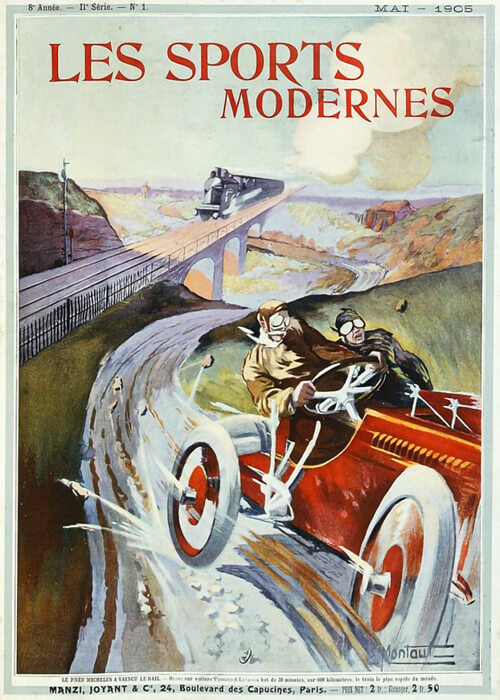
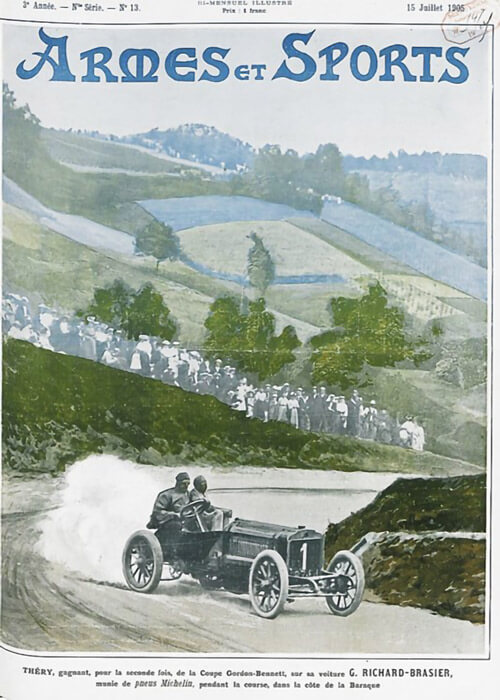
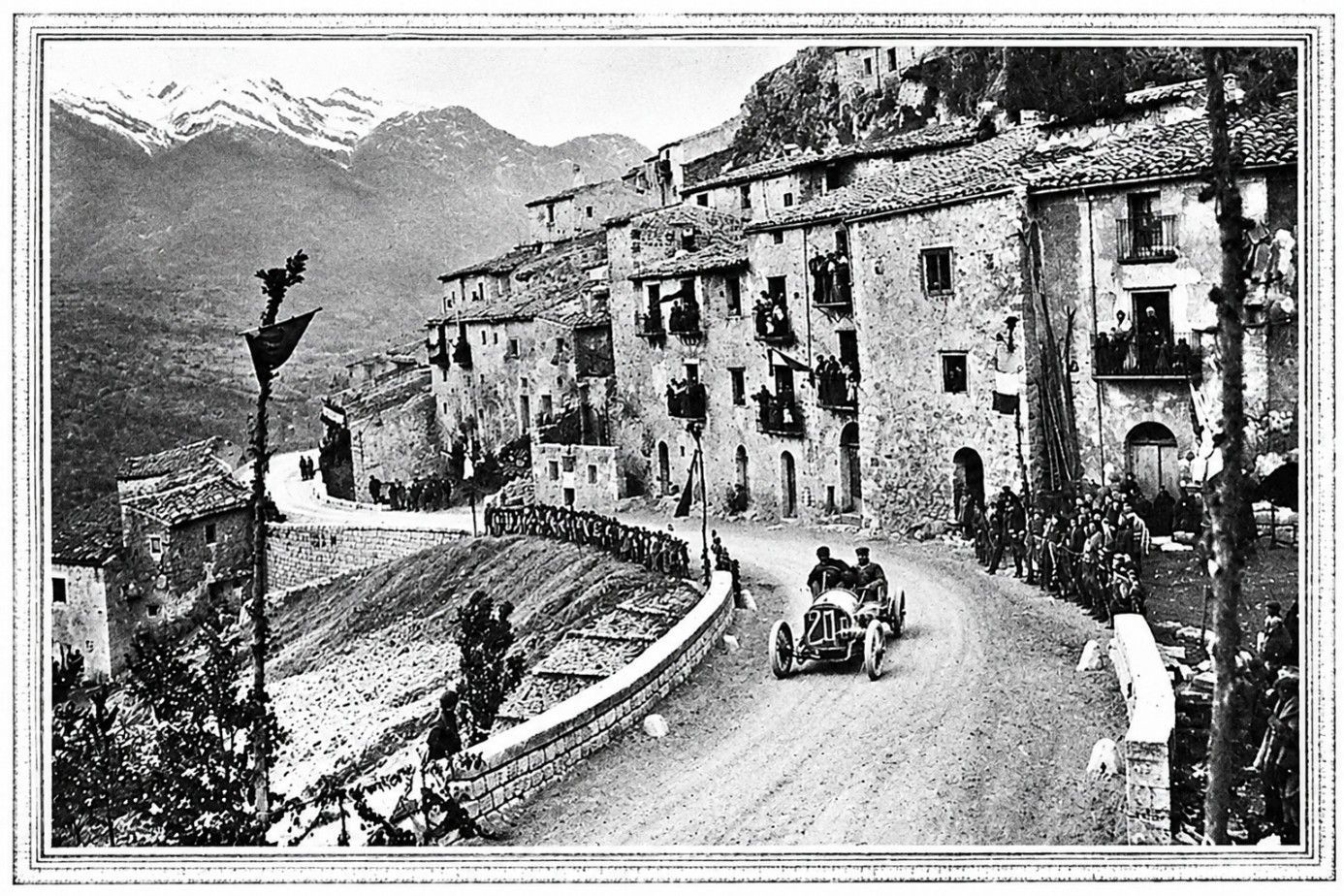
Some of the most beautiful pictures of early Targa Florio racing that capture the whole spirit of the Sicilian landscape and villages, are shown in this article. In this second Targa, it was the 1907 champ Felice Nazzaro in a Fiat who won. Some weeks later, he was to win the German Kaiser price, and then the Grand Prix de l’A.C.F too; a spendid year for this campione Italiana. If motorracing in those days would have something of a “Grand Slam”, he’d be one of the first to claim this title.

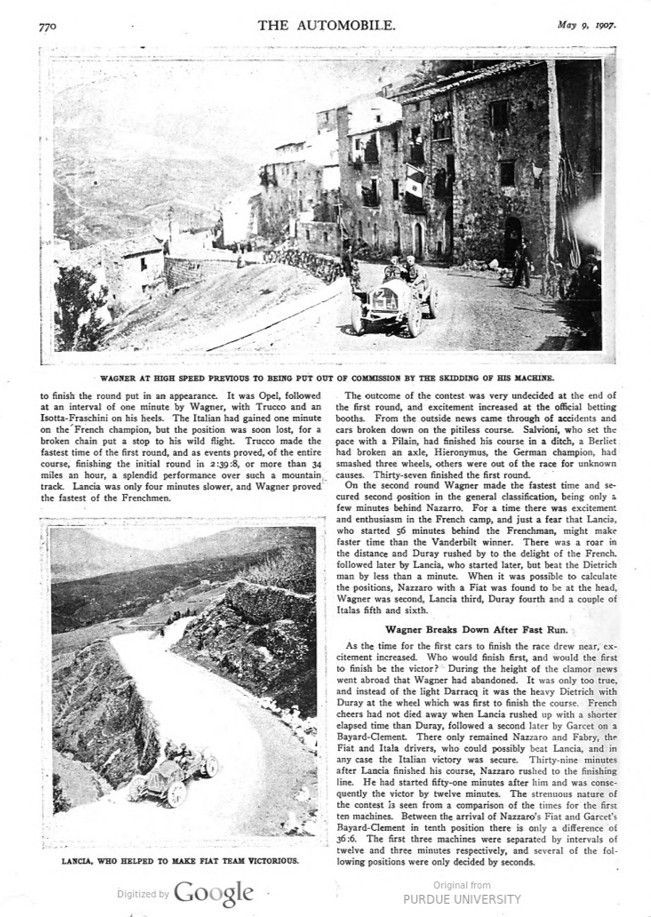

By courtesy of hathitrust.org www.hathitrust.org, Text and jpegs compiled by motorracinghistory.
THE AUTOMOBILE Vol. XVI, No. 19, May 9, 1907
HOW NAZZARO WON THE TARGA TORIO
PALERMO, April 25. – Italy is victorious. Of the first ten cars to finish this hard-fought fight seven are Italian and three French. First, second and third positions have been secured by the newcomers to automobiling; France takes fourth, sixth and tenth positions. Nazarro on a Fiat is the victor, at an average speed of 33.45 miles an hour, with Lancia on the same make of machine twelve minutes later and Fabry’s Itala in third position.
After three or four days of rain the morning opened with a bright sky and gentle Sicilian breezes which wafted the aroma of citron and orange trees from the distance. Exactly at 5 o’clock Salvioni, an Italian piloting a French Pilain stripped touring machine went over the line amid the excited chattering of an Italian crowd encouraged by a cheer from the strong Franco element. Three times round a mountainous course, starting from the level of the sea and mounting up to giddy heights over one thousand meters above, with grades that stand up like walls, and descents that test the most powerful brakes. It is the thousand-bend course, for of the 92.47 miles forming the circuit there is only one stretch that can lay claim to be a straightaway run, and there are portions of the circuit where the road winds about on itself in the most intricate and perplexing manner. Three times round gives a total distance of 277.4 miles.
Opel, on an Opel machine, followed the leader; Wagner was just behind him, getting away with a rush and a roar, the fastest of the lot. Lancia was about in the middle of the forty-six; Gauderman on a Bayard-Clement had the position that Albert Clement would have occupied had not the military martinets de- clared that he should not leave his barracks. Hémery was at the wheel of a Deluca-Daimler, an English-Italian combination. An Isotta Fraschini, Italian construction, De Dietrich design, closed the list of competitors, forty-six in number.
Hardly had the last machine passed out of sight than the first to finish the round put in an appearance. It was Opel, followed at an interval of one minute by Wagner, with Trucco and an Isotta-Fraschini on his heels. The Italian had gained one minute on the French champion, but the position was soon lost, for a broken chain put a stop to his wild flight. Trucco made the fastest time of the first round, and as events proved, of the entire course, finishing the initial round in 2:39:8, or more than 34 miles an hour, a splendid performance over such a mountain track. Lancia was only four minutes slower, and Wagner proved the fastest of the Frenchmen.
The outcome of the contest was very undecided at the end of the first round, and excitement increased at the official betting booths. From the outside news came through of accidents and cars broken down on the pitiless course. Salvioni, who set the pace with a Pilain, had finished his course in a ditch, a Berliet had broken an axle, Hieronymus, the German champion, had smashed three wheels, others were out of the race for unknown causes. Thirty-seven finished the first round.
On the second round Wagner made the fastest time and secured second position in the general classification, being only a few minutes behind Nazarro. For a time there was excitement and enthusiasm in the French camp, and just a fear that Lancia, who started 56 minutes behind the Frenchman, might make faster time than the Vanderbilt winner. There was a roar in the distance and Duray rushed by to the delight of the French. followed later by Lancia, who started later, but beat the Dietrich man by less than a minute. When it was possible to calculate the positions, Nazzaro with a Fiat was found to be at the head, Wagner was second, Lancia third, Duray fourth and a couple of Italas fifth and sixth.
Wagner Breaks Down After Fast Run.
As the time for the first cars to finish the race drew near, excitement increased. Who would finish first, and would the first to finish be the victor? During the height of the clamor news went abroad that Wagner had abandoned. It was only too true, and instead of the light Darracq it was the heavy Dietrich with Duray at the wheel which was first to finish the course. French cheers had not died away when Lancia rushed up with a shorter elapsed time than Duray, followed a second later by Garcet on a Bayard-Clement.
There only remained Nazzaro and Fabry, the Fiat and Itala drivers, who could possibly beat Lancia, and in any case the Italian victory was secure. Thirty-nine minutes after Lancia finished his course, Nazzaro rushed to the finishing line. He had started fifty-one minutes after him and was consequently the victor by twelve minutes. The strenuous nature of the contest is seen from a comparison of the times for the first ten machines. Between the arrival of Nazzaro’s Fiat and Garcet’s Bayard-Clement in tenth position there is only a difference of 36:6. The first three machines were separated by intervals of twelve and three minutes respectively, and several of the following positions were only decided by seconds.

Fiat had a most remarkable victory, for Lancia, Nazzaro and Weillschott were all among the first ten. Itala and Lorraine- Dietrich each had two with this select circle. The French, while admitting their defeat, point out that the two Isotta-Fraschini are really French machines being built in Italy under Lorraine-Dietrich designs.
Nazzaro, who in addition to the Targa, will pocket the first prize of $3,000 in cash, was second in the last Gordon Bennett contest, in which Théry reached the pinnacle of his glory, and was second last year in the French Grand Prix, being beaten then by Szisz on a Renault, but defeating Albert Clement after the most exciting neck-and-neck races ever known. “Now we are ready for the Grand Prix,” declare the Italians. “So are we,” riposte the French.
Official Positions at Finish of the Targa Florio. H. M. S.
1. Nazzaro, Fiat (Italy), Michelin dismountable rims. 8 17 36 – Average, 33.45 miles an hour.
2. Lancia, Fiat (Italy), Michelin tires. 8 29 29
3. Fabry, Itala (Italy), Michelin tires. 8 32 40
4. Duray, Lorraine-Dietrich (France). 8 39 7
5. Cagno, Itala (Italy). 8 39 16
6. Gabriel, Lorraine-Dietrich (France). 8 39 46
7. Tamagni, Isotta-Fraschini (Italy). 8 41 45
8. Weillschott, Fiat (Italy). 8 42 52
9. Sorel, Isotta-Fraschini (Italy). 8 52 0
10. Garcet, Bayard-A. Clément (France). 8 53 14
11. Minoia, Isotta-Fraschini (Italy). 8 53 19
12. Maggioni, Züst (Germany). 9 0 7
13. Ison, Deluca-Daimler (Italy). 9 1 22
14. Dureste, Gobron (France). 9 10 24
15. Erle, Benz (Germany). 9 11 15
16. Gremo, Junior (Italy). 9 13 38
17. Spamann, Benz (Germany). 9 15 56
18. Buzio, Diatto-Clément (Italy). 9 20 5
19. Gauderman, Bayard-A. Clément (France). 9 29 4
20. Hubertot, Deluca-Daimler (Italy). 9 32 20
21. Collinet, Bayard-A. Clément (France). 9 38 25
22. Gallina, Rapid (Italy). 9 50 10
23. De Bojario, Benz (Germany). 9 52 40
24. Hémery, Deluca-Daimler (Italy). 10 16 20
25. Capuggi, Züst (Germany). 10 32 30
26. Gasté, Radia (France). 10 33 25
27. Faure, Gobron (France). 11 17 25
28. Pizzagalli, Pilain (France). 11 21 53
Mechanical defects put very few machines out of the race, most of those not present at the finish being the victims of accidents due to the wild nature of the course. Wagner, who at the end of the second round appeared a certain winner, was forced to abandon, owing to his car skidding. His companion Hanriot was put out of commission in a similar manner. Both the Berliet machines skidded, smashing their wheels and breaking axles. Garcet, who was terribly fast on his Bayard-Clément, and looked certain for third place at one time, lost this position through a tire tearing off and his carbureter choking with dust.


Photos left to right: HIERONYMUS, A GERMAN VICTIM OF THE PITILESS COURSE. – FABRY AND HIS ITALA ON A ROAD IN THE MOUNTAIN WILDNESS AROUND PETRALIA SOTTANI. – LANCIA, WHO HELPED TO MAKE FIAT TEAM VICTORIOUS.
Photos.
Page 769: NAZZARO ON HIS VICTORIOUS FIAT PASSING THROUGH PETRALIA SOTTANI ON WILD SICILIAN COURSE.
Page 770: WAGNER AT HIGH SPEED PREVIOUS TO BEING PUT OUT OF COMMISSION BY THE SKIDDING OF HIS MACHINE. – LANCIA, WHO HELPED TO MAKE FIAT TEAM VICTORIOUS.
Page 771: HIERONYMUS, A GERMAN VICTIM OF THE PITILESS COURSE. – FABRY AND HIS ITALA ON A ROAD IN THE MOUNTAIN WILDNESS AROUND PETRALIA SOTTANI.