The 1896 Paris-Marseille-Paris ran for 10 days, thereby covering some 1.700 kilometers of public roads. During the course, particpants also faced terrible weather that caused numerous crashes an breakdowns. This article in the new motor magazine The Horseless Age is one of the very long kind, taking 14 pages including twelve tables: one for each raceday and one for average speed and best speed. I’ve divided the article in two parts, this one being the second.

With permission of hathitrust hathitrust.org == Text and fotos compiled by motorracinghistory
THE HORSELESS AGE — Volume 1, No. 12, October 1896
Paris-Marseilles-Paris. (Part II)
FULL ACCOUNT OF THE GREAT TO-DAY ROAD RACE OF 1,051 MILES.
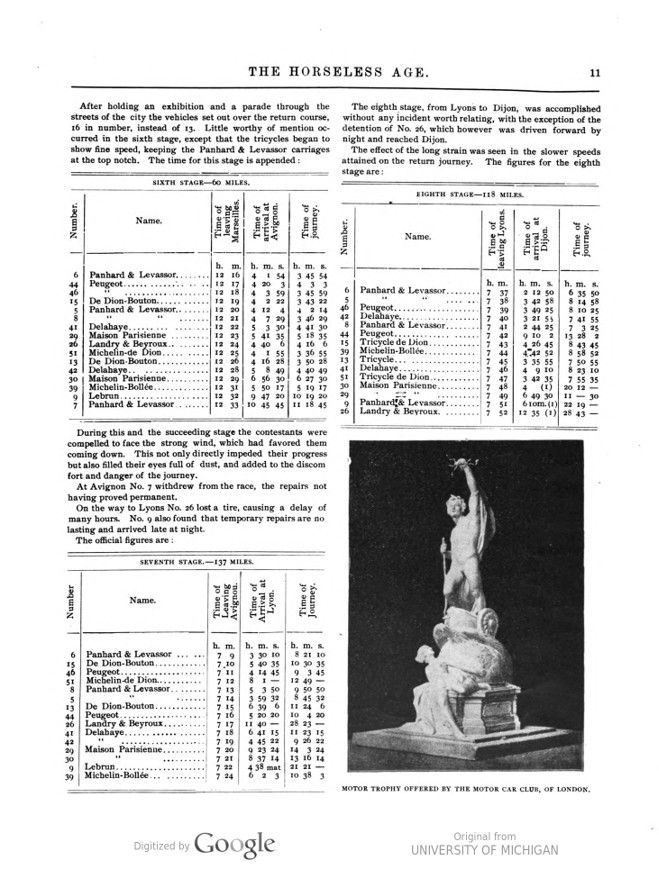
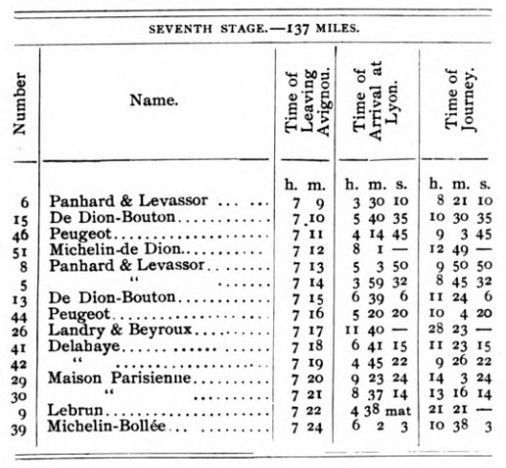
During this and the succeeding stage the contestants were compelled to face the strong wind, which had favored them coming down. This not only directly impeded their progress but also filled their eyes full of dust, and added to the discom fort and danger of the journey. At Avignon No. 7 withdrew from the race, the repairs not having proved permanent.
On the way to Lyons No. 26 lost a tire, causing a delay of many hours. No. 9 also found that temporary repairs are no lasting and arrived late at night.
The official figures are: (see further below table SEVENTH STAGE-137 MILES.)
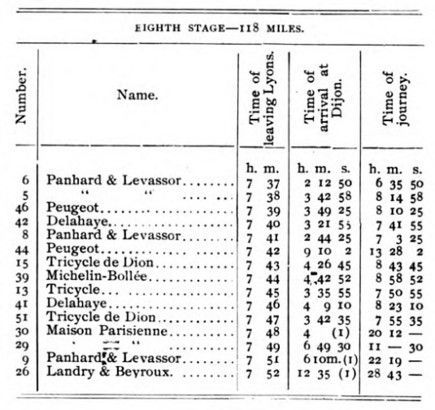
The eighth stage, from Lyons to Dijon, was accomplished without any incident worth relating, with the exception of the detention of No. 26, which however was driven forward by night and reached Dijon.
The effect of the long strain was seen in the slower speeds attained on the return journey. The figures for the eighth stage are: (see further below table EIGHTH STAGE-118 MILES.)
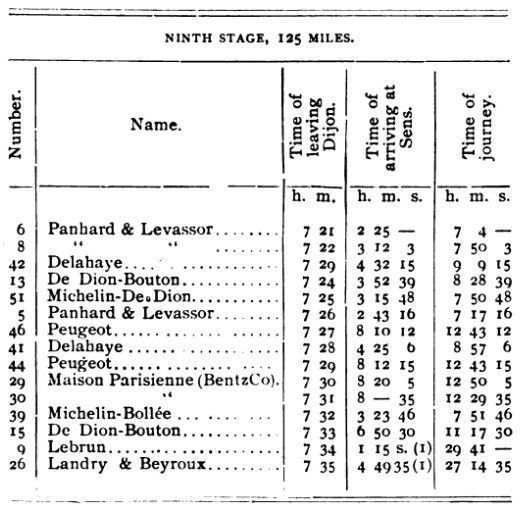
The ninth stage, instead of being from Dijon to Auxerre, like the second, extended from Dijon to Sens, 35 miles more, and as it was distinguished by perils and accidents on the outward journey, the contestants had good cause to remember it.
At 8.21 No. 6 was sent on its way, followed by the other 13 in the order of their performance during the last stage. On reaching the controle at Sens the conductor of No. 6 was presented with a magnificent bouquet.
No. 44 was proceeding finely up to the controle, when, within half a mile of it, the differential gear got out of order and caused a delay of over three hours.
No. 46 also met with a detention at Avallon, the pump having gotten out of order.
Notwithstanding their disabled condition, Nos. 26 and 9 persevered in the hope of reaching Paris without outside aid.
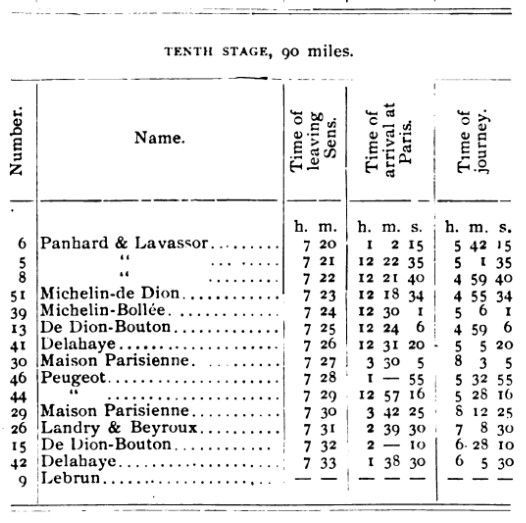
All now nerved themselves for the final stage from Sens to Paris, 90 miles. The weather was fine, and at 7.20 the word was given, No. 6 leading off, followed by Nos. 5 and 8, all Panhard & Levassor vehicles.
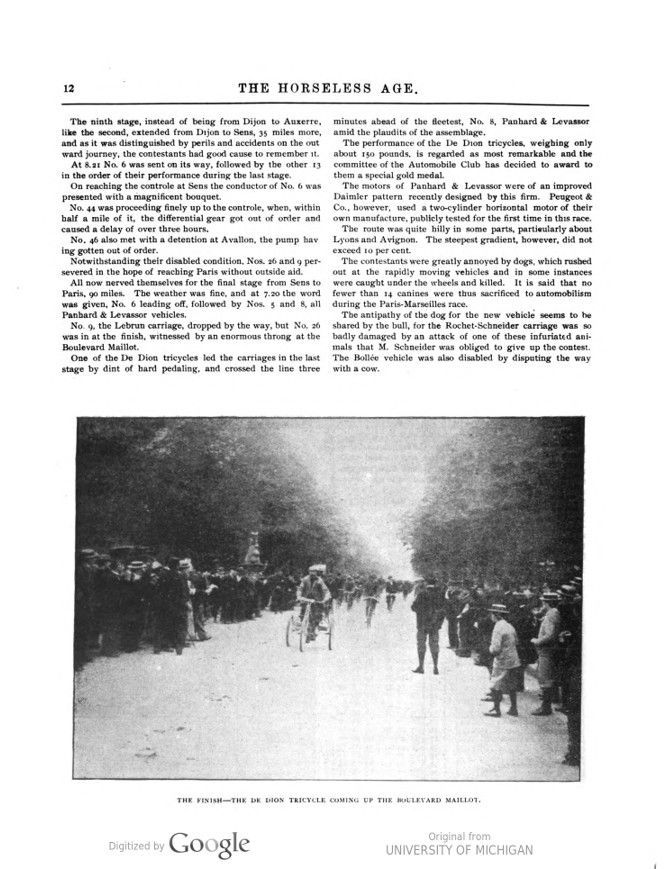
No. 9, the Lebrun carriage, dropped by the way, but No. 26 was in at the finish, witnessed by an enormous throng at the Boulevard Maillot.
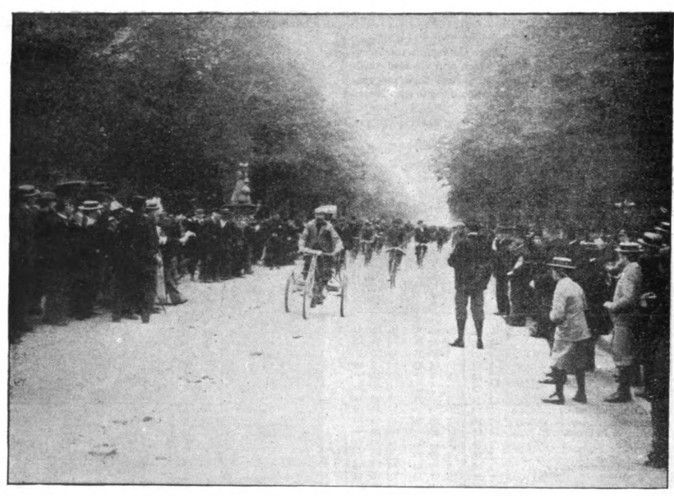
One of the De Dion tricycles led the carriages in the last stage by dint of hard pedaling, and crossed the line three minutes ahead of the fleetest, No. 8, Panhard & Levassor amid the plaudits of the assemblage.
The performance of the De Dion tricycles, weighing only about 150 pounds, is regarded as most remarkable and the committee of the Automobile Club has decided to award to them a special gold medal.
The motors of Panhard & Levassor were of an improved Daimler pattern recently designed by this firm. Peugeot & Co., however, used a two-cylinder horizontal motor of their own manufacture, publicly tested for the first time in this race.
The route was quite hilly in some parts, particularly about Lyons and Avignon. The steepest gradient, however, did not exceed 10 per cent.
The contestants were greatly annoyed by dogs, which rushed out at the rapidly moving vehicles and in some instances were caught under the wheels and killed. It is said that no fewer than 14 canines were thus sacrificed to automobilism during the Paris-Marseilles race.
The antipathy of the dog for the new vehicle seems to be shared by the bull, for the Rochet-Schneider carriage was so badly damaged by an attack of one of these infuriated animals that M. Schneider was obliged to give up the contest. The Bollée vehicle was also disabled by disputing the way with a cow.
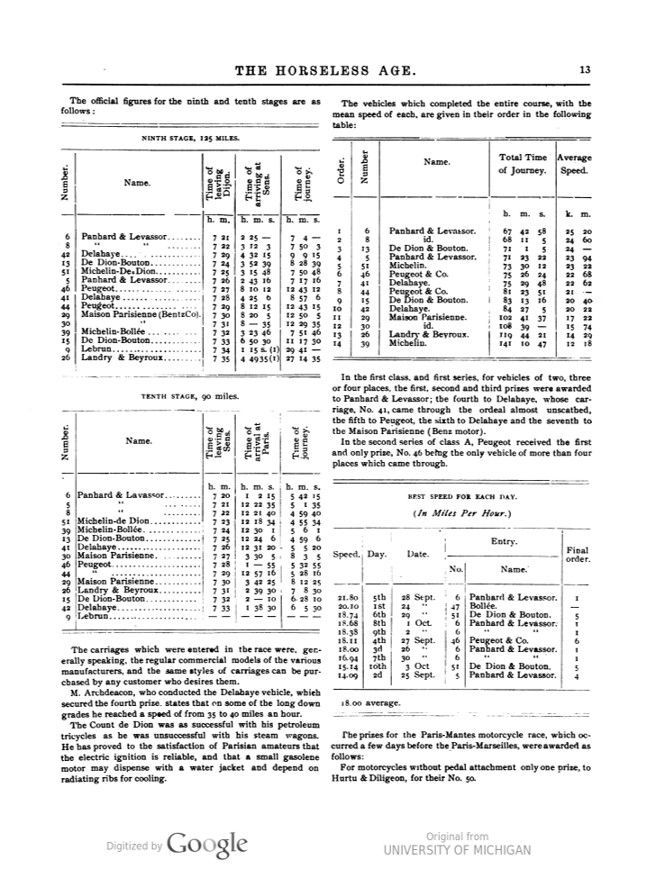
The official figures for the ninth and tenth stages are as follows: (see below tables NINTH STAGE, 125 MILES and TENTH STAGE, 90 MILES.)
The carriages which were entered in the race were, generally speaking, the regular commercial models of the various manufacturers, and the same styles of carriages can be purchased by any customer who desires them.
M. Archdeacon, who conducted the Delahaye vehicle, which secured the fourth prize, states that on some of the long downgrades he reached a speed of from 35 to 40 miles an hour.
The Count de Dion was as successful with his petroleum tricycles as he was unsuccessful with his steam wagons. He has proved to the satisfaction of Parisian amateurs that the electric ignition is reliable, and that a small gasolene motor may dispense with a water jacket and depend on radiating ribs for cooling.
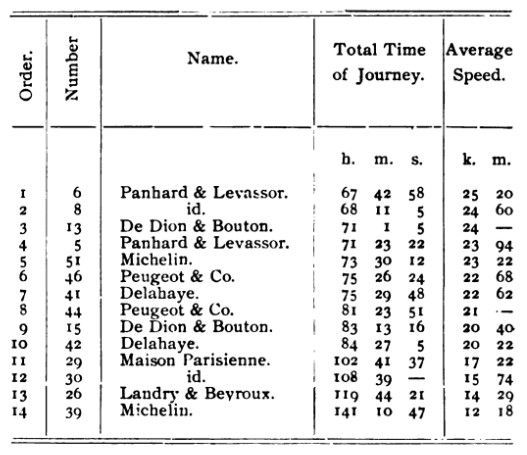
The vehicles which completed the entire course, with the mean speed of each, are given in their order in the following table: (see below table ORDER, NUMBER, NAME.)
In the first class, and first series, for vehicles of two, three or four places, the first, second and third prizes were awarded to Panhard & Levassor; the fourth to Delahaye, whose carriage, No. 41, came through the ordeal almost unscathed, the fifth to Peugeot, the sixth to Delahaye and the seventh to the Maison Parisienne (Benz motor).
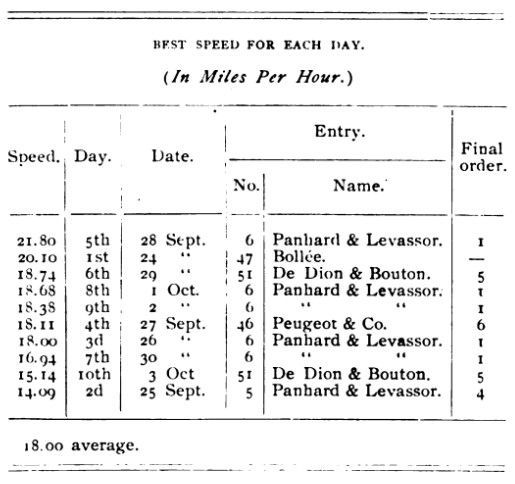
In the second series of class A, Peugeot received the first and only prize, No. 46 being the only vehicle of more than four places which came through. (see table REST SPEED FOR EACH DAY.)
The prizes for the Paris-Mantes motorcycle race, which occurred a few days before the Paris-Marseilles, were awarded as follows:
For motorcycles without pedal attachment only one prize, to Hurtu & Diligeon, for their No. 50.
For motorcycles with pedal attachment, four prizes, as follows:
1. No. 52. Michelin (tricycle De Dion).
2. No. 15. De Dion & Bouton.
3. No. 51.-Michelin.
4. No. 13. De Dion & Bouton.
The motor trophy offered by the Motor Car Club was awarded to De Dion & Bouton for their petroleum tricycles. Another trophy, offered by M. Xau, was awarded to No. 8, which accomplished the course with the least interruption.
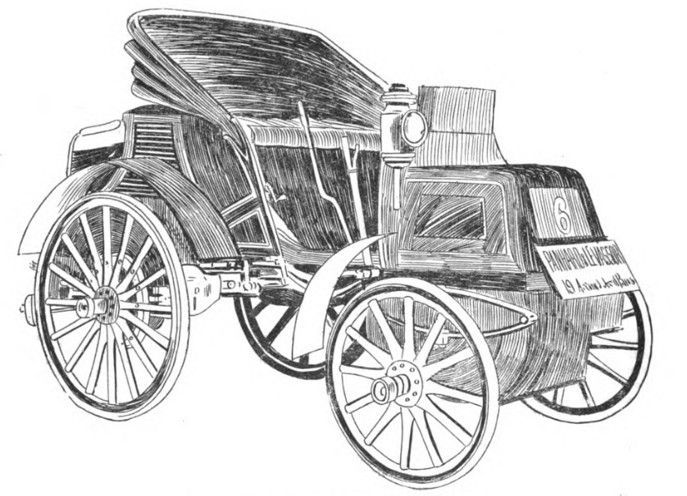
M. Michelin’s special prize of 2,000 francs for the vehicle making the best time was, of course, awarded to No. 6. Medals of silver were also voted to all the operators and passengers who had accomplished the entire course.
At the exposition which followed the race, and continued open for a week, all the prize winners in the race were in evidence, as well as a number of others.
Peugeot & Co. showed their break No. 46, which won the only prize for vehicles of more than four places, besides their other racing carriage and a vis-a-vis. The dust and stain of travel was not removed from these vehicles, making them all the more interesting as proofs of the terrible experiences of the contest.
Panhard & Levassor had in addition to their three winners an omnibus and a tourists‘ wagon, already sold.
A break for six persons and the other souvenir of the race were shown by M. Delahaye, two vehicles by the Maison Parisienne, two Triouleyres carriages, one Landry & Beyroux, two by Michelin, and quite a number of De Dion and Michelin tricycles which gave so good an account of themselves in the race, and two Roger delivery wagons.
In addition to these there were two tricycles made by Clement & Co., the great bicycle manufacturers; vehicles of Gautier & Wehrle, recent converts from steam to petroleum; a petroleum vis-a-vis by Mors, and a motor carriage and motor tricycle from the Humber factories.
An exhibit of parts was also made by those who are now catering to the new industry, odometers, ignition tubes, lamps, lubricators, burners, springs and axles, castings, wheels, bateries, tires, etc., were shown. A number of the leading carriage builders showed some of their best styles of vehicles fitted with different motors of the approved kind.
The correspondent of the Autocar describing this exhibition gives an able summary of the results of the contest, which we reprint verbatim:
„Some idea of the lessons of the trials may be obtained from an inspection of the vehicles as they appear after the race. At present only a few of them are on view at the exhibition in the Palais de l’Industrie, and it is to be hoped that the others will soon be added to this interesting collection, as otherwise the information available must necessarily be incomplete. The first thing that strikes one is that the autocars are in a much better state than could have been looked for after such a terribly trying run. If it were not for the mud and dust that covered them it would be difficult to imagine that they had run upward of a thousand miles under the worst possible conditions. The No. 13 tricycle is intact. It is a solidly constructed machine with large tubes, and the front fork is made double. The tubes where they join are strengthened by clamps, and it is only at the bottom bracket where they are simply brazed. That this is a weak point in the petroleum tricycle was seen in the breaking of the tube at this point in the machine ridden by M. Delieuvin in the Paris-Mantes race. Some stability is, however, given to the machine by light tubes which connect the bottom bracket with the bottom of the case containing the motor. The cog wheel connecting the motor with the driving axle is exposed, and this would seem to be liable to be clogged up in muddy weather.
The three Panhard & Levassor vehicles also show little signs of wear. They had suffered principally in the tires, which are flat rubber bands apparently cemented onto the wheels. Some of them were cut to pieces, and were fastened onto the rims with iron wire. Evidently, for fast running the tires will need a good deal more attention than has been given them by manufacturers so far, for they are undoubtedly one of the most necessary equipments of the autocar. The iron tire is, of course, the most trustworthy, just like the solid tire on the bicycle, but the inconvenience of the latter is increased tenfold in the iron tire of the autocar. This necessity for some good tire is particularly impressed upon one when witnessing the behavior of an autocar when traveling at full speed. If the roads be not perfectly level and smooth, and unfortunately these conditions prevail very rarely indeed, the carriage jumps and vibrates like a torpedo boat at sea, and it is very necessary that some of this motion should be taken up by the tires. It is true that the inconvenience arising from this vibration of the vehicle is more apparent than real, and that the siders themselves do not appreciate it so much as the onlooker, but all the same it is quite enough to make it very desirable that the jumping and the trepidation should be, if possible, entirely suppressed.
This, of course, cannot be done by the iron tires, and only partially by the solid India rubber tires. But these latter have proved themselves to be useless for fast running. It seems that the greater the speed of the vehicle the more destructive is the action on the solid rubber tires. Then we have the pueumatic tires, and it must be con- fessed that these came out best in the race, though only a relative best. Punctures were frequent all through the contest, and a lot of time was lost in repairing them. This is a serious matter for the private owner who has not the skill to properly repair tires himself, and it is not surprising that so many buyers should prefer the solid to the air tires. Apparently the only way to overcome the difficulty is to invent an unpuncturable pneumatic tire. This is a somewhat visionary achievement in the light bicycle tire, but for the autocar a much wider scope is offered to the inventor, and there is really no reason why something should not be done to protect the large carriage tires from puncture.
The only carriages to show any sign of hard usage in the in the Panhard & Levassor group was the No. 5, which, it will be remembered, was overturned, and it is simply surprising how little damage is done to the vehicle. It was traveling at the rate of 25 miles an hour when the carriage collided against a tree in trying to avoid a dog, and yet the only damage sustained are the bending and denting of one or two accessories, such as the lamp, the mud-guards, the brake, and the case containing the motor. This carriage ran remarkably well throughout the race, but the No. 8 caused a good deal of trouble through the extinction of the burners and other little defects that interfered with progress. It is here necessary to rectify a statement made in our last report that the Panhard & Levassor vehicles are fitted with Daimler motors; as a matter of fact, the firm have abandoned the Daimler motor for one of their own design and manufacture. This is a very similar one, being likewise a two-cylinder vertical motor placed in the fore part of the vehicle, and the firm claims that it is lighter and more powerful than the original Daimler. There are some notable changes in the disposition of the motor and in the gearing, of which we hope to be able to give a full description very shortly.
MM. Peugeot & Co. showed their Nos. 44 and 46, the latter securing the first prize for vehicles with more than four places, and neither of them showed much sign of wear and tear. In these vehicles the two-cylinder horizontal motor is placed under the front part of the vehicle, and is geared onto the driving axle by three cog wheels. All the parts are well closed in, and the only difficulty met with by the firm was the continual blowing out of the burners. This indeed caused a considerable amount of inconvenience to nearly all the competitors, and it is evident that this part of the autocar requires a good deal of improvement. Experts are becoming increasingly of the opinion that the firing tube is not nearly so satisfactory as the electrical battery. It is true that the firing tube is more certain and regular in its action and that the electrical battery is liable to cause premature explosions, but this drawback of electricity is more than counterbalanced by other advantages, of which one of the most important is that it can bid defiance to all kinds of weather. Had the gas mixture in the Peugeot carriages been exploded by the electricity, it is to be presumed that they would have shown up much better at the finish, as no time would have been lost in perpetually relighting the burners. The Bollée tandems suffered from the same trouble. The Delahaye carriages came through the race in an eminently satisfactory manner, and there was scarcely a single breakage noticeable, the only thing being the snapping of the step, which had been tied up with string. These are all the vehicles of which an opportunity has been given for close inspection so far, but the exhibition comprises several new autocars, which will be dealt with in our next issue. After such a long run, during which the carriages were driven at their maximum speed, it is very encouraging to find that the autocars have come out so successfully, but there is one point to which attention must be drawn, and that is the tendency of the vehicles to catch up the dust. In a race there is, of course, no time to carefully clean the mechanism of the oil that oozes out on the carriage. The dust is thus caught by the oil, and the vehicles, after a long run, have a very untidy appearance. It smothers the chain and the mechanism, and one’s clothes are spoilt by contact with the adhering dust. This, however, is an exceptional case and in private autocars, where the owner is able to give proper attention to the mechanism, the vehicle is in every way as clean and neat as the ordinary carriage. It yet remains evident that makers have every interest in taking precautions to prevent the slightest danger of any overflow, either of lubricating oil or petroleum spirit, and they must make the autocar of the future as little liable to inconvenience from this cause as any other type of vehicle.
„As for the other lessons of the trials, the battle of the motors has again resulted in a striking victory for the vertical engines. It is perhaps inadvisable to attach too much importance to this, for the exceptional conditions under which the race was run hardly afford us entirely trustworthy data. As we have stated before, a race provokes so many accidents that the question of luck enters very largely into the calculations, and had all the competitors been equally favored on this point, it is very probable that the result might have been modified, or at least we should have had something more solid to go upon in estimating the respective merits of the horizontal and vertical motors. An intelligent system of technical trials would throw much more light upon this question than a race of this description. To a certain extent the same thing may be said of steam. This power has had no chance of showing up to advantage, but all the same its utter failure practically means the death-blow of steam. There are only two men who have faith in steam, and these are Count de Dion and M. Serpollet, and they are both convinced that improved engines will soon be invented that will place this power in the rank which it ought properly to occupy for autocar propulsion. Such are the salient lessons to be learned from the Paris-Marseilles race, and if nothing else were possible from this great contest it would yet have fully justified itself.
Photos.
Page 11: MOTOR TROPHY OFFERED BY THE MOTOR CAR CLUB, OF LONDON.
Page 12: THE FINISH – THE DE DION TRICYCLE COMING UP THE BOULEVARD MAILLOT.
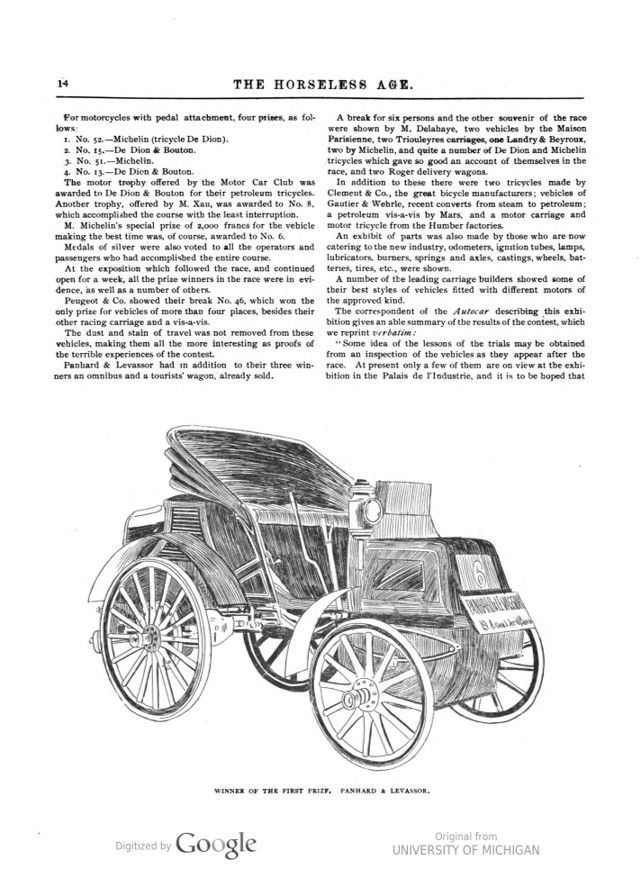
Page 14: WINNER OF THE FIRST PRIZE. PANHARD & LEVASSOR
Page 15: PARIS-MARSEILLES RACE, SEPT. 24 TO OCT. 4, 1896. – AVERAGE SPEEDS IN MILES PER Hour. OUTWARD JOURNEY. HOMEWARD JOURNEY, TOTAL JOURNEY.