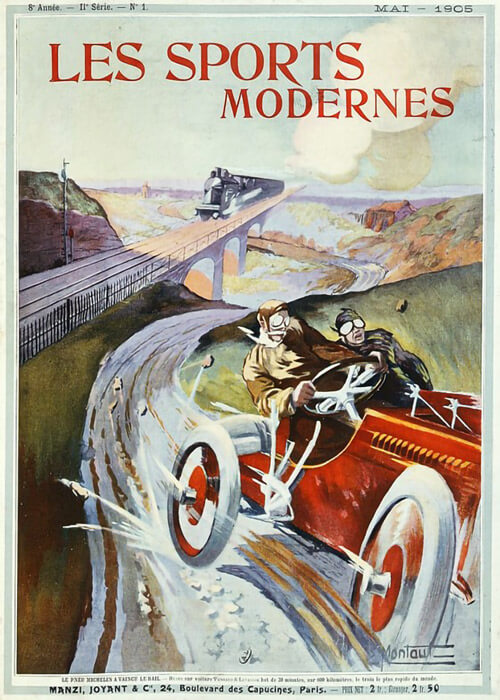
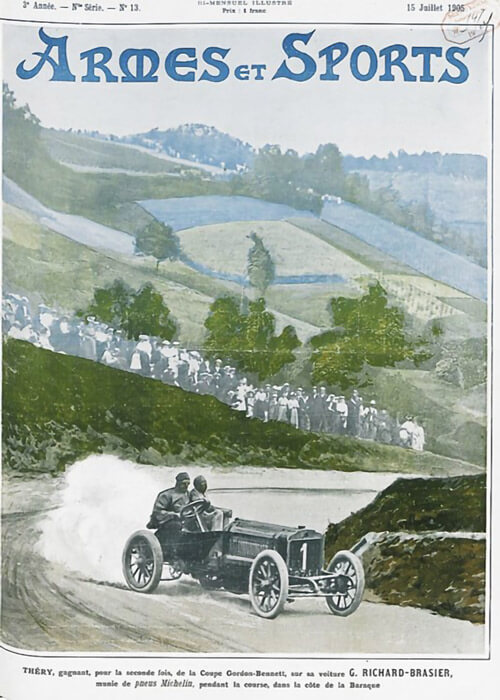
The 1896 Paris-Marseille-Paris ran for 10 days, thereby covering some 1.700 kilometers of public roads. During the course, particpants also faced terrible weather that caused numerous crashes an breakdowns. This article in the new motor magazine The Horseless Age is one of the very long kind, taking 14 pages including twelve tables: one for each raceday and one for average speed and best speed. I’ve divided the article in two parts, this one being the first.
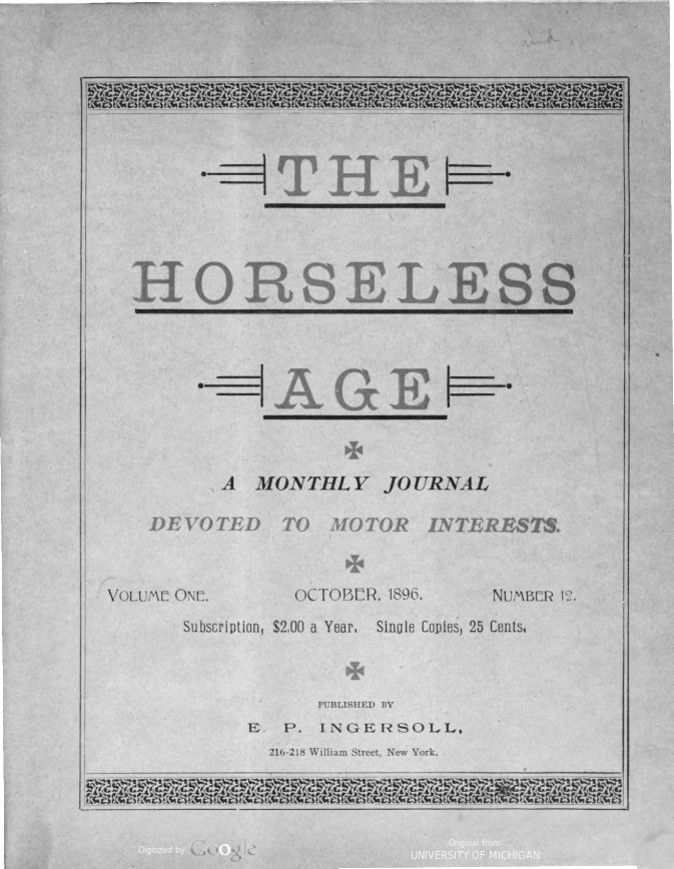
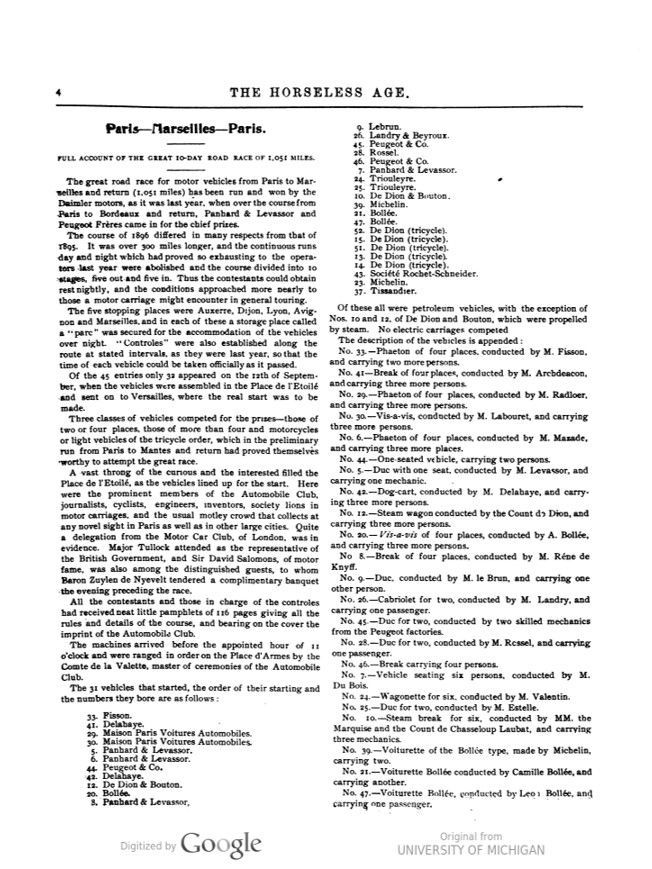


With permission of hathitrust hathitrust.org == Text and fotos compiled by motorracinghistory
THE HORSELESS AGE — Volume 1, No. 12, October 1896
Paris-Marseilles-Paris. (Part I)
FULL ACCOUNT OF THE GREAT TO-DAY ROAD RACE OF 1,051 MILES.
The great road race for motor vehicles from Paris to Marseilles and return (1,051 miles) has been run and won by the Daimler motors, as it was last year, when over the course from Paris to Bordeaux and return, Panhard & Levassor and Peugeot Frères came in for the chief prizes.
The course of 1896 differed in many respects from that of 1895. It was over 300 miles longer, and the continuous runs day and night which had proved so exhausting to the operators last year were abolished and the course divided into to stages, five out and five in. Thus the contestants could obtain rest nightly, and the conditions approached more nearly to those a motor carriage might encounter in general touring.
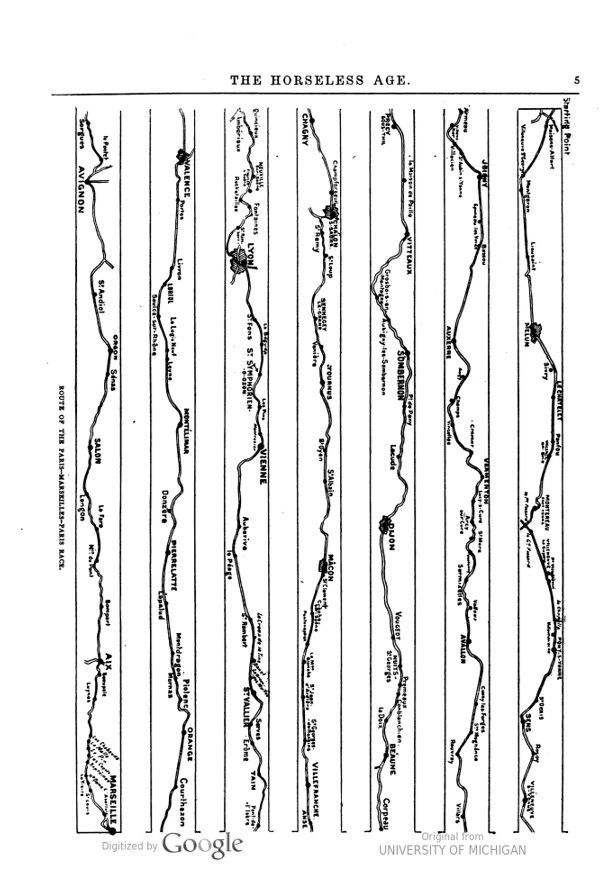
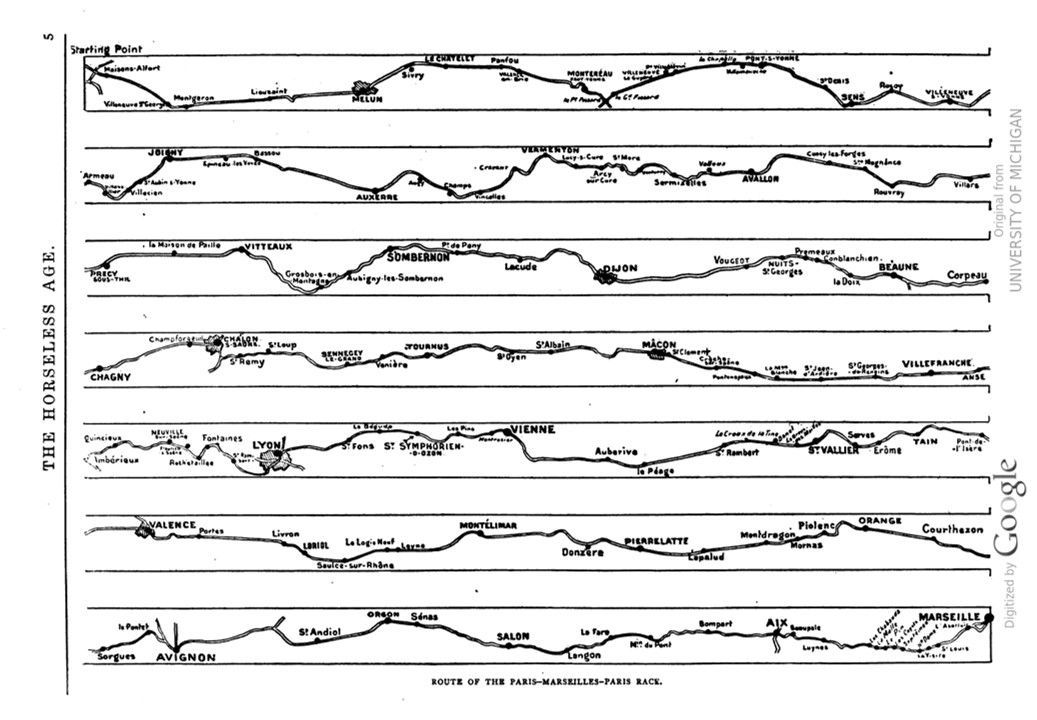
The five stopping places were Auxerre, Dijon, Lyon, Avignon and Marseilles, and in each of these a storage place called a „parc“ was secured for the accommodation of the vehicles overnight. „Controles“ were also established along the route at stated intervals, as they were last year, so that the time of each vehicle could be taken officially as it passed.
Of the 45 entries only 32 appeared on the 12th of September, when the vehicles were assembled in the Place de l’Etoilé and sent on to Versailles, where the real start was to be made.
Three classes of vehicles competed for the prizes – those of two or four places, those of more than four and motorcycles or light vehicles of the tricycle order, which in the preliminary run from Paris to Mantes and return had proved themselves worthy to attempt the great race.
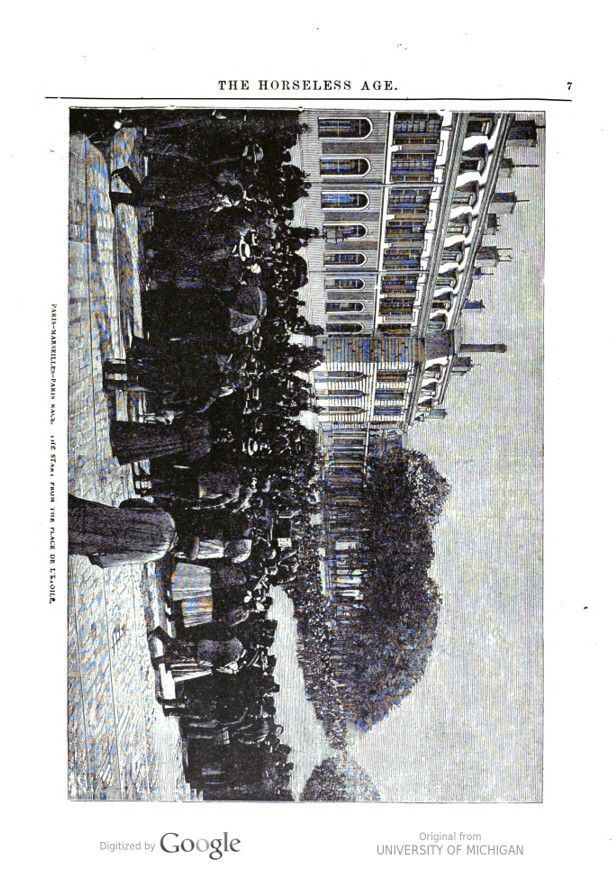
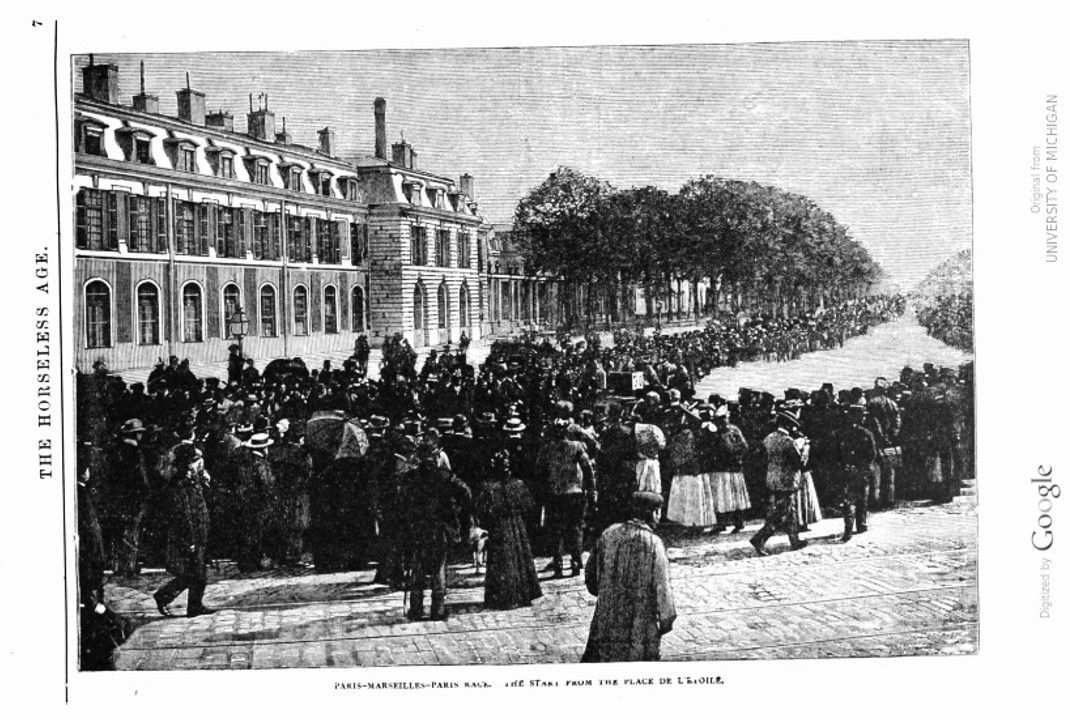
A vast throng of the curious and the interested filled the Place de l’Etoilé, as the vehicles lined up for the start. Here were the prominent members of the Automobile Club, journalists, cyclists, engineers, inventors, society lions in motor carriages, and the usual motley crowd that collects at any novel sight in Paris as well as in other large cities. Quite a delegation from the Motor Car Club, of London, was in evidence. Major Tullock attended as the representative of the British Government, and Sir David Salomons, of motor fame, was also among the distinguished guests, to whom Baron Zuylen de Nyevelt tendered a complimentary banquet the evening preceding the race.
All the contestants and those in charge of the controles had received neat little pamphlets of 116 pages giving all the rules and details of the course, and bearing on the cover the imprint of the Automobile Club.
The machines arrived before the appointed hour of 11 o’clock and were ranged in order on the Place d’Armes by the Comte de la Valette, master of ceremonies of the Automobile Club.
The 31 vehicles that started, the order of their starting and the numbers they bore are as follows:
33. Fisson.
41. Delahaye.
29. Maison Paris Voitures Automobiles.
30. Maison Paris Voitures Automobiles.
5. Panhard & Levassor.
6. Panhard & Levassor.
44. Peugeot & Co.
42. Delahaye.
12. De Dion & Bouton.
20. Bollée.
8. Panhard & Levassor,
9. Lebrun.
26. Landry & Beyroux.
45. Peugeot & Co.
28. Rossel.
46. Peugeot & Co.
7. Panhard & Levassor.
24. Triouleyre.
25. Triouleyre.
10. De Dion & Bouton.
39. Michelin.
21. Bollée.
47. Bollée.
52. De Dion (tricycle).
15. De Dion (tricycle).
51. De Dion (tricycle).
13. De Dion (tricycle).
14. De Dion (tricycle).
43. Société Rochet-Schneider.
23. Michelin.
37. Tissandier
Of these all were petroleum vehicles, with the exception of Nos. 10 and 12, of De Dion and Bouton, which were propelled by steam. No electric carriages competed.
The description of the vehicles is appended :
No. 33. Phaeton of four places, conducted by M. Fisson, and carrying two more persons.
No. 41. Break of four places, conducted by M. Archdeacon, and carrying three more persons.
No. 29. Phaeton of four places, conducted by M. Radloer, and carrying three more persons.
No. 30. Vis-a-vis, conducted by M. Labouret, and carrying three more persons.
No. 6. Phaeton of four places, conducted by M. Mazade, and carrying three more places.
No. 44. One-seated vehicle, carrying two persons.
No. 5. Duc with one seat, conducted by M. Levassor, and carrying one mechanic.
No. 42. Dog-cart, conducted by M. Delahaye, and carrying three more persons.
No. 12. Steam wagon conducted by the Count de Dion, and carrying three more persons.
No. 20. Vis-a-vis of four places, conducted by A. Bollée, and carrying three more persons.
No 8. Break of four places, conducted by M. Réne de Knyff.
No. 9. Duc, conducted by M. le Brun, and carrying one other person.
No. 26. Cabriolet for two, conducted by M. Landry, and carrying one passenger.
No. 45. Duc for two, conducted by two skilled mechanics from the Peugeot factories.
No. 28. Duc for two, conducted by M. Rcssel, and carrying one passenger.
No. 46. Break carrying four persons.
No. 7. Vehicle seating six persons, conducted by M. Du Bois.
No. 24. Wagonette for six, conducted by M. Valentin.
No. 25. Duc for two, conducted by M. Estelle.
No. 10. Steam break for six, conducted by MM. the Marquise and the Count de Chasseloup Laubat, and carrying three mechanics.
No. 39. Voiturette of the Bollée type, made by Michelin, carrying two.
No. 21. Voiturette Bollée conducted by Camille Bollée, and carrying another.
No. 47. Voiturette Bollée, conducted by Leo Bollée, and carrying one passenger,
No. 51. De Dion tricycle, conducted by M. Chevalin, winner of the Paris-Mantes race.
No. 15.-De Dion tricycle, conducted by M. Delieuvin, also a prize winner in the Paris-Mantes event.
No. 52. De Dion tricycle, conducted by M. Collomb.
No. 13. De Dion tricycle, conducted by M. Viet.
No. 14.-De Dion tricycle, conducted by M. Boiron.
No. 43. Vis-a-vis, for four, conducted by M. Rochet.
No. 23. Tandem Bollée voiturette (Michelin).
No. 37. Vis-a-vis for two, conducted by M. Tissandier and carrying one passenger.
No. 38. Vis-a-vis for four, conducted by M. Tenting.
It will be seen that in the majority of instances manufacturers took charge of their own vehicles and were accompanied by trusted employees or friends who were experienced in the motor line.
A great deal of interest centred around the new Bollée carriage, No. 20, which reached Paris only a few hours before the race. In this vehicle the body is separated entirely from the motor and machinery. The motor, developing six horsepower, is a two-cylinder horizontal engine and leather belting is employed in transmission. The hot tube is used in firing.
A slight accident marred the exhibition in the Place d’Armes. The crowd gathered so closely around the vehicles that when the word was given M. Fisson to start, one sightseer who was not agile enough to get out of the way was struck and knocked down by the wheel. His injuries were found to be slight, but M. Fisson and several who followed him were called back for a new start. Hundreds of cyclists and students of the automobile followed the carriages to Versailles, some on bicycles, others in motor carriages and others in horse conveyances.
From Versailles the vehicles were despatched at intervals of one minute. After all had been sent off the Baron Zuylen de Nyevelt, president of the Automobile Club, invited a number of the club’s guests to accompany him on a special train, which he had chartered for the purpose of following the race.
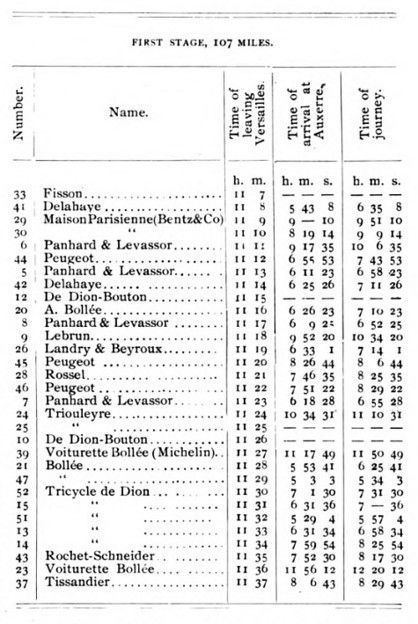
Between Versailles and Auxerre there were three „flying controles,“ or places where official time was taken on the wing. These places were Melim, Petit-Fossard and Sens. Before Auxerre was reached several mishaps occurred. No. 5, of Panhard & Levassor, lost one of its solid tires, causing a delay of one hour and a half; No. 6, of the same firm, was delayed two hours by an accident to the shaft; the steam brake of the Count de Dion, No. 10, was brought to a standstill by a hot box and did not reach Auxerre until half past eight the next morning; No. 12 also, a heavy De Dion steam wagon, crushed its pneumatics on the way and was obliged to withdraw; No. 45, a Peugeot carriage, was troubled with a creeping tire.
The entrance into Auxerre was attended by a great public demonstration; in fact, the people all along the route showed the liveliest interest, peasants bringing their luncheon and sitting by the roadside to see the carriages pass.
Between Versailles and Auxerre there were three „flying controles,“ or places where official time was taken on the wing. These places were Melim, Petit-Fossard and Sens. Before Auxerre was reached several mishaps occurred. No. 5, of Panhard & Levassor, lost one of its solid tires, causing a delay of one hour and a half; No. 6, of the same firm, was delayed two hours by an accident to the shaft; the steam brake of the Count de Dion, No. 10, was brought to a standstill by a hot box and did not reach Auxerre until half past eight the next morning; No. 12 also, a heavy De Dion steam wagon, crushed its pneumatics on the way and was obliged to withdraw; No. 45, a Peugeot carriage, was troubled with a creeping tire.
The entrance into Auxerre was attended by a great public demonstration; in fact, the people all along the route showed the liveliest interest, peasants bringing their luncheon and sitting by the roadside to see the carriages pass. The official time of each vehicle for the first stage is as follows: (see table further below, FIRST STAGE, 107 MILES). It will be seen that the quickest trip was made by the motorcycles of De Dion and Bollée, No. 47 of the latter accomplishing the distance at an average speed of nearly 20 miles an hour.
As fast as they arrived the vehicles were put up for the night in the park, where the curious public examined them from a distance.
The conductors and passengers, and those who were following the race, retired early to be on hand for the start, which occurred from the outgoing controle at 7 o’clock the next morning, No. 47, the Bollée voiturette, which made the best time from Marseilles, taking the lead.
Rain, accompanied by a terrific wind, intervened, and caused much discomfort to the racers, but this was nothing as compared with the fury of the elements which they were to experience later on this stage of the course through the Rhone valley.
The same rule of sending the vehicles off at intervals of one minute was observed here, the last to receive the word being another Bollée voiturette, No. 23, which was the last to arrive at Auxerre.
Again the members of the Automobile Club and their guests took the special train to proceed to Dijon. The rain increased in violence as the contestants proceeded toward Dijon, and the wind rose to the force of a hurricane, frequently blowing the carriages to one side of the road.
Despatches were continually sent from the flying controles announcing the passage of the vehicles to the Paris press, and to the officers of the Automobile Club.
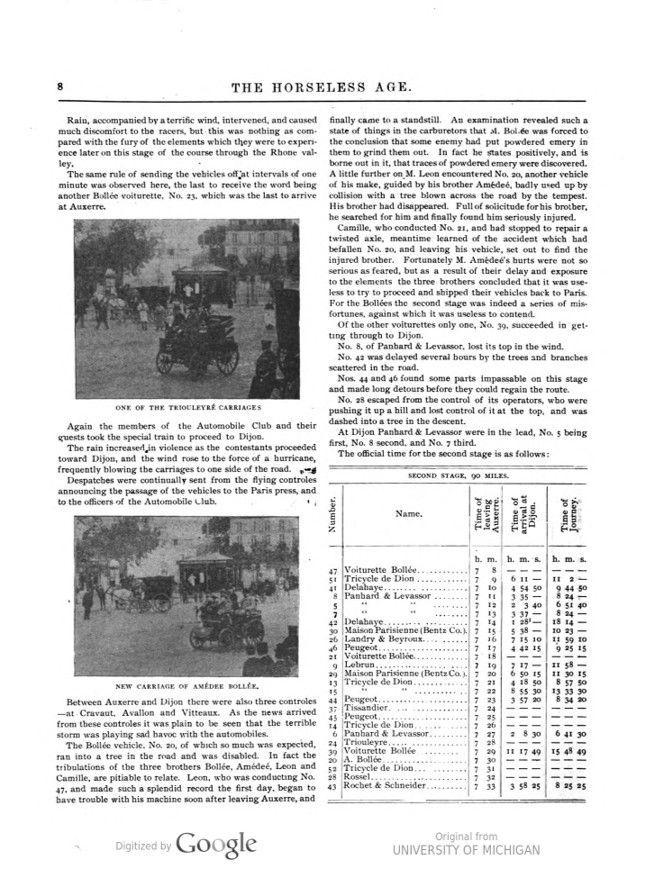
Between Auxerre and Dijon there were also three controles – at Cravaut, Avallon and Vitteaux. As the news arrived from these controles it was plain to be seen that the terrible storm was playing sad havoc with the automobiles.
The Bollée vehicle, No. 20, of which so much was expected, ran into a tree in the road and was disabled. In fact the tribulations of the three brothers Bollée, Amédeé, Leon and Camille, are pitiable to relate. Leon, who was conducting No. 47, and made such a splendid record the first day, began to have trouble with his machine soon after leaving Auxerre, and finally came to a standstill. An examination revealed such a state of things in the carburetors that M. Bolée was forced to the conclusion that some enemy had put powdered emery in them to grind them out.
In fact he states positively, and is borne out in it, that traces of powdered emery were discovered. A little further on M. Leon encountered No. 20, another vehicle of his make, guided by his brother Amédeé, badly used up by collision with a tree blown across the road by the tempest. His brother had disappeared. Full of solicitude for his brother, he searched for him and finally found him seriously injured.
Camille, who conducted No. 21, and had stopped to repair a twisted axle, meantime learned of the accident which had befallen No. 20, and leaving his vehicle, set out to find the injured brother. Fortunately M. Amédeé’s hurts were not so serious as feared, but as a result of their delay and exposure to the elements the three brothers concluded that it was useless to try to proceed and shipped their vehicles back to Paris. For the Bollées the second stage was indeed a series of mis- fortunes, against which it was useless to contend.
Of the other voiturettes only one, No. 39, succeeded in getting through to Dijon. No. 8, of Panhard & Levassor, lost its top in the wind.
No. 42 was delayed several hours by the trees and branches scattered in the road.
Nos. 44 and 46 found some parts impassable on this stage and made long detours before they could regain the route.
No. 28 escaped from the control of its operators, who were pushing it up a hill and lost control of it at the top, and was dashed into a tree in the descent.
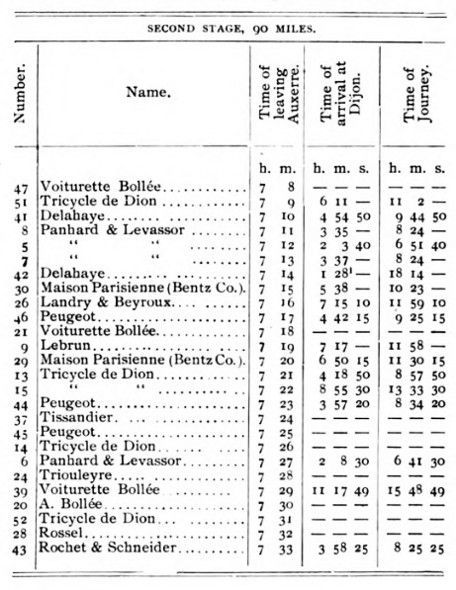
At Dijon Panhard & Levassor were in the lead, No. 5 being first, No. 8 second, and No. 7 third.
The official time for the second stage is as follows: (see table below, SECOND STAGE, 90 MILES)
The morning of the third day the rain still fell in torrents, though the wind had somewhat abated. At about half past seven the racers were sent off on their way to Lyons, the Panhard & Levassor carriages taking the lead.
The three controles of the third stage were not passed without accident, but owing to the abatement of the storm, better time was made.
No. 7, of Panhard & Levassor, while avoiding a loaded wagon which it encountered in the road, ran into the sidewalk and was overturned, injuring one of the passengers so seriously that he had to be taken back to Paris by train.
No. 43 ran into a cow and got the worst of the encounter, in consequence of which it was unable to proceed.
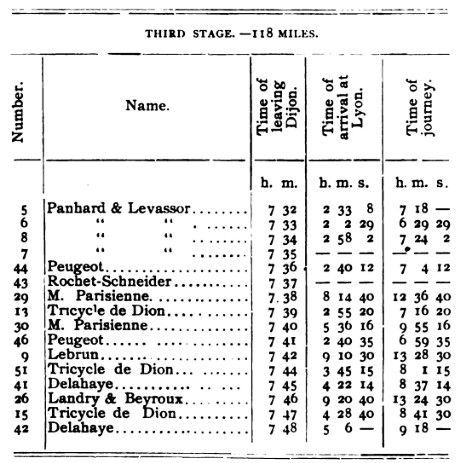
The table for the third stage is appended: (see table THIRD STAGE, 118 MILES)
The fourth stage, from Lyon to Avignon, which also included three controles, was marked by several accidents, only one being of a serious nature.
No. 26 was delayed by a hot box.
No. 5, conducted by M. Levassor, winner of the Paris-Bordeaux race, ran over a big dog and upset, throwing M. Levassor against a tree, and bruising and shaking him up considerably.
After recovering from the shock, M. Levassor and comrade resumed the journey as best they could with a broken spring, until a blacksmith shop was reached, where the damage was repaired.
At half-past nine in the evening No. 5 reached the park at Avignon, and M. Levassor had his injuries examined by a physician. Fortunately they were not serious, although the conduct of the vehicle was given into the hands of his companion for the rest of the way.
No. 9 also met with an accident. One of its solid tires came loose and caught in the machinery, necessitating a delay of 24 hours.
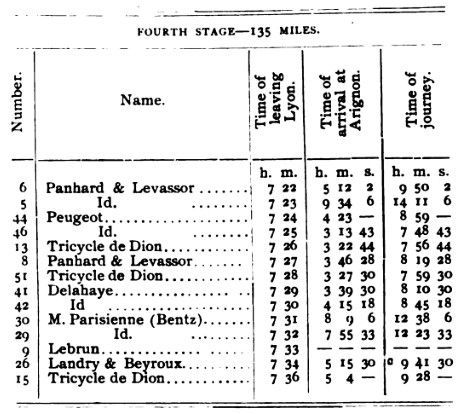
The table of the fourth stage, somewhat longer than those previous, is as follows: (table FOURTH STAGE-135 MILES.)
Owing to the pleasant weather the crowd of sightseers increased in number as the contestants approached Marseilles, Thousands of enthusiastic spectators cheered the vehicles on their departure from Avignon for Marseilles, No 46, a Peugeot carriage, leading the way. With everything favorable and a short stage before them the carriages quickly covered the distance, all but three entering the city before noon. It is estimated that 100,000 people gathered in the street and parks of the Mediterranean city to do honor to automobilism.
The official time between Avignon and Marseilles is as follows: (table FIFTH STAGE. 60 MILES.)
During the night several other vehicles, which had met with accidents on the way, joined the others at Marseilles. The Panhard & Levassor carriage No. 7, which had been delayed 24 hours on the third stage, came in in the evening, and at 3 o’clock in the morning No. 39, a tandem voiturette, put in an appearance. No. 9 also reached Avignon before the return journey was commenced.
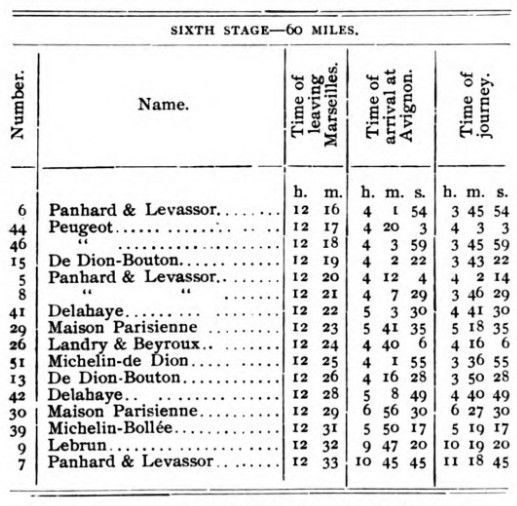
After holding an exhibition and a parade through the streets of the city the vehicles set out over the return course, 16 in number, instead of 13. Little worthy of mention occurred in the sixth stage, except that the tricycles began to show fine speed, keeping the Panhard & Levassor carriages at the top notch. The time for this stage is appended: (table SIXTH STAGE-60 MILES.)

Photos.
Page 5. ROUTE OF THE PARIS-MARSEILLES-PARIS RACE
Page 6: ONE OF COUNT DE DION’S STEAM WAGONS.
Page 7: PARIS-MARSEILLES-PARIS RACE. THE START FROM THE PLACE DE L’ÉTOILE.
Page 8: ONE OF THE TRIOULEYRÉ CARRIAGES – NEW CARRIAGE OF AMÉDEE BOLLÉE.
Page 9: PARIS-MARSEILLES-PARIS RACE. VIEWS OF CONTROLES AND PARKS ON THE ROUTE.