The 1898, the young automotive magazine The Automotor and Horseless Vehicle Journal, in its second year and seated in London, started reporting the newly City-to-City races on public roads. Although, in similarity to the US The Horseless Age, she reported and discussed mainly technical issues, race events also came into her scope. This description of the Paris-Amsterdam-Paris race is written in the typical British style. Take Your time, read it and You’ll love it!
With permission of hathitrust hathitrust.org == Text and fotos compiled by motorracinghistory
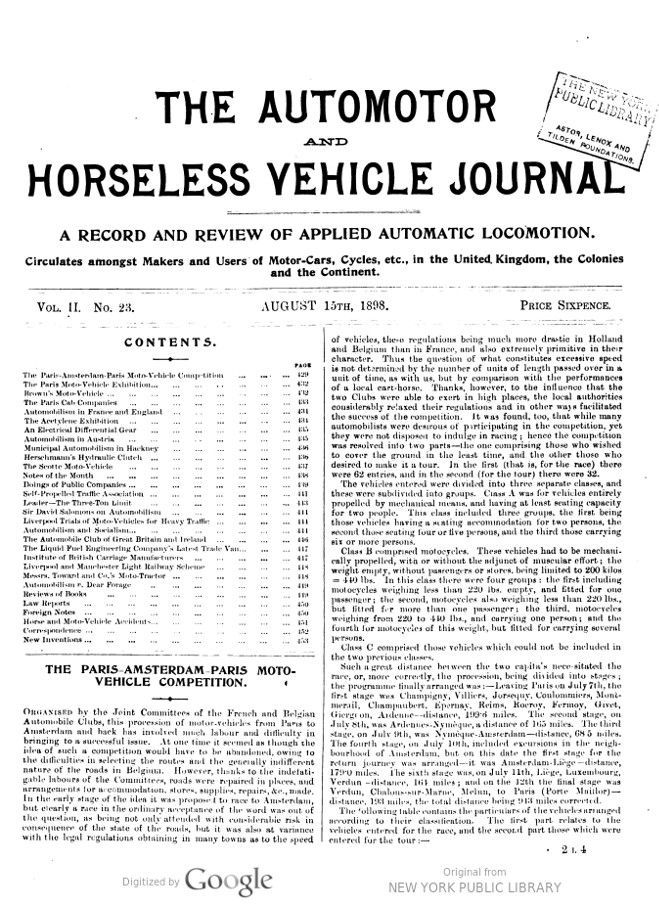
The Automotor and Horseless Vehicle Journal — Volume II, No. 23, August 15, 1898
THE PARIS-AMSTERDAM-PARIS MOTO-VEHICLE COMPETITION.
ORGANISED by the Joint Committees of the French and Belgian Automobile Clubs, this procession of motor-vehicles from Paris to Amsterdam and back has involved much labour and difficulty in bringing to a successful issue. At one time it seemed as though the idea of such a competition would have to be abandoned, owing to the difficulties in selecting the routes and the generally indifferent nature of the roads in Belgium.
However, thanks to the indefatigable labours of the Committees, roads were repaired in places, and arrangements for accommodation, stores, supplies, repairs, &c., made. In the early stage of the idea it was proposed to race to Amsterdam, but clearly a race in the ordinary acceptance of the word was out of the question, as being not only attended with considerable risk in consequence of the state of the roads, but it was also at variance with the legal regulations obtaining in many towns as to the speed of vehicles, these regulations being much more drastic in Holland and Belgium than in France, and also extremely primitive in their character. Thus the question of what constitutes excessive speed is not determined by the number of units of length passed over in a unit of time, as with us, but by comparison with the performances of a local cart-horse. Thanks, however, to the influence that the two Clubs were able to exert in high places, the local authorities considerably relaxed their regulations and in other ways facilitated the success of the competition. It was found, too, that while many automobilists were desirous of participating in the competition, yet they were not disposed to indulge in racing; hence the competition was resolved into two parts-the one comprising those who wished to cover the ground in the least time, and, the other those who desired to make it a tour. In the first (that is, for the race) there were 62 entries, and in the second (for the tour) there were 32.
The vehicles entered were divided into three separate classes, and these were subdivided into groups.
Class A was for vehicles entirely propelled by mechanical means, and having at least seating capacity for two people. This class included three groups, the first being those vehicles having a seating accommodation for two persons, the second those seating four or five persons, and the third those carrying six or more persons.
Class B comprised motocycles. These vehicles had to be mechanically propelled, with or without the adjunct of muscular effort; the weight empty, without passengers or stores, being limited to 200 kilos 440 lbs. In this class there were four groups: the first including motocycles weighing less than 220 lbs. empty, and fitted for one passenger; the second, motocycles also weighing less than 220 lbs., but fitted for more than one passenger; the third, motocycles weighing from 220 to 440 lbs., and carrying one person; and the fourth for motocycles of this weight, but fitted for carrying several persons.
Class C comprised those vehicles which could not be included in the two previous classes.
Such a great distance between the two capita’s necessitated the race, or, more correctly, the procession, being divided into stages; the programme finally arranged was: –
Leaving Paris on July 7th, the first stage was Champigny, Villiers, Jorsequy, Coulommiers, Mont- merail, Champaubert, Epernay, Reims, Kocroy, Fermoy, Givet, Giergnon, Ardenne – distance, 1996 miles.
The second stage, on July 8th, was Ardennes-Nymèque, a distance of 165 miles.
The third stage, on July 9th, was Nymèque-Amsterdam-distance, 68 5 miles.
The fourth stage, on July 10th, included excursions in the neighbourhood of Amsterdam, but on this date the first stage for the return journey was arranged – it was Amsterdam-Liège-distance, 1790 miles.
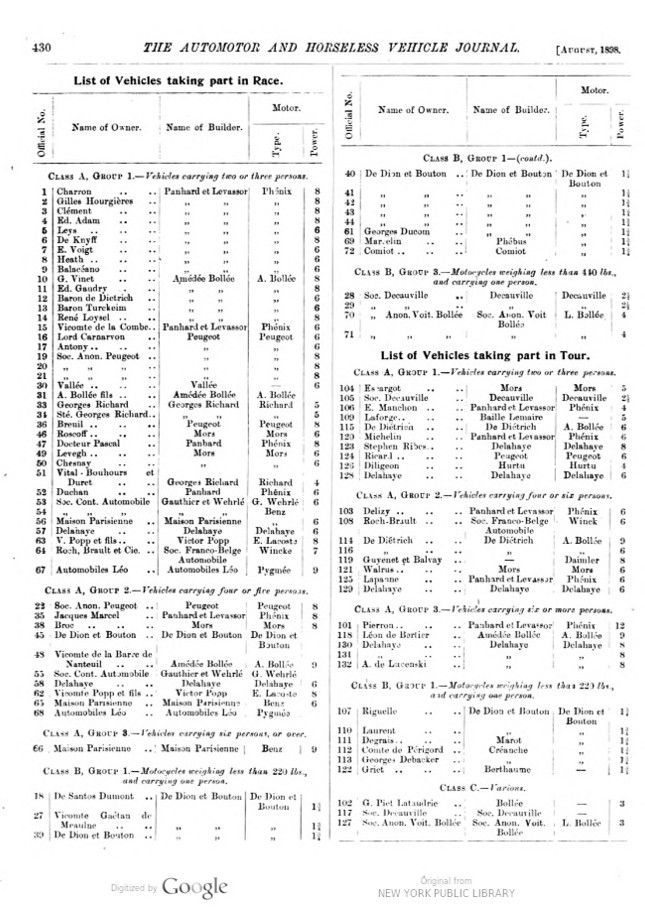
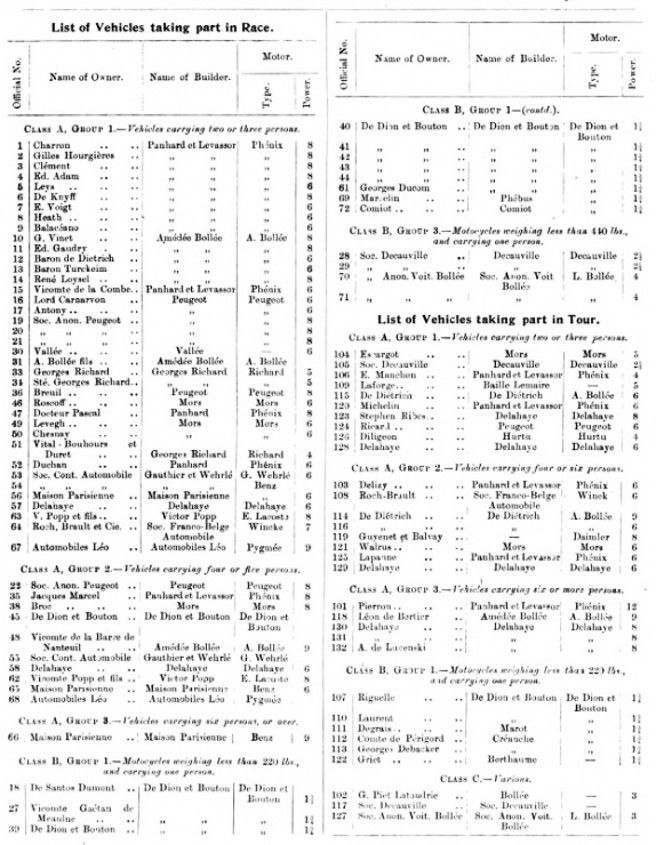
The sixth stage was, on July 11th, Liège, Luxembourg, Verdun – distance, 164 miles; and on the 12th the final stage was Verdun, Chalons-sur-Marne, Melun, to Paris (Porte Maillor) — distance, 193 miles, the total distance being 943 miles corrected. The following table contains the particulars of the vehicles arranged according to their classification. The first part relates to the vehicles entered for the race, and the second part those which were entered for the tour: – (see table 1 – on page 430)
List of Vehicles taking part in Race.
CLASS A, GROUP 1. – Vehicles carrying two or three persons.
CLASS A, GROUP 2. – Vehicles carrying four or five persons.
CLASS A, GROUP 3. – Vehicles carrying six persons, or over.
CLASS B, GROUP 1. – Motocycles weighing less than 220 lbs. and carrying one person.
CLASS B, GROUP 3. – Motocycles weighing less than 440 lbs. and carrying one person.
List of Vehicles taking part in Tour.
CLASS A, GROUP 1. – Vehicles carrying two or three persons.
CLASS A, GROUP 2. – Vehicles carrying four or six persons.
CLASS A, GROUP 3. – Vehicles carrying six or more persons.
CLASS B, GROUP 1. – Motocycles weighing less than 220 lbs. and carrying one person.
CLASS C. – Various.
Unlike the Paris cab trials, the present competition possessed little of interest to the constructor, although it must be admitted that the successful accomplishment of such a long and trying journey is a valuable test of endurance and good workmanship. Several of the vehicles had been specially built with a view to breaking the record, and were fitted, as will be seen by a reference to the accompanying table, with exceptionally powerful motors. The roads were generally of an inferior description, especially near the French frontier, and not a few accidents resulted in consequence of this.
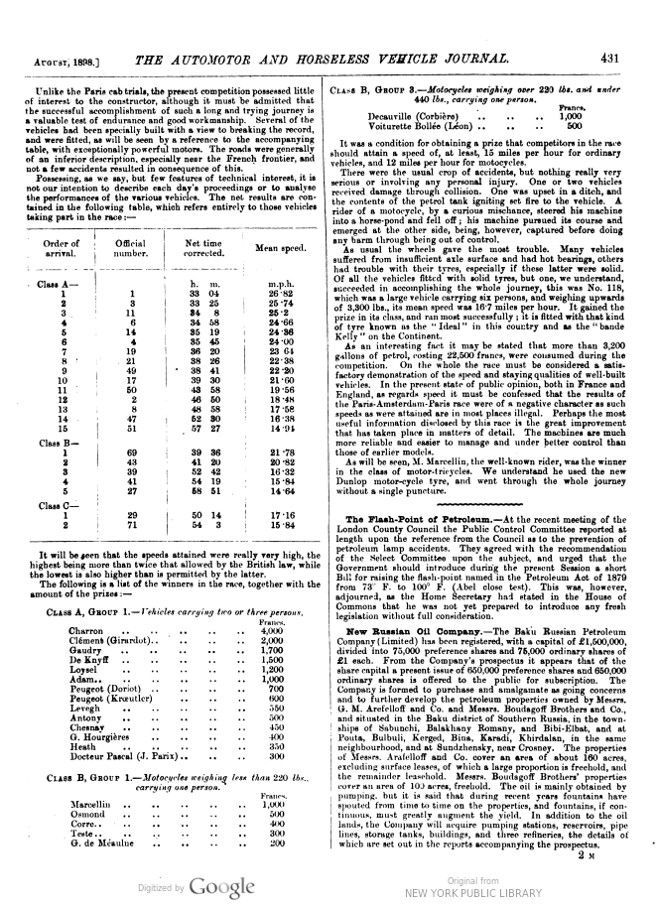
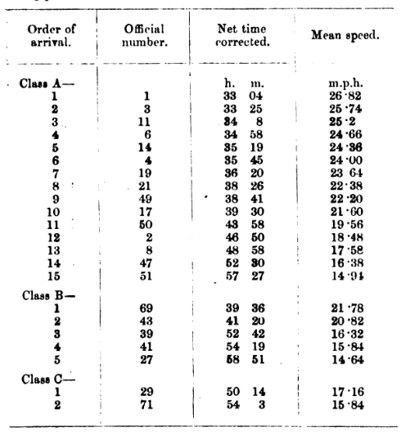
Possessing, as we say, but few features of technical interest, it is not our intention to describe each day’s proceedings or to analyse the performances of the various vehicles. The net results are contained in the following table, which refers entirely to those vehicles taking part in the race: – (see table 2 – on page 431)
Order of arrival. – Official number. – Net time corrected. – Mean speed. m.p.h. for Class A- / Class B- / Class C-
It will be seen that the speeds attained were really very high, the highest being more than twice that allowed by the British law, while the lowest is also higher than is permitted by the latter.
The following is a list of the winners in the race, together with the amount of the prizes: – (see table 3 – on page 431)
CLASS A, GROUP 1. – Vehicles carrying two or three persons.
CLASS B, GROUP 1. – Motocycles weighing less than 220 lbs., carrying one person.
CLASS B, GROUP 3. – Motocycles weighing over 220 lbs. and under 440 lbs., carrying one person.
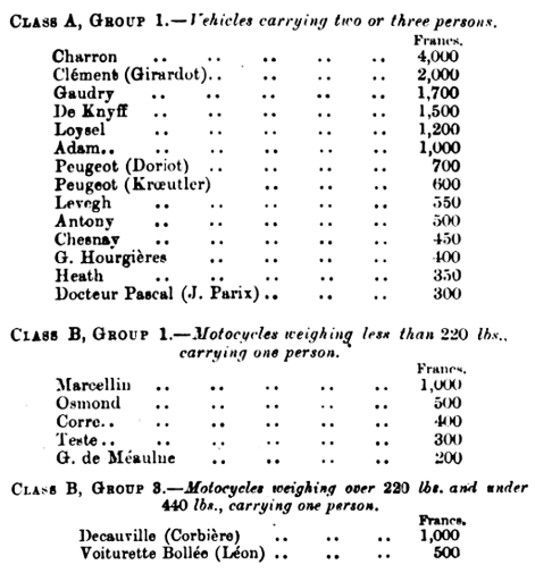
It was a condition for obtaining a prize that competitors in the race should attain a speed of, at least, 15 miles per hour for ordinary vehicles, and 12 miles per hour for motocycles.
There were the usual crop of accidents, but nothing really very serious or involving any personal injury. One or two vehicles received damage through collision. One was upset in a ditch, and the contents of the petrol tank igniting set fire to the vehicle. A rider of a motocycle, by a curious mischance, steered his machine into a horse-pond and fell off; his machine pursued its course and emerged at the other side, being, however, captured before doing any harm through being out of control.
As usual the wheels gave the most trouble. Many vehicles suffered from insufficient axle surface and had hot bearings, others had trouble with their tyres, especially if these latter were solid. Of all the vehicles fitted with solid tyres, but one, we understand, succeeded in accomplishing the whole journey, this was No. 118, which was a large vehicle carrying six persons, and weighing upwards of 3,300 lbs., its mean speed was 16.7 miles per hour. It gained the prize in its class, and ran most successfully; it is fitted with that kind of tyre known as the „Ideal“ in this country and as the „bande Kelly“ on the Continent.
As an interesting fact it may be stated that more than 3,200 gallons of petrol, costing 22,500 francs, were consumed during the competition. On the whole the race must be considered a satisfactory demonstration of the speed and staying qualities of well-built vehicles. In the present state of public opinion, both in France and England, as regards speed it must be confessed that the results of the Paris-Amsterdam-Paris race were of a negative character as such speeds as were attained are in most places illegal. Perhaps the most useful information disclosed by this race is the great improvement that has taken place in matters of detail. The machines are much more reliable and easier to manage and under better control than those of earlier models. As will be seen, M. Marcellin, the well-known rider, was the winner in the class of motor-tricycles. We understand he used the new Dunlop motor-cycle tyre, and went through the whole journey without a single puncture.
——————