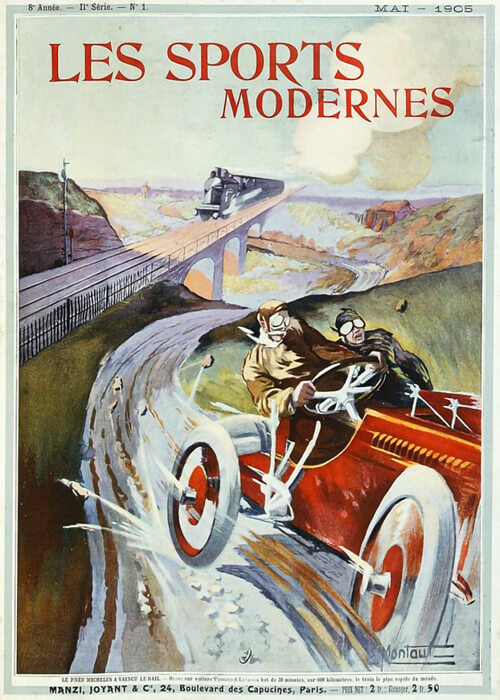
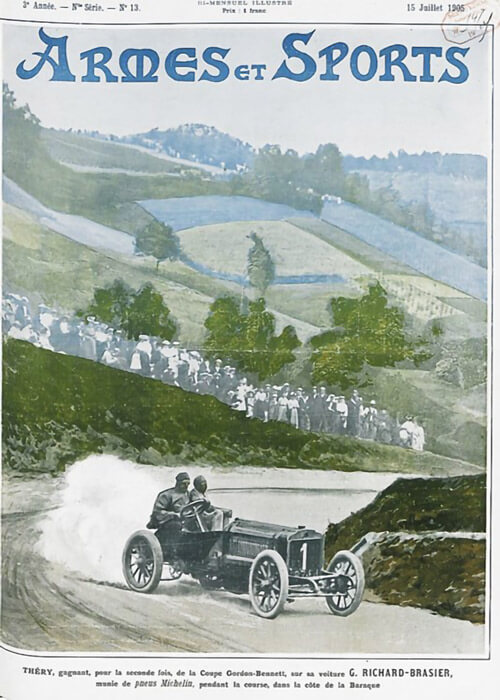
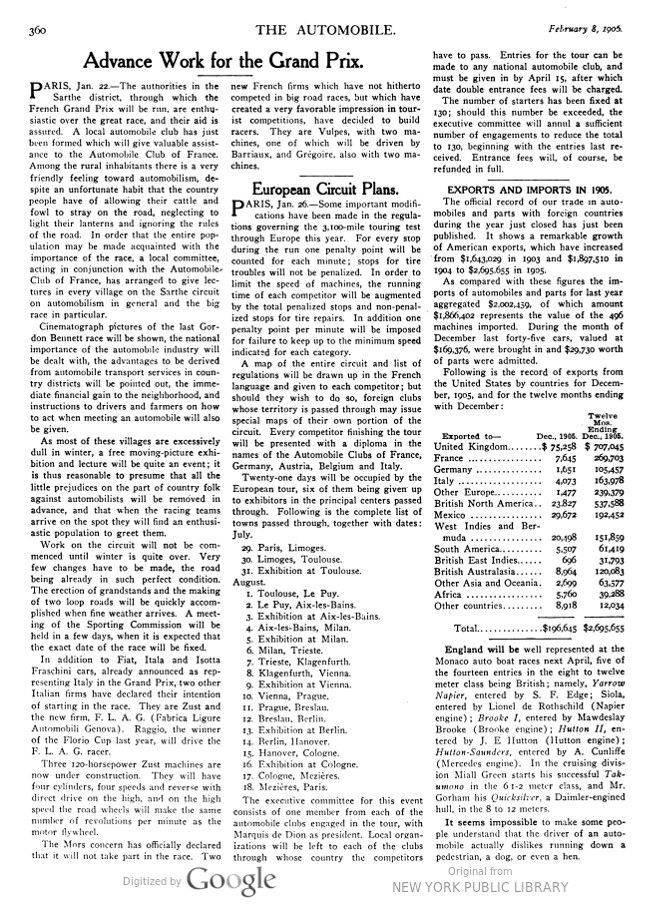
Here, two articles of The Automobile are shown, both encompassing the preparations for the Grand Prix. In those early days of motoring, many American magazines published some characteristics and preparations of the road course. In the second article of March 22, preparations such as preliminary vehicle tests are described.
With permission of hathitrust hathitrust.org == Text and fotos compiled by motorracinghistory
THE AUTOMOBILE — Volume 14, No. 6, February 8, 1906
Advance Work for the Grand Prix.
PARIS, Jan. 22. – The authorities in the Sarthe district, through which the French Grand Prix will be run, are enthusiastic over the great race, and their aid is assured. A local automobile club has just been formed which will give valuable assistance to the Automobile Club of France. Among the rural inhabitants there is a very friendly feeling toward automobilism, despite an unfortunate habit that the country people have of allowing their cattle and fowl to stray on the road, neglecting to light their lanterns and ignoring the rules of the road. In order that the entire population may be made acquainted with the importance of the race, a local committee, acting in conjunction with the Automobile Club of France, has arranged to give lectures in every village on the Sarthe circuit on automobilism in general and the big race in particular.
Cinematograph pictures of the last Gordon Bennett race will be shown, the national importance of the automobile industry will be dealt with, the advantages to be derived from automobile transport services in country districts will be pointed out, the immediate financial gain to the neighborhood, and instructions to drivers and farmers on how to act when meeting an automobile will also be given.
As most of these villages are excessively dull in winter, a free moving-picture exhibition and lecture will be quite an event; it is thus reasonable to presume that all the little prejudices on the part of country folk against automobilists will be removed in advance, and that when the racing teams arrive on the spot they will find an enthusiastic population to greet them.
Work on the circuit will not be commenced until winter is quite over. Very few changes have to be made, the road being already in such perfect condition. The erection of grandstands and the making of two loop roads will be quickly accomplished when fine weather arrives. A meeting of the Sporting Commission will be held in a few days, when it is expected that the exact date of the race will be fixed
As most of these villages are excessively dull in winter, a free moving-picture exhibition and lecture will be quite an event; it is thus reasonable to presume that all the little prejudices on the part of country folk against automobilists will be removed in advance, and that when the racing teams arrive on the spot they will find an enthusiastic population to greet them.
Work on the circuit will not be commenced until winter is quite over. Very few changes have to be made, the road being already in such perfect condition. The erection of grandstands and the making of two loop roads will be quickly accomplished when fine weather arrives. A meeting of the Sporting Commission will be held in a few days, when it is expected that the exact date of the race will be fixed.
In addition to Fiat, Itala and Isotta Fraschini cars, already announced as rep- resenting Italy in the Grand Prix, two other Italian firms have declared their intention of starting in the race. They are Zust and the new firm, F. L. A. G. (Fabrica Ligure Automobili Genova). Raggio, the winner of the Florio Cup last year, will drive the F. L. A. G. racer.
Three 120-horsepower Zust machines are now under construction. They will have four cylinders, four speeds and reverse with direct drive on the high, and on the high speed the road wheels will make the same number of revolutions per minute as the motor flywheel.
The Mors concern has officially declared that it will not take part in the race. Two new French firms which have not hitherto competed in big road races, but which have created a very favorable impression in tourist competitions, have decided to build racers. They are Vulpes, with two machines, one of which will be driven by Barriaux, and Grégoire, also with two machines.
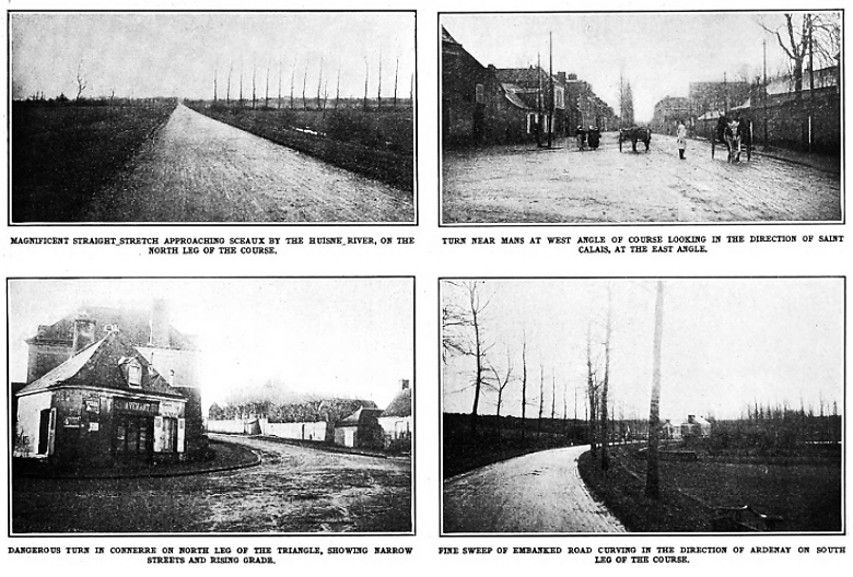
Photos. Page 361.
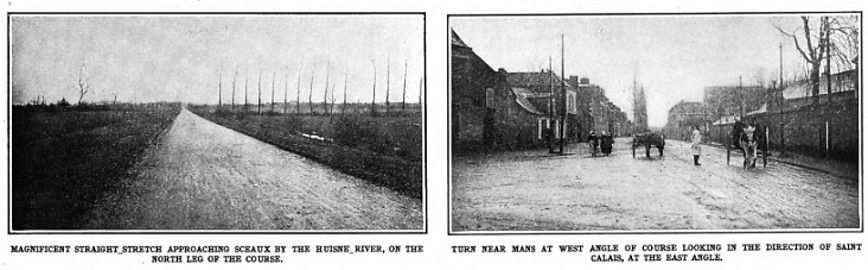
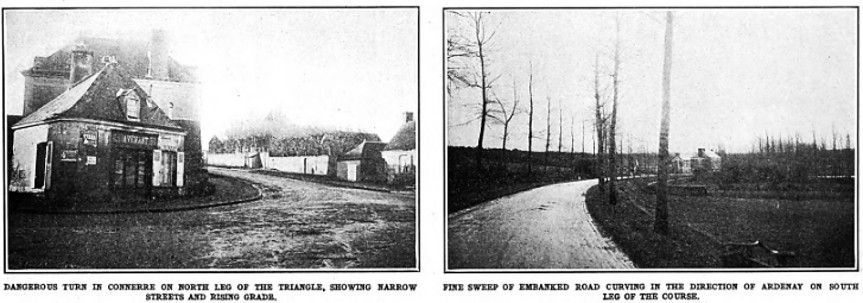
CHARACTERISTIC VIEWS OF THE NEW COURSE JUST SELECTED FOR THE FRENCH GRAND PRIX AUTOMOBILE RACE, NEAR LE MANS, IN THE DEPARTMENT OF SARTHE, FRANCE -//- MAGNIFICENT STRAIGHT STRETCH APPROACHING SCEAUX BY THE HUISNE RIVER, ON THE NORTH LEG OF THE COURSE. -//- TURN NEAR MANS AT WEST ANGLE OF COURSE LOOKING IN THE DIRECTION OF SAINT CALAIS, AT THE EAST ANGLE. -//- DANGEROUS TURN IN CONNERRE ON NORTH LEG OF THE TRIANGLE, SHOWING NARROW STREETS AND RISING GRADE. -//- FINE SWEEP OF EMBANKED ROAD CURVING IN THE DIRECTION OF ARDENAY ON SOUTH LEG OF THE COURSE.
With permission of hathitrust hathitrust.org == Text and fotos compiled by motorracinghistory
THE AUTOMOBILE — Volume 14, No. 6, February 8, 1906
The Grand Prix Preparations.
Entries Being Received, Racers Being Made Ready. – Darracq Will Have a Differential.
– W. K. Vanderbilt, Jr., Orders a Six-cylinder Mercedes.
PARIS, March 12. – The fall of the Ministry has caused a delay in the granting of government permission to hold the race for the Grand Prix on June 26 and 27. This week a deputation from the Automobile Club waited on the Minister of the Interior to submit their scheme and ask for its authorization. The reply was deferred until a consultation could be made with the Minister of Public Works and the opinion of the Prefect of the Sarthe obtained. Before the day was out, however, the government had fallen, and with it the club’s request, for it will now be necessary to await the formation of a new cabinet and pay an official visit to the successor of M. Dubief.
It had been intended to wait until all these formalities were accomplished before accepting entries, but owing to this sudden change engagements are being received at once, the fee being $1,000 per car.
The $20,000 subvention demanded of the Sarthe department by the Automobile Club of France is now practically secured, the town council having voted $7,000; the Conseil Général, $5,000; the railroad company, $1,000, and the remainder being obtained by public subscription. Active work on the circuit has not yet commenced, but the various teams are by no means idle. Hémery ran down on one of last year’s racers as soon as he returned home; Sisz on a Renault, Wagner on a Darracq, and Duray on a Dietrich, have also made a close study of the circuit.
As most of these villages are excessively dull in winter, a free moving-picture exhibition and lecture will be quite an event; it is thus reasonable to presume that all the little prejudices on the part of country folk against automobilists will be removed in advance, and that when the racing teams arrive on the spot they will find an enthusiastic population to greet them.
Work on the circuit will not be commenced until winter is quite over. Very few changes have to be made, the road being already in such perfect condition. The erection of grandstands and the making of two loop roads will be quickly accomplished when fine weather arrives. A meeting of the Sporting Commission will be held in a few days, when it is expected that the exact date of the race will be fixed
Cars Are Being Tried Out.
Despite the secrecy which is maintained regarding the French racers to take part in the Grand Prix, a few particulars have become known. Freak cars are entirely absent, and, indeed, in some cases, last year’s models with modifications in detail only, will be seen at the starting line. Drive by side chain has lost ground this year, a larger proportion of racers having transmission by propeller shaft than before.
Two distinctive features will mark the Grand Prix racers: the center of gravity will be placed low and very large gasoline and oil supplies will be carried. Tanks with a capacity of over 40 gallons are being fitted on some of the racers in order that the six rounds of the circuit may be covered without a stop for refilling.
At the Brasier factory three four-cylinder racers are being built, with cylinders 165 mm. bore, and giving about 104 horsepower. They have four speeds, transmission by cardan to rear axle, are built low, and have the greatest weight placed well in the center.
The three Dietrichs will have chain drive; the cars, which are well advanced, are of 130 horsepower.
Both Panhard & Levassor and Hotchkiss cars will have cardan transmission, the former racers showing an increase of horsepower on last year’s models. The Hotchkiss engines have a bore of 180 mm., will be fitted with the new carbureter brought out this year, and will have high tension Eiseman magneto.
The Bayard-Clément, also with shaft drive, have four-cylinder motors of 180 mm. bore and 150 mm. stroke, running at a very high speed and developing rather more power than last year.
The Darrccq racer will this year carry a differential.
Mercedes will be represented by three six-cylinder racers of 150 mm. bore and 140 mm. stroke, giving 135 horsepower, four speeds with direct drive on the high, ball bearings throughout, and capable of giving II0 miles an hour on the level.
W. K. Vanderbilt Orders a Mercedes.
W. K. Vanderbilt, Jr., while stopping in Paris this week, placed an order with the Mercedes concern for one of the six-cylinder racers, with which he intends to do some speeding in the states this summer. Napier will also figure in the race with six-cylinder engines, the bore and stroke of which are 140 mm. Wolseley, who is also coming over, will bring 105-horsepower flyers.
What Cars They Drive.
The new A. A. A. officials are enthusiasts and all drive their own cars. President John Farson recently bought a new Acme; Chairman W. H. Hotchkiss, of the Highways Committee, drives a Packard; Chairman S. S. Gorham, of the Law Committee, is a Wintonite; and Chairman Paul Deming, of the Touring Committee, has been a White steamer man for many years.