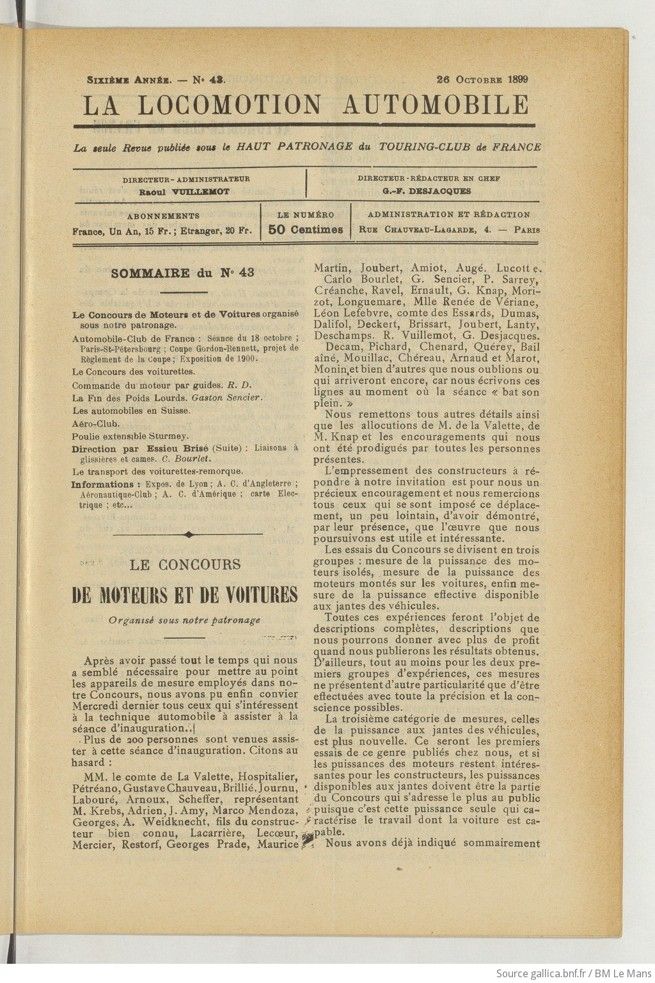
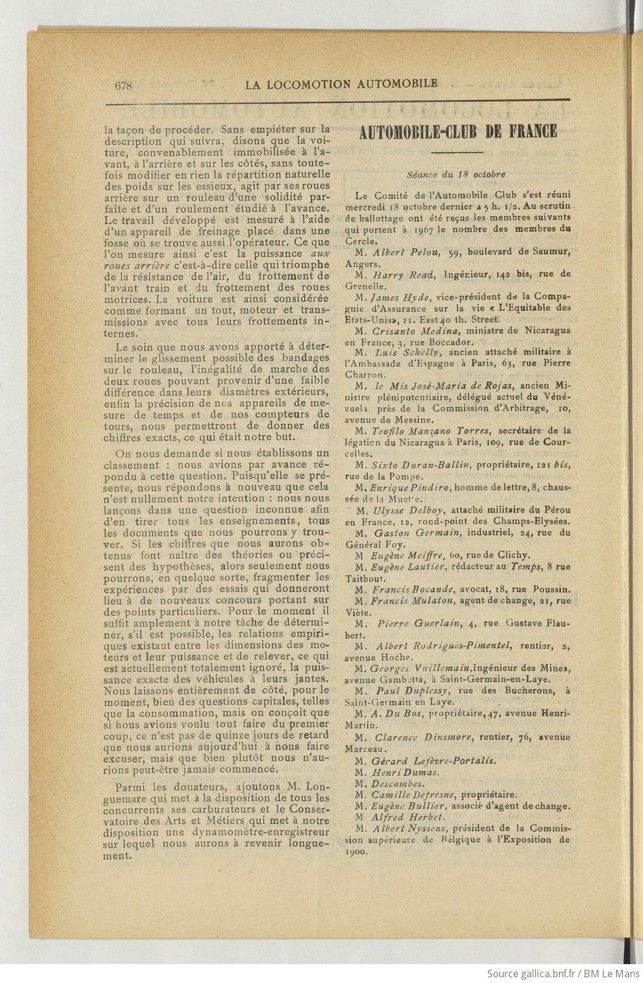
The regulations for the Gordon Bennett Cup races are published here in the Locomotion Automobile of end October 1899. About a month later, these also would be published in Le Vélo. To this date, it was the first version; a bit later, some modifications were added. Typical of the ACF is, that they would publish their minutes of meetings completely sequenced as these unfolded, meaning that the most interesting of all, the rules, came after the updated member list. (Translation).
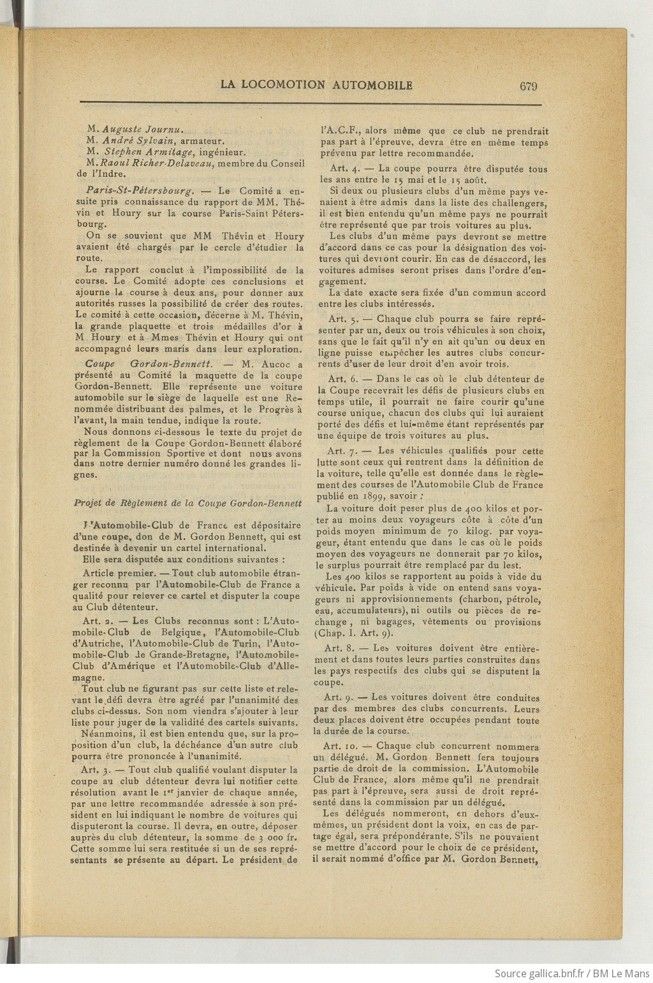
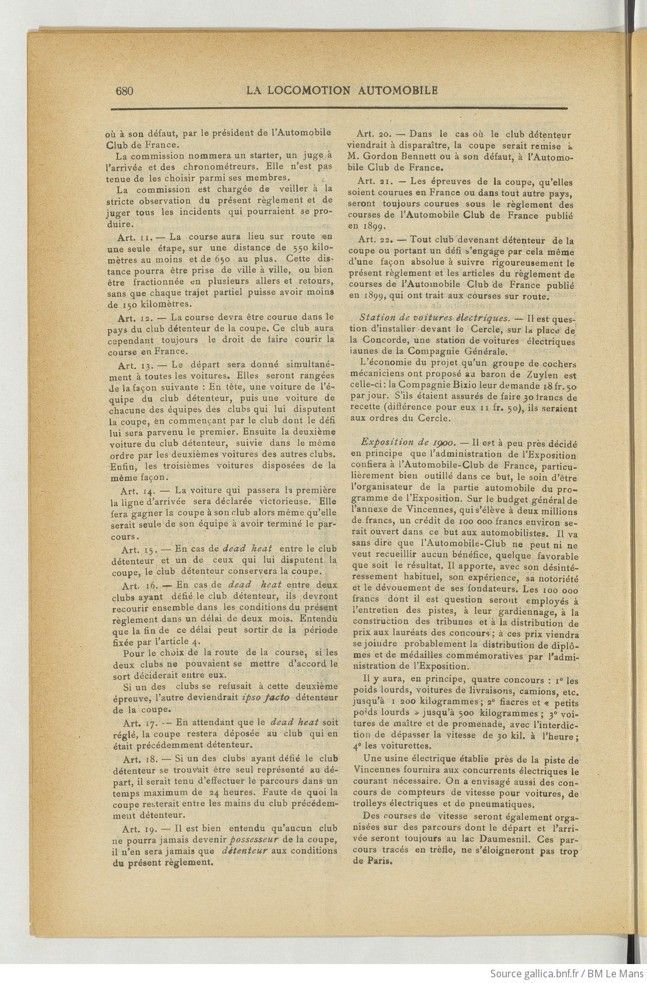
Text and photos with courtesy of the Bibliothèque national français, gallica.bnf.fr/ https://www.bnf.fr/fr
Compiled by motorracinghistory, translation by Deepl
La Locomotion Automobile, 6e Year, No. 43, October 26, 1899
AUTOMOBILE-CLUB OF FRANCE
Meeting of October 18.
The Automobile Club Committee met on Wednesday, October 18, at 5:30 p.m. The following members were admitted following a runoff vote, bringing the total number of Club members to 1,967.
Mr. Albert Pelou, 59 Boulevard de Saumur, Angers.
Mr. Harry Read, Engineer, 142 bis, rue de Grenelle.
Mr. James Hyde, Vice President of the life insurance company “L’Equitable des Etats-Unis,” 11 East 40th Street.
Mr. Crisanto Medina, Nicaraguan Minister to France, 3, rue Boccador.
Mr. Luis Schelly, former military attaché at the Spanish Embassy in Paris, 63 Rue Pierre Charron.
Mr. José-Maria de Rajas, former Minister Plenipotentiary, current delegate of Venezuela to the Arbitration Commission, 10 Avenue de Messine.
Mr. Teofilo Manzano Torres, Secretary of the Nicaraguan Legation in Paris, 109, rue de Courcelles.
Mr. Sixto Duran-Ballin, business owner, 121 bis, rue de la Pompe.
Mr. Enrique Pindiro, writer, 8, chaussée de la Muette.
Mr. Ulysse Delboy, military attaché of Peru in France, 12 Rond-point des Champs-Élysées.
Mr. Gaston Germain, industrialist, 24 Rue du Général Foy.
Mr. Eugène Meiffre, 60 Rue de Clichy.
Mr. Eugène Lautier, editor at *Le Temps*, 8 Rue Taitbout.
Mr. Francis Bocandé, attorney, 18 Rue Poussin.
Mr. Francis Mulaton, stockbroker, 21 Rue Viète.
Mr. Pierre Guerlain, 4 Rue Gustave Flaubert.
Mr. Albert Rodrigues-Pimentel, man of independent means, 2 Avenue Hoche.
Mr. Georges Vuillemain, Mining Engineer, Avenue Gambetta, in Saint-Germain-en-Laye.
Mr. Paul Duplessy, Rue des Bûcherons, in Saint-Germain-en-Laye.
Mr. H. Du Bos, property owner, 47 Avenue Henri-Martin.
Mr. Clarence Dinsmore, man of independent means, 76 Avenue Marceau.
Mr. Gérard Lefèvre-Portalis.
Mr. Henri Dumas.
Mr. Descombes.
Mr. Camille Defresne, property owner.
Mr. Eugène Ballier, partner in a brokerage firm.
Mr. Alfred Herbet.
Mr. Albert Nyssens, president of the Belgian High Commission at the 1900 Exposition.
Mr. Auguste Journu.
Mr. André Sylvain, shipowner.
Mr. Stephen Armitage, engineer.
Mr. Raoul Richer Delaveau, member of the Indre Council.
Paris–St. Petersburg. — The Committee then reviewed the report by Messrs. Thévin and Houry on the Paris–St. Petersburg race.
It will be recalled that Messrs. Thévin and Houry had been commissioned by the club to survey the route.
The report concluded that the race was impossible. The Committee adopted these conclusions and postponed the race for two years to give the Russian authorities time to establish roads. On this occasion, the Committee awarded Mr. Thévin the grand plaque and three gold medals to Mr. Houry and to Mrs. Thévin and Mrs. Houry, who accompanied their husbands on their exploration.
Gordon-Bennett Cup. — Mr. Aucoc presented the Committee with a model of the Gordon-Bennett Cup. It depicts a motor car on whose seat sits Fame, distributing palm branches, while Progress, at the front with an outstretched hand, points the way.
Below we present the text of the draft regulations for the Gordon-Bennett Cup drawn up by the Sports Commission, the main points of which we outlined in our last issue.
Draft Regulations for the Gordon-Bennett Cup
The Automobile Club of France is the custodian of a cup, a gift from Mr. Gordon Bennett, which is intended to become an international challenge cup.
It will be contested under the following conditions:
Article 1. — Any foreign automobile club recognized by the Automobile Club of France is eligible to accept this challenge and compete for the cup against the holding club.
Article 2. — The recognized clubs are: the Automobile Club of Belgium, the Automobile Club of Austria, the Automobile Club of Turin, the Automobile Club of Great Britain, the Automobile Club of America, and the Automobile Club of Germany.
Any club not included on this list that accepts the challenge must be approved unanimously by the clubs listed above. Its name will be added to their list for the purpose of determining the validity of subsequent challenges.
Nevertheless, it is understood that, upon the proposal of one club, the disqualification of another club may be declared by unanimous vote.
Art. 3. — Any qualified club wishing to challenge the cup-holding club must notify the latter of this intention before January 1 of each year, by registered letter addressed to its president, specifying the number of cars that will compete in the race. It must also deposit the sum of 3,000 francs with the cup-holding club. This sum will be refunded if one of its representatives appears at the starting line. The president of the A.C.F. must also be notified by registered letter, even if the club does not participate in the event.
Art. 4. — The cup may be contested annually between May 15 and August 1.
If two or more clubs from the same country are admitted to the list of challengers, it is understood that a single country may be represented by no more than three cars.
In this case, the clubs from the same country must agree on which cars will compete. In the event of a disagreement, the cars admitted will be selected in the order of entry.
The exact date will be set by mutual agreement among the clubs involved.
Art. 5. — Each club may be represented by one, two, or three vehicles of its choice; the fact that only one or two are on the starting line shall not prevent the other competing clubs from exercising their right to field three.
Art. 6. — In the event that the club holding the Cup receives challenges from several clubs in a timely manner, it may hold only a single race, with each of the challenging clubs and the cup-holding club itself represented by a team of no more than three cars.
Art. 7. — Vehicles eligible for this competition are those that meet the definition of a car as set forth in the racing regulations of the Automobile Club de France published in 1899, namely:
The car must weigh more than 400 kilograms and carry at least two passengers side by side, with a minimum average weight of 70 kilograms per passenger, it being understood that if the average weight of the passengers does not amount to 70 kilograms, the difference may be made up with ballast.
The 400 kilograms refer to the vehicle’s curb weight. Curb weight is defined as the weight without passengers, supplies (coal, petroleum, water, batteries), tools or spare parts, luggage, clothing, or provisions (Chap. I, Art. 9).
Art. 8. — The cars must be built entirely, in all their parts, in the respective countries of the clubs competing for the cup.
Art. 9. — The cars must be driven by members of the competing clubs. Both seats must be occupied throughout the entire duration of the race.
Art. 10. — Each competing club shall appoint a delegate. Mr. Gordon Bennett shall always be an ex officio member of the committee. The Automobile Club de France, even if it does not participate in the event, shall also be represented ex officio on the committee by a delegate.
The delegates shall appoint, from among themselves, a chairperson whose vote shall be decisive in the event of a tie. If they are unable to agree on the choice of this chairperson, he or she shall be appointed ex officio by Mr. Gordon Bennett, or, in his absence, by the president of the Automobile Club de France.
The committee shall appoint a starter, a finish-line judge, and timekeepers. It is not required to select them from among its own members.
The committee is responsible for ensuring strict compliance with these regulations and for adjudicating any incidents that may occur.
Art. 11. — The race will take place on public roads in a single stage, over a distance of at least 550 kilometers and no more than 650 kilometers. This distance may be measured from city to city, or divided into several round trips, provided that each leg is no less than 150 kilometers.
Art. 12. — The race must be held in the country of the club holding the cup. However, that club shall always have the right to hold the race in France.
Art. 13. — The start will be given simultaneously to all cars. They will be lined up as follows: At the front, a car from the cup-holding club’s team, followed by one car from each of the teams of the clubs challenging for the cup, beginning with the club whose challenge was received first.
Next will be the second car from the defending club, followed in the same order by the second cars from the other clubs. Finally, the third cars will be arranged in the same manner.
Art. 14. — The car that crosses the finish line first shall be declared the winner. It shall win the cup for its club even if it is the only car from its team to have completed the course.
Art. 13. — In the event of a dead heat between the defending club and one of the clubs challenging for the cup, the defending club shall retain the cup.
Art. 16. — In the event of a dead heat between two clubs that have challenged the defending club, they must compete together under the terms of these rules within two months. Provided that the end of this period may fall outside the timeframe set forth in Article 4.
Regarding the choice of race route, if the two clubs cannot reach an agreement, the matter shall be decided by lot. If one of the clubs refuses to participate in this second race, the other shall ipso facto become the holder of the cup.
Art. 17. — Pending the resolution of the dead heat, the cup shall remain with the club that previously held it.
Art. 18. — If one of the clubs that challenged the current holder is the only one represented at the starting line, it shall be required to complete the course within a maximum of 24 hours. Failing this, the cup shall remain in the possession of the club that previously held it.
Art. 19. — It is understood that no club may ever become the owner of the cup; it shall only ever be the holder thereof under the terms of these regulations.
Art. 20. — In the event that the holding club ceases to exist, the cup shall be handed over to Mr. Gordon Bennett or, in his absence, to the Automobile Club de France.
Art. 21. — The races for the cup, whether held in France or in any other country, shall always be conducted in accordance with the racing regulations of the Automobile Club de France published in 1899.
Art. 22. — Any club that becomes the holder of the cup or issues a challenge thereby undertakes, in an absolute manner, to strictly adhere to these regulations and to those articles of the Automobile Club de France’s racing regulations published in 1899 that pertain to road races.