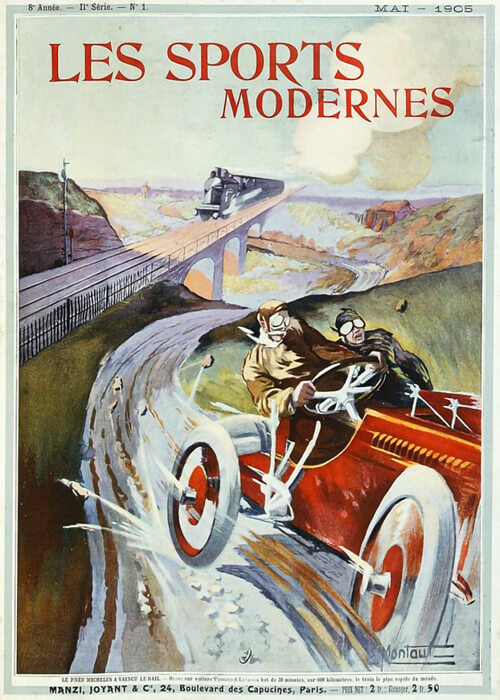
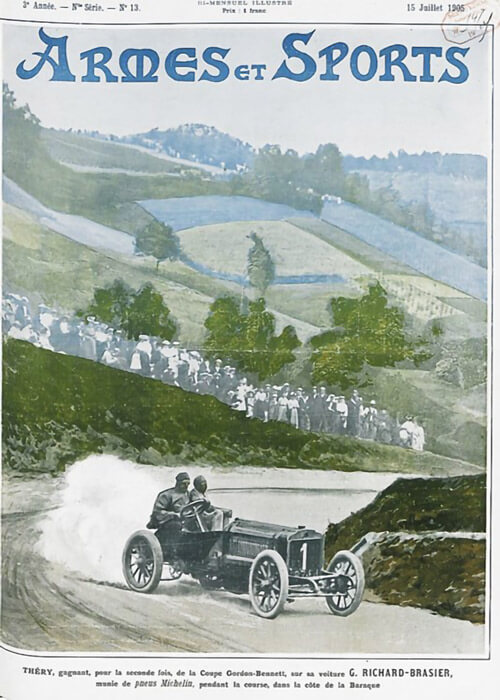
At the end of December 1904, the French Autombile Club, as well as several manufacturers and drivers gathered to discuss organising for 1905 a new event, a Grand Prix de l’ACF on a separate and guarded circuit, on the same day as the Gordon Bennet Cup. The magazine L’Auto would make 100.000! Francs available as a first prize award. What’s more, from 1906 on, the French automobile industry would not participate anymore in the Gordon Bennett Cup races. As second item on this ACF meeting, was the choice for the course of the 1905 Elimination trials and for the race itself.

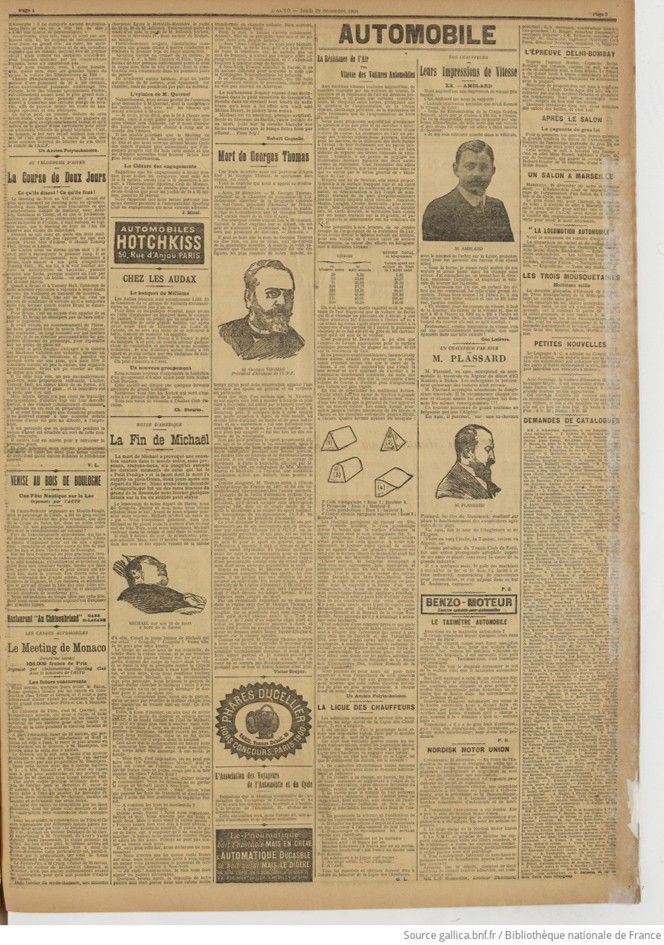
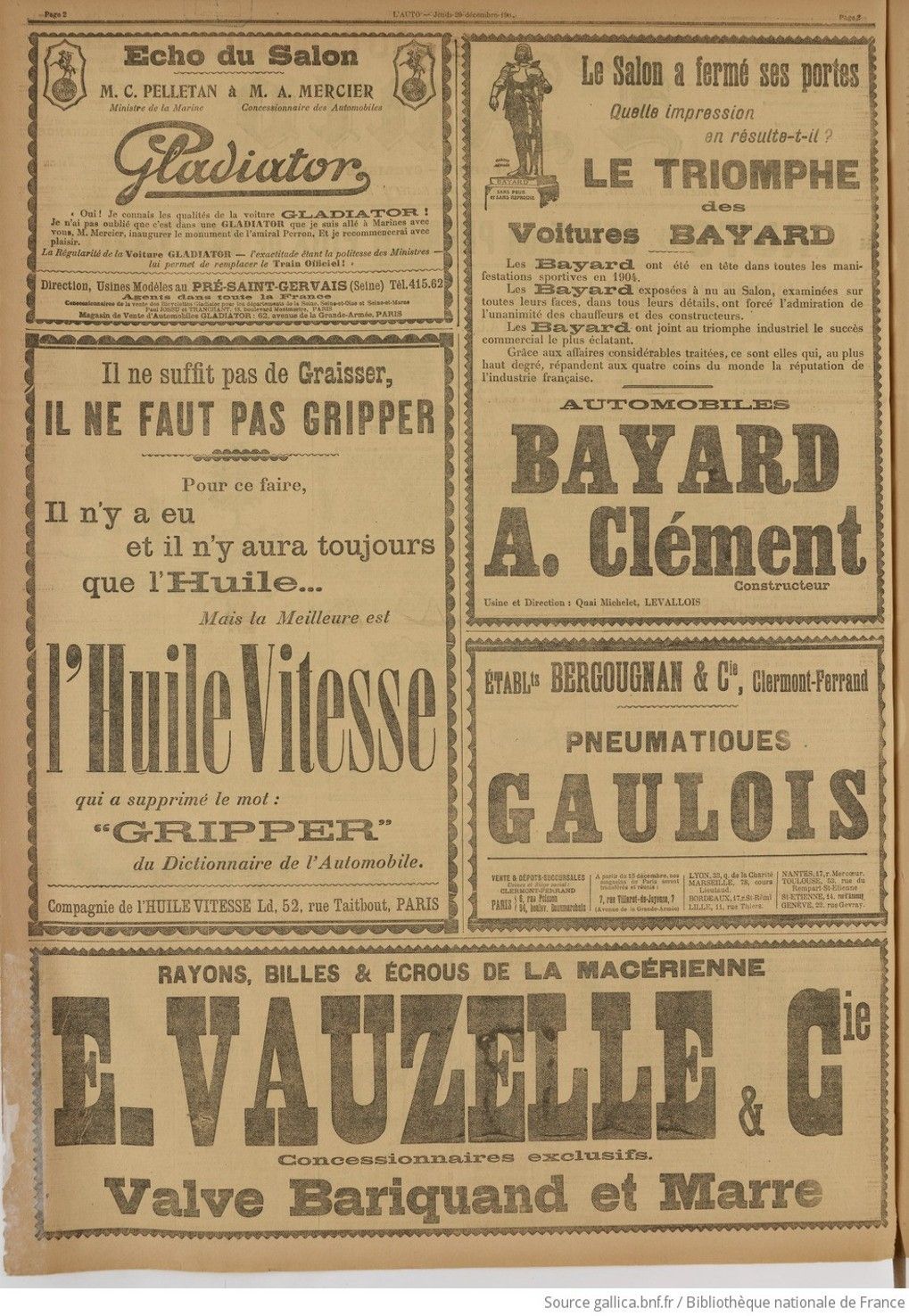

With permission of the Bibliothèque national francais gallica.bnf.fr
Text and photos compiled by motorracinghistory, translation by DeepL deepl.com
L’Auto — 5th Year, No. 1535, December 29, 1904 – Part 1
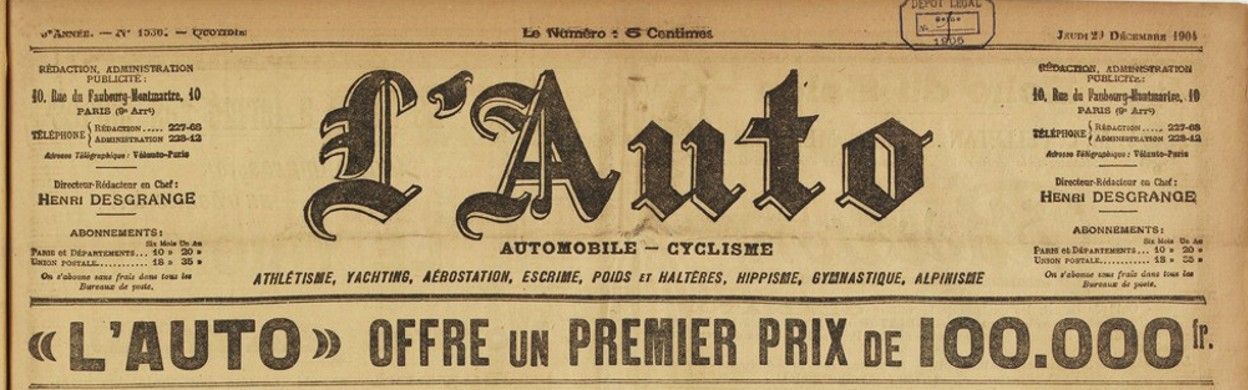
“L’AUTO” OFFERS A FIRST PRIZE OF 100,000 FRANCS.
A HISTORIC DAY AT THE A. C. F.
The Gordon Bennett Cup in 1905. – The A.C.F. Grand Prix.
CHOICE OF THE AUVERGNE CIRCUIT
The Automobile Club de France takes up the cause of French manufacturers. The Cordon Bennett Cup will be run in 1905, but framed by an international event with a fair formula. – Creation of the A.C.F. Grand Prix. The choice of the Circuit d’Auvergne. – The rules of the Qualifying Heats. The question of licenses and drivers.
We shall see later with what authority, with what skill, and with what concern, too, the Automobile Club de France has once again been able to look after the interests of the French automobile industry. It has found a way to reconcile these interests with the utmost courtesy and the utmost propriety.
The Gordon-Bennett Cup will be run this year and will have to undergo modifications for 1906 in relation to the size of our factories and our production, and also in relation to the simplest form of justice.
This year, we will have run on the same day as the Gordon Bennett Cup, a Grand Prix of the Automobile Club de France, a sensational international event for which entries will be free, subject to a maximum representation for each brand.
It is the return, but this time under conditions of absolute safety, on a well-guarded circuit, to the major open motor racing events such as Paris-Berlin and Paris-Vienna.
L’Auto wanted, in its own way, to celebrate such an important event in the history of motor racing and it immediately decided to award the 1905 Grand Prix of the Automobile Club de France, created yesterday by the A. C. F., with a first prize of One hundred thousand francs
We have also decided to have two gold medals struck, also donated by L’Auto, which will be transferable in 1906 and subsequent years to the successive winners of the Automobile Club de France Grand Prix.
Tomorrow, we will give our readers all the details concerning the awarding of this first prize of one hundred thousand francs and we will explain how we hope to increase this sum and create even more prizes. For now, it is enough that we have given the automobile industry this token of our admiration and devotion.
L’AUTO.
A DECISIVE ACT
L’Auto was right to write, last May, that the Automobile Club de France would, when the time was right, take up the cause of French manufacturers, whose rights were disregarded by the unfairness of the current Gordon Bennett Cup regulations.
This has been done since yesterday. The A.C.F. committee has acted with admirable vigor, while managing to keep the commitments it made in 1904 when it accepted the trophy won at Taunus by Théry’s Richard-Brasier.
It is common knowledge that all informed minds had already noticed the extraordinary injustice of a rule that allowed a small nation, new to the automotive industry, to be represented by three cars of the same brand, the only brand it had, while the French industry, so formidable, so rich in major construction centers, was forced to force its manufacturers to fight each other first, to arrive at presenting only three selected vehicles of the kind.
And so it was that our greatest brands, those that have done the most to ensure the French automotive industry’s place at the top of the world market, were denied, by the inevitable hazards of a preparatory race, the right to take part in the international battle, the right to defend our industrial colors that they have contributed so much to imposing on the whole world for more than ten years!
On the morning of the 1904 qualifiers, L’Auto said out loud what everyone was thinking, and in recent days, as public opinion was once again stirred by an intolerable state of affairs, we repeated: the Automobile Club de France is there and will act when the time comes.
The time has come. It was only yesterday that the Automobile Club de France committee met to discuss the organization of the Eliminatoires and the 1905 Gordon-Bennett Cup, so it was only yesterday that it was necessary to act vigorously.
The matter had been under discussion for many months. The decisive act took only a few minutes to accomplish. It is no less crucial for that.
It was impossible for the Automobile Club de France and the manufacturers it covers with its flag to renege on the honorary commitment made in 1904, when they agreed to play a big game with so few trumps in their hands, when they agreed to try their luck with a chivalrous spirit full of danger.
We brought the Cup back to France; we placed it in the place of honor in the salons of the A.C.F., and in doing so we made a moral commitment to put it back into play in 1905, under the same regulations, so terrible and so burdensome for our industry.
The manufacturers understood this well, and the A.C.F. did not fail in its word yesterday.
The Gordon-Bennett Cup will be raced this year in Auvergne, as it was raced in Taunus. But, alongside the cars selected by each country that will compete for the international trophy, we will see a major international race involving other cars, representing all makes in equal numbers, believing they have a chance of triumphing in this gigantic struggle.
And while racing for the Cup, the “defenders” and “challengers” cars will also be participating in the international race classification. So much for 1905. But the same does not apply for 1906.
In 1906, France will no longer have any honor to uphold, it will no longer be in the strict necessity of applying itself regulations that it disapproves of.
Therefore, the Automobile Club de France yesterday solemnly declared, in a vote cast unanimously by the members of its committee, that in 1906 France, which it represents, will not take part in the Gordon-Bennett Cup, if the regulations are not made fairer.
And at the same time, the A.C.F., which has not forgotten the vital need for the “race” for manufacturers and the entire automotive industry, announced the creation of a Grand Prix de l’Automobile Club de France, an annual grand prix, a classic grand prix, a true grand prix of the entire automotive world.
This is what the Automobile Club de France did yesterday afternoon.
In light of this act, all the other decisions made during the same session take a back seat.
Whether we go to Auvergne, whether the regulations for the Eliminatory and the Cup are what we want in 1905, it matters little to us today: French industry has just avoided the dangerous pitfall that could stand in its way; French manufacturers are no longer designated to be the unjust victims of a truly abominable state of affairs. The Automobile Club de France and its directors have once again shown that they are highly worthy of the difficult task they have taken on with rare authority, and that we can rely on them completely: our national industry is in safe hands that will be able to maintain its prestige and supremacy
Géo Lefèvre.
THE COMMITTEE MEETING
Further on, you will read the official communiqués from the Automobile Club de France Committee concerning the French Eliminations and the Gordon Bennett Cup.
In the eloquent brevity of these minutes, one finds a faithful summary of the important work of yesterday’s session.
Without listening at the doors, we were nevertheless able to obtain fairly precise information on the various incidents – very simple ones, moreover – of this historic session.
The discussion then turned to the question of the choice of a circuit.
The Sports Commission, through its chairman, Mr. René de Knyff, clearly indicated that the choice of the Auvergne circuit seemed to be imposed on the Committee by its vote on June 29th.
The Auvergne Circuit presents all the difficulties required to ensure the victory of the car that is not only the fastest, but also the most flexible and the most maneuverable.
In Auvergne, it will not only be a question of climbing very tough hills; all cars, with current engines, can do so, making light work of this illusory difficulty.
What is needed is a course that requires numerous and rapid braking, constant gear changes, and continual clutch use.
The Auvergne Circuit allows for all of this.
Mr. Brasier then took the floor to indicate that he, as a constructor, preferred the Circuit des Ardennes, as the Auvergne Circuit was really dangerous and allowed certain drivers to practice the “traffic jam” maneuver in a rather large part of the course. Nevertheless, the hero of the 1904 Gordon Bennett Cup then declared that he would go along with the majority opinion.
The Marquis de Chasseloup-Laubat replied immediately to defend the opinion of the Sporting Commission and to suggest an easy remedy for the traffic jam maneuver.
All that would be needed would be to cordon off the entrance to the dangerous part and only allow the cars to leave at intervals, giving each of them full freedom of action.
And on this point, Mr. René de Knyff replied that the sports commission would agree, if necessary, to the proposal of the Marquis de Chasseloup-Laubat, but that he believed the precaution to be unnecessary until further notice.
And on that basis, the Circuit d’Auvergne was voted unanimously, not without the president of the A.C.F., Mr. Baron de Zuylen, having read a declaration from the mayor of Clermont-Ferrand and Mr. Michelin, guaranteeing a subsidy of 200,000 francs.
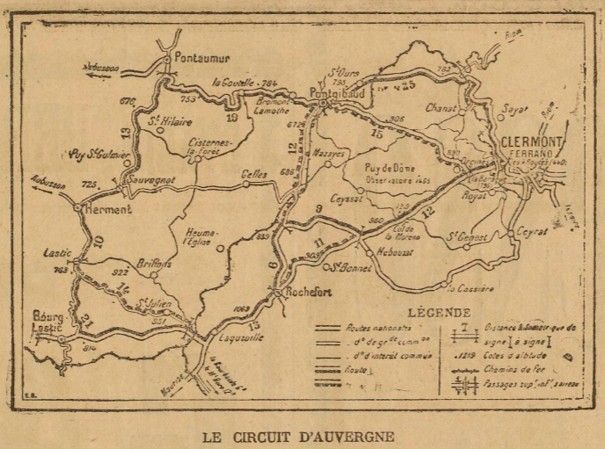
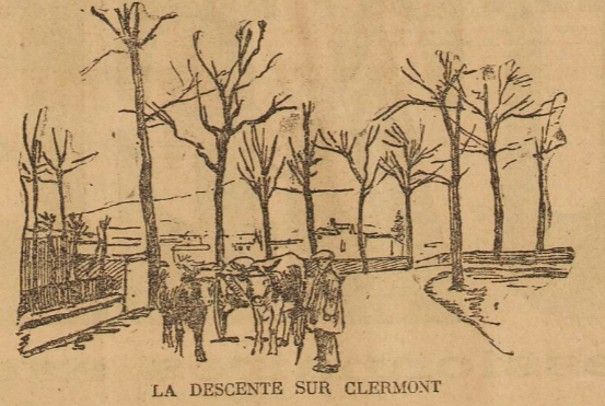
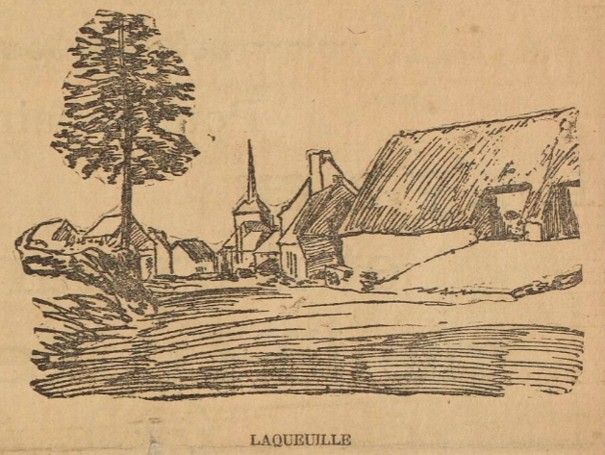
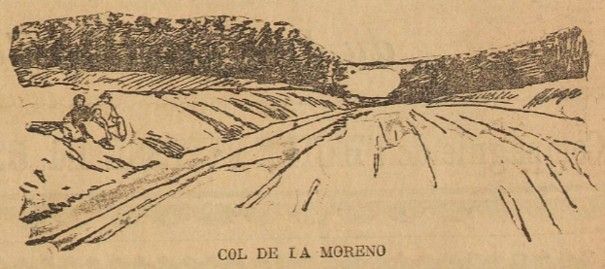
Photos. The Circuit of Auvergne – The Descent to Clermont – Laqueuille – Pass of the Moreno
The complete regulations for the French Eliminatoires can be found below.
The points that seem most important to us are as follows:
1. The entry fee remains at 10,000 francs; our manufacturers will take comfort in the thought that they will be able to race in a Grand Prix of the Automobile Club de France, even if they are not called upon to race in the Gordon Bennett Cup.
2. Any manufacturer entering one or more cars must have manufactured the engine and transmission.
3° Measures will be taken to prevent drivers from bargaining and to avoid last-minute hiring of drivers already engaged.
4° Measures will also be taken to ensure as far as possible that French cars are driven by French drivers, and to prevent these French drivers from driving cars of another nationality in the Gordon Bennett Cup or in foreign Eliminations.
* * * * * *
And once these regulations had been adopted, the board moved on to the momentous resolutions, which we discussed at length above.
The Marquis de Chasseloup-Laubat took the floor and explained that the board of directors had endorsed the proposals he had developed before them and that he would present them again to the committee.
The Marquis de Chasseloup-Laubat then went on to describe the ridiculous situation created by the current Gordon Bennett Cup regulations for French constructors, and even for constructors belonging to nations with a very powerful automotive industry.
He then destroyed the parallel that some had tried to draw between the America’s Cup and the Gordon Bennett Cup, the America’s Cup being a purely sporting event, with no commercial interests at stake and always contested with equal chances between the challenger and the defender.
The Gordon Bennett Cup is a very special event, the rules of which must include many different elements that are not included today. These regulations must be radically reformed, or France will no longer be able to accept them.
It goes without saying that these modifications could only concern the 1906 Gordon Bennett Cup.
And so the Marquis de Chasseloup-Laubat presented the draft resolutions that appear in the minutes, the full text of which is given below and the extreme importance of which is commented on above.
The committee then decided, and finally, to maintain the Chasseloup-Laubat Cup for the French qualifiers. That was all, and that was enough. The committee of the Automobile Club de France had held a meeting that will go down in history.
G. L.