Since the initial Petit Journal contest of 1894, Paris was undisputedly the automobile capital. But some years later, Bordeaux more and more played an automotive role. In the May 1899 “Semaine Bordeaux” event, two “courses automobiles” were organized, that are reported in the article. Paris-Périgueux-Paris race, organized among others by “Le Vélo” (again, a newspaper), was the one-day festival opener over some 210 km, that was won by Henri Barbereauu in a Léon Bollé at a rate of some 56 kmh! Then came the Paris-Bordeaux race over 565 km, won by Ferrnand Charron in a Panhard&Levassor averaging about 48 kmh. The first three places were swept by Panhard&Levassor vehicles; one would say of course (in those years). This report gives a comprehensive summary of that week.

With permission of the Bibliothèque national francais gallica.bnf.fr
Text and photos compiled by motorracinghistory, Translation by DeepL deepl.com
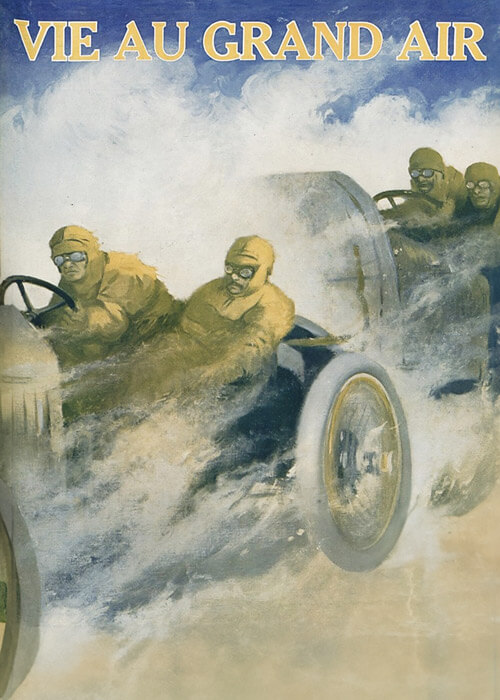
La Vie au Grand Air – No. 38, June 4, 1899
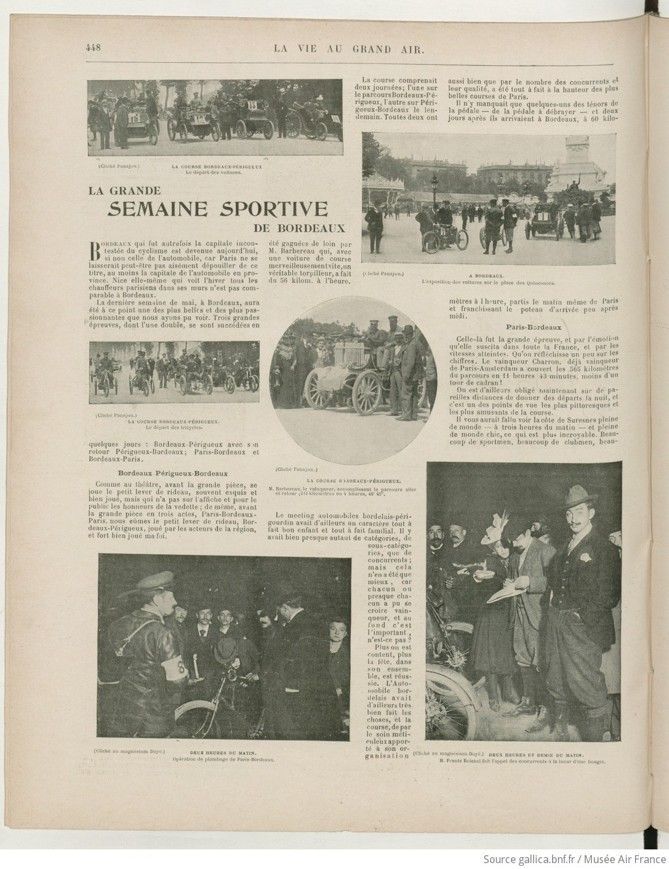
THE GREAT SPORTS WEEK IN BORDEAUX
Bordeaux, which was once the undisputed capital of cycling, has now become—if not the capital of the automobile (since Paris might not readily relinquish that title)—at least the provincial capital of the automobile. Not even Nice—which welcomes all the Parisian drivers within its walls every winter—can compare to Bordeaux.
The last week of May in Bordeaux was truly one of the most beautiful and exciting we have ever witnessed. Three major races, one of which was a doubleheader, took place in quick succession over the course of a few days: Bordeaux–Périgueux, with its return leg from Périgueux to Bordeaux; Paris–Bordeaux and Bordeaux–Paris.
Bordeaux Périgueux-Bordeaux
Just as in the theater, before the main event, there is a short curtain-raiser—often exquisite and well-performed—but one that does not receive the star treatment on the program or in the eyes of the audience; similarly, before the main three-act play, Paris–Bordeaux–Paris, we had the little curtain-raiser, Bordeaux–Périgueux, performed by local actors—and very well done, I must say.
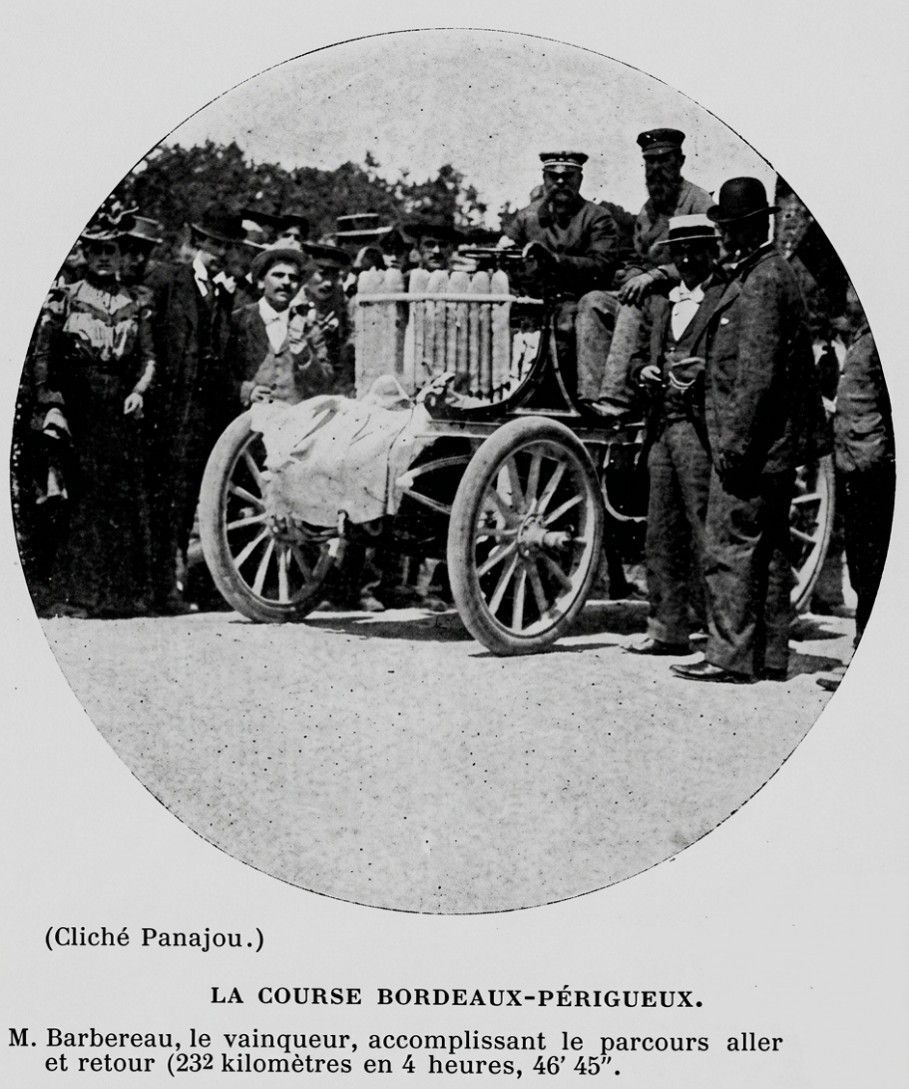
The race spanned two days: one on the Bordeaux–Périgueux route, the other on the Périgueux–Bordeaux route the following day. Both were won by a wide margin by Mr. Barbereau, who, in a wonderfully fast race car—a veritable torpedo—reached speeds of 56 kilometers per hour.
The Bordeaux-Périgord automobile meet, moreover, had a thoroughly good-natured and family-friendly atmosphere. There were almost as many categories and subcategories as there were competitors; but that only made it better, since almost everyone could feel like a winner—and in the end, that’s what matters, isn’t it?
The happier everyone is, the more successful the event is overall. The Bordeaux Automobile Club had, in fact, organized everything very well, and the race—thanks to the meticulous care taken in its organization as well as the number and caliber of the competitors—was every bit as impressive as the finest races in Paris.
The only ones missing were a few of the top cyclists—those who ride with a clutch—and two days later they arrived in Bordeaux at 60 kilometers per hour, having left Paris that very morning and crossed the finish line shortly after noon.
Paris-Bordeaux
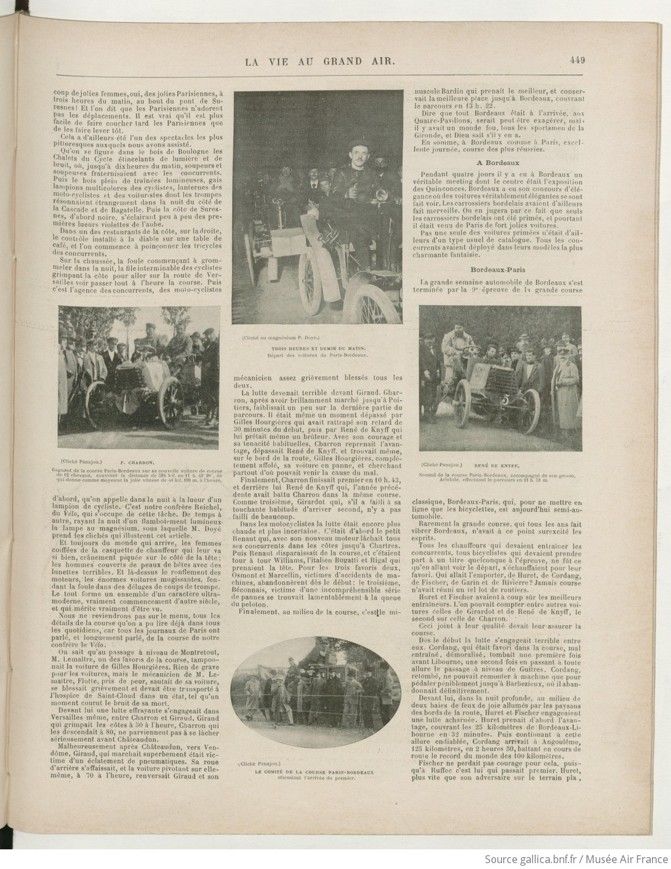
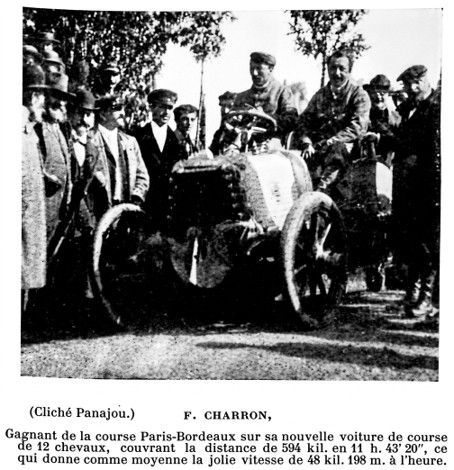
That was the great race, both for the excitement it stirred throughout France and for the speeds achieved. Let’s consider the numbers for a moment. The winner, Charron—who had already won Paris–Amsterdam—covered the 565-kilometer course in 11 hours and 43 minutes, less than a full hour!
In fact, for such long distances, races now have to start at night, and this is one of the most picturesque and entertaining aspects of the race.
You should have seen the Suresnes waterfront packed with people—at three in the morning—and packed with chic people, which is even more incredible. Lots of athletes, lots of club members, lots of pretty women—yes, pretty Parisian women—at three in the morning, at the end of the Suresnes Bridge! And people say that Parisian women don’t like to go out. It’s true that it’s easier to get Parisian women to stay up late than to get them up early. That, incidentally, was one of the most picturesque sights we witnessed. Just imagine the Chalets du Cycle in the Bois de Boulogne, sparkling with light and noise, where, until ten in the morning, revelers mingled with the competitors. Then the woods, full of trails of light—the cyclists’ cheerful multicolored lanterns, the lanterns of motorcyclists and motorists whose horns echoed strangely through the night near the Cascade and Bagatelle. Then the Suresnes Hill, at first pitch-black, gradually lighting up with the first violet glimmers of dawn. In one of the restaurants on the hill, on the right, the checkpoint was haphazardly set up on a café table, and they began punching the competitors’ tricycles.
On the road, the crowd began to grumble in the night as the endless line of cyclists climbed the hill to head toward the road to Versailles to watch the race pass by shortly. Then came the competitors’ registration area—the motorcyclists first—who were called out into the night by the glow of a cyclist’s lantern. It is our colleague Reichel, from Vélo, who is in charge of this task. From time to time, the magnesium lamp cuts through the night with a brilliant flash, under which Mr. Doyé takes the photographs that illustrate this article.
And people are still arriving—women wearing the chauffeur’s caps that suit them so well, boldly perched on the side of their heads; men clad in animal skins and sporting formidable glasses. And against this backdrop, the roar of engines, the enormous, bellowing cars plowing through the crowd amid a deluge of honking. The whole scene forms an ultra-modern spectacle, truly the dawn of a new century, and one that is truly worth seeing.
We won’t go over the details of the race again—all the details have already been reported in every daily newspaper—since all the Parisian papers have covered, and covered at length, the race organized by our colleague, *Le Vélo*. It is known that at the Montretout railroad crossing, Mr. Lemaître, one of the race favorites, collided with Gilles Hourgières’s car. There was no serious damage to the cars, but Mr. Lemaître’s mechanic, Flotte, overcome by fear, jumped out of his car, was seriously injured, and had to be transported to the Saint-Cloud hospital in such a condition that for a moment rumors circulated that he had died.
Ahead of him, a terrifying battle was unfolding right in Versailles itself between Charron and Giraud. Giraud, who was climbing the hills at 50 à l’heure, and Charron, who was descending them at 80, were unable to pull away from each other significantly until they reached Châteaudun.
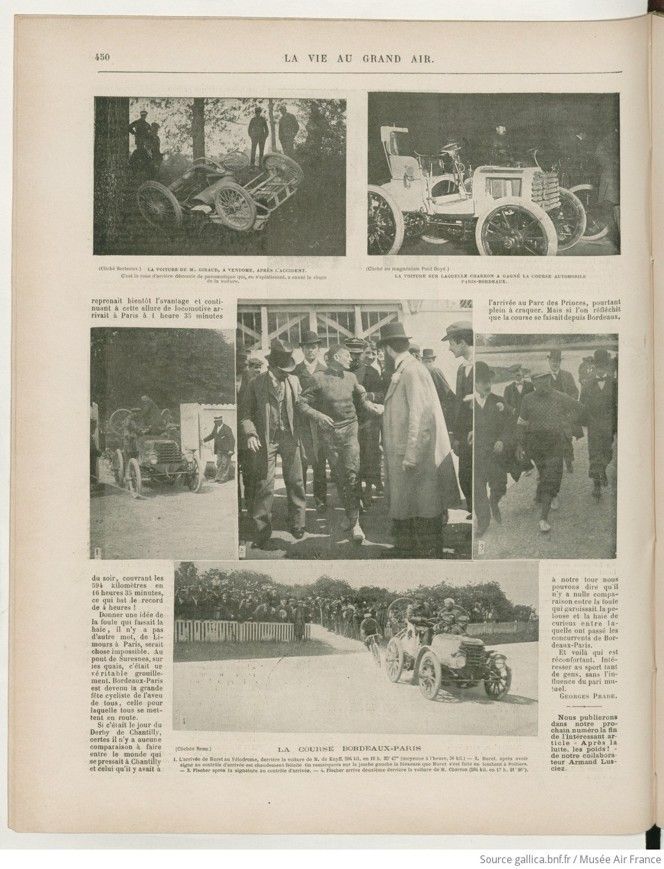
Unfortunately, after Châteaudun, near Vendôme, Giraud—who had been driving superbly—suffered a tire blowout. His rear tire collapsed, and the car spun out of control at 70 à l’heure, overturning and seriously injuring both Giraud and his mechanic.
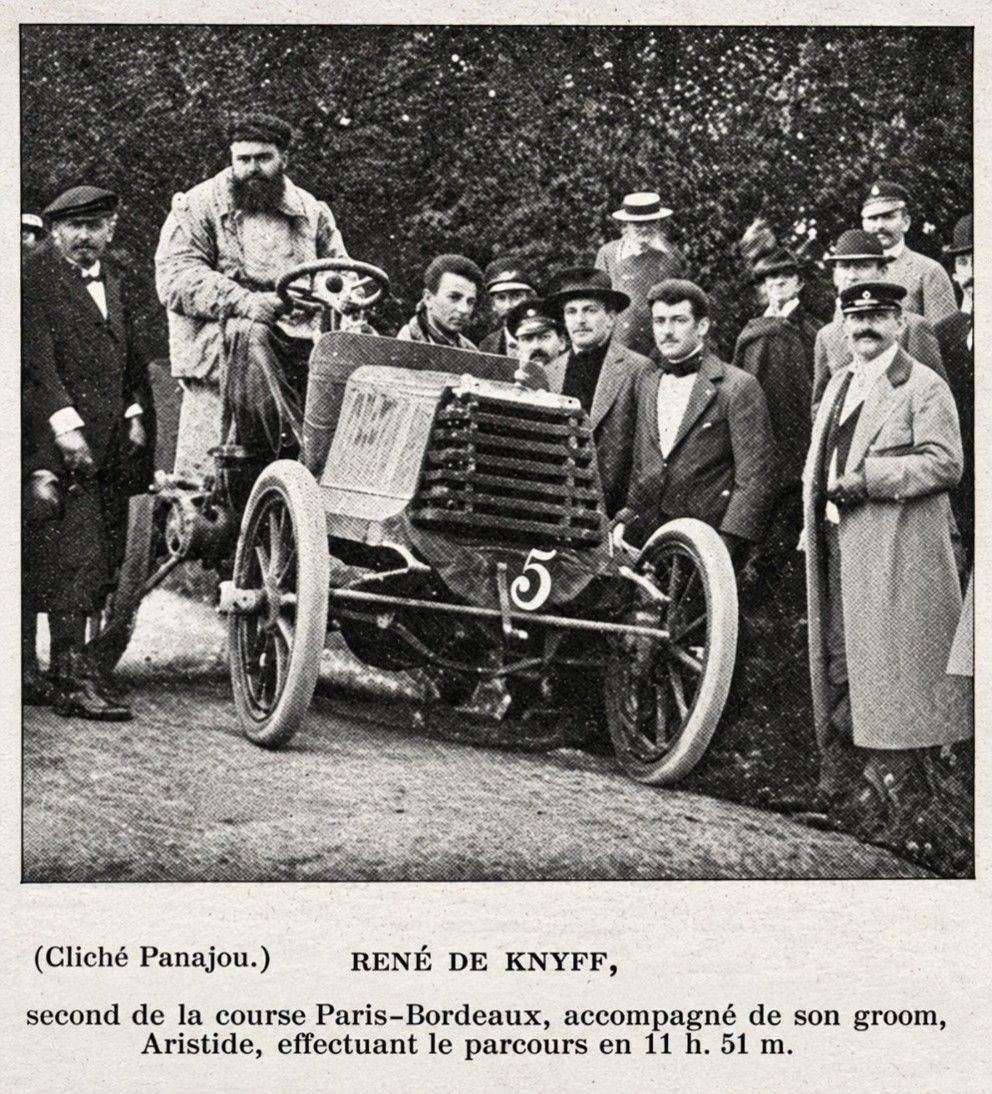
The battle became fierce ahead of Giraud. Charron, after driving brilliantly all the way to Poitiers, began to falter slightly on the final stretch of the course. For a moment, he was even overtaken by Gilles Hourgières, who had made up the 30-minute deficit he’d had at the start, and then by René de Knyff, who even lent him a burner. With his usual courage and tenacity, Charron regained the lead, passed René de Knyff, and even found Gilles Hourgières by the side of the road, completely distraught, his car broken down, and searching everywhere for the cause of the problem.
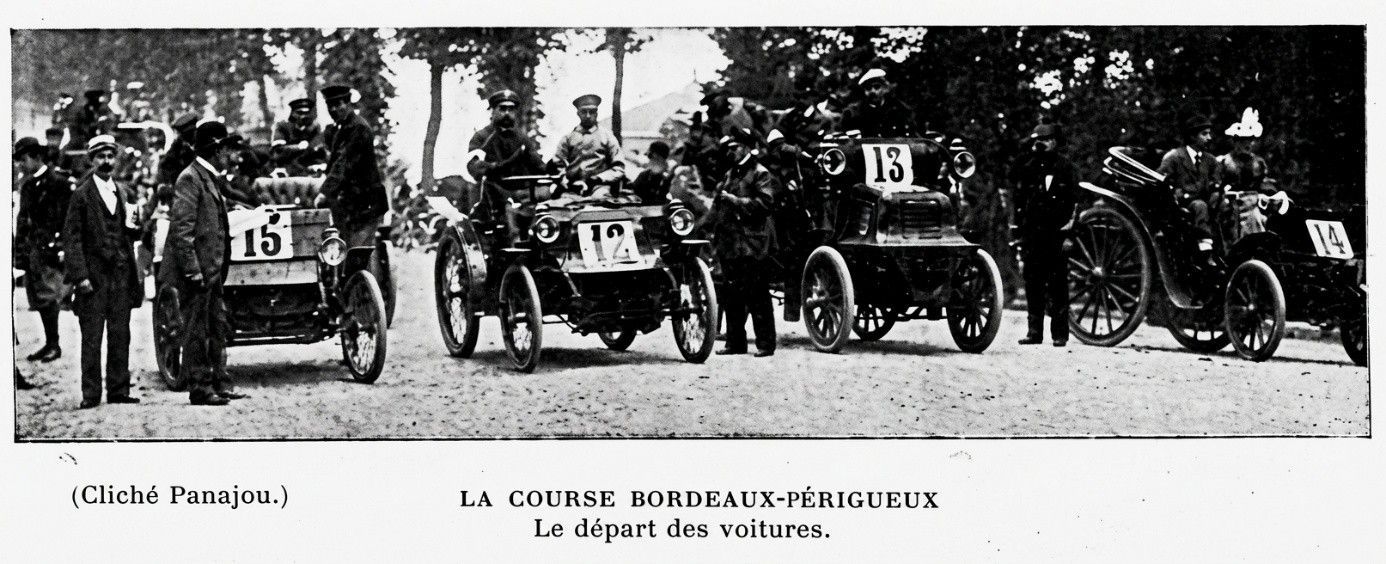
In the end, Charron finished first in 10 hours, 43 minutes, followed by René de Knyff, who had beaten Charron in the same race the previous year. Coming in third was Girardot, who, while falling short of his endearing habit of finishing second, came very close.
Among the motorcyclists, the battle was even fiercer and more unpredictable. At first, it was the young Renaut who, with his new engine, left all his competitors in the dust on the climbs leading up to Chartres. Then Renaut dropped out of the race, and Williams, the Italian Bugatti, and Rigal took the lead in turn. Of the three favorites, two—Osmont and Marcellin—were forced to retire early due to mechanical failures; the third, Béconnais, plagued by a baffling string of breakdowns, found himself lamentably at the back of the pack.
Finally, halfway through the race, it was the diminutive Bardin who took the lead and held it all the way to Bordeaux, covering the course in 13 hours and 22 minutes. To say that all of Bordeaux was at the finish line at the Quatre-Pavillons might be an exaggeration, but there was a huge crowd—all the sportsmen from the Gironde, and God knows there are plenty of them.
All in all, in Bordeaux as in Paris, it was an excellent day and a highly successful race.
In Bordeaux
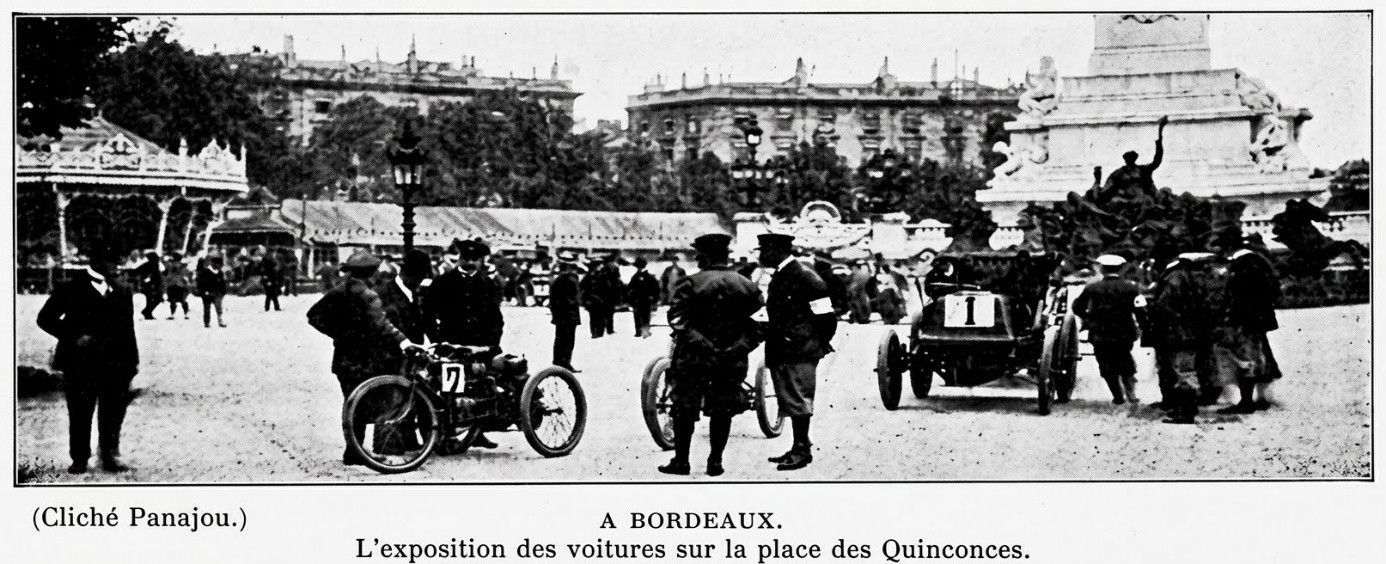
For four days, Bordeaux hosted a veritable gathering centered around the Quinconces exhibition. Bordeaux held its own elegance contest, where truly elegant cars were on display. The Bordeaux coachbuilders, in fact, had done a marvelous job. This is evident from the fact that only the Bordeaux coachbuilders received awards, even though some very attractive cars had come from Paris.
Not a single one of the award-winning vehicles was a standard catalog model. All the competitors had displayed the most charming creativity in their designs.
Bordeaux-Paris
Bordeaux’s great automobile week concluded with the 9th edition of the classic race, Bordeaux-Paris, which—to mention only bicycles—is now a semi-automobile race.
Rarely has the great race, which thrills Bordeaux every year, stirred such excitement.
All the drivers who were to drive the competitors, all the cyclists who were to take part in the race in any capacity—even if only to watch the start—were cheering on their favorite. Who would win: Huret, Cordang, Fischer, Garin, or Rivière? Never had a race brought together such a field of road racers.
Huret and Fischer undoubtedly had the best coaches. Among the other teams were those of Girardot and René de Knyff, the latter riding for Charron.
This, combined with their skill, was sure to secure them the race.
From the very start, a fierce battle raged between them. Cordang, who was the favorite in the race but was poorly trained and demoralized, fell once before Libourne and a second time as he sped through the Guitres railroad crossing. Cordang, having fallen again, could only get back on his bike to pedal laboriously as far as Barbezieux, where he finally gave up.
Ahead of him, in the dead of night, amid two rows of bonfires lit by farmers along the roadside, Muret and Fischer engaged in a fierce battle. Huret initially took the lead, covering the 25 kilometers from Bordeaux to Libourne in 32 minutes. Then, continuing at this breakneck pace, Cordang reached Angoulême—125 kilometers—in 2 hours and 50 minutes, breaking the 100-kilometer world record along the way.
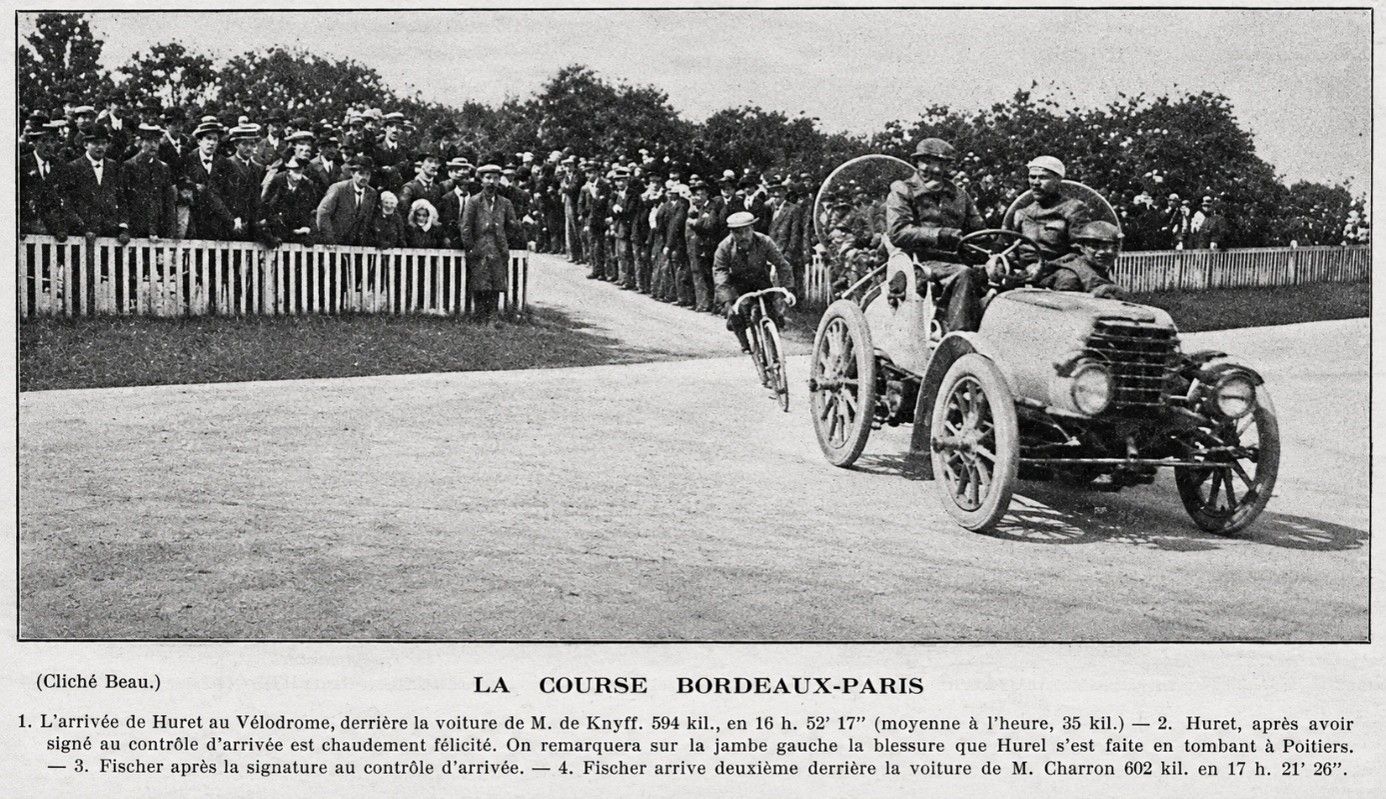
Fischer did not lose heart, however, as he was the first to pass through Ruffec. Huret, faster than his opponent on flat terrain, soon regained the lead and, continuing at this locomotive-like pace, arrived in Paris at 1:35 p.m., covering the 594 kilometers in 16 hours and 35 minutes—breaking the record by 4 hours !
It would be impossible to convey the sheer size of the crowd—there is no other word for it—lining the route from Limours to Paris. At the Suresnes bridge, along the riverbanks, it was a veritable swarm of people. Bordeaux-Paris has become, by all accounts, the great cycling festival—the one for which everyone sets out.
If it had been the day of the Chantilly Derby, there would certainly be no comparison between the crowds thronging Chantilly and those at the finish line at the Parc des Princes—which was nonetheless packed to the brim. But when you consider that the race started in Bordeaux, we, in turn, can say that there is no comparison between the crowd filling the lawn and the line of onlookers through which the Bordeaux-Paris competitors passed.
And that is heartening. To get so many people interested in the sport, without the influence of pari-mutuel betting.
GEORGES PRADE
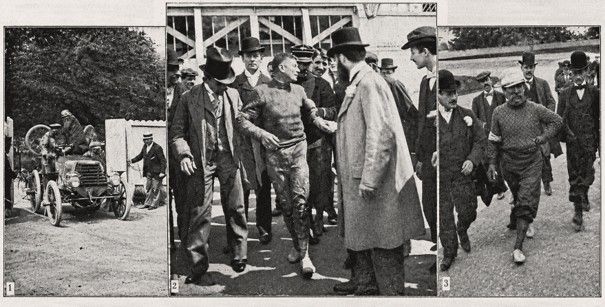
1. Huret’s arrival at the Velodrome, behind Mr. de Knyff’s car. 594 km in 16 h 35′ 47″ (average speed: 36 km/h) — 2. Huret, after signing in at the finish line, is warmly congratulated. Note the injury on his left leg that Huret sustained when he fell in Poitiers. — 3. Fischer after signing in at the finish line. — 4. Fischer finishes second behind Mr. Charron’s car (594 km in 17 h 21′ 26″). Photos modified by AI.
Photos.
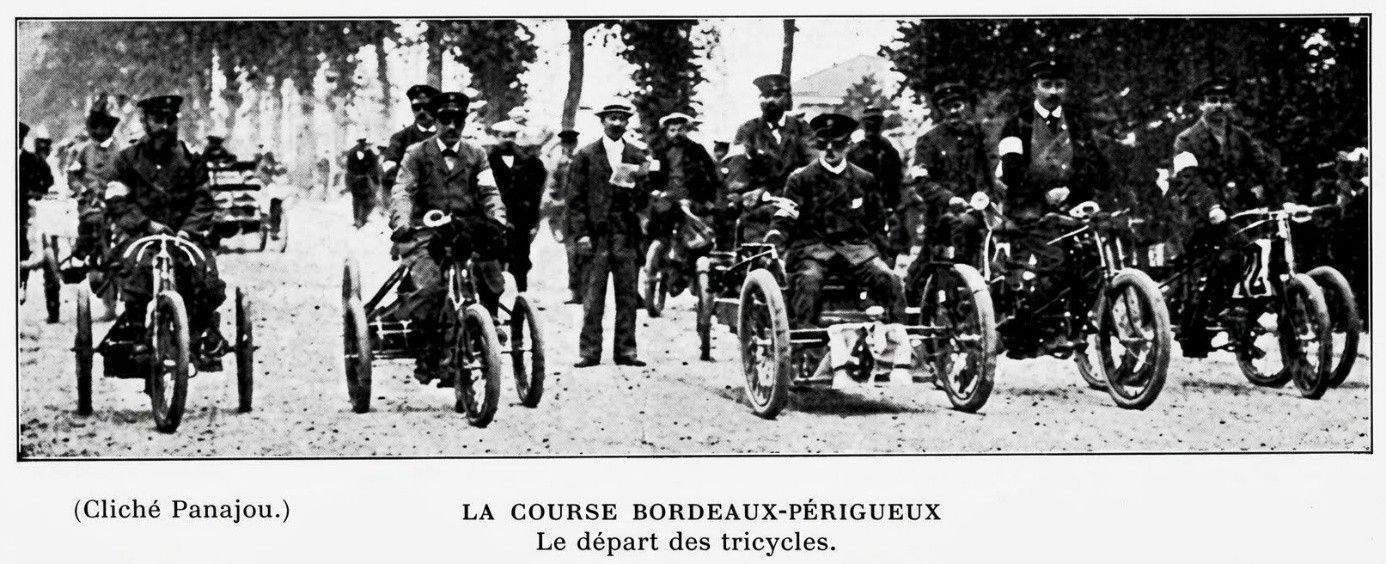
THE BORDEAUX-PÉRIGUEUX RACE. The tricycles set off. (Photo by Panajou.)
THE BORDEAUX-PÉRIGUEUX RACE. The cars set off. (Magnesium print by Doyé.)
TWO O’CLOCK IN THE MORNING. Sealing operation for the Paris-Bordeaux race. (Photo by Panajou.)
THE BORDEAUX-PÉRIGUEUX RACE. Mr. Barbereau, the winner, completing the round trip in 4 hours, 46 minutes, and 45 seconds.
IN BORDEAUX. The car exhibition on the Place des Quinconces.
2:30 A.M. Mr. Frantz Reichel avoids the competitors’ roll call by candlelight. (Magnesium photograph by Doyé.)
Page 449.
F. CHARRON, winner of the Paris-Bordeaux race in his new 12-horsepower race car, covering the distance of 594 kilometers in 11 hours, 43 minutes, and 20 seconds, which works out to an average speed of 48 kilometers and 198 meters per hour. (Photo by Panajou.)
THREE-HALF O’CLOCK IN THE MORNING. Departure of the Paris-Bordeaux cars. (Magnesium photograph by P. Doyé.)
THE PARIS-BORDEAUX RACE COMMITTEE awaiting the arrival of the winner. (Photograph by Panajou.)
RENÉ DE KNYFF. Runner-up in the Paris-Bordeaux race, accompanied by his valet, Aristide, completing the course in 11 hours, 51 minutes. (Photo by Panajou.)
Page 450
MR. GIRAUD’S CAR IN VENDÔME AFTER THE ACCIDENT. It was the rear wheel, which had lost its tire, that deflated and caused the car to overturn. (Photo by Berteaux.)
THE CAR IN WHICH CHARRON WON THE PARIS-BORDEAUX AUTOMOBILE RACE. (Magnesium photograph by Paul Doyé.)
(Photos by Beau.) THE BORDEAUX-PARIS RACE
1. Huret’s arrival at the Velodrome, behind Mr. de Knyff’s car. 594 km in 16 h 35′ 47″ (average speed: 36 km/h) — 2. Huret, after signing in at the finish line, is warmly congratulated. Note the injury on his left leg that Huret sustained when he fell in Poitiers. — 3. Fischer after signing in at the finish line. — 4. Fischer finishes second behind Mr. Charron’s car (594 km in 17 h 21′ 26″). Photos modified by AI.