The Collier’s Weekly normally writes about all kinds of events that happened all year long. This one, the 1912 500-Miles Sweepstakes at the Indianapolis Motor Speedway, is a particularly long read. Long yes, but all the more interesting. It’s a report on the race in such a way, as if You would be on location at that time. Be it in the pits or as one of the more than hundred thousands of spectators, sitting in one of the grandstands. For me, this is more like a time machine, going back to an era more than a century ago.

Text and jpegs by courtesy of hathitrust.org www.hathitrust.org, compiled by motorracinghistory.com
Collier’s THE NATIONAL WEEKLY, VOL. XLIX (49), No. 13, JUNE 12, 1912 page 10-28
In the Pit
The Five-Hundred-Mile Indianapolis Automobile Race as Seen from an Inside Vantage Point in the Company of Repair Men and Strategists. By GELETT BURGESS
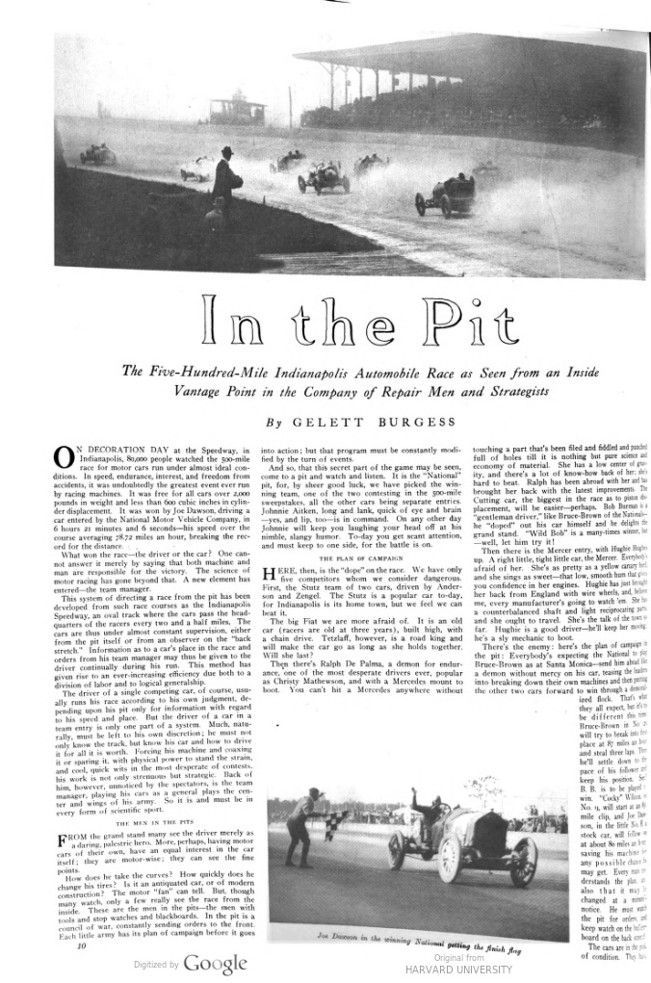
ON DECORATION DAY at the Speedway, in Indianapolis, 80,000 people watched the 500-mile race for motor cars run under almost ideal conditions. In speed, endurance, interest, and freedom from accidents, it was undoubtedly the greatest event ever run by racing machines. It was free for all cars over 2,000 pounds in weight and less than 600 cubic inches in cylinder displacement. It was won by Joe Dawson, driving a car entered by the National Motor Vehicle Company, in 6 hours 21 minutes and 6 seconds – his speed over the course averaging 78.72 miles an hour, breaking the record for the distance.
What won the race – the driver or the car? One can- not answer it merely by saying that both machine and man are responsible for the victory. The science of motor racing has gone beyond that. A new element has entered the team manager.
This system of directing a race from the pit has been developed from such racecourses as the Indianapolis Speedway, an oval track where the cars pass the headquarters of the racers every two and a half miles. The cars are thus under almost constant supervision, either from the pit itself or from an observer on the “back stretch.” Information as to a car’s place in the race and orders from his team manager may thus be given to the This method has driver continually during his run. given rise to an ever-increasing efficiency due both to a division of labor and to logical generalship.
The driver of a single competing car, of course, usually runs his race according to his own judgment, depending upon his pit only for information with regard to his speed and place. But the driver of a car in a team entry is only one part of a system. Much, naturally, must be left to his own discretion; he must not only know the track, but know his car and how to drive it for all it is worth. Forcing his machine and coaxing it or sparing it, with physical power to stand the strain, and cool, quick wits in the most desperate of contests. his work is not only strenuous but strategic. Back of him, however, unnoticed by the spectators, is the team manager, playing his cars as a general plays the center and wings of his army. So it is and must be in every form of scientific sport.
THE MEN IN THE PITS
FROM the grand stand many see the driver merely as a daring, palestric hero. More, perhaps, having motor cars of their own, have an equal interest in the car itself; they are motor-wise; they can see the fine points.
How does he take the curves? How quickly does he change his tires? Is it an antiquated car, or of modern construction? The motor “fan” can tell. But, though many watch, only a few really see the race from the inside. These are the men in the pits – the men with tools and stop watches and blackboards. In the pit is a council of war, constantly sending orders to the front. Each little army has its plan of campaign before it goes into action; but that program must be constantly modified by the turn of events.
And so, that this secret part of the game may be seen, come to a pit and watch and listen. It is the “National” pit, for, by sheer good luck, we have picked the winning team, one of the two contesting in the 500-mile sweepstakes, all the other cars being separate entries. Johnnie Aitken, long and lank, quick of eye and brain -yes, and lip, too-is in command. On any other day Johnnie will keep you laughing your head off at his nimble, slangy humor. To-day you get scant attention, and must keep to one side, for the battle is on.
THE PLAN OF CAMPAIGN
HERE, then, is the “dope” on the race. We have only five competitors whom we consider dangerous. First, the Stutz team of two cars, driven by Anderson and Zengel. The Stutz is a popular car to-day, for Indianapolis is its hometown, but we feel we can beat it.
The big Fiat we are more afraid of. It is an old car (racers are old at three years), built high, with a chain drive. Tetzlaff, however, is a road king and will make the car go as long as she holds together. Will she last?
Then there’s Ralph De Palma, a demon for endurance, one of the most desperate drivers ever, popular as Christy Mathewson, and with a Mercedes mount to boot. You can’t hit a Mercedes anywhere without touching a part that’s been filed and fiddled and punched full of holes till it is nothing but pure science and economy of material. She has a low center of gravity, and there’s a lot of know-how back of her; she’s hard to beat. Ralph has been abroad with her and has brought her back with the latest improvements. The Cutting car, the biggest in the race as to piston displacement, will be easier – perhaps. Bob Burman is a “gentleman driver,” like Bruce-Brown of the Nationals- he “doped” out his car himself and he delights the grandstand. “Wild Bob” is a many-times winner, but – well, let him try it!
Then there is the Mercer entry, with Hughie Hughes up. A right little, tight little car, the Mercer. Everybody’s afraid of her. She’s as pretty as a yellow canary bird. and she sings as sweet – that low, smooth hum that gives you confidence in her engines. Hughie has just brought her back from England with wire wheels, and believe me, every manufacturer’s going to watch ’em. She has a counterbalanced shaft and light reciprocating parts, and she ought to travel. She’s the talk of the town so far. Hughie is a good driver – he’ll keep her moving; he’s a sly mechanic to boot.
There’s the enemy: here’s the plan of campaign in the pit: Everybody’s expecting the National to play Bruce-Brown as at Santa Monica – send him ahead like a demon without mercy on his car, teasing the leaders into breaking down their own machines and then putting the other two cars forward to win through a demoralized flock. That’s what they all expect, but it’s to be different this time. Bruce-Brown in No. 2 will try to break into first place at 87 miles an hour and steal three laps. Then he’ll settle down to the pace of his follower and keep his position. Set? B. B. is to be played win. “Cocky” Wilcox, in No. 9, will start at an 83-mile clip, and Joe Dawson, in the little No. 8 a stock car, will follow on at about 80 miles an hour saving his machine for any possible chance he may get. Every man understands the plan, as also that it may be changed at a minutes-notice. He must watch the pit for orders, and keep watch on the bullet board on the back stretch.
The cars are in the peak of condition. They have been tested and tightened and tuned for months. Each one was sent out on the track first with instructions to break it to pieces if possible. It was driven to its limit, then brought back and put on the operating table and dissected to find its weakest part. Pistons, shafts, and gears and bearings were examined, altered, or replaced, if necessary. Then the car was balanced. Which tire wears out first? The right front? Shift the engine or the gasoline tank and try her out again on the track. The left rear? Arrange the weights so that all treads show equal wear, if possible. The wheels themselves must be balanced so that they will revolve without coming to rest at any one spot. Wire a piece of lead on this spoke and tape it. There! For the Speedway is paved with brick, and, though the fastest course in the United States, it is fierce on the cars. The incessant vibration, unnoticeable at a moderate speed, is terrific at a fast gait, and steel crystallizes wickedly. Different sized springs must be tried on the car – all sorts of new inventions must be tested. A thousand things to be prepared and done – but, thank heavens, it’s all over. We are all ready for the war to begin.
It is 9.30 A. M. at the Speedway, fair and cool. Since 5.30 crowds have been arriving in trains and in ten thousand automobiles. Every grandstand is filled, even so the little new one, with sixteen railroads presidents in it. The touring cars are parked all around the track, all over the infield. It is a smart crowd, too, mind you! The cheapest admission gate is a dollar – for the best places two dolars, plus the price of the seats, which turns up to seven dollars each. Smart are the gowns; real are the diamonds and the lace. In man’s attire fancy paids predominate. There are four or five bands playing “Everybody’s going It.” Three balloons are filling, ready to ascend. Here’s an ambulance corps, one of six, each complete with blond Red Cross nurses. There’s a squad of the National Guard. Wiglagging atop the directors’ stand are men signaling all over the place. Badges and umpires and technical committees everywhere – telephones in all parts of the course. Bulletin boards, garages, and, wonderful to retire, lunch counters with printed lists prices: “Don’t be Overcharged!”
In the paddock inclosure are two hundred and fifty bona free newspaper men asking questions. Photographers everywhere. Six thousand applicants have been refused passes. BANG! there goes the gun to get into position. All ready for the line-up!
In ranks of five abreast the cars are arranged. A gray roadster, just in front of the first row, stands ready like a captain to lead the procession, and bring it round the track to the flying start at sixty miles an hour. The manager of each entry gives his last hurried words of construction – Bang! Crank your engine! In an instant there are twenty-four vomits of smoke uniting in one great cloud, and a rattle like two dozen barrels of blazing firecrackers. Hop into your car, mechanicians; in the minute the race will start! Bang! They’re off, Carl Fisher, the owner of the Speedway, leading in his roadster, which no car must pass till after the trip round the course. Faster and faster! They have crossed thekine!
It’s a fair start and the race is on. We can see them swing into the first curve, and, just before they go out of sight, positions begin to change. The procession stretches out. The grandstand rustles with talk. In the pit we wait and crane our necks, looking up the straightaway stretch to see them come.
Here they are upon us already with a roar, No. 1, а Stutz car, leading. Well, she was in the front rank, and should hold her place a while. No one has really begun to hurry. Each is waiting to find a good hole in the bunch to shoot through. Wait till the second round. On the third trip De Palma gets the lead, and it is plain he in- tends to keep it. Our stop watches mark his next lap 1.49. That means 822 miles an hour. He must be in earnest.
DOWN TO THE GRIND OF THE RACE
BY THE time the string has tailed out so that a car is lapped, Bruce-Brown has forced his way ahead to third place, fighting Wishart in the other Mercedes, a 1912 model; he is driving on his own account. The Fiat car is just behind him. The National car is evidently worrying them both. Bruce-Brown is doing the lap in 1.48.
The string now tears by for a dozen or so rounds in this order: Mercedes (De Palma), Mercedes (Wishart), National (Bruce-Brown), Fiat (Tetzlaff), Knox (Mulford), National (Wilcox), the last two changing places at times. No. 5, a Case car, a three-ton affair, has already come in to change a tire. How that hot rubber smells! She is a queer-looking beast, something like a whale, more like a tumble-bug, with her curves and her patterned radiator. A month ago, she was queerer still, with a tail behind, her body designed by Hiram Maxim, with a “perfect streamline” form. Everything was done by scientific theories in her designing, but she is too heavy and they have already chopped off several hundred pounds of superfluous weight.
But where’s Cocky Wilcox in No. 9? Anxiously we strain our eyes! He should be passing by this time. There he is, up the stretch, but, to our horror, turning in toward the pits. In an instant everyone is excited, desperate. Is it a tire or engine trouble? He slows down at the pit, shaking his head and scowling. There is a horrible pungent smell of scorching rubber from the hot tires. Cocky hops out; up goes the hood. What’s the matter? Alas, Cocky doesn’t know.
NEW STRATEGY FOR A CHANGING BATTLE
THEN for a heartbreaking twenty minutes driver and mechanician and manager and helper (bright little “Red” Lime greedy for work) explore the engine. It has been missing, and nobody knows why. The consultation seems interminable. A quick tire change and get-away by De Palma at the next pit makes our delay seem the longer. Incessantly, like fiery arrows, the cars shoot by. There goes the Mercer, a shaft of yellow with her wire wheels – t he chocolate-colored Lexington – the dark red Firestone-Columbus, driver and mechanician in bright red uniforms – a thing with a long tail like a shark, with men in white, hooded with sand veils. The white White darts past, with her rocket-shaped stern. She has six cylinders cast en bloc ! De Palma goes round and round the track, but Wishart’s car is groaning. If she’d only “go out”!
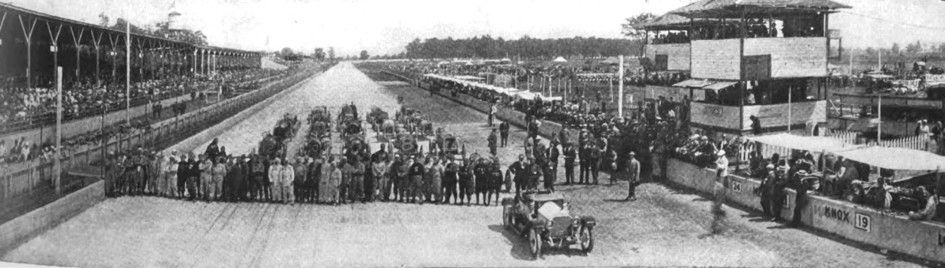
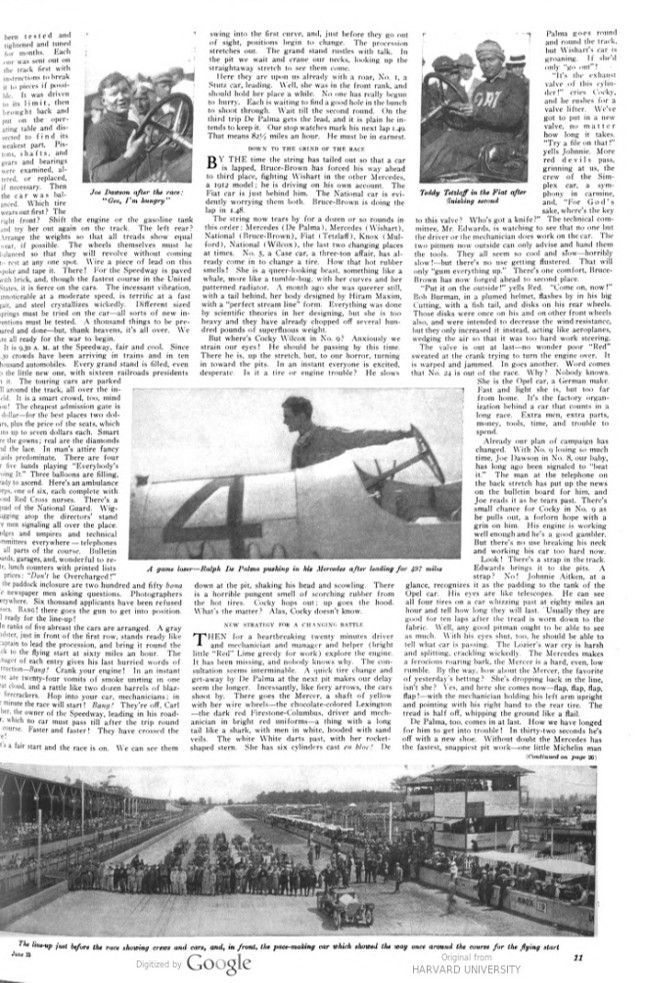
Page 11: The line-up just before the race showing crews and cars, and, in front, the pace-making car which showed the way, once around the course for the flying start
“It’s the exhaust valve of this cylinder!” cries Cocky, and he rushes for a valve lifter. We’ve got to put in a new valve, no matter how long it takes. “Try a file on that!” yells Johnnie. More red devils pass, grinning at us, the crew of the Simplex car, a symphony in carmine, and, “For God’s sake, where’s the key to this valve? Who’s got a knife?” The technical committee, Mr. Edwards, is watching to see that no one but the driver or the mechanician does work on the car. The two pitmen now outside can only advise and hand them the tools. They all seem so cool and slow – horribly slow! – but there’s no use getting flustered. That will only “gum everything up.” There’s one comfort, Bruce-Brown has now forged ahead to second place.
“Put it on the outside!” yells Red. “Come on, now!” Bob Burman, in a plumed helmet, flashes by in his big Cutting, with a fish tail, and disks on his rear wheels. Those disks were once on his and on other front wheels also, and were intended to decrease the wind resistance, but they only increased it instead, acting like aeroplanes, wedging the air so that it was too hard work steering.
The valve is out at last – no wonder poor “Red” sweated at the crank trying to turn the engine over. is warped and jammed. In goes another. Word comes that No. 24 is out of the race. Why? Nobody knows. She is the Opel car, a German make. Fast and light she is, but too far from home. It’s the factory organization behind a car that counts in a long race. Extra men, extra parts, money, tools, time, and trouble to spend.
Already our plan of campaign has changed. With No. 9 losing so much time, Joe Dawson in No. 8, our baby, has long ago been signaled to “beat it.” The man at the telephone on the back stretch has put up the news on the bulletin board for him, and Joe reads it as he tears past. There’s small chance for Cocky in No. 9 as he pulls out, a forlorn hope with a grin on him. His engine is working well enough and he’s a good gambler. But there’s no use breaking his neck and working his car too hard now.
Look! There’s a strap in the track. Edwards brings it to the pits. A strap? No! Johnnie Aitken, at a glance, recognizes it as the padding to the tank of the Opel car. His eyes are like telescopes. He can see all four tires on a car whizzing past at eighty miles an hour and tell how long they will last. Usually they are good for ten laps after the tread is worn down to the fabric. Well, any good pitman ought to be able to see as much. With his eyes shut, too, he should be able to tell what car is passing. The Lozier’s war cry is harsh and splitting, crackling wickedly. The Mercedes makes a ferocious roaring bark, the Mercer is a hard, even, low rumble. By the way, how about the Mercer, the favorite of yesterday’s betting? She’s dropping back in the line, isn’t she? Yes, and here she comes now – flap, flap, flap, flap! – with the mechanician holding his left arm upright and pointing with his right hand to the rear tire. The tread is half off, whipping the ground like a flail.
De Palma, too, comes in at last. How we have longed for him to get into trouble! In thirty-two seconds he’s off with a new shoe. Without doubt the Mercedes has the fastest, snappiest pit work – one little Michelin man in yellow works like a buttonhole machine. It is beautiful. Before I can snap him with my camera, De Palma is off. Our own pit work is pretty lumpy – slow and careless. “That isn’t the right rear tire – get the other!” “Does she need any more gasoline?” “What is in that can, gasoline or oil?” The cans are just alike.
BRUCE-BROWN’S BREAKDOWN
STILL, other team crews’ work is even worse. As we try to believe our own eyes we see the yellow Mercer come down the stretch-yes, actually being pushed by Hughie Hughes and his mechanician! Out of gasoline! Nearly a mile they have tugged at her. Another crew has put on a wrong tire and has to take it off.
It is already evident that the 500-mile speed record is going to be broken. Bulletins, scoreboards, and stopwatches agree that the pace is faster than last year. It is a fast track anyway, but when the temperature is high the bricks get heated so that the tires burn up badly. But it has rained for two days and the pavement is cool. Tires last longer; cars go faster. Bruce-Brown in No. 29 is stepping right along in his National, trying to pass De Palma. That is, he was – but with unanimous groan our pit sees him up the stretch heading in for the pits. What d’you think? Another bum valve! This time it is hopeless. A half hour’s work shows the piston rings have broken. Well, it’s the fortune of war. Bruce-Brown gets away on three cylinders, comes in again, and is out of it.
The press bulletin has it that “he wept like a child” – but he didn’t. He’s been through too many battles for that.
SATISFACTORY DEARTH OF ACCIDENTS
JOE DAWSON, meanwhile, in the stock car has been hurried along. He has mysteriously squirmed up to third place already, and we are telephoning his position and time to the blackboard on the back stretch: “3-4” and “3-2,” and so on, showing how far he is behind the Fiat. De Palma, cool, determined, driving a beautiful race, has hypnotized the grand stand. Every time he passes there is a cheer. The Fiat is pounding right along, too; she is a pretty good car yet. Teddy Tetzlaff certainly knows how to humor the old girl.
The Speedway is breaking its record for attendance and for management. Two thousand two hundred employees are at work for Carl Fisher to-day, and every one of them is right on the job. The crowds are seated, the automobiles are parked without confusion, but – there’s something missing-the race lacks excitement. It’s only a parade.
There are few in that 80,000 who, did they but dare confess it, half hoped for and half dreaded an accident. Of course they didn’t want anyone to be killed or even hurt, but, if it did happen, they wanted to be where they could see it. Last year a mechanician was killed opposite the grand stand. To-day we in the pits see nothing so thrilling. Up on the north curve we hear the McFarlan car, No. 23, has blown a tire and skidded into the wall. sideswiping off two wheels – but she didn’t turn over, and Marquette was uninjured. Over on the east side, too, the No. 1 Stutz turned a back somersault, but Anderson happily escaped with his man. The only excitement of the sort the grand stand has, however, is when the red Simplex comes in afire. Her red uniformed crew look more like devils than ever, but one squirt of the fire extinguisher puts out the flames and saves her, though she soon drops out of the race. The Marquette–Buick, one of a flock of fast flyers, too, has burned her insides. The Marquette–Buick is out of the running, so is the Lozier the Firestone-Columbus, both Cases, and the Lexington There are now twelve cars running. Twelve places are to he rewarded. Every car, if it can only hold together and finish, is sure of the money The least prize is $1,000.
But we must pay attention to the race, Let the crowds across in the seven-dollar seats of the grand stand open their luncheon baskets and their champagne and beer, we in the pit must study our cars and stopwatches. But it must be confessed that there is little suspense. The order of the procession has not changed much for two or three hundred miles First, De Palma in his Mercedes; second, Joe Dawson in the National stock car: third, Tetzlaff in his Fiat; fourth, Mertz in a Stutz; fifth, Hughie Hughes driving the Mercer. The National camp is not quite sure of Joe’s position, some timing him for second place, some for third. It is hard to keep track exactly. The Stutz people are sure they are running fourth. There is a man for every entry upon the long score board, putting up cars for every lap, and the places are telephoned to it from the judges’ stand. But the horograph and the adding machines have not yet checked up the exact times. Last year, after thirty-six hours’ solid work in the office, the positions were changed. It won’t be so to-day; the first five cars now running have kept their positions so steadily that little change is expected. De Palma and Mulford are running the race without relief drivers, but the Nationals are not willing to risk any driver for the whole long 500 miles without rest or food. Few, indeed, can stand it; it is too hard on nerve and muscle. Barney Oldfield, the veteran of the game, in shepherd’s plaid with a monogram on his shirt and BO for a belt buckle, says no one can stand it successfully. A driver may get out of his car at the end of the race smiling and cool; he may say he is as fresh as ever, but inevitably the long strain must tell on any man. He can still drive fast perhaps, but he cannot drive wisely-the brain loses its quick reaction, and the man becomes mechanical, a bit apathetic. It must be so, but De Palma still hurtles on without rest.
Both Cocky and Joe of the Nationals, however, have been relieved. Rader takes the big racer, and Don Herr drives No. 8 for ninety miles. In the big Fiat, Caleb Bragg is driving, allowing Tetzlaff to eat, while Knipper relieves Mertz, who has been driving a beautiful and consistent race in the smooth-running, graceful Stutz -much to the relief, too, we imagine, of Mrs. Mertz, for Charley has more than once had a narrow escape from death. He was a National man, but the company will not allow married men to drive for them.
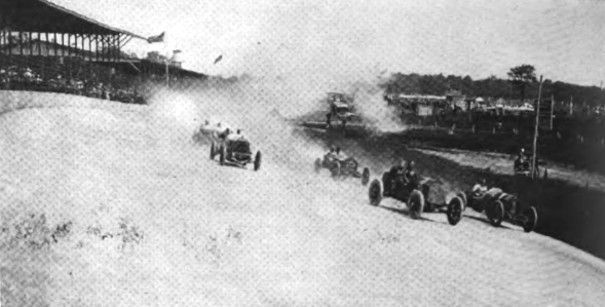
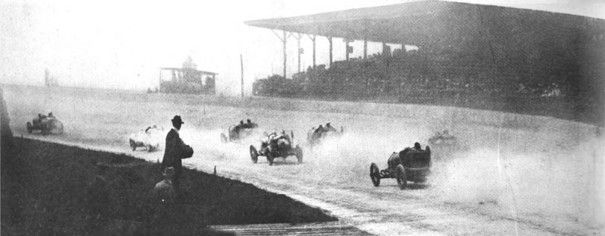
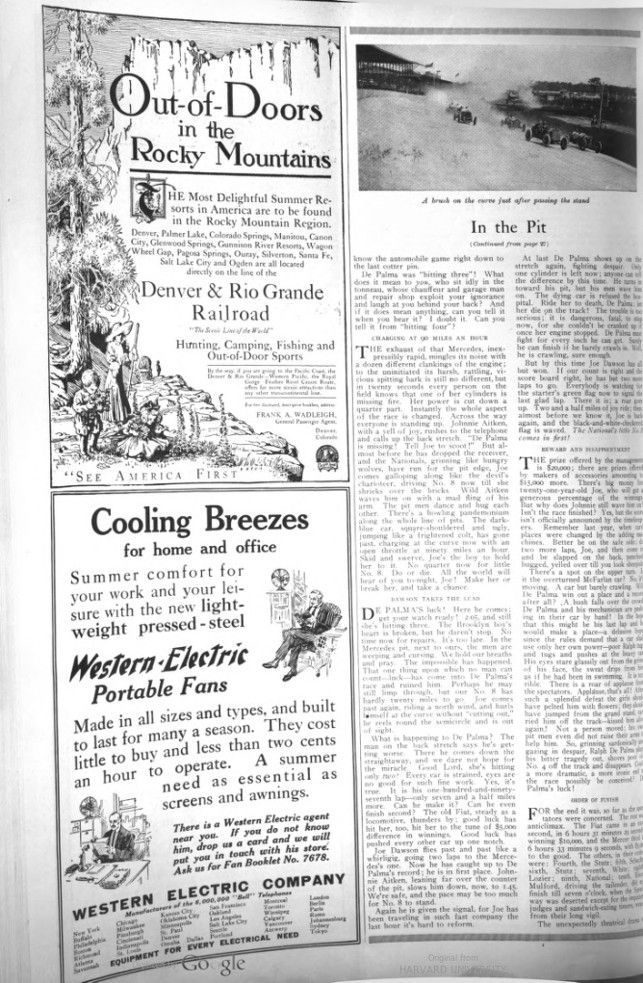
Page 28: A brush on the curve just after passing the stand
<—-
BURMAN’S MISHAP
AT 380 miles the order is 4. 8. 3, 15, 28, 21 – Mercedes, National, Cutting, Stutz. Mercer. Soon Burman is missing, and a rumor starts and sweeps over the entire Speedway that he has had an accident. There is some magic about this swift-flying gossip. It is as if a breeze bore the news – one can watch its progress leaping along the stands. Simultaneously, from all parts of the enclosure, men start running toward the south. How, in heaven’s name, did they know – and so soon? It is telepathy. The ambulance gallops across the emergency road, and after a while we see it drive slowly back toward the hospital. Word passes from lip to lip that the Cutting has taken a tumble. First a right, then, almost instantly, a left tire, blowing out, caught Burman trying to keep from skidding, and he was thrown out. Luckily, he is not badly hurt, but he has two nasty wrists to show for it, and is bandaged up. So they drop out one by one.
Toward one o’clock it begins to get hot. The bricks have now warmed up, and cars begin to come in for new tires. How jaded, how dirty, the men look! Sweaty, too. Occasionally a tire blows up in front of the grand stand with a pistol shot that startles the girls, and the poor unfortunate car has to go two and a half miles on a flat shoe. Already the knowing manufacturers are comparing notes on the English wire-spoked wheels. The Mercer car blew her tires, but the wire wheels did not collapse, and the car did not overturn.
The tire trouble, which was expected to affect this race more than any other cause of delay, will apparently hardly figure at all in the result. To a large extent this is due to the cool weather, but much must be attributed to an improvement in the manufacture of the tires since last year. Everyone agrees that they are better. The precise age of the shoe itself also counts largely in its efficiency. If it is too old it deteriorates and blows out. The rubber is soft, however, in a too-new tire, and will wear out rapidly. The National team will not permit a single tire to blow out, but, in spite of its anxiety to win, is replacing them as fast as badly so changed, worn. Several have been which last year would have been kept on several laps longer.
Owing to the monotonous order of the first five cars, our interest has lapsed in the race, but now our attention is renewed; we are nearing the end. Joe Dawson, after an hour of sandwiches and ice water and gossip, is now back on the track refreshed. Cocky Wilcox, too, is back, and is putting poor valve-weak No. 9 ahead for all she is worth, to get a “place.” Don Merr, keen as a wildcat, is watching the car he drove so well. He has more real interest in the race than all the others in the pit. There are now two races being run: one for the first three places, the others, far behind the leaders, trying for fourth place, or at least for records and what money they can earn.
CHEERS FOR THE FAVORITE
SOON after the four-hundredth mile, finding that Joe Dawson is spinning round the track in about 1 minute 50 seconds, Johnnie Aitken, as No. 8 passes, gives a hand signal to take it easier. Joe is now in second place, De Palma seven laps ahead of him, and the Fiat car eleven laps behind. It’s no use trying to catch the Mercedes car, she’s too fast. Joe must keep ahead of the other and save his car.
De Palma has only six laps to go now; he is passing us on his one hundred and ninety-fifth. He is sure to win; he has driven wonderfully. And well he deserves a victory, poor fellow, for, although he has won many short races, his bad luck is famous. In two long-distance races he has broken down while in the lead and within a dozen or so miles of the finish. He has driven with broken tendons; he has fractured a thigh on the track. He has been pitched and ditched and disappointed time and again, but he has always been game. The grand stand wants him to get his first long-distance winning to-day and the prizes that will go with it. They are cheering him on, and he is driving a terrible pace. Why so fast? Thirty-five thousand dollars is in sight – no mean reward! He has been going over ninety miles an hour – his car is good for a hundred and twenty, but it takes it out of her; he ought to be careful. But it’s a sure thing now, and the crowd is getting bored and is about ready to leave. The baskets are packed, all the cigars are smoked up. No more champagne. Well, the Nationals are satisfied with the race as it stands. Second place is worth $20,000, almost what it has cost them to prepare for the grind, and it will be won by a stock car, a feather in any company’s cap. So, with the experience already in hand and the money in sight, the Nationals are ready to root for De Palma, whose luck seems at last to have changed. Here he comes now! Give him a cheer, boys.
DE PALMA IS “MISSING”
HE flashes past, to the eyes of a layman no different than he had passed 195 times before to-day. But what on earth is the matter? A chorus of yells from the pits is running down the line like a bolt of lightning. Then, almost simultaneously, a howl from the grand stand, a mighty rustling like the wind in the forest before a storm. The pitmen wave and talk excitedly; in the boxes across the way men are rising all over the place, babbling like madmen; women, too, are almost hysterical. People crane their necks, field glasses are ripped out of their cases, the crowd points and stares. De Palma is “missing”! He is “hitting three”!
Except in Detroit, perhaps, this mental reaction could have come so swiftly in no other city in the wide world. But Indianapolis is motor-wise. It is a city of the working, not the idle, rich. Men have earned their money with their skill of hand and brain, not in speculation, and mechanical instinct is in the blood, from the wealthy manufacturer down to the prettiest manicure girl. Indianapolitans know the automobile game right down to the last cotter pin.
De Palma was “hitting three”! What does it mean to you, who sit idly in the tonneau, whose chauffeur and garage man and repair shop exploit your ignorance and laugh at you behind your back? And if it does mean anything, can you tell it when you hear it? I doubt it. Can you tell it from “hitting four”?
CHARGING AT 90 MILES AN HOUR
THE exhaust of that Mercedes, inexpressibly rapid, mingles its noise with a dozen different clankings of the engine; to the uninitiated its harsh, rattling, vicious spitting bark is still no different, but in twenty seconds every person on the field knows that one of her cylinders is missing fire. Her power is cut down a quarter part. Instantly the whole aspect of the race is changed. Across the way everyone is standing up. Johnnie Aitken, with a yell of joy, rushes to the telephone and calls up the back stretch. “De Palma is missing! Tell Joe to scoot!” But almost before he has dropped the receiver, and the Nationals, grinning like hungry wolves, have run for the pit edge, Joe comes galloping along like the devil’s charioteer, driving No. 8 now till she shrieks over the bricks. Wild Aitken waves him on with a mad fling of his arm. The pit men dance and hug each other. There’s a howling pandemonium along the whole line of pits. The dark-blue car, square-shouldered and ugly, jumping like a frightened colt, has gone past, charging at the curve now with an open throttle at ninety miles an hour. Skid and swerve, Joe’s the boy to hold her to it. No quarter now for little No. 8. Do or die. All the world will hear of you to-night, Joe! Make her or break her, and take a chance.
DAWSON TAKES THE LEAD
DE PALMA’S luck! Here he comes; get your watch ready! 2.05, and still she’s hitting three. The Brooklyn boy’s heart is broken, but he daren’t stop. No time now for repairs. It’s too late. In the Mercedes pit, next to ours, the men are weeping and cursing. We hold our breaths and pray. The impossible has happened. That one thing upon which no man can count-luck-has come into De Palma’s race and ruined him. Perhaps he may still limp through, but our No. 8 has hardly twenty miles to go. Joe comes past again, riding a north wind, and hurls himself at the curve without “cutting out,” he reels round the semicircle and is out of sight. true.
What is happening to De Palma? The man on the back stretch says he’s getting worse. There he comes down the straightaway, and we dare not hope for the miracle. Good Lord, she’s hitting only two! Every ear is strained, eyes are no good for such fine work. Yes, it’s It is his one-hundred-and-ninety-seventh lap – only seven and a half miles more. Can he make it? Can he even finish second? The old Fiat, steady as a locomotive, thunders by; good luck has hit her, too, hit her to the tune of $5,000 difference in winnings. Good luck has pushed every other car up one notch.
Joe Dawson flies past and past like a whirligig, going two laps to the Mercedes’s one. Now he has caught up to De Palma’s record; he is in first place. Johnnie Aitken, leaning far over the counter of the pit, slows him down, now, to 1.45. We’re safe, and the pace may be too much for No. 8 to stand.
Again he is given the signal, for Joe has been traveling in such fast company the last hour it’s hard to reform.
At last De Palma shows up on the stretch again, fighting despair. Only one cylinder is left now; anyone can tell the difference by this time. He turns in toward his pit, but his men wave him on. The dying car is refused the hospital. Ride her to death, De Palma; let her die on the track! The trouble is too serious; it is dangerous, fatal, to stop now, for she couldn’t be cranked up if once her engine stopped. De Palma must fight for every inch he can get. Surely he can finish if he barely crawls in. Well, he is crawling, sure enough.
But by this time Joe Dawson has all but won. If our count is right and the score board right, he has but two more laps to go. Everybody is watching for the starter’s green flag now to signal the last glad lap. There it is; a roar goes up. Two and a half miles of joy ride; then, almost before we know it, Joe is back again, and the black-and-white-checkered flag is waved. The National’s little No. 8 comes in first!
REWARD AND DISAPPOINTMENT
THE prize offered by the management is $20,000; there are prizes offered by makers of accessories amounting to $15,000 more. There’s big money for twenty-one-year-old Joe, who will get a generous percentage of the winnings. But why does Johnnie still wave him on? Isn’t the race finished? Yes, but the score isn’t officially announced by the timekeepers. Remember last year, when cars places were changed by the adding machines. Better be on the safe side; do two more laps, Joe, and then come in and be slapped on the back, punched hugged, yelled over till you look sheepish.
There’s a spot on the upper turn. Is it the overturned McFarlan car? No, it’s moving. A car but barely crawling. Wil De Palma win out a place and a record after all? A hush falls over the crowd De Palma and his mechanician are pushing in their car by hand! In the hope that this might be his last lap and he would make a place – a delusive hope since the rules demand that a car shall use only her own power – poor Ralph tug and tugs and pushes at the heavy car His eyes stare glassily out from the grim of his face, the sweat drips from him as if he had been in swimming. It is terrible. There is a roar of applause from the spectators. Applause, that’s all! After such a splendid defeat the girls should have pelted him with flowers; they should have jumped from the grand stand, carried him off the track – kissed him alone again! Not a person moved; his own pit men even did not raise their arms to help him. So, grinning sardonically gazing in despair, Ralph De Palma plays his bitter tragedy out, shoves poor old No. 4 off the track and disappears. Could a more dramatic, a more ironic end to the race possibly be conceived? De Palma’s luck!
ORDER OF FINISH
FOR the end it was, so far as the spectators were concerned. The rest was anticlimax. The Fiat came in an easy second, in 6 hours 31 minutes 29 second winning $10,000, and the Mercer third in 6 hours 33 minutes 9 seconds, with $500m to the good. The others, in their order were: Fourth, the Stutz; fifth, Schacht sixth, Stutz: seventh, White; eighth Lozier; ninth, National; tenth, Mulford, driving the tailender, did not finish till seven o’clock, when the Speedway was deserted except for the impatient judges and sandwich-eating timers, wear from their long vigil.
The unexpectedly theatrical drama of De Palma’s defeat will help the next competition, showing how closely a car may win. The incident, too, will adorn many a tale and point many a moral. One thing is emphasized, a platitude of motor racing: the race is won before it starts. A good driver with a good car, good generalship, and a factory behind it should always win – and would, were it not for that one unknown element, luck, whose strains and stresses no man can calculate. The picture of De Palma pushing his own car home no witness will ever forget. Many will, no doubt, feel as if, virtually, De Palma was the real winner. But it is not so. There’s nothing in the race but the finish, and Joe Dawson finished first. Had De Palma failed at one hundred miles it would have been no different in justice or sentiment.
Photos.
Page 10. Joe Dawson in the winning National getting the finish flag
Page 11. Joe Dawson after the race: “Gee, I’m hungry” – Teddy Tetzlaff in the Fiat after finishing second – A game loser-Ralph De Palma pushing in his Mercedes after leading for 497 miles – The line-up just before the race showing crews and cars, and, in front, the pace-making car which showed the way, once around the course for the flying start
Page 26. Cocky Wilcox pulling away from the repair pit after changing tires – The automobile parkway space, with a turn of the course in the background
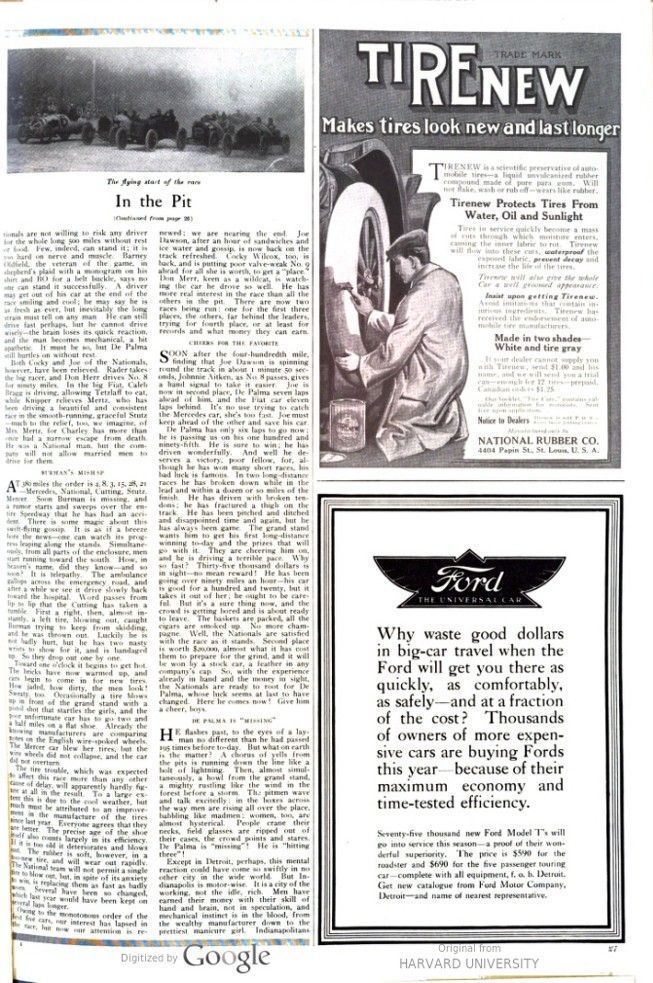
Page 27: The flying start of the race
Page 28: A brush on the curve just after passing the stand