This 1903 Paris-Madrid report of Motor Age, first a summary is given with the finish results at Bordeaux. Then, no less than fourteen (14!) small chapters describe specific points of the race.
Text and photos with courtesy of hathitrust.org hathitrust.org, compiled by motorracingistory.com
MOTOR AGE VOL. III. No. 22. MAY 28, 1903.
GABRIEL THE LEADER IN THE PARIS-MADRID RACE
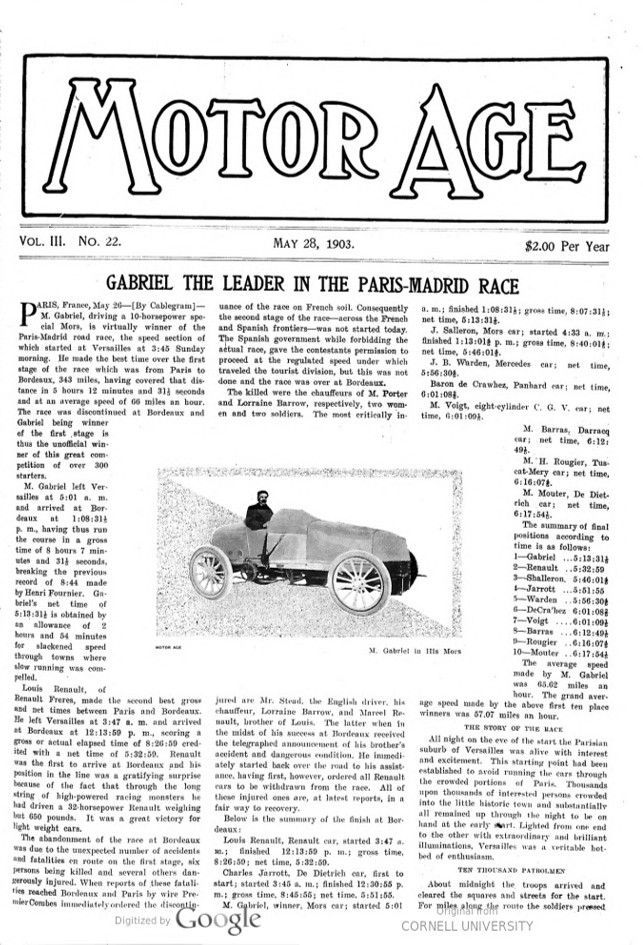
PARIS, France, May 26 – [By Cablegram] – M. Gabriel, driving a 10-horsepower special Mors, is virtually winner of the Paris-Madrid road race, the speed section of which started at Versailles at 3:45 Sunday morning. He made the best time over the first stage of the race which was from Paris to Bordeaux, 343 miles, having covered that distance in 5 hours 12 minutes and 31 seconds and at an average speed of 66 miles an hour. The race was discontinued at Bordeaux and Gabriel being winner of the first stage is thus the unofficial winner of this great competition of over 300 starters.
M. Gabriel left Versailles at 5:01 a.m. at Bordeaux and arrived at 1:08:31 p.m., having thus run the course in a gross time of 8 hours 7 minutes and 31 seconds, breaking the previous record of 8:44 made by Henri Fournier. Gabriel’s net time of 5:13:31 is obtained by an allowance of 2 hours and 54 minutes for slackened speed through towns where slow running was compelled.
Louis Renault, of Renault Freres, made the second best gross and net times between Paris and Bordeaux. He left Versailles at 3:47 a. m. and arrived at Bordeaux at 12:13:59 p. m., scoring a gross or actual elapsed time of 8:26:59 credited with a net time of 5:32:59. Renault was the first to arrive at Bordeaux and his position in the line was a gratifying surprise because of the fact that through the long string of high-powered racing monsters he had driven a 32-horsepower Renault weighing but 650 pounds. It was a great victory for light weight cars.
The abandonment of the race at Bordeaux was due to the unexpected number of accidents and fatalities en route on the first stage, six persons being killed and several others dangerously injured. When reports of these fatalities reached Bordeaux and Paris by wire Premier Combes immediately ordered the discontinuance of the race on French soil. Consequently, the second stage of the race – across the French and Spanish frontiers – was not started today. The Spanish government while forbidding the actual race, gave the contestants permission to proceed at the regulated speed under which traveled the tourist division, but this was not done and the race was over at Bordeaux.
The killed were the chauffeurs of M. Porter and Lorraine Barrow, respectively, two women and two soldiers. The most critically injured are Mr. Stead, the English driver, his chauffeur, Lorraine Barrow, and Marcel Renault, brother of Louis. The latter, when in the midst of his success at Bordeaux received the telegraphed announcement of his brother’s accident and dangerous condition. He immediately started back over the road to his assistance, having first, however, ordered all Renault cars to be withdrawn from the race. All of these injured ones are, at latest reports, in a fair way to recovery.
Below is the summary of the finish at Bordeaux:
Louis Renault, Renault car, started 3:47 a. m.; finished 12:13:59 p. m.; gross time, 8:26:59; net time, 5:32:59.
Charles Jarrott, De Dietrich car, first to start; started 3:45 a. m.; finished 12:30:55 p. m.; gross time, 8:45:55; net time, 5:51:55.
M. Gabriel, winner, Mors car; started 5:01 a. m.; finished 1:08:31; gross time, 8:07:31; net time, 5:13:31.
J. Salleron, Mors car; started 4:33 a.m.; finished 1:13:01 p. m.; gross time, 8:40:01; net time, 5:46:01.
J. B. Warden, Mercedes car; net time, 5:56:30 2/5.
Baron de Crawhez, Panhard car; net time, 6:01:08.
M. Voigt, eight-cylinder C. G. V. car; net time, 6:01:09.
M. Barras, Darracq car; 49%. net time, 6:12: 49½
M. H. Rougier, Tuscat-Mery car; net time, 6:16:07.
M. Mouter, De Dietrich car; net time, 6:17:54.
The summary of final positions according to time is as follows:
1-Gabriel 5:13:31
2-Renault 5:32:59
3-Shalleron 5:46:01 4/5
4-Jarrott 5:51:55
5 Warden 5:56:30 4/5
6-DeCrawhez 6:01:08
7-Voigt 6:01:09
8-Barras 6:12:49
9-Rougier 6:16:07
10-Mouter 6:17:54
The average speed made by M. was 65.62 Gabriel miles an hour. The grand aver- age speed made by the above first ten place winners was 57.07 miles an hour.
THE STORY OF THE RACE
All night on the eve of the start the Parisian suburb of Versailles was alive with interest and excitement. This starting point had been established to avoid running the cars through the crowded portions of Paris. Thousands upon thousands of interested persons crowded into the little historic town and substantially all remained up through the night to be on hand at the early start. Lighted from one end to the other with extraordinary and brilliant illuminations, Versailles was a veritable hot-bed of enthusiasm.
TEN THOUSAND PATROLMEN
About midnight the troops arrived and cleared the squares and streets for the start. For miles along the route the soldiers pressed back the crowd. Six thousand of them and 4,000 policemen strenuously forced a clearing through the greatest crowd of gesticulating Frenchmen and excited dames and damsels that ever gathered in old Versailles.
Near to the starting point were over 5,000 automobiles, decorated and illuminated, Chinese lanterns galore casting a festive carnival spirit over the assemblage which they thickly dotted.
PROMINENT SPECTATORS
Society was there and the modern bourgeois swarmed round it, truly French and truly agog with the greatness of the moment. They were waiting, waiting for the first car to shoot forward from the starting point of the greatest automobile race ever run – the greatest speed contest in the history of the world.
Owing to the participation in the contest of W. K. Vanderbilt Jr., Foxhall Keene, C. Gray Dinsmore, and other Americans, great interest had been aroused among Americans, especially the members of the Newport set, who arrived in large numbers. Many fashionable parties of Americans came to Versailles in automobiles, and some chartered special trains. Among the parties were those of Col. and Mrs. John Jacob Astor, Mr. and Mrs. Herman Oelrichs, Elisha Dyer, Mr. and Mrs. Clarence Moore, Mr. and Mrs. Truxton Beale, of Washington; Mr. and Mrs. Perry Belmont, Capt. Philip Leding, of New York; Mr. and Mrs. E. C. Benedict, of New York; John Biddle, of Washington; Mrs. A. G. Spreckels, S. G. Murphy, and Mr. and Mrs. Fremont Older, of San Francisco.
READY TO START
The contestants arrived during the evening, their huge machines trembling and groaning. The drivers wore rubber coats drawn high and tight around the throat, and had their faces and heads completely enveloped in masks. They did not wear goggles, but heavy plate glass was fixed in the mask, forming a miniature window which afforded protection to the eyes without interfering with the sight. The contestants practically all sat low to minimize the resistance to the wind.
At 3:35 in the morning the crowd stiffened, swayed and recoiled as a bomb exploded by the officials warned the contestants to get ready. A long breathless spell, during which the thundering and hammering of starting motors along the great line of contestants increased the exciting pressure, and 10 minutes brought a second bomb. The race was on.
JARROTT THE FIRST
Drowned by the prolonged roar of the shouts from thousands of lusty throats, its own un-muffled cries lost in the great conclave of hu man voices, the four-cylindered Gaul – de Dietrich – driven by Charles Jarrott jumped away and dashed past the swaying lines of waving arms and swinging hats.
Then every minute the performance was repeated and for over 4 hours the big speed machines and the light saucy sputtering thoroughbreds crept up the diminishing line and shot away toward distant Bordeaux. The last starter got under way at 6:45 a.m.
SOME OF THE CONTESTANTS
Prominent among the contestants, either because of the machines driven or their previous performances, were the following: Six 45-horsepower De Dietrich cars driven by Jarrott, Lorraine Barrow, Stead, Gras, Heatjens and R. de Brouhe. Three 24-horsepower de Dietrichs were driven by Madame du Gast, the only woman in the race, and Messrs. Mouter and Desbrosses.
Of the ten Renault cars, three were of the Paris-Madrid style, three Paris-Vienna style, and four voiturettes. The first three were driven by Louis and Marcel Renault, and Grus. The Paris-Vienna cars were driven by Oury. Louvet and Labbee. Two of the 10-horsepower voiturettes were driven by Cormier and Richet.
The C. G. V. company started six racing cars. Charron drove the new 40-horsepower, eight-cylinder car, and Girardot drove a 60-horsepower vehicle. Voigt was on a similar car, while Giraud and Camoit drove 20-horsepower cars. Ernest L’hoste had a 15-horsepower machine.
Rigolly and Koechlin drove two of the three 110-horsepower Gobron-Brillie cars. There were also two 40-horsepower Paris-Vienna style cars, driven by Count de Maigret and Taveraux.
Nine Mercedes cars started. Five of these were of 90 horsepower, and four of the drivers were Werner, Baron de Caters, Hieronymus and Degrais. The four 60-horsepower cars were driven by Terry, Gastaud, P. Rainy and Paul Albert. One of the 90-horsepower cars belongs to the king of the Belgians, who allowed the firm to use it in this event, as it could not possibly build another in time for the race.
Four of the Decauville cars were driven by Thery, Mestayer, Ullman and Captain Genty. These are all 45-horsepower cars.
THE AMERICAN LIST
The Americans entered in the race were W. K. Vanderbilt, Jr., C. Gray Dinsmore, W. T. Dannat, Foxhall Keene and Tod Sloan. H. S. Harkness did not start, his new car, built in Brooklyn, while on hand not being in shape for the event. Keene, Sloan and Dannat also failed to start. Vanderbilt lost a couple of minutes in starting, being late 1 minute at the starting line and losing another minute in a discussion with the officials. He got away sixtieth at 4:18 a.m.
THE RACE
Louis Renault, third starter, made a magificent run that carried him first into Bordeaux. Long before he reached Chartres, he had overtaken and passed Charles Jarrott and Rene de Knyff, and gained a lead which he never lost after. Dispatches from Vendome, Tours, and Poitiers told of his passing through ahead, and Bordeaux sent the announcement of his arrival first. At Beourdiniere, between Chartres and Bonneval, his machine attained a maximum speed of 83 miles per hour.
Charles Jarrott finished second at 12:30, having covered the course in the gross time of 8 hours and 45 minutes. M. Gabriel arrived third at 1:08, his total time being 8 hours and 7 minutes.
FOURNIER AND VANDERBILT QUIT
The name of W. K. Vanderbilt, Jr., disappeared from the reports along the route after Rambouillet, where he passed twenty-eighth in order at 4:45 in the morning, going in fine form. The omission of his name and that of Henri Fournier from the dispatches from Chartres, the next town on the road, brought forth a number of inquiries.
It was learned later that both of them and Baron de Forest withdrew from the race together before reaching Chartres. All of them suffered breakdowns due to the motors and having lost 3 hours they decided that it was useless to continue. C. Gray Dinsmore was thus the only American to finish.
There were thirteen towns and villages through which the cars were required to run slowly. The time allowance in traveling through these, amounted to 2 hours and 54 minutes. Bends in the road were other obstacles which made the maximum speed impossible except on certain favorable stretches. Cars that were capable of making 70 to 80 miles an hour had to reduce their speed more than 50 per cent in order to negotiate these sharp turns – met with on the greater part of the route every 20 or 25 miles.
THE ACCIDENTS
Marcel Renault was injured at Coupe, 21 miles from Poitiers. He was compelled to turn his machine abruptly into a ditch in order to avoid a level railway crossing whose gate closed just as he arrived. In so doing he collided with a tree and was thrown to the ground with great force and was unconscious when picked up and carried to a nearby farmhouse. His chauffeur was also seriously injured. Other reports say Renault’s accident occurred in making a sharp turn.
Lorraine Barrows met with his spill near Libourne, 17 miles from Bordeaux, at 1:45 Sunday afternoon. It appears that Mr. Barrows had tried to avoid a dog which was crossing the track, and his car struck a tree with terrific force. His chauffeur was killed outright. Barrows himself was picked up unconscious but still breathing, and was taken to a hospital, where an operation was performed. At latest reports he is improving.
Two miles from Angouleme a car driven by M. Tourand swerved from the roadway and dashed into a group of spectators. It was here that the greatest loss of life occurred. The car was wrecked, and two soldiers, a child, and M. Tourand’s machinist were killed. M. Tourand himself was seriously hurt.
Another accident occurred near Bonneval, 19 miles from Chartres, where L. Porter’s car was overturned while crossing the Paris-Tours railroad track. The broken gasoline reservoir spread its contents over the demolished car and the wreckage instantly caught fire. Terry’s Mercedes was also in this mix-up but both driver and chauffeur escaped.
Near Arveyres Mr. Stead and another competitor collided, and both men, with their machinists, were injured. They had been racing wheel to wheel and both cars went into the ditch together. Mr. Stead was caught under the machine, while his chauffeur was hurled to a distance of 30 feet and had his head and body badly cut. Mr. Stead was conscious when he was picked up, and was conveyed to the nearest farm.
A woman was killed near Ablis while trying to cross the road ahead of one of the racing machines.
NO EFFECT ON CUP RACE
London, England, May 26 – [by Cablegram] The particular fashion in which the Paris-Bordeaux accidents appeared to the British automobiling public was the effect upon the Gordon Bennett international cup race in Ireland next July. At the Automobile Club of Great Britain yesterday there were many callers bent on learning if there was danger of interference with the plans for the cup race.
The executive committee of the club held a long session and in the evening gave out a statement which, after showing that the Paris-Madrid race and the Coupe International contest can hardly be compared goes on to say:
„In regard to the latter 7,000 police officers, assisted by the troops and stewards, will have strict instructions to keep spectators off the roads and away from the corners.
„A source of danger in the Paris-Madrid race was the character of the road surface. A constant cloud of dust hid the sharp corners and prevented the drivers from seeing the gulleys which occasionally cut across the road. In Ireland, however, arrangements have been made to spend nearly $7,500 in removing the gullies and sharp bridges, and all corners will be treated to prevent the dust being raised.“
Almost every cause which has contributed to the accidents during the first stage of the Paris-Madrid race will be absent from the Coupe Internationale race, and there is little fear that the mishaps in connection with Sunday’s racing, which have startled and alarmed the public, will repeat themselves in Ireland.
„The two cases are totally different,“ said John Scott Montagu, clubman and editor of the Car. Remember that one stage of the Paris-Madrid course from Paris to Bordeaux is 343 miles, and it is exceedingly difficulty to properly safeguard such a long route. Our whole course in Ireland, on the contrary, is only 93 miles long, and along it we have arranged for seven thousand police and stewards. That will mean an average of more than one person on duty for every hundred yards. Instead of the 216 cars starting in the Paris-Madrid races we will have only twelve, three from each of the countries enlisting – America, England, France and Germany – and the drivers of these twelve cars will all be representatives of the four nations and the most skilled drivers in the world.
„It is to be hoped that the public will realize the gigantic difference between 216 cars trying to catch each other in tremendous clouds of dust, and driven by a conglomeration of people, some of whom are not highly trained experts – driving almost every type of automobile known – and a very small number of automobiles, each driven by a well-known expert, and of a size, weight and speed that will be practically uniform. I think the House of Commons will appreciate the wide difference between the Paris-Madrid race and that which will decide, over the Irish course next July, the championship of the world.“
NOTES OF THE RACE
M. George Berry, deputy for Paris, announces his intention of questioning the prime minister regarding the Paris-Madrid race. If he does not receive a satisfactory response he will introduce a resolution proposing that such races be forbidden in the future.
M. Gabriel, the winner of the race as far as Bordeaux, vigorously condemns the reckless imprudence of the spectators along the route, and the lack of official precautions to restrain them. He says the farther he got from Paris the less able the populace seemed to conceive the danger and gauge the speeds of the cars. When they were warned by experienced persons that the approaching machines were speeding like express trains they laughed incredulously and only dashed aside in terror as the vehicles rushed past. In many localities half a dozen gendarmes and a dozen soldiers were entrusted with the task of keeping two or three thousand spectators off the route. Naturally, they were unable to do this.
The Royal Automobile Club of Madrid, Spain, has decided to return the donors the prizes offered for the interrupted race.
The illuminations which were fixed for Sunday night at Bordeaux, in honor of the automobile race have been countermanded as a sign of mourning for the persons killed during the contest.
THE TOURIST SECTION
Sixty automobiles, belonging to the tourist contingent of the Paris-Madrid race, and which started a week before the racing section, arrived at Madrid Tuesday evening. King Alfonso, Prince Henry of Prussia, and the members of the Spanish royal family witnessed the arrival of the cars from a balcony of the royal palace. An enormous crowd lined the streets.
The tourist section from Paris to Madrid left French soil at. Pau on Monday. They were entertained at an artistic soiree, and when they left all the machines were decorated with flowers. On arriving at San Sebastian they received great demonstrations from the inhabitants. At San Sebastian fetes were organized in their honor.
CARELESS PATROLLING
Joseph Pennell, the artist and writer, has sent a graphic description of the race, to the Daily Chronicle of London. In it he comments on the service of the military which was supposed to guard the course:
„The conduct of the military authorities was incredible. From Chartres to the narrow bridge at the foot of the hill the road was kept by a regiment of infantry and some gendarmes, and though pedestrians were not permitted to cross the bridge, but had to pass through the stream below, thus making a jam at both ends of the bridge, ordinary motor cars and motor cycles were allowed free passage, of which they took such advantage that one of the racing cars was stopped dead in order that a person on an ordinary car might crawl over.“
Photos.
Page 1. M. Gabriel in his Mors
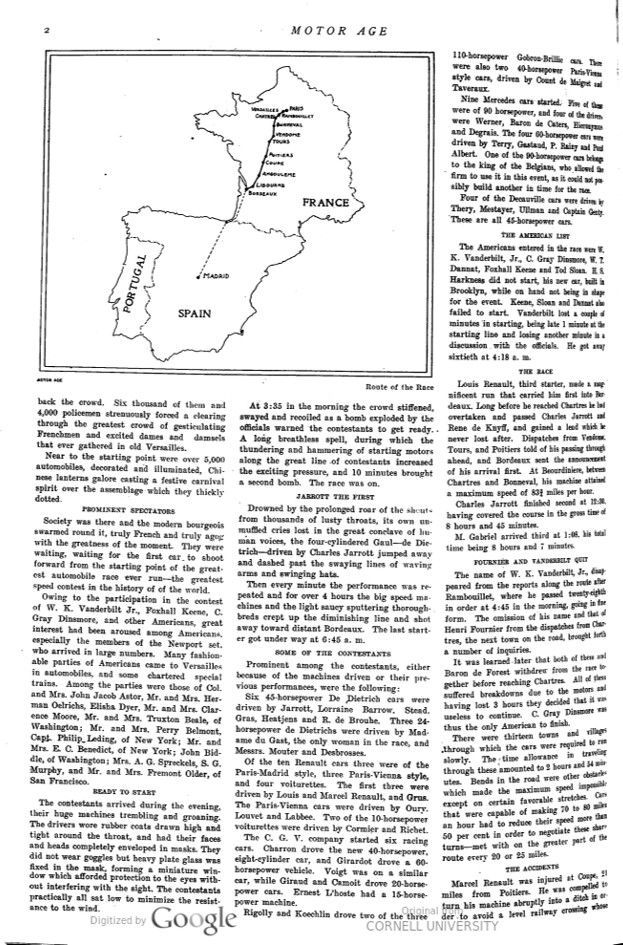
Page 2. Route of the Race – PARIS VERSAILLES CHATRES RAMBOUILLET BONNEVAL VENDOME TOURS POITIERS COUPE ANGOULEME LIBOURNE BORDEAUX
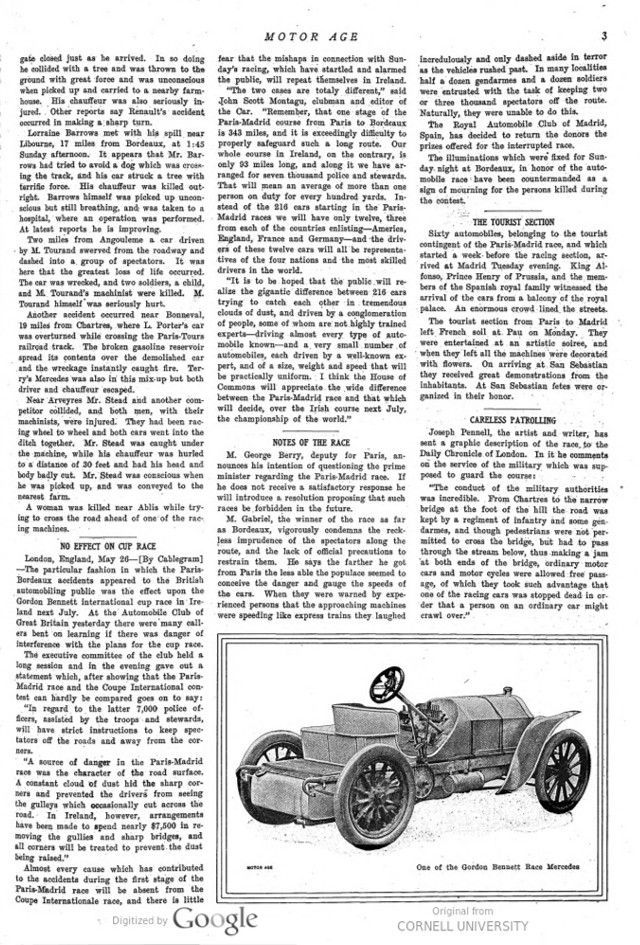
Page 3. One of the Gordon Bennett Race Mercedes