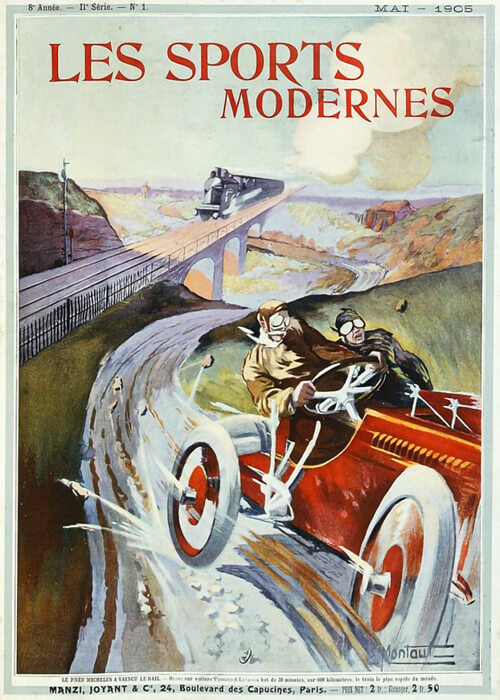
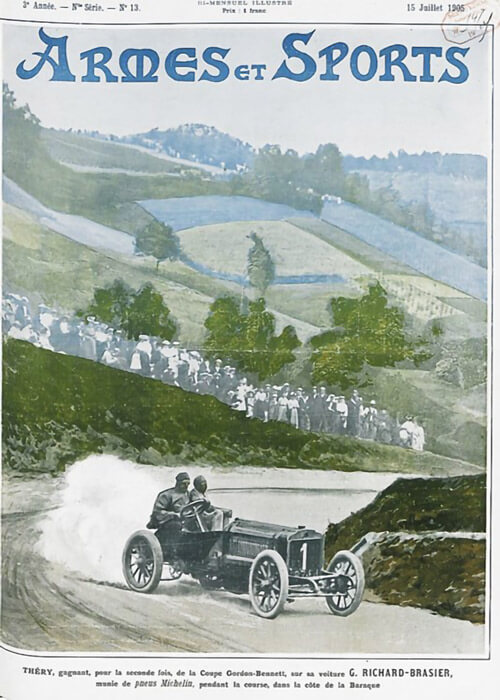
This relativel long read is a very thorough report of the first Grand Prix. Speeds were high and are winners; on the other hand, two days are much too long for such a race. The second day wasn’t necessary, as the grandstands were almost empty. Above that, the non-present British and American teams were deerly missed, to ensure enough interesting driving scenes for the spectators.
With permission of hathitrust hathitrust.org == Text and fotos compiled by motorracinghistory
Motor Age — Volume X, No. 2, July 12, 1906
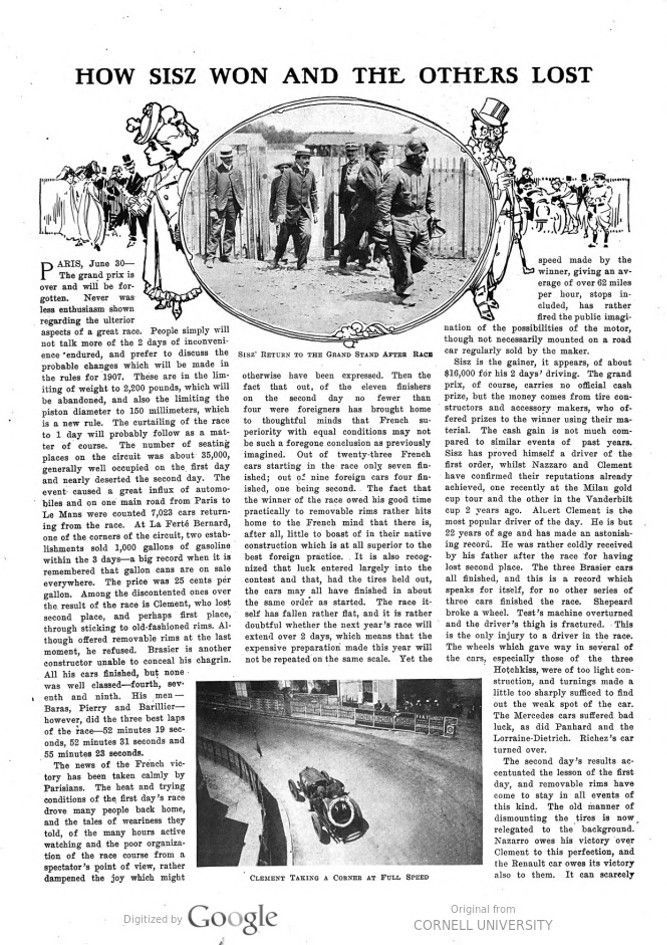
HOW SISZ WON AND THE OTHERS LOST
PARIS, June 30 – The grand prix is over and will be forgotten. Never was less enthusiasm shown regarding the ulterior aspects of a great race. People simply will not talk more of the 2 days of inconvenience endured and prefer to discuss the probable changes which will be made in the rules for 1907. These are in the limiting of weight to 2,200 pounds, which will be abandoned, and also the limiting the piston diameter to 150 millimeters, which is a new rule. The curtailing of the race to 1 day will probably follow as a matter of course. The number of seating places on the circuit was about 35,000, generally well occupied on the first day and nearly deserted the second day. The event caused a great influx of automobiles and on one main road from Paris to Le Mans were counted 7,023 cars returning from the race.
At La Ferté Bernard, one of the corners of the circuit, two establishments sold 1,000 gallons of gasoline within the 3 days – a big record when it is remembered that gallon cans are on sale everywhere. The price was 25 cents per gallon. Among the discontented ones over the result of the race is Clement, who lost second place, and perhaps first place, through sticking to old-fashioned rims. Although offered removable rims at the last moment, he refused. Brasier is another constructor unable to conceal his chagrin. All his cars finished, but none was well classed – fourth, seventh and ninth. His men – Baras, Pierry and Barillier – however, did the three best laps of the race – 52 minutes 19 seconds, 52 minutes 31 seconds and 55 minutes 23 seconds.
The news of the French victory has been taken calmly by Parisians. The heat and trying conditions of the first day’s race drove many people back home, and the tales of weariness they told, of the many hours active watching and the poor organization of the race course from a spectator’s point of view, rather dampened the joy which might otherwise have been expressed. Then the fact that out of the eleven finishers on the second day, no fewer than four were foreigners, has brought home that French thoughtful minds superiority with equal conditions may not be such a foregone conclusion as previously imagined. Out of twenty-three French cars starting in the race only seven finished; out of nine foreign cars four finished, one being second. The fact that the winner of the race owed his good time practically to removable rims rather hits home to the French mind that there is, after all, little to boast of in their native construction which is at all superior to the best foreign practice. It is also recognized that luck entered largely into the contest and that, had the tires held out, the cars may all have finished in about the same order as started. The race itself has fallen rather flat, and it is rather doubtful whether the next year’s race will extend over 2 days, which means that the expensive preparation made this year will not be repeated on the same scale. Yet the speed made by the winner, giving an average of over 62 miles per hour, stops included, has rather fired the public imagination of the possibilities of the motor, though not necessarily mounted on a road car regularly sold by the maker.
Sisz is the gainer, it appears, of about $16,000 for his 2 days’ driving. The grand prix, of course, carries no official cash prize, but the money comes from tire constructors and accessory makers, who offered prizes to the winner using their material. The cash gain is not much compared to similar events of past years. Sisz has proved himself a driver of the first order, whilst Nazzaro and Clement have confirmed their reputations already achieved, one recently at the Milan gold cup tour and the other in the Vanderbilt cup 2 years ago. Albert Clement is the most popular driver of the day. He is but 22 years of age and has made an astonishing record. He was rather coldly received by his father after the race for having lost second place. The three Brasier cars all finished, and this is a record which speaks for itself, for no other series of three cars finished the race. Shepeard broke a wheel. Test’s machine overturned and the driver’s thigh is fractured. This is the only injury to a driver in the race. The wheels which gave way in several of the cars, especially those of the three Hotchkiss, were of too light construction, and turnings made a little too sharply sufficed to find out the weak spot of the car. The Mercedes cars suffered bad luck, as did Panhard and the Lorraine-Dietrich. Richez’s car turned over.
The second day’s results accentuated the lesson of the first day, and removable rims have come to stay in all events of this kind. The old manner of dismounting the tires is now relegated to the background. Nazarro owes his victory over Clement to this perfection, and the Renault car owes its victory also to them. It can scarcely be considered that this is an improvement in tires. It is really a modification to the rim of the wheel. Six bolts suffice to hold the removable part in position, and a tap of the hammer is sufficient to remove it from the wheel, once the bolts are withdrawn.
The day has been disappointing as regards the efficiency of goudron. First several of the drivers, including Edmond and Jenatzy, abandoned the race for this reason, and all were more or less incommoded by the fumes and dust. Unless the goudron is laid on an absolutely perfect surface it is worse than useless, for it is deceptive. The loose stones scatter under the impulse from the wheels and cause a rough surface over the remaining parts holding good. Where the surface is thus bad every succeeding car causes a worse rut, and the dust is sudden and terrible in such places. The circuit is not considered any better from this standpoint than those which have preceded it, but the great dust nuisance has been largely obviated. The black ribbon road has tried the eyes of the drivers to a considerable extent, and even spectators have suffered to considerable numbers. In the 2 days of the race over 300 cases of sunstroke and eye troubles were treated at the medical service at the grand stands.
The grand prix has not been the great and overwhelming success anticipated, and it is admitted the absence of British and American contingents deducted much from the otherwise brilliant gathering. There were a goodly showing of American and British visitors, and the opinion of all these seems to be that the first day’s race was entirely sufficient for all needs and requirements, as was proved by the second day’s results. The distance imposed on the drivers and the strain on the sightseers was beyond human endurance for pleasure seeking, and the second day in particular was marked by ennui and lack of enthusiasm among the attendance. The five machines qualified for the Vanderbilt race are the Renault, Clement-Bayard, Brasier first, Panhard and the second Brasier.
This year’s race has been a victory for the small motors. The Clement, Brasier and Renault motors were those of the smallest diameter, and it is considered that 75 or 80 effective horsepower at the wheels is sufficient to win any race where pneumatics are the limiting feature. In fact, the races of the last few years have proved this, with the exception of the Itala car in last year’s Brescia circuit. It is also certain that mufflers will have much consideration in the next race, as they were found to be of great value and much appreciated by the drivers.
THE FIRST DAY
The circuit was closed at 5 a. m. Tuesday for the first day’s race, and those who wished to be well placed had to be stirring early. Pont de Gennes is not an accessible place and the majority of the spectators had been either up all night or about from before dawn. Trains had taken crowds down from Paris, and the number of people on the circuit was really astonishing and fully up to expectations. Probably 180,000 people put themselves about to visit the circuit. The day was a glorious one, with a sun pitilessly hot from morning to night. Scarcely a breath of wind stirred the bunting, and the polished tarred circuit, running like a ribbon over the monotonous national roads, smoked in the heat. Several drivers complained of goudron in the eyes, stating that in spite of the goggles, the gases, or, as some think, the tarred dust, mounted to their eyes, al- ready tired out by constant straining at the narrow black line over which the cars traveled at such prodigious speeds.
Several cars were officially timed to pass the grandstand at the rate of 92 miles an hour, but the effect to the eye was not that given. by the passage of an express train on rails, although nearly twice as quick. To a careful observer differences of 10 to 20 miles per hour could be observed in the passage of various cars, and especially when one car arrived with an interval of but 30 seconds or more after another. The day early resolved itself into a question of tires. M. Brasier, whose first car, driven by Baras, made a record on the first lap of running around, 642 miles in 52 minutes 19 seconds, signaled his men by means of a large notice board to drive slower, whilst Lancia, starting 90 seconds after the first departure, arrived first at the tribunes, in 52 minutes 42 seconds, suffered for his speed in the succeeding laps by having a number of tire troubles.
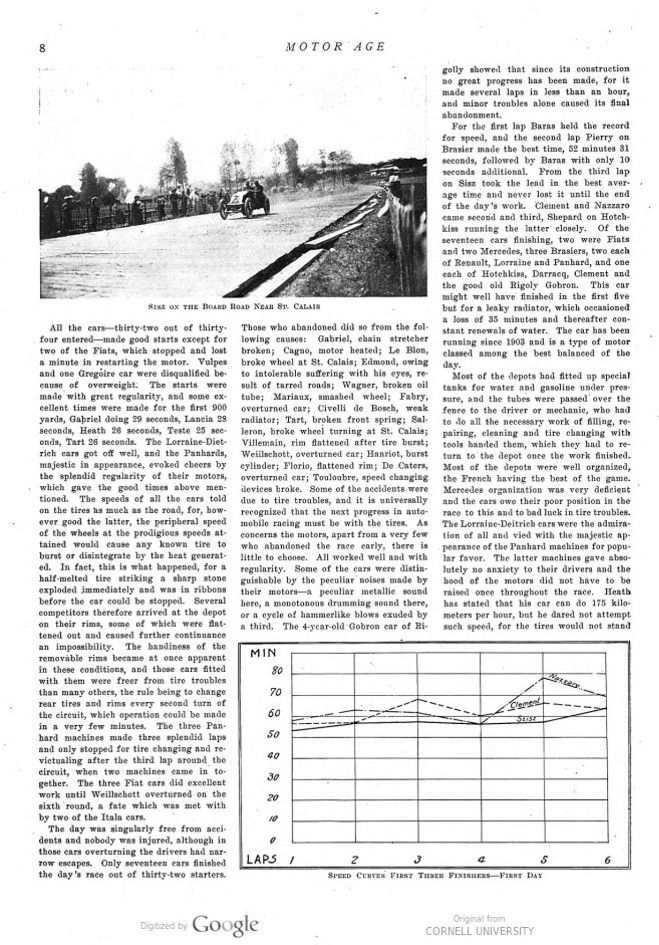
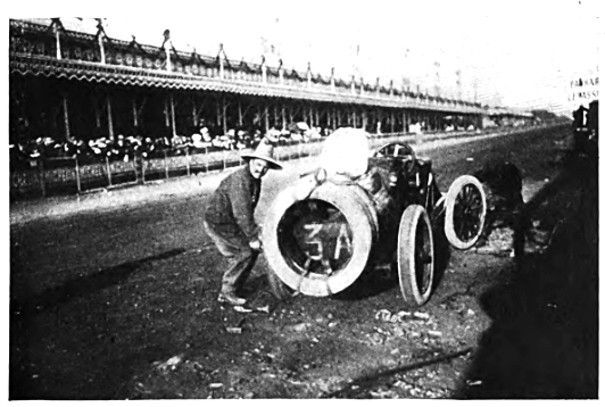
In fact, tire troubles after the first lap were the order of the day. However, out of twenty- eight cars finishing the first lap, sixteen did it inside the hour, and twelve did the same trick on the second lap. . Those cars which were fitted with removable rims, a patent exploited by the Michelin tire people, had much to be thankful for, as only a few minutes were sufficient to dismount and mount two rear tires. To this fact is due the excellent time of 5 hours 45 minutes 30 seconds made by Sisz for six laps. The expected time of 48 minutes hoped for by the sanguine was never attained, but 52 and 53 minutes is considered a wonderful time for the journey round a circuit on which are found several turnings necessitating slackening of speed to 3 miles per hour, and those of the Fourche and in the Forest of Vibraye were rounded at speeds of 12 miles per hour at most, the maximum considered safe by any of the drivers.
All the cars-thirty-two out of thirty-four entered-made good starts except for two of the Fiats, which stopped and lost a minute in restarting the motor. Vulpes and one Gregoire car were disqualified because of overweight: The starts were made with great regularity, and some excellent times were made for the first 900 yards, Gabriel doing 29 seconds, Lancia 28 seconds, Heath 26 seconds, Teste 25 seconds, Tart 26 seconds. The Lorraine-Dietrich cars got off well, and the Panhards, majestic in appearance, evoked cheers by the splendid regularity of their motors, which gave the good times above mentioned. The speeds of all the cars told on the tires as much as the road, for, however good the latter, the peripheral speed of the wheels at the prodigious speeds attained would cause any known tire to burst or disintegrate by the heat generated. In fact, this is what happened, for a half-melted tire striking a sharp stone exploded immediately and was in ribbons before the car could be stopped. Several competitors therefore arrived at the depot on their rims, some of which were flattened out and caused further continuance an impossibility. The handiness of the removable rims became at once apparent in these conditions, and those cars fitted with them were freer from tire troubles than many others, the rule being to change rear tires and rims every second turn of the circuit, which operation could be made in a very few minutes. The three Panhard machines made three splendid laps and only stopped for tire changing and revictualing after the third lap around the circuit, when two machines came in together. The three Fiat cars did excellent work until Weillschott overturned on the sixth round, a fate which was met with by two of the Itala cars.
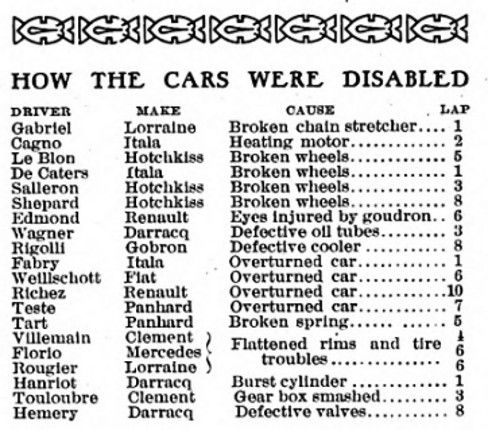
The day was singularly free from accidents, and nobody was injured, although in those cars overturning the drivers had narrow escapes. Only seventeen cars finished the day’s race out of thirty-two starters. Those who abandoned did so from the following causes: Gabriel, chain stretcher broken; Cagno, motor heated; Le Blon, broke wheel at St. Calais; Edmond, owing to intolerable suffering with his eyes, result of tarred roads; Wagner, broken oil tube; Mariaux, smashed wheel; Fabry, overturned car; Civelli de Bosch, weak radiator; Tart, broken front spring; Salleron, broke wheel turning at St. Calais; Villemain, rim flattened after tire burst; Weilschott, overturned car; Hanriot, burst cylinder; Florio, flattened rim; De Caters, overturned car; Touloubre, speed changing devices broke. Some of the accidents were due to tire troubles, and it is universally recognized that the next progress in automobile racing must be with the tires. As concerns the motors, apart from a very few who abandoned the race early, there is little to choose. All worked well and with regularity. Some of the cars were distinguishable by the peculiar noises made by their motors-a peculiar metallic sound here, a monotonous drumming sound there, or a cycle of hammerlike blows exuded by a third. The 4-year-old Gobron car of Rigolly showed that since its construction no great progress has been made, for it made several laps in less than an hour, and minor troubles alone caused its final abandonment.
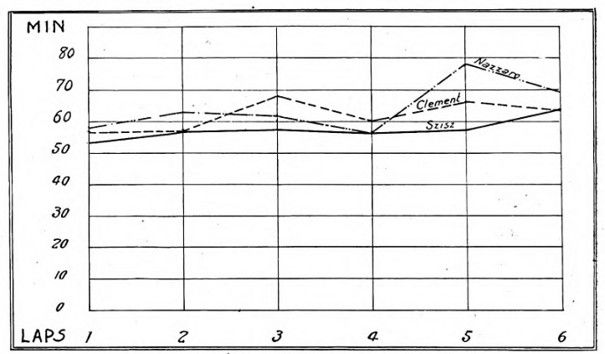
For the first lap, Baras held the record for speed, and the second lap Pierry on Brasier made the best time, 52 minutes 31 seconds, followed by Baras with only 10 seconds additional. From the third lap on Sisz took the lead in the best average time and never lost it until the end of the day’s work. Clement and Nazzaro came second and third, Shepard on Hotchkiss running the latter closely. Of the seventeen cars finishing, two were Fiats and two Mercedes, three Brasiers, two each of Renault, Lorraine and Panhard, and one each of Hotchkiss, Darracq, Clement and the good old Rigoly Gobron. This car might well have finished in the first five but for a leaky radiator, which occasioned a loss of 35 minutes and thereafter constant renewals of water. The car has been running since 1903 and is a type of motor classed among the best balanced of the day.
Most of the depots had fitted up special tanks for water and gasoline under pressure, and the tubes were passed over the fence to the driver or mechanic, who had to do all the necessary work of filling, repairing, cleaning and tire changing with tools handed them, which they had to return to the depot once the work finished. Most of the depots were well organized, the French having the best of the game. Mercedes organization was very deficient, and the cars owe their poor position in the race to this and to bad luck in tire troubles. The Lorraine-Deitrich cars were the admiration of all and vied with the majestic appearance of the Panhard machines for popular favor. The latter machines gave absolutely no anxiety to their drivers, and the hood of the motors did not have to be raised once throughout the race. Heath has stated that his car can do 175 kilometers per hour, but he dared not attempt such speed, for the tires would not stand the strain. The Renault cars, with their lively motors placed low in the chassis, look too light for the speed they attain, but here again appearances are deceptive. Nothing in the day’s events was attributed to bad driving and the drivers have all added to their laurels. Finally, there were no accidents to people to deplore.
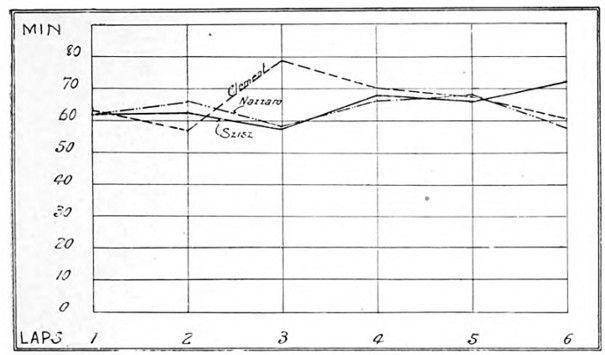
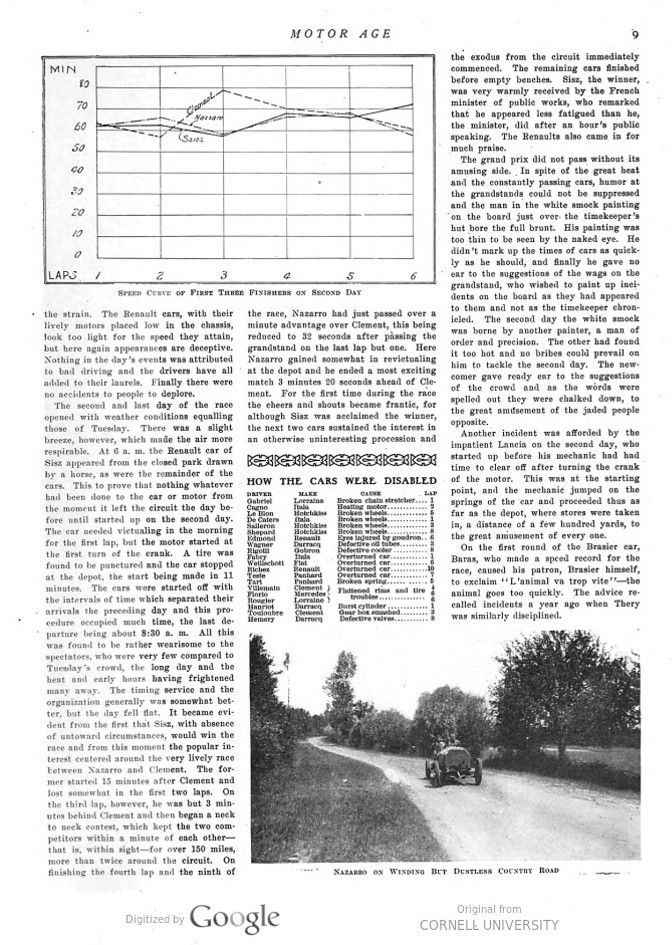
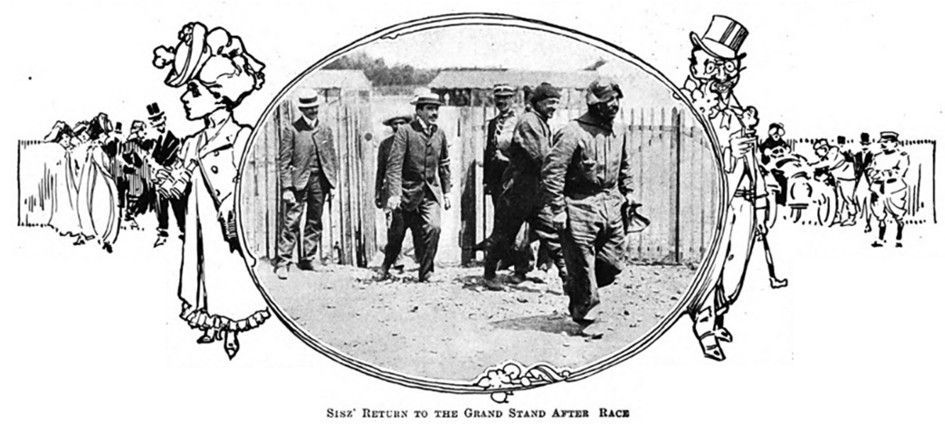
The second and last day of the race opened with weather conditions equaling those of Tuesday. There was a slight breeze, however, which made the air more respirable. At 6 a. m. the Renault car of Sisz appeared from the closed park drawn by a horse, as were the remainder of the cars. This to prove that nothing whatever had been done to the car or motor from the moment it left the circuit the day before until started up on the second day. The car needed victualing in the morning for the first lap, but the motor started at the first turn of the crank. A tire was found to be punctured and the car stopped at the depot, the start being made in 11 minutes. The cars were started off with the intervals of time which separated their arrivals the preceding day and this procedure occupied much time, the last departure being about 8:30 a.m. All this was found to be rather wearisome to the spectators, who were very few compared to Tuesday’s crowd, the long day and the heat and early hours having frightened many away. The timing service and the organization generally was somewhat better, but the day fell flat. It became evident from the first that Sisz, with absence of untoward circumstances, would win the race and from this moment the popular interest centered around the very lively race between Nazarro and Clement. The former started 15 minutes after Clement and lost somewhat in the first two laps. On the third lap, however, he was but 3 minutes behind Clement and then began a neck to neck contest, which kept the two competitors within a minute of each other – that is, within sight – for over 150 miles, more than twice around the circuit. On finishing the fourth lap and the ninth of the race, Nazarro had just passed over a minute advantage over Clement, this being reduced to 32 seconds after passing the grandstand on the last lap but one. Here Nazarro gained somewhat in revictualing at the depot and he ended a most exciting match 3 minutes 20 seconds ahead of Clement. For the first time during the race the cheers and shouts became frantic, for although Sisz was acclaimed the winner, the next two cars sustained the interest in an otherwise uninteresting procession and the exodus from the circuit immediately commenced. The remaining cars finished before empty benches. Sisz, the winner, was very warmly received by the French minister of public works, who remarked that he appeared less fatigued than he, the minister, did after an hour’s public speaking. The Renaults also came in for much praise.
The grand prix did not pass without its amusing side. In spite of the great heat and the constantly passing cars, humor at the grandstands could not be suppressed and the man in the white smock painting on the board just over the timekeeper’s hut bore the full brunt. His painting was too thin to be seen by the naked eye. He didn’t mark up the times of cars as quickly as he should, and finally he gave no ear to the suggestions of the wags on the grandstand, who wished to paint up incidents on the board as they had appeared to them and not as the timekeeper chronicled. The second day the white smock was borne by another painter, a man of order and precision. The other had found it too hot and no bribes could prevail on him to tackle the second day. The newcomer gave ready ear to the suggestions of the crowd and as the words were spelled out, they were chalked down, to the great amusement of the jaded people opposite.
Another incident was afforded by the impatient Lancia on the second day, who started up before his mechanic had had time to clear off after turning the crank of the motor. This was at the starting point, and the mechanic jumped on the springs of the car and proceeded thus as far as the depot, where stores were taken in, a distance of a few hundred yards, to the great amusement of everyone.
On the first round of the Brasier car, Baras, who made a speed record for the race, caused his patron, Brasier himself, to exclaim “L’animal va trop vite” – the animal goes too quickly. The advice recalled incidents a year ago when Thery was similarly disciplined.
Photos
Page 6 – 9
SISZ RETURN TO THE GRAND STAND AFTER RACE
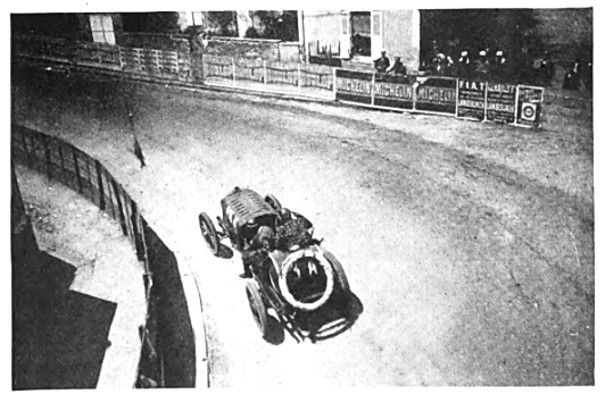
CLEMENT TAKING A CORNER AT FULL SPEED
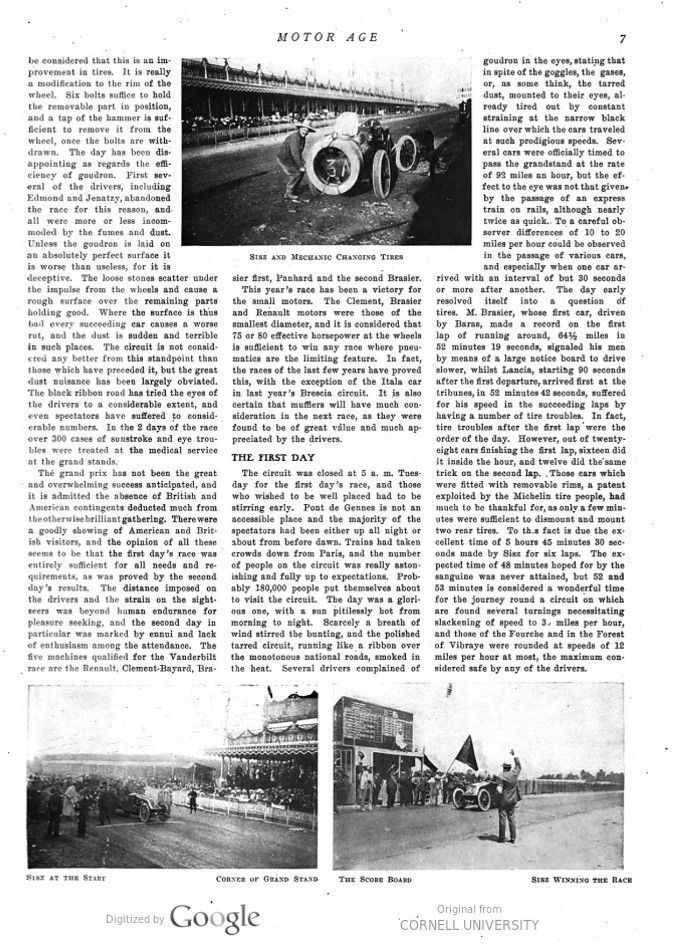
SISZ AND MECHANIC CHANGING TIRES
SISZ AT THE START, CORNER OF GRAND STAND – THE SCORE BOARD, SISZ WINNING THE RACE
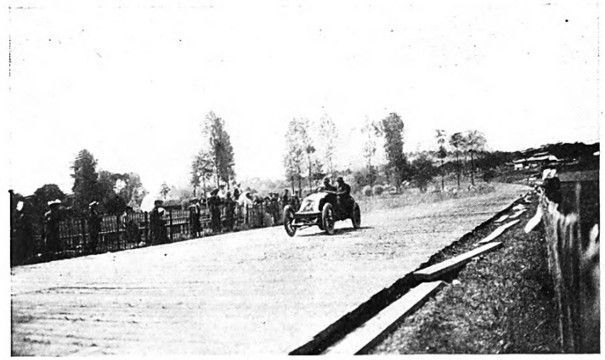
SISZ ON THE BOARD ROAD NEAR ST. CALAIS
SPEED CURVES FIRST THREE FINISHERS – FIRST DAY: Nazzaro, Clement, Szisz
SPEED CURVE OF FIRST THREE FINISHERS ON SECOND DAY: Nazzaro, Clement, Szisz
HOW THE CARS WERE DISABLED
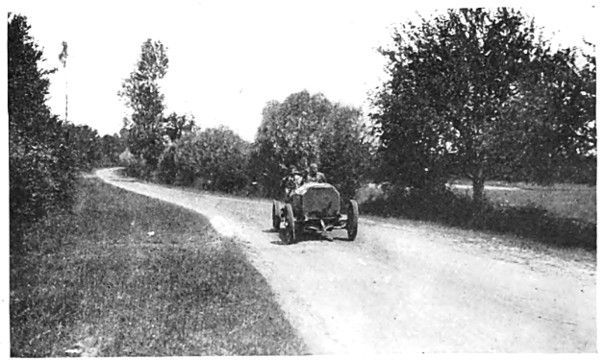
NAZARRO ON WINDING BUT DUSTLESS COUNTRY ROAD