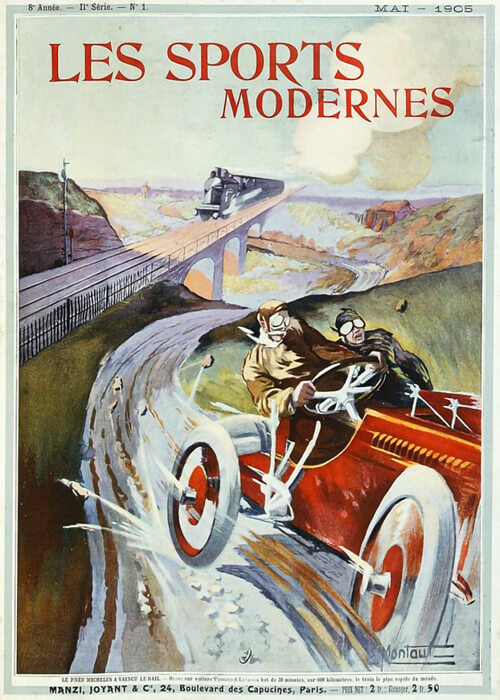
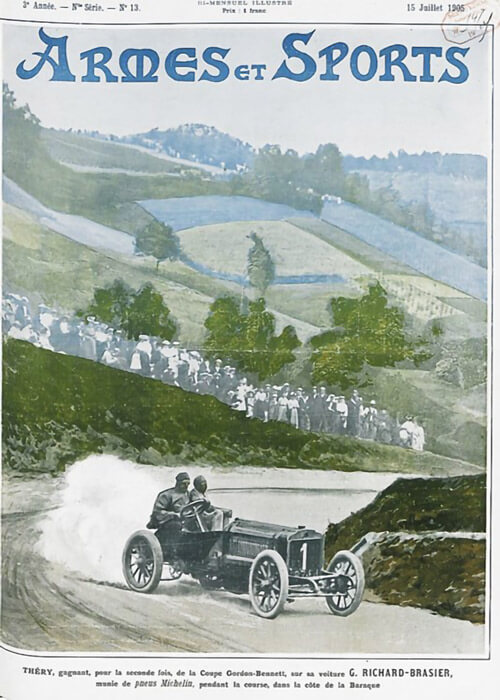
In this reasonably long read, the course and it’s characteristics are presented, the drivers are acknowledged and the cars with their technical specifics are listed. This is typical for race reports of those days: prior to race events, extensive views were written on the three “ingredients” of a motor race: course, drivers and cars.
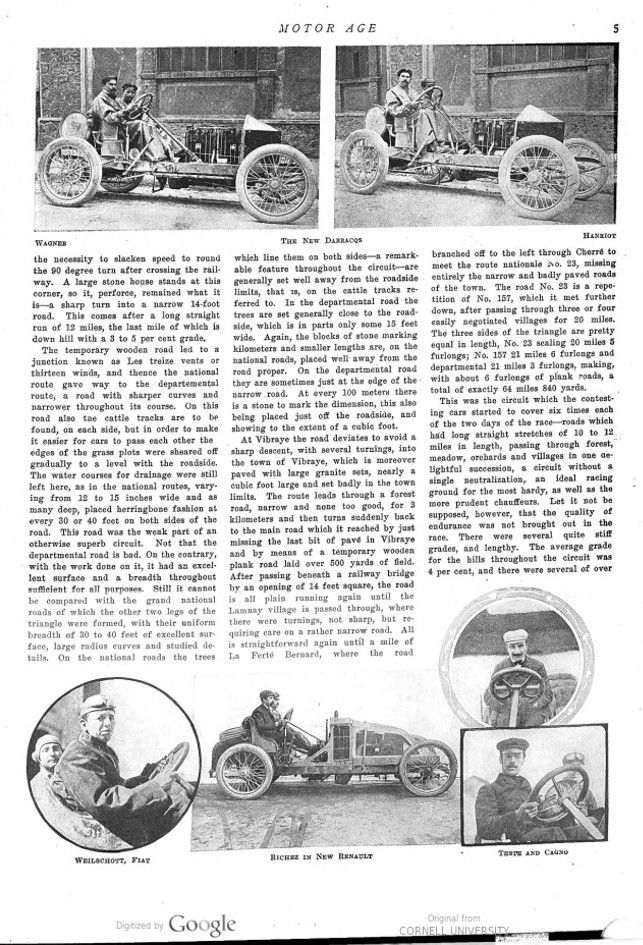
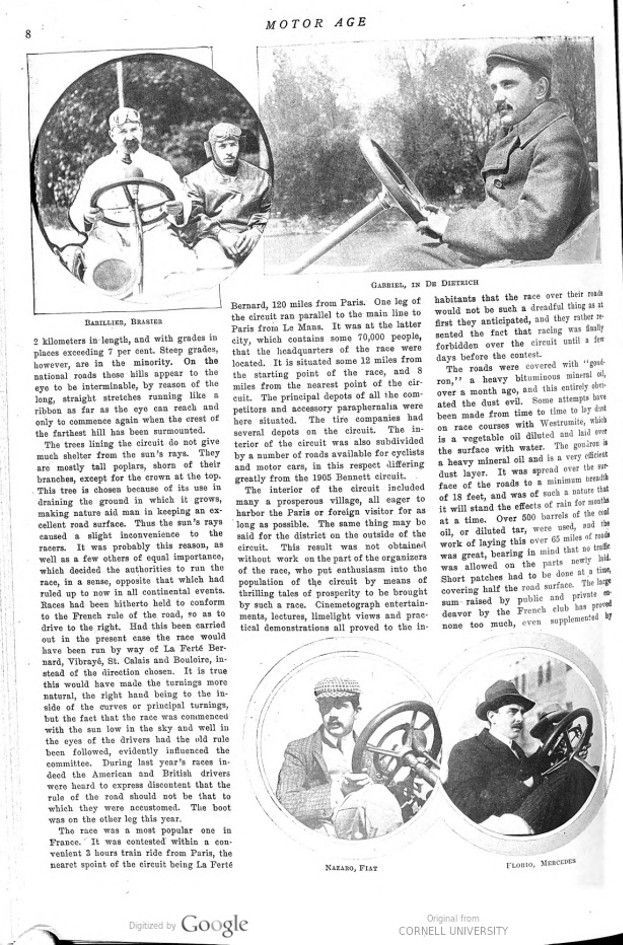
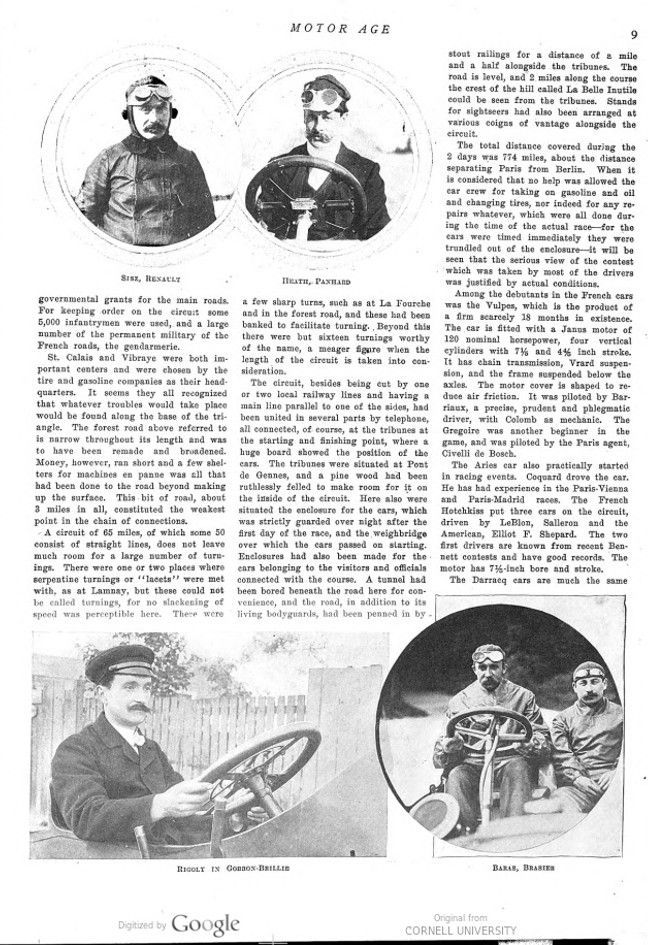
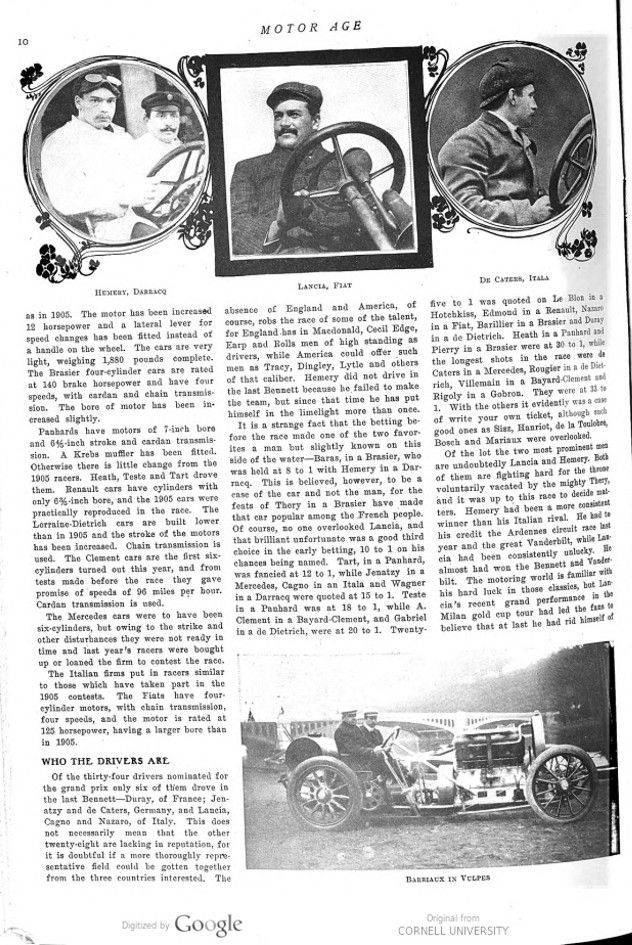
With permission of hathitrust hathitrust.org == Text and fotos compiled by motorracinghistory
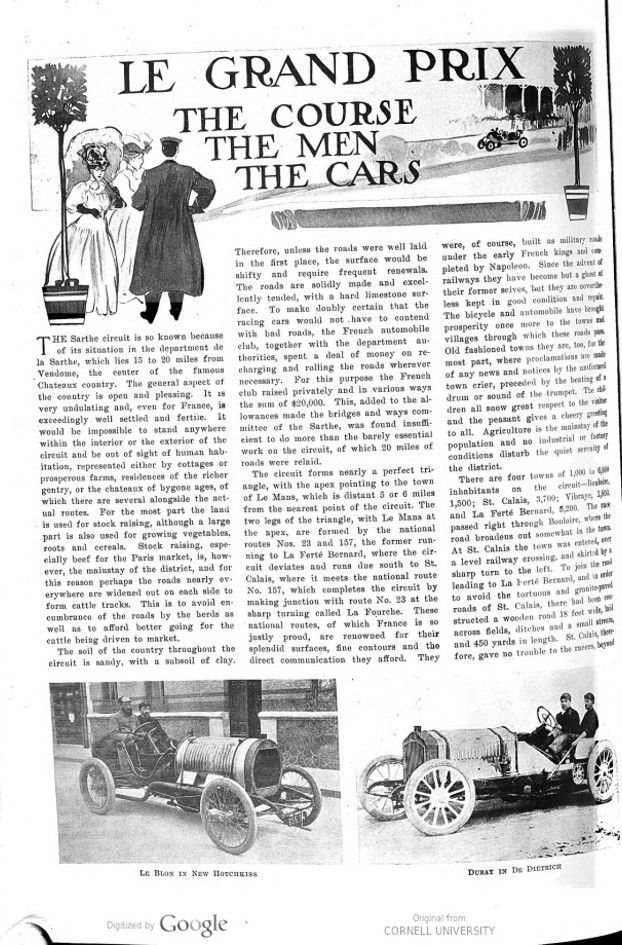
Motor Age — Volume IX, No. 24, June 14, 1906
LE GRAND PRIX
THE COURSE – THE MEN – THE CARS
THE Sarthe circuit is so known because of its situation in the department de la Sarthe, which lies 15 to 20 miles from Vendome, the center of the famous Chateaux country. The general aspect of the country is open and pleasing. It is very undulating and, even for France, is exceedingly well settled and fertile. It would be impossible to stand anywhere within the interior or the exterior of the circuit and be out of sight of human habitation, represented either by cottages or prosperous farms, residences of the richer gentry, or the chateaux of bygone ages, of which there are several alongside the actual routes. For the most part the land is used for stock raising, although a large part is also used for growing vegetables, roots and cereals. Stock raising, especially beef for the Paris market, is, however, the mainstay of the district, and for this reason perhaps the roads nearly everywhere are widened out on each side to form cattle tracks. This is to avoid encumbrance of the roads by the herds as well as to afford better going for the cattle being driven to market.
The soil of the country throughout the circuit is sandy, with a subsoil of clay. Therefore, unless the roads were well laid in the first place, the surface would be shifty and require frequent renewals. The roads are solidly made and excellently tended, with a hard limestone surface. To make doubly certain that the racing cars would not have to contend with bad roads, the French automobile club, together with the department authorities, spent a deal of money on recharging and rolling the roads wherever necessary. For this purpose the French club raised privately and in various ways the sum of $20,000. This, added to the allowances made the bridges and ways committee of the Sarthe, was found insufficient to do more than the barely essential work on the circuit, of which 20 miles of roads were relaid.
The circuit forms nearly a perfect triangle, with the apex pointing to the town of Le Mans, which is distant 5 or 6 miles from the nearest point of the circuit. The two legs of the triangle, with Le Mans at the apex, are formed by the national routes Nos. 23 and 157, the former running to La Ferté Bernard, where the circuit deviates and runs due south to St. Calais, where it meets the national route No. 157, which completes the circuit by making junction with route No. 23 at the sharp turning called La Fourche. These national routes, of which France is so justly proud, renowned for their splendid surfaces, fine contours and the direct communication they afford. They were, of course, built as military roads under the early French kings and completed by Napoleon. Since the advent of railways they have become but a ghost of their former selves, but they are nevertheless kept in good condition and repair. The bicycle and automobile have brought prosperity once more to the towns and villages through which these roads pass. Old fashioned towns they are, too, for the most part, where proclamations are made of any news and notices by the uniformed town crier, preceded by the beating of a drum or sound of the trumpet. The children all show great respect to the visitor and the peasant gives a cheery greeting to all. Agriculture is the mainstay of the population and no industrial or factory conditions disturb the quiet serenity of the district.
There are four towns of 1,000 to 6,000 the circuit-Bouloire, inhabitants on 1,500; St. Calais, 3,700; Vibraye, 1,800. and La Ferté Bernard, 5,200. The race passed right through Bouloire, where the road broadens out somewhat in the town. At St. Calais the town was entered, over a level railway crossing, and skirted by a sharp turn to the left. To join the road leading to La Ferté Bernard, and in order to avoid the tortuous and granite-paved roads of St. Calais, there had been constructed a wooden road 18 feet wide, laid across fields, ditches and a small stream, and 450 yards in length. St. Calais, therefore, gave no trouble to the racers, beyond the necessity to slacken speed to round the 90-degree turn after crossing the railway. A large stone house stands at this corner, so it, perforce, remained what it is a sharp turn into a narrow 14-foot road. This comes after a long straight run of 12 miles, the last mile of which is downhill with a 3 to 5 per cent grade.
The temporary wooden road led to a junction known as Les treize vents or thirteen winds, and thence the national route gave way to the departemental route, a road with sharper curves and narrower throughout its course. On this road also the cattle tracks are to be found, on each side, but in order to make it easier for cars to pass each other the edges of the grass plots were sheared off gradually to a level with the roadside. The water courses for drainage were still left here, as in the national routes, varying from 12 to 15 inches wide and as many deep, placed herringbone fashion at every 30 or 40 feet on both sides of the road. This road was the weak part of an otherwise superb circuit. Not that the departmental road is bad. On the contrary, with the work done on it, it had an excel- lent surface and a breadth throughout sufficient for all purposes. Still it cannot be compared with the grand national roads of which the other two legs of the triangle were formed, with their uniform breadth of 30 to 40 feet of excellent surface, large radius curves and studied details. On the national roads the trees which line them on both sides – a remarkable feature throughout the circuit – are generally set well away from the roadside limits, that is, on the cattle tracks referred to. In the departmental road the trees are set generally close to the road-side, which is in parts only some 15 feet wide. Again, the blocks of stone marking kilometers and smaller lengths are, on the national roads, placed well away from the road proper. On the departmental road they are sometimes just at the edge of the narrow road. At every 100 meters there is a stone to mark the dimension, ibis also being placed just off the roadside, and showing to the extent of a cubic foot.
At Vibraye the road deviates to avoid a sharp descent, with several turnings, into the town of Vibraye, which is moreover paved with large granite sets, nearly a cubic foot large and set badly in the town limits. The route leads through a forest road, narrow and none too good, for 3 kilometers and then turns suddenly back to the main road which it reached by just missing the last bit of pavé in Vibraye and by means of a temporary wooden plank road laid over 500 yards of field. After passing beneath a railway bridge by an opening of 14 feet square, the road is all plain running again until the Lamnay village is passed through, where there were turnings, not sharp, but re- quiring care on a rather narrow road. All is straightforward again until a mile of La Ferté Bernard, where the road branched off to the left through Cherré to meet the Route Nationale No. 23, missing entirely the narrow and badly paved roads of the town. Road No. 23 is a repetition of No. 157, which it met further down, after passing through three or four easily negotiated villages for 20 miles. The three sides of the triangle are pretty equal in length, No. 23 scaling 20 miles 5 furlongs; No. 157 21 miles 6 furlongs and departmental 21 miles 3 furlongs, making, with about 6 furlongs of plank roads, a total of exactly 64 miles 840 yards.
This was the circuit which the contesting cars started to cover six times each of the two days of the race – roads which had long straight stretches of 10 to 12 miles in length, passing through forest, meadow, orchards and villages in one delightful succession, a circuit without a single neutralization, an ideal racing ground for the most hardy, as well as the more prudent chauffeurs. Let it not be supposed, however, that the quality of endurance was not brought out in the race. There were several quite stiff grades, and lengthy. The average grade for the hills throughout the circuit was 4 per cent, and there were several of over 2 kilometers in length, and with grades in places exceeding 7 per cent. Steep grades, however, are in the minority. On the national roads these hills appear to the eye to be interminable, by reason of the long, straight stretches running like a ribbon as far as the eye can reach and only to commence again when the crest of the farthest hill has been surmounted.
The trees lining the circuit do not give much shelter from the sun’s rays. They are mostly tall poplars, shorn of their branches, except for the crown at the top. This tree is chosen because of its use in draining the ground in which it grows, making nature aid man in keeping an excellent road surface. Thus the sun’s rays caused a slight inconvenience to the racers. It was probably this reason, as well as a few others of equal importance, which decided the authorities to run the race, in a sense, opposite that which had ruled up to now in all continental events. Races had been hitherto held to conform to the French rule of the road, so as to drive to the right. Had this been carried out in the present case the race would have been run by way of La Ferté Bernard, Vibraye, St. Calais and Bouloire, instead of the direction chosen. It is true this would have made the turnings more natural, the right hand being to the inside of the curves or principal turnings, but the fact that the race was commenced with the sun low in the sky and well in the eyes of the drivers had the old rule been followed, evidently influenced the committee. During last year’s races i deed the American and British drivers were heard to express discontent that the rule of the road should not be that to which they were accustomed. The boot was on the other leg this year.
The race was a most popular one in France. It was contested within a convenient 3 hours train ride from Paris, the nearest point of the circuit being La Ferté Bernard, 120 miles from Paris. One leg of the circuit ran parallel to the main line to Paris from Le Mans. It was at the latter city, which contains some 70,000 people, that the headquarters of the race were located. It is situated some 12 miles from the starting point of the race, and 8 miles from the nearest point of the circuit. The principal depots of all the competitors and accessory paraphernalia were here situated. The tire companies had several depots on the circuit. The interior of the circuit was also subdivided by a number of roads available for cyclists and motor cars, in this respect differing greatly from the 1905 Bennett circuit.
The interior of the circuit included many a prosperous village, all eager to harbor the Paris or foreign visitor for as long as possible. The same thing may be said for the district on the outside of the circuit. This result was not obtained without work on the part of the organizers of the race, who put enthusiasm into the population of the circuit by means of thrilling tales of prosperity to be brought by such a race. Cinemetograph entertainments, lectures, limelight views and practical demonstrations all proved to the inhabitants that the race over their roads would not be such a dreadful thing as at first they anticipated, and they rather resented the fact that racing was finally forbidden over the circuit until a few days before the contest.
The roads were covered with “goudron,” a heavy bituminous mineral oil, over a month ago, and this entirely obviated the dust evil. Some attempts have been made from time to time to lay dust on racecourses with Westrumite, which is a vegetable oil diluted and laid over the surface with water. The goudron is a heavy mineral oil and is a very efficient dust layer. It was spread over the surface of the roads to a minimum breadth of 18 feet, and was of such a nature that it will stand the effects of rain for months at a time. Over 500 barrels of the coal oil, or diluted tar, were used, and the work of laying this over 65 miles of roads was great, bearing in mind that no traffic was allowed on the parts newly laid. Short patches had to be done at a time, covering half the road surface. The large sum raised by public and private endeavor by the French club has proved none too much, even supplemented by governmental grants for the main roads. For keeping order on the circuit some 5,000 infantrymen were used, and a large number of the permanent military of the French roads, the gendarmerie.
St. Calais and Vibraye were both important centers and were chosen by the tire and gasoline companies as their headquarters. It seems they all recognized that whatever troubles would take place would be found along the base of the tri- angle. The forest road above referred to is narrow throughout its length and was to have been remade and broadened. Money, however, ran short and a few shelters for machines en panne was all that had been done to the road beyond making up the surface. This bit of road, about 3 miles in all, constituted the weakest point in the chain of connections.
A circuit of 65 miles, of which some 50 consist of straight lines, does not leave much room for a large number of turnings. There were one or two places where serpentine turnings or “lacets” were met with, as at Lamnay, but these could not be called turnings, for no slackening of speed was perceptible here. There were a few sharp turns, such as at La Fourche and in the forest road, and these had been banked to facilitate turning. Beyond this there were but sixteen turnings worthy of the name, a meager figure when the length of the circuit is taken into consideration.
The circuit, besides being cut by one or two local railway lines and having a main line parallel to one of the sides, had been united in several parts by telephone, all connected, of course, at the tribunes at the starting and finishing point, where a huge board showed the position of the cars. The tribunes were situated at Pont de Gennes, and a pine wood had been ruthlessly felled to make room for it on the inside of the circuit. Here also were situated the enclosure for the cars, which was strictly guarded over night after the first day of the race, and the weighbridge over which the cars passed on starting. Enclosures had also been made for the cars belonging to the visitors and officials connected with the course. A tunnel had been bored beneath the road here for convenience, and the road, in addition to its living bodyguards, had been penned in by stout railings for a distance of a mile and a half alongside the tribunes. The road is level, and 2 miles along the course the crest of the hill called La Belle Inutile could be seen from the tribunes. Stands for sightseers had also been arranged at various coigns of vantage alongside the circuit.
The total distance covered during the 2 days was 774 miles, about the distance separating Paris from Berlin. When it is considered that no help was allowed the car crew for taking on gasoline and oil and changing tires, nor indeed for any repairs whatever, which were all done during the time of the actual race – for the cars were timed immediately they were trundled out of the enclosure – it will be seen that the serious view of the contest which was taken by most of the drivers was justified by actual conditions.
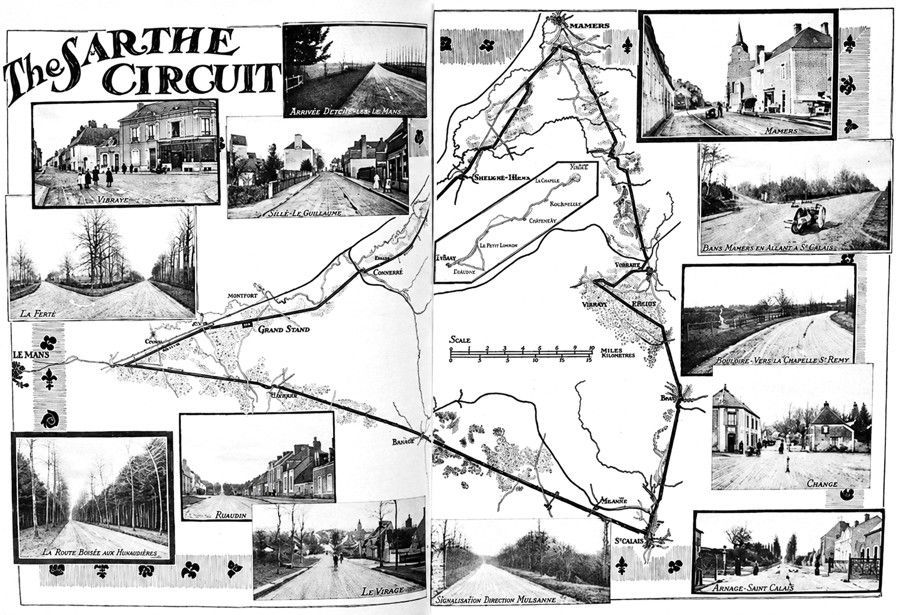
The SARTHE CIRCUIT
Photos.
TURN AT ENTRANCE TO CONNERRÉ – BETWEEN FERTE BERNAND AND SCEAUX – THE FORKS – SCEAUX SUR L’HUISNE
BETWEEN FORKS AND ARDENAY
ENTERING BOULOIRE – LEAVING BOULOIRE
LAMNAY
LEAVING MAIN ROAD IN VIRBAY FOREST
BERFAY – WINDING ROAD LEAVING BERFAY – ENTERING SAINT CALAIS – STRAIGHT LINE BETWEEN BOULOIRE AND ST CALAIS
Map of the course:
LE MANS – Champagne – St Mars – GRAND STAND (MONTFORT) – Connerré – Dunes – Sceaux-sur-l’Huisne – LA-FERTE BERNARD – Lamnay – VIBRAYE – VIBRAYE FOREST – Berfay – ST. CALAIS – Montaille – Bouloire – Ardenay
Among the debutants in the French cars was the Vulpes, which is the product of a firm scarcely 18 months in existence. The car is fitted with a Janus motor of 120 nominal horsepower, four vertical cylinders with 7 1/5 and 4 4/5 inch stroke. It has chain transmission, Vrard suspension, and the frame suspended below the axles. The motor cover is shaped to reduce air friction. It was piloted by Barriaux, a precise, prudent and phlegmatic driver, with Colomb as mechanic. The Gregoire was another beginner in the game, and was piloted by the Paris agent, Civelli de Bosch.
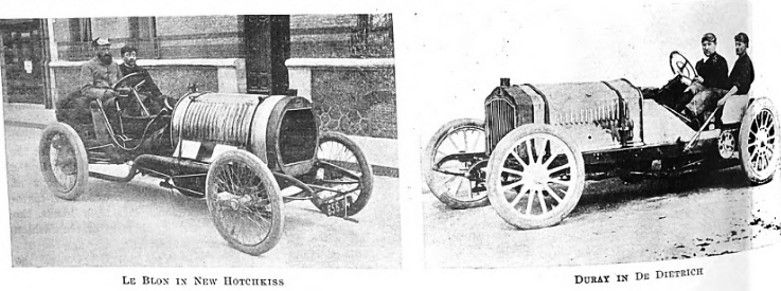
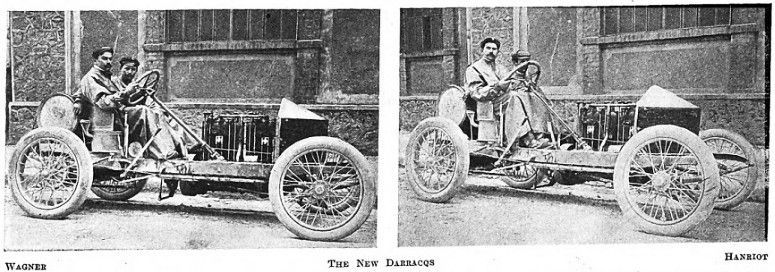
The Aries car also practically started in racing events. Coquard drove the car. He has had experience in the Paris-Vienna and Paris-Madrid races. The French Hotchkiss put three cars on the circuit, driven by LeBlon, Salleron and the American, Elliot F. Shepard. The two first drivers are known from recent Bennett contests and have good records. The motor has 7 1/5-inch bore and stroke. The Darracq cars are much the same as in 1905. The motor has been increased 12 horsepower and a lateral lever for speed changes has been fitted instead of a handle on the wheel. The cars are very light, weighing 1,880 pounds complete. The Brasier four-cylinder cars are rated at 140 brake horsepower and have four speeds, with cardan and chain transmission. The bore of motor has been increased slightly.
The Panhards have motors of 7-inch bore and 6 4/5-inch stroke and cardan transmission. A Krebs muffler has been fitted. Otherwise there is little change from the 1905 racers. Heath, Teste and Tart drove them. Renault cars have cylinders with only 6 2/5-inch bore, and the 1905 cars were practically reproduced in the race. Lorraine-Dietrich cars are built lower than in 1905 and the stroke of the motors has been increased. Chain transmission is used. The Clement cars are the first six-cylinders turned out this year, and from tests made before the race they gave promise of speeds of 96 miles per hour. Cardan transmission is used.
The Mercedes cars were to have been six-cylinders but owing to the strike and other disturbances they were not ready in time and last year’s racers were bought up or loaned the firm to contest the race.
The Italian firms put in racers similar to those which have taken part in the 1905 contests. The Fiats have four-cylinder motors, with chain transmission, four speeds, and the motor is rated at 125 horsepower, having a larger bore than in 1905.
WHO THE DRIVERS ARE
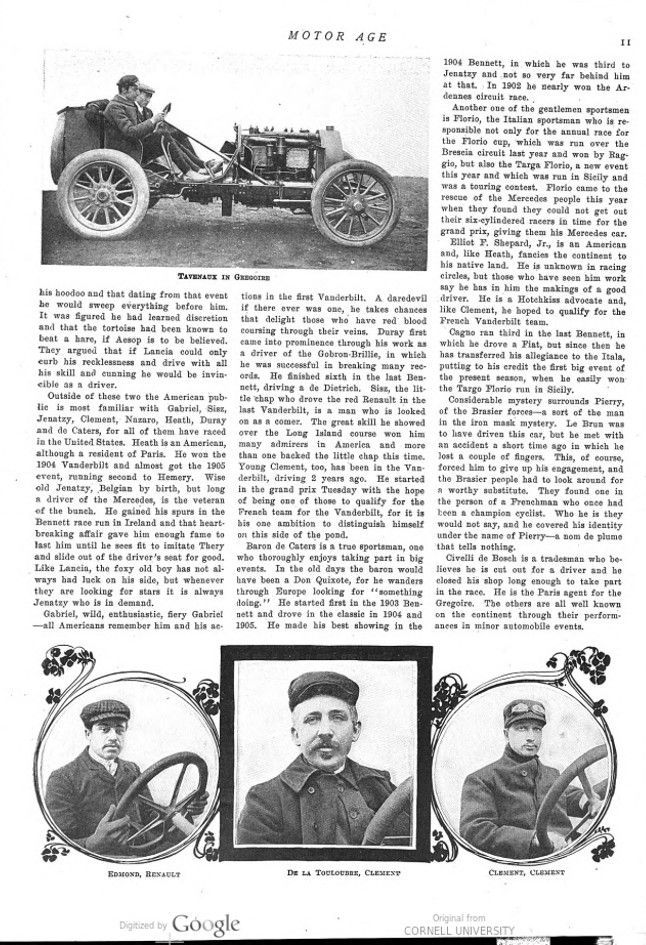
Of the thirty-four drivers nominated for the grand prix only six of them drove in the last Bennett – Duray, of France; Jenatzy and de Caters, Germany, and Lancia, Cagno and Nazaro, of Italy. This does not necessarily mean that the other twenty-eight are lacking in reputation, for it is doubtful if a more thoroughly representative field could be gotten together from the three countries interested. The absence of England and America, of course, robs the race of some of the talent, for England has in Macdonald, Cecil Edge, Earp and Rolls men of high standing as drivers, while America could offer such men as Tracy, Dingley, Lytle and others of that caliber. Hemery did not drive in the last Bennett, because he failed to make the team, but since that time he has put himself in the limelight more than once.
It is a strange fact that the betting before the race made one of the two favorites a man but slightly known on this side of the water – Baras, in a Brasier, who was held at 8 to 1 with Hemery in a Darracq. This is believed, however, to be a case of the car and not the man, for the feats of Thery in a Brasier have made that car popular among the French people. Of course, no one overlooked Lancia, and that brilliant unfortunate was a good third choice in the early betting, 10 to 1 on his chances being named. Tart, in a Panhard, was fancied at 12 to 1, while Jenatzy in a Mercedes, Cagno in an Itala and Wagner in a Darracq were quoted at 15 to 1. Teste in a Panhard was at 18 to 1, while A. Clement in a Bayard-Clement, and Gabriel in a de Dietrich, were at 20 to 1. Twenty-five to 1 was quoted on Le Blon in a Hotchkiss, Edmond in a Renault, Nazaro in a Fiat, Barillier in a Brasier and Duray in a de Dietrich. Heath in a Panhard and Pierry in a Brasier were at 30 to 1, while the longest shots in the race were de Caters in a Mercedes, Rougier in a de Dietrich, Villemain in a Bayard-Clement and Rigoly in a Gobron. They were at 33 to 1. With the others it evidently was a case of write your own ticket, although such good ones as Sisz, Hanriot, de la Toulobre, Bosch and Mariaux were overlooked.
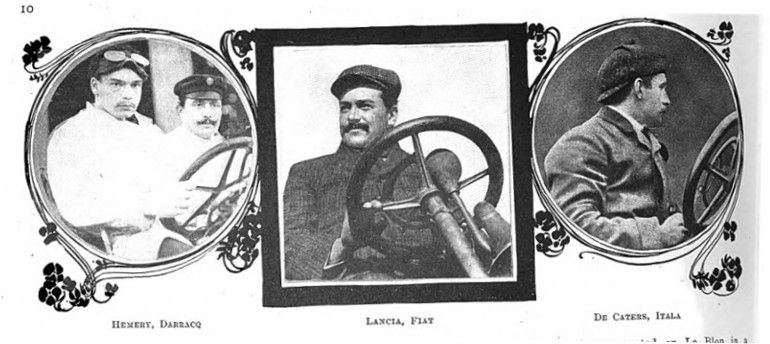
Of the lot the two most prominent men are undoubtedly Lancia and Hemery. Both of them are fighting hard for the throne voluntarily vacated by the mighty Thery, and it was up to this race to decide matters. Hemery had been a more consistent winner than his Italian rival. He had to his credit the Ardennes circuit race last year and the great Vanderbilt, while Lancia had been consistently unlucky. He almost had won the Bennett and Vanderbilt. The motoring world is familiar with his hard luck in those classics, but Lancia’s recent grand performance in the Milan gold cup tour had led the fans to believe that at last he had rid himself of his hoodoo and that dating from that event he would sweep everything before him. It was figured he had learned discretion and that the tortoise had been known to beat a hare, if Aesop is to be believed. They argued that if Lancia could only curb his recklessness and drive with all his skill and cunning he would be invincible as a driver.
Outside of these two the American public is most familiar with Gabriel, Sisz, Jenatzy, Clement, Nazaro, Heath, Duray and de Caters, for all of them have raced in the United States. Heath is an American, although a resident of Paris. He won the 1904 Vanderbilt and almost got the 1905 event, running second to Hemery. Wise old Jenatzy, Belgian by birth, but long a driver of the Mercedes, is the veteran of the bunch. He gained his spurs in the Bennett race run in Ireland and that heart-breaking affair gave him enough fame to last him until he sees fit to imitate Thery and slide out of the driver’s seat for good. Like Lancia, the foxy old boy has not always had luck on his side, but whenever they are looking for stars it is always Jenatzy who is in demand.
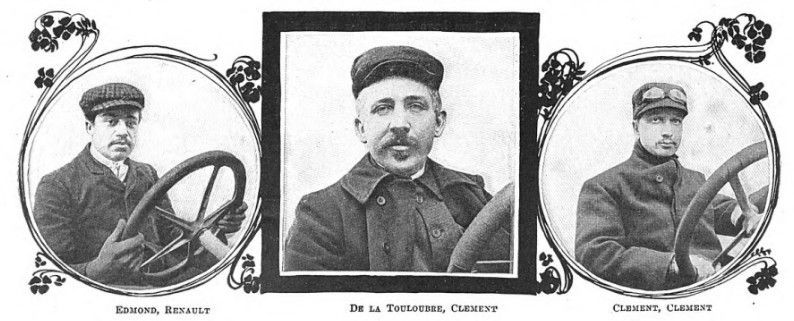
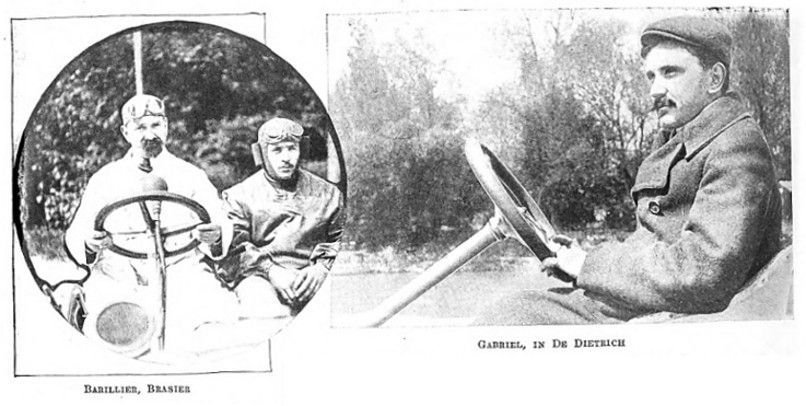
Gabriel, wild, enthusiastic, fiery Gabriel -all Americans remember him and his actions in the first Vanderbilt. A daredevil if there ever was one, he takes chances that delight those who have red blood coursing through their veins. Duray first came into prominence through his work as a driver of the Gobron-Brillie, in which he was successful in breaking many records. He finished sixth in the last Bennett, driving a de Dietrich. Sisz, the little chap who drove the red Renault in the last Vanderbilt, is a man who is looked on as a comer. The great skill he showed over the Long Island course won him many admirers in America and more than one backed the little chap this time. Young Clement, too, has been in the Vanderbilt, driving 2 years ago. He started in the grand prix Tuesday with the hope of being one of those to qualify for the French team for the Vanderbilt, for it is his one ambition to distinguish himself on this side of the pond.

Baron de Caters is a true sportsman, one who thoroughly enjoys taking part in big events. In the old days the baron would have been a Don Quixote, for he wanders through Europe looking for “something doing.” He started first in the 1903 Bennett and drove in the classic in 1904 and 1905. He made his best showing in the I I 1904 Bennett, in which he was third to Jenatzy and not so very far behind him at that. In 1902 he nearly won the Ardennes circuit race.
Another one of the gentlemen sportsmen is Florio, the Italian sportsman who is responsible not only for the annual race for the Florio cup, which was run over the Brescia circuit last year and won by Raggio, but also the Targa Florio, a new event this year and which was run in Sicily and was a touring contest. Florio came to the rescue of the Mercedes people this year when they found they could not get out their six-cylindered racers in time for the grand prix, giving them his Mercedes car.
Elliot F. Shepard, Jr., is an American and, like Heath, fancies the continent to his native land. He is unknown in racing circles, but those who have seen him work say he has in him the makings of a good driver. He is a Hotchkiss advocate and, like Clement, he hoped to qualify for the French Vanderbilt team.
Cagno ran third in the last Bennett, in which he drove a Fiat, but since then he has transferred his allegiance to the Itala, putting to his credit the first big event of the present season, when he easily won the Targo Florio run in Sicily.
Considerable mystery surrounds Pierry, of the Brasier forces – a sort of the man in the iron mask mystery. Le Brun was to have driven this car, but he met with an accident a short time ago in which he lost a couple of fingers. This, of course, forced him to give up his engagement, and the Brasier people had to look around for a worthy substitute. They found one in the person of a Frenchman who once had been a champion cyclist. Who he is they would not say, and he covered his identity under the name of Pierry – a nom de plume that tells nothing. Civelli de Bosch is a tradesman who believes he is cut out for a driver and he closed his shop long enough to take part in the race. He is the Paris agent for the Gregoire. The others are all well-known on the continent through their performances in minor automobile events.
Photos.
Page 4: LE BLON IN NEW HOTCHKISS – DURAY IN DE DIETRICH
Page 5: THE NEW DARRACQS – WAGNER – HANRIOT – WEILSCHOTT, FIAT – RICHEZ IN NEW RENAULT – TESTE AND CAGNO – NAZARO, FIAT – FLORIO, MERCEDES
Page 6 + 7
Page 8: BARILLIER, BRASIER – GABRIEL, IN DE DIETRICH –
Page 9: SISZ, RENAULT – HΕAΤΗ, ΡΑNHARD – RIGOLY IN GOBRON-BRILLIE – BARAS, BRASIER
Page 10: HEMERY, DARRACQ – LANCIA, FIAT – DE CATERS, ITALA – BARRIAUX IN VULPES
Page 11: TAVENAUX IN GREGOIRE – EDMOND, RENAULT – DE LA TOULOUBRE, CLEMENT – CLEMENT, CLEMENT