Introduction on the title is on it’s way.
With permission of hathitrust hathitrust.org == Text and fotos compiled by motorracinghistory
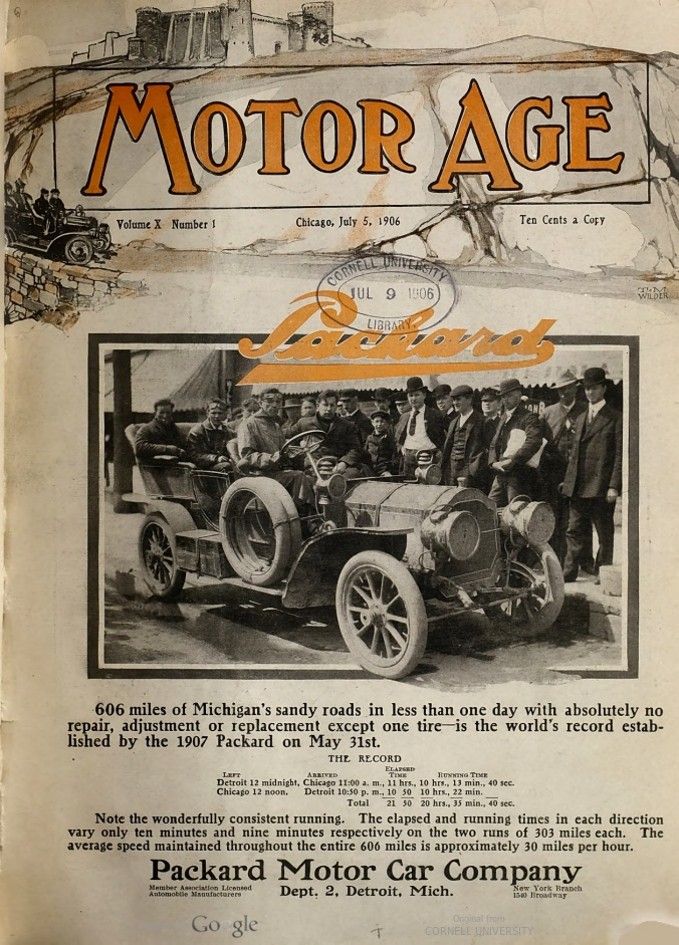
Motor Age — Volume X, No. 1, July 5, 1906
ELEVEN FINISH IN GRAND PRIX
Brasier Makes Best Team Showing, While Fiat Lands Twice in First Five –
Pair of Mercedes Placed – Drivers Nearly Blinded by Tar Dust on Sarthe Course
New York, July 2 – Now that the grand prix is a matter of history, more complete reports of the great contest that was held on the Sarthe course Tuesday and Wednesday of last week are coming to hand by cable from Paris. It was almost impossible last Wednesday for New Yorkers to get more than the bare results, the excitement immediately after the finish of the contest being so great that the Frenchmen evidently forgot that people on this side of the Atlantic were anxious to learn the fate of the others outside of the first three. It was not until Thursday, though, that their curiosity was relieved. Then along came the information that of the thirty-two cars that had started in the big event only eleven had finished. There also was a slight revision of the times of the first three. The revised table of finishers was given as follows:
Order. Car and Driver. Time H. M. S.
1 – Renault, Sisz ……… 12 14 07
2 – Fiat, Nazaro …….…. 12 45 25
3 – Clement-Bayard, Clement 12 49 46
4 – Brasier, Barillier ….. 13 53 00
5 – Fiat, Lancia ………… 14 22 11
6 – Panhard, Heath ….. 14 47 45
7 – Brasier, Baras ……… 15 15 50
8 – De Dietrich, Duray . 15 26 01
9 – Brasier, Pierry …….. 16 15 07
10 – Mercedes, Burton 16 18 42
11 – Mercedes, Marieaux 16 38 51
This would make the qualifiers for the Vanderbilt, Sisz in a Renault, Clement in a Bayard-Clement, Barillier in a Brasier, Heath in a Panhard, and Baras in a Brasier. It is said here that there is a possibility of the Brasier people declining the issue, in which event it will take some thinking to make up the French team, for Duray in a de Dietrich was the only other French finisher. This, however, is a question Chairman Thompson doubtless will settle before he leaves France. It is well known that the Hotchkiss makers would eagerly grab at the chance to send young Elliott F. Shephard over, for the first day of the race the young man made a grand showing. An upset the second day put him out of the running, but he luckily escaped injury.
That Sisz would win was a foregone conclusion after the little Renault man had forged to the front in the third round the first day. He handled himself well at all times, and when he passed the stands the first time around on Wednesday he was going at 92 miles an hour. He was out to win the race and took no chances. Driving carefully, he did not make the speed the second day that he did the first, and Nazaro picked up some 8 minutes on him. However, Sisz always had something up his sleeve and had more than half an hour to spare at the end.
Tire troubles, of course, were responsible for many of the drivers dropping out. Every car had to wrestle with the problem, and it is said of Sisz that he changed nineteen times, but so skillful was he with the Vinet movable rim that he lost not more than 5 minutes at each operation. Accidents put several out of business. Right after rounding the curve at La Fourch on the second lap of the second day one of the front wheels on Teste’s Panhard flew off. This caused an upset and Teste broke his thigh, several ribs, and injured his wrist. This perhaps was the most serious accident in the race. The tar which was used on the road to put it in condition for the race raised mischief with the eyes of the drivers.
The tar soon became dust and rolled up in miniature clouds, blinding the drivers despite the fact they wore goggles. Edmond perhaps was the greatest sufferer, and when he finished, he was nearly blind.
There was a change in the order of finish as printed in the last issue of Motor Age. It seems that Heath was placed sixth instead of fifth, the latter position going to Lancia. This gives Italy two of the eleven places-second and fifth. The race proved to be anything, but the snap anticipated for France, for of the eleven finishers four of them were outsiders-two Fiats and two Mercedes. It’s true the Mercedes were some 4 hours behind Sisz, but still Burton and Marieaux managed to pull through and be credited with finishing, something twenty-one other cars failed to do. The Brasier team made the best team showing of any in the race, landing fourth, seventh and ninth.
BEFORE THE RACE
Paris, June 22 – In view of the proximity of the. Sarthe circuit to Paris, large numbers of people are proceeding to the course in automobiles, and the various towns around the circuit are choked with applications for garage room. The time from Paris to Le Mans is 5 or 6 hours comfortably driving, via Versailles, Rambouillet, Chartres and Le Ferté Bernard. The circuit has been thrown open to the racing cars once more from today, leaving just 1 week for practice. Complaints are made that the turning at La Fourche has been insufficiently banked and requests are being made for more cement. Rooms and apartments throughout the district are, as usual, scarce and expensive, this being of course only natural in view of the nearness of the circuit from Paris.
The official government authorization for the use of the Sarthe circuit and without neutralization has only just been granted. The certainty that this would be given has of course been known for some time, but in the first place the French automobile club took the bull by the horns and made immense preparations – on paper – in order to bluff any attempt which might have been made earlier to stop the race project. This sort of procedure – that is, start first and get the authorization afterwards – is a very successful means of riding through France administrative methods, and is adopted by energetic foreigners with great gusto in all sorts of business deals in French commercial life.
The French club talked about erecting a huge garage close to its grandstand, which latter was to be the largest ever erected for an automobile race course. The first was easy, the second was considered more difficult. However, it has been done and the tribunes of the Automobile Club of France on the Sarthe circuit are the largest ever designed for any race course. Six thousand people are easily accommodated therein and under cover. The price charged for a box for six people is $60 and a single place costs $6 for the 2 days and $4 for 1 day. Opposite is a large time-board, 80 feet square, where time will be put up as received from the various points along the course where telephones have been installed. The grand stand is 800 feet long and is flanked by two other stands belonging to the local clubs. Buffets, press rooms and telegraph offices complete the outfit. The telegraphic equipment of thirty operators accompanying the president on his official tours will be present for the press messages. Opposite the grand stands is the garage for extra cars, revictualing centers, medical service, and the closed park where the weigh bridge is installed. Behind this is a vast field which was lately covered with pine trees. It is now a camping ground let out for the many whose duties compel them to be constantly at hand. The proximity of the circuit to Paris has sent down immense crowds and the whole countryside is teeming with tens of thousands of visitors. Grandstands are erected everywhere, some 300 being dotted around the course, making an average of five per mile, resulting from private enterprise or public munificence.
At the time these lines are read, the race will have been contested by the fastest group of racing cars the world has ever. Retrospective details can therefore present a certain interest in view of possible eventualities during the race. For French people and for the spectators in the race itself there will be two winners. the winner on the first day and the winner on the second day, for it is highly improbable that there will be a repetition on the second day on the part of one car of the giddy – almost staggering – speed, which must carry the winner over the line at the end of the first day’s race. The greatest uncertainty remains in every mind regarding the probable winner. It might be easy to point out a few cars which surely will not win, but it would be idle to do so at this hour, and even betting men are refusing odds on some which seem certain of success. Some consider it will be a tire race, especially those who have been over the circuit of late and have had a few breakdowns on route 157, the surface of which is covered with fine, sharp stones which all the sweeping in the world would not rid, let alone the goudronnage which has been applied in unstinted quantities.
The equipments and repair shops of the foreign contingents have caused admiration, especially the shop of the Itala men, where a portable engine with electric generator is proving its worth in gold as a handy field outfit. It supplies light, motive power and heat without danger in a district covered with pine saplings, the dry season having already been responsible for the starting of fires here and there.
The great crowds of people drawn to the circuit from all parts have caused another cessation in the racing trials – that is, the routes are shut to racing cars again tomorrow, until the race itself. This is a measure of prudence, but the drivers have seen enough during the past 4 days to show them the nature of the work cut out. At 5 a. m. on the morning of the race a pilot car will set out from St. Calais and another from the grand stand, to warn the commissiares, who are stationed at each 3 miles, that the race is commencing; then the crowd will be cleared from the course by the gendarmes, and the soldiers take their positions alongside the route at every 50 feet about. The commissaires must see that the course is kept clear. They also have to signal by means of flags. For instance, when one car is seen approaching another, a blue flag is held out to the first passing car, to inform him that he may be caught up. The commissaires are also to signal to approaching cars if any car breaks down within their beat. They also have to give a helping hand to drag them off the circuit. The commissaires also are charged to see that no supplies are taken on except at the given spots.
For the grand prix cars, Michelin tires have been adopted by the Panhard, Fiat, Itala, one Clement, the Renault, three Hotchkiss and two Lorraine-Dietrichs. Hemery, in a Darracq, has adopted Dunlops, as have two Clements and the Vulpes car. Rigoly, on the Gobron car, has on Bergougnan tires. The remaining cars are fitted with Continental tires.