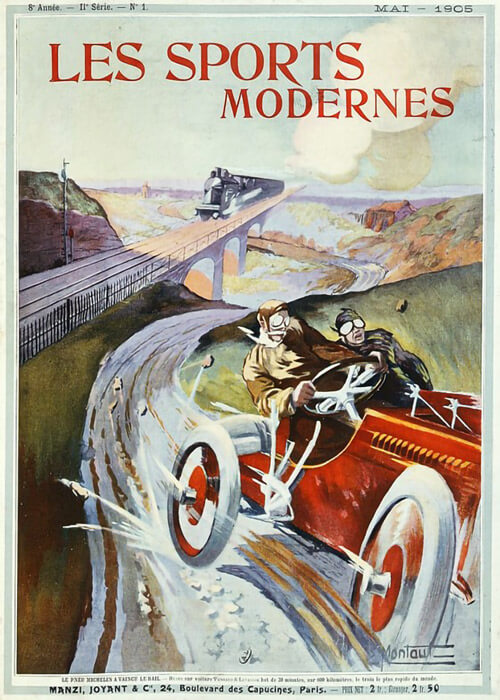
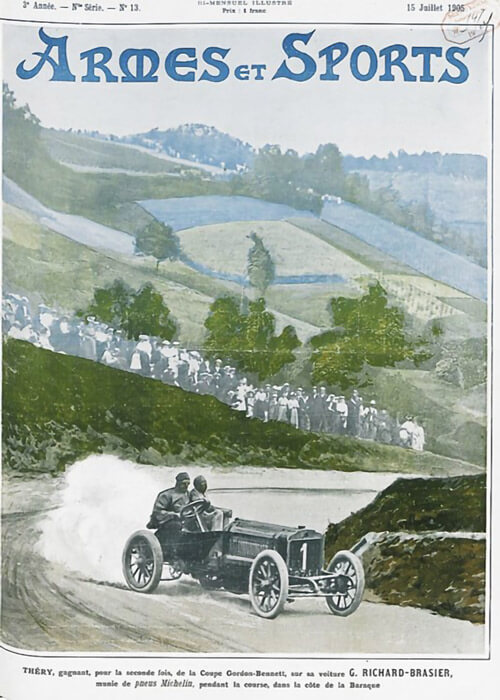
The night before the race, the early morning and the first hours of the Paris-Madrid race are described here very lively. The huge masses that came for that event and the enthuisiasm of all those spectators standing along the streets. In this first part of the day, nothing seemed to darken the bright skys of technical progress by fast automobiles. How could they all know what was to come later that day! (Translation included at the end).
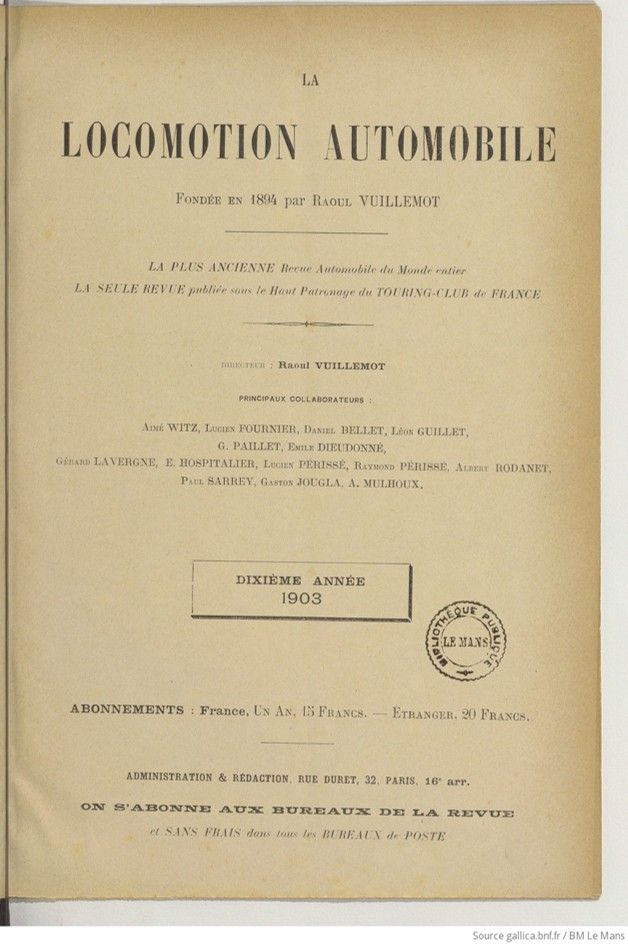
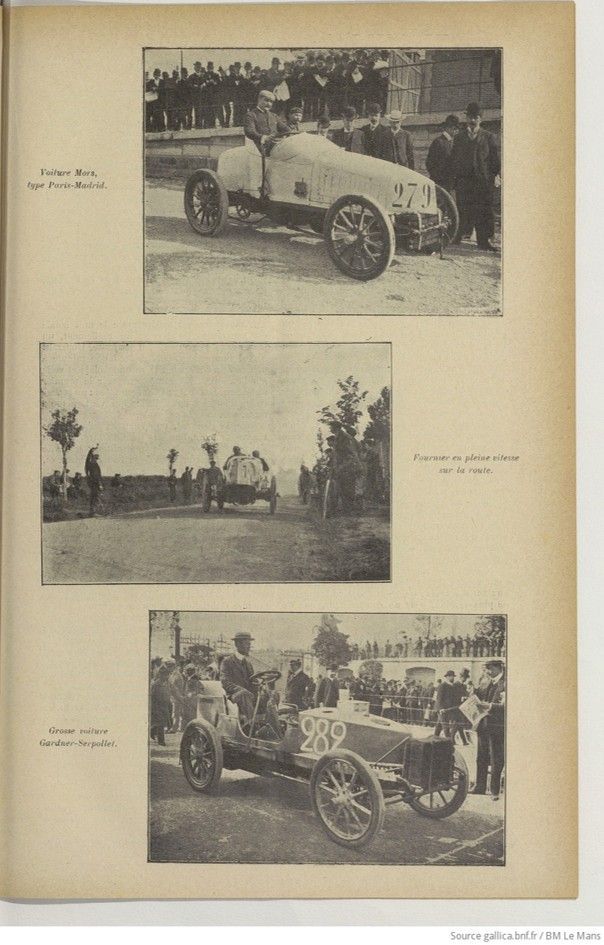
Avec l’autorisation du Bibliothèque national francais gallica.bnf.fr Texte et photos compilé par motorracinghistory
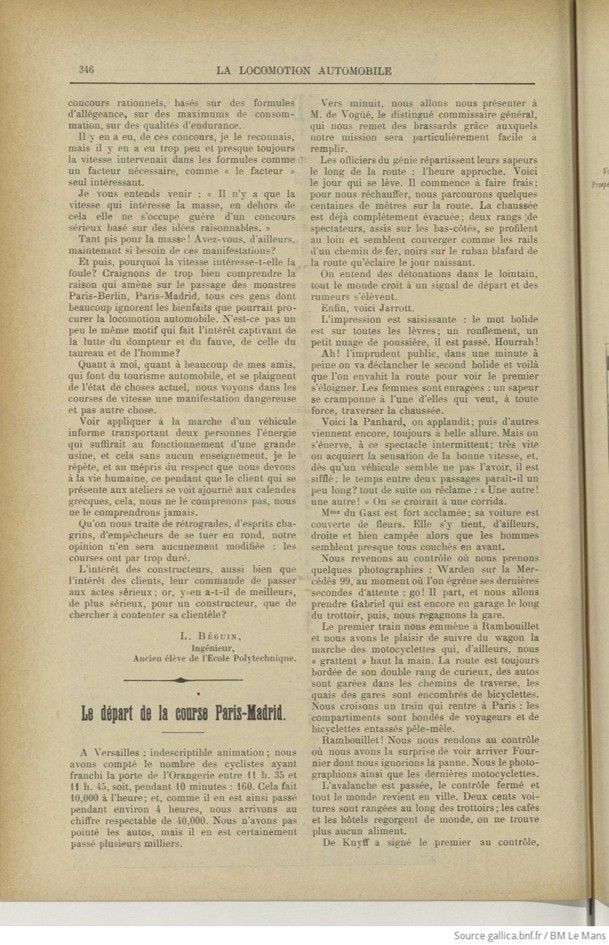
La Locomotion Automobile — 10e Année, No. 22, 28 mai1903, pages 346-349
Le départ de la course Paris-Madrid.
A Versailles : indescriptible animation ; nous avons compté le nombre des cyclistes ayant franchi la porte de l’Orangerie entre 11 h. 35 et 11 h. 45, soit, pendant 10 minutes : 160. Gela fait 10,000 à l’heure ; et, comme il en est ainsi passé pendant environ 4 heures, nous arrivons au chiffre respectable de 40,000. Nous n’avons pas pointé les autos, mais il en est certainement passé plusieurs milliers.
Vers minuit, nous allons nous présenter à M. de Vogüé, le distingué commissaire général qui nous remet des brassards grâce auxquels notre mission sera particulièrement facile à remplir.
Les officiers du génie répartissent leurs sapeurs le long de la route : l’heure approche. Voici le jour qui se lève. Il commence à faire frais; pour nous réchauffer, nous parcourons quelques centaines de mètres sur la route. La chaussée est déjà complètement évacuée ; deux rangs ;de spectateurs, assis sur les bas-côtés, se profilent au loin et semblent converger comme les rails d’un chemin de fer, noirs sur le ruban blafard de la route qu’éclaire le jour naissant.
On entend des détonations dans le lointain, tout le monde croit à un signal de départ et des rumeurs s’élèvent.
Enfin, voici Jarrott.
L’impression est saisissante : le mot bolide est sur toutes les lèvres; un ronflement, un petit nuage de poussière, il est passé. Hourrah!
Ah! l’imprudent public, dans une minute à peine on va déclancher le second bolide et voilà que l’on envahit la route pour voir le premier s’éloigner. Les femmes sont enragées : un sapeur se cramponne à l’une d’elles qui veut, à toute force, traverser la chaussée.
Voici la Panhard, on applaudit; puis d’autres viennent encore, toujours à belle allure. Mais on s’énerve, à ce spectacle intermittent; très vite on acquiert la sensation de la bonne vitesse, et, dès qu’un véhicule semble ne pas l’avoir, il est sifflé ; le temps entre deux passages paraît-il un peu long? tout de suite on réclame : « Une autre! une autre! » On se croirait à une corrida.
Mme Gast est fort acclamée; sa voiture est couverte de fleurs. Elle s’y tient, d’ailleurs, droite et bien campée alors que les hommes semblent presque tous couchés en avant.
Nous revenons au contrôle où nous prenons quelques photographies : Warden sur la Mercédès 99, au moment où l’on égrène ses dernières secondes d’attente : go! Il part, et nous allons prendre Gabriel qui est encore en garage le long du trottoir, puis, nous regagnons la gare.
Le premier train nous emmène à Rambouillet et nous avons le plaisir de suivre du wagon la marche des motocyclettes qui, d’ailleurs, nous « grattent » haut la main. La route est toujours bordée de son double rang de curieux, des autos sont garées dans les chemins de traverse, les quais des gares sont encombrés de bicyclettes. Nous croisons un train qui rentre à Paris : les compartiments sont bondés de voyageurs et de bicyclettes entassés pêle-mêle.
Rambouillet ! Nous nous rendons au contrôle où nous avons la surprise de voir arriver Fournier dont nous ignorions la panne. Nous le photographions ainsi que les dernières motocyclettes.
L’avalanche est passée, le contrôle fermé et tout le monde revient en ville. Deux cents voitures sont rangées au long des trottoirs ; les cafés et les hôtels regorgent de monde, on ne trouve plus aucun aliment.
De Knyff a signé le premier au contrôle, 17 minutes après que nous l’avions applaudi au départ. Il était suivi de près par Jarrot et Louis Renault.
Des dépêches arrivent de Chartres, annonçant les passages, et la matinée s’écoule ainsi, tiède et affamante, coupée de considérations diverses sur l’accident d’Ablis, sur la possibilité d’autres encore, sur l’utilité des courses de vitesse, et surtout sur l’absolue nécessité de les maintenir, si réellement elles servent la cause du progrès.
On parle encore des favoris. Mors, Panhard, Renault, Mercédès, etc. Les Mercédès semblent faire prime : nous les avons vues à belle allure et fort applaudies.
L.N.
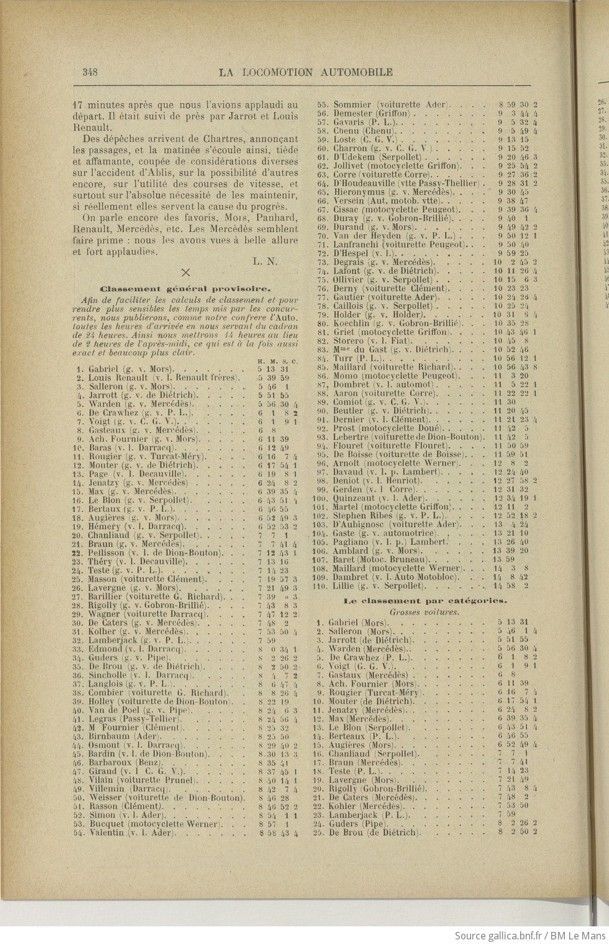
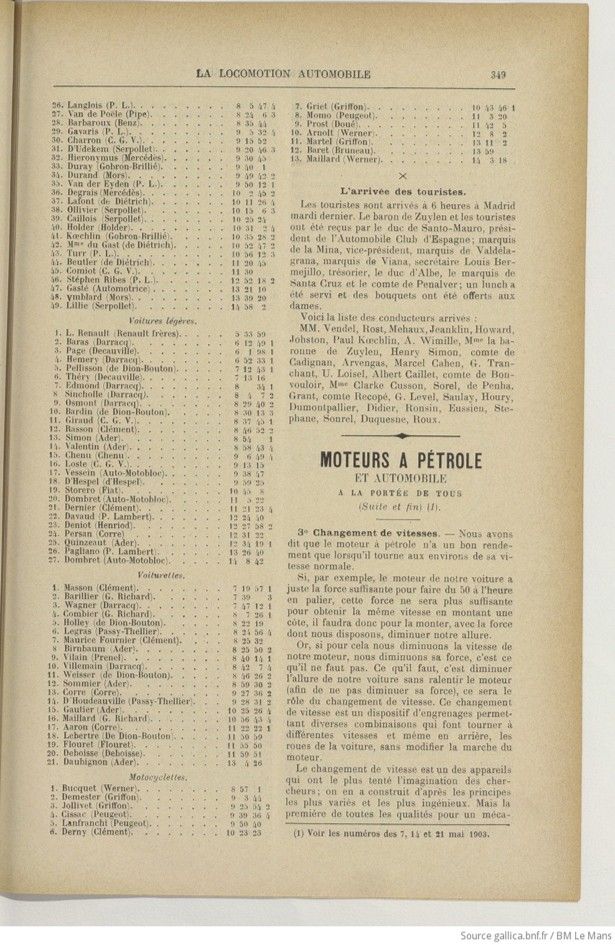
Classement général provisoire.
Afin de faciliter les calculs de classement et pour rendre plus sensibles les temps mis par les concurrents, nous publierons, comme notre confrère l’Auto, toutes les heures d’arrivée en nous servant du cadran de 24 heures. Ainsi nous mettrons 14 heures au lieu de 2 heures de l’après-midi, ce qui est à la fois aussi exact et beaucoup plus clair.
(les premiers 20 calssificers) H. M. s. c. (g.v. = grosse voiture, v.l. = voiture légère)
1. Gabriel (g. v. Mors) 5 13 31
2. Louis Renault (v. l. Renault frères) 5 39 59
3. Salleron (g. v. Mors) 5 46 1
4. Jarrott (g. v. de Dietrich) 5 51 55
5. Warden (g. v. Mercédès) 5 56 30 4
6. De Crawliez (g. v. P. L.) 6 1 8 2
7. Voigt (g. v. C. G. V.) 6 19 1
8. Gasteaux (g. v. Mercédès) 6 8
9. Ach. Fournier (g. v. Mors) 6 11 39
10. Baras (v. l. Darracq) 6 12 49
11. Rougier (g. v. Turcat-Méry) 6 16 7 4
12. Monter (g. v. de Diétrich) 6 17 54 1
13. Page (v. l. Decauville) 6 19 8 1
14. Jenatzy (g. v. Mercédès) 6 24 8 2
15. Max (g. v. Mercédès) 6 39 35 4
16. Le Blon (g. v. Serpollet) 6 43 51 1
17. Bertaux (g. v. P. L.) 6 46 5 5
18. Augières (g. v. Mors) 6 52 49 3
19. Hémery (v. l. Darracq) 6 52 53 2
20. Chanliaud (g. v. Serpollet.) 7 7 1
Translation by DeepL deepl.com
The start of the Paris-Madrid race.
In Versailles: indescribable excitement; we counted the number of cyclists who passed through the Orangerie gate between 11:35 a.m. and 11:45 a.m.—that is, over the course of 10 minutes—and came to 160. That works out to 10,000 per hour; and, since they passed by at that rate for about 4 hours, we arrive at the respectable figure of 40,000. We didn’t count the cars, but several thousand certainly passed by.
Around midnight, we went to meet Mr. de Vogüé, the distinguished commissioner general, who gave us armbands that would make our mission particularly easy to carry out.
The engineering officers deployed their workmen along the road: the hour was approaching. Dawn was breaking. It was starting to get chilly; to warm up, we walked a few hundred meters along the road. The road is already completely cleared; two rows of spectators, seated on the shoulders, stand out in the distance and seem to converge like railroad tracks, black against the pale ribbon of the road illuminated by the breaking dawn.
We hear explosions in the distance; everyone thinks it’s a starting signal, and murmurs rise.
Finally, here comes Jarrott.
The sight is breathtaking: the word “race car” is on everyone’s lips; a roar, a little cloud of dust—and he’s gone. Hurrah!
Ah! The reckless crowd—in barely a minute the second speedster is set to start, and yet here they are swarming onto the road to watch the first one speed away. The women are frantic: a workman clings to one of them who is trying, with all her might, to cross the roadway.
Here comes the Panhard; the crowd applauds. Then others follow, still moving at a brisk pace. But this intermittent spectacle is getting on people’s nerves; very quickly, they get a feel for what constitutes good speed, and as soon as a vehicle seems to lack it, it’s booed. Does the time between two passes seem a little long? Immediately, the crowd demands: “Another one! Another one! ” It’s like being at a bullfight.
Mrs. Gast is loudly cheered; her car is covered with flowers. She stands upright and steady in it, while almost all the men seem to be leaning forward.
We return to the checkpoint, where we take a few photographs: Warden in the Mercedes 99, just as the final seconds of the countdown tick away: “Go!” He sets off, and we go to pick up Gabriel, who’s still in the garage along the sidewalk, then head back to the train station.
The first train takes us to Rambouillet, and we have the pleasure of watching from the train car as the motorcycles pass by—which, by the way, easily outpace us. The road is still lined with two rows of onlookers; cars are parked on the side streets, and the station platforms are cluttered with bicycles.
We pass a train returning to Paris: the compartments are packed with passengers and bicycles crammed together haphazardly.
Rambouillet! We head to the checkpoint, where we’re surprised to see Fournier arrive—we hadn’t known he’d broken down. We take photos of him and the last few motorcycles.
The rush is over, the checkpoint is closed, and everyone is heading back into town. Two hundred cars are lined up along the sidewalks; the cafés and hotels are packed with people, and there’s no food to be found.
De Knyff was the first to sign in at the checkpoint, 17 minutes after we had cheered him on at the start. He was closely followed by Jarrot and Louis Renault.
Dispatches are arriving from Chartres, announcing the finish times, and the morning passes in this way—mild and hunger-inducing—interspersed with various reflections on the accident at Ablis, on the possibility of further accidents, on the value of speed races, and above all on the absolute necessity of continuing them, if they truly serve the cause of progress.
There is still talk of the favorites: Mors, Panhard, Renault, Mercedes, etc. The Mercedes seem to be leading the pack: we saw them driving at a brisk pace and receiving loud applause.
L.N.
Provisional Overall Standings.
To simplify the calculation of standings and to make the competitors’ times easier to understand, we will publish—as our colleague „L’Auto“ does—all finish times using the 24-hour clock. Thus, we will write “14:00” instead of “2:00 p.m.,” which is both just as accurate and much clearer.
(Top 20 finishers) H. M. s. c. (g.v. = heavy car, v.l. = light car)