Text and jpegs by courtesy of hathitrust.org www.hathitrust.org, compiled by motorracinghistory.com
MOTOR – THE NATIONAL MAGAZINE OF MOTORING – Vol. 22, No. 2, May 1914
The Foreign Cars for Indianapolis
France, England and Belgium Send Representative Cars in Their Endeavor to Retain the Blue Ribbon Wrested from Us by Goux With His Grand Prix Peugeot on Memorial Day Last Year.
THE International Sweepstakes Race, to be run at Indianapolis on Memorial Day, will undoubtedly merit its title to an even greater degree than heretofore, judging from the number and quality of the European entries.
Jules Goux at the moment of his triumph last year expressed his desire to return and give us an opportunity of regaining our lost laurels in 1914 and, apparently, not content with fulfilling his wish by entering the Peugeot car which he steered into second place in the French Grand Prix last July, he has persuaded his doughty team-mate, Georges Boillot, to accompany him and bring along the car with which he won the French Classic in the record time for that race by covering the 569 miles at a rate of 72.03 miles per hour.
M. Boillot achieved his second successive win by this performance and, in addition, he accounted for the Boulogne circuit of 388 miles on the smaller car referred to below.
Two strings to their bow being evidently considered insufficient by the Peugeot people, a third representative of the type known as the “Three-Liter” Peugeot is being sent over. This is the car which, in the hands of Boillot, made such a sensational debut at Boulogne last September when it traveled the hilly and winding course at an average of 63.2 miles per hour. This speed is not sufficiently great to expect any results at Indianapolis, but, of course, the conditions will be very different from those at Boulogne, and it is well to recollect that this little car is said to develop 92 horsepower at 2,800 revolutions per minute, that it has traveled at over 95 miles per hour for a measured kilometer on an ordinary road, and finally that it may reasonably be expected to cover the full distance at Indianapolis without stopping for tires or fuel. It is estimated that a 25-gallon tank of gasoline will more than suffice for the 500 miles, and it is not anticipated that any tire will need replacement—the latter, of course, is a matter in which luck plays a not inconsiderable part. Arthur Duray will be the driver.
France will also be represented by the Delage, which was placed fourth in last year’s Grand Prix. Perhaps the chief claim of this car to recognition as a speed-wagon is its performance with Bablot at the wheel at Le Mans, France, last August when it completed the 336-mile course at the average rate of 77 miles per hour, despite the fact that the motor stalled during a tire change and three strong men failed to restart it. Just when Bablot was preparing to give up all idea of being able to continue the race, Leon Molon, the aviator, arrived on the scene and promptly turned the motor over. Bablot traveled the next lap at the rate of 85 miles an hour. Albert Guyot, a pilot who has many fine performances to his credit, will drive the Delage at Indianapolis.
England pins her faith to a Sunbeam of later type than the car which ran so consistently and silently into fourth place on the Speedway last year. This is the car which took third place in the French Grand Prix last July and later on traveled 1,078 miles 460 yards in twelve hours on Brooklands track.
D. Resta drove at Brooklands, but Jean Chassagne, who was at the wheel in France, will take charge here.
As we write, Dame Rumor is busy with tales of altered wheelbases, different gear ratios and generally amended specifications to meet the supposedly altered conditions at Indianapolis when compared with Brooklands (Europe’s try-out track), but it is safe to assume that whatever changes are made, they will be in the nature of minor details and that any of us who are present at the Speedway on the 30th of this month will witness in truth a battle of the giants of motoring.
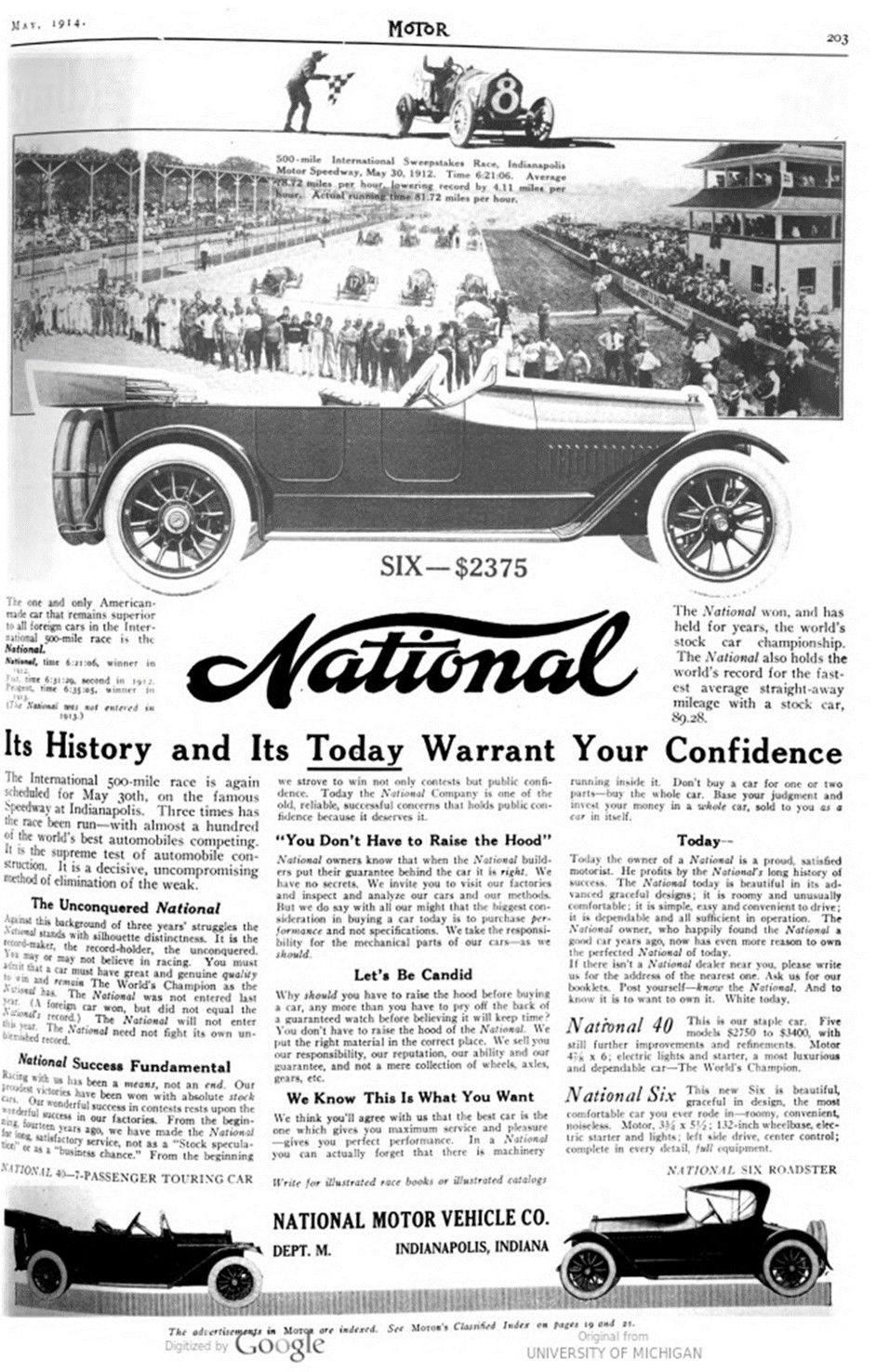
While there is every indication that this month’s race will prove a faster one than last year’s event, it should be remembered that Goux’s average speed of 76.59 miles per hour was not a record for the race – that honor belonging to Joe Dawson, who, in 1912, covered the 500 miles on his National car at an average speed of 78.72 miles per hour, while Tetzlaff was even faster for the first half of the race.
The conditions governing the contest remain unchanged, a total piston displacement of 450 cubic inches being the maximum.
Photo captions.
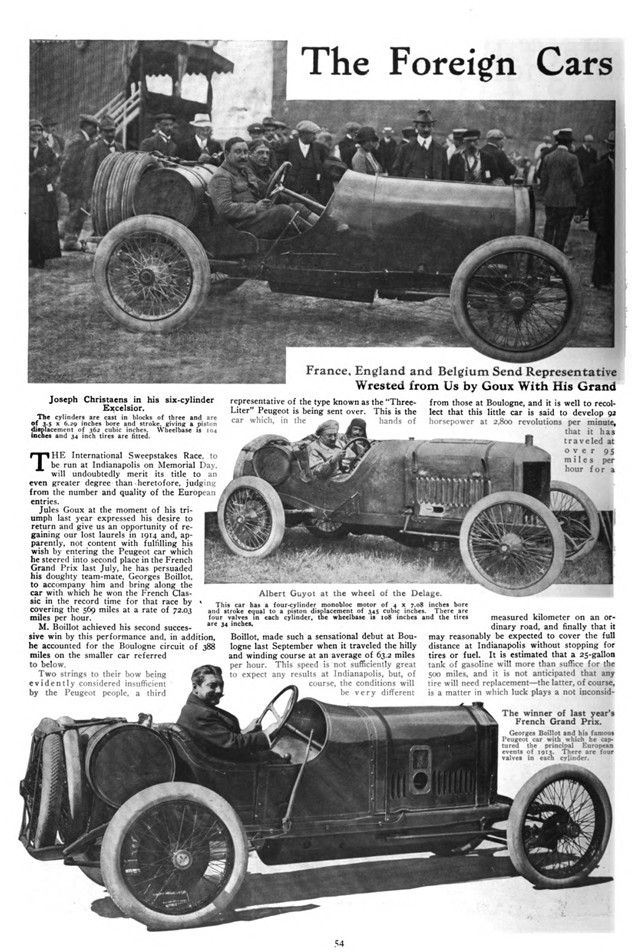
Joseph Christaens in his six-cylinder Excelsior.
The cylinders are cast in blocks of three and are of 3.5 x 6.29 inches bore and stroke, giving a piston displacement of 362 cubic inches. Wheelbase is 104 inches and 34-inch tires are fitted.
Albert Guyot at the wheel of the Delage.
This car has a four-cylinder monobloc motor of 4 x 7.08 inches bore and stroke equal to a piston displacement of 345 cubic inches. There are four valves in each cylinder, the wheelbase is 108 inches, and the tires are 34 inches.
The winner of last year’s French Grand Prix.
Georges Boillot and his famous Peugeot car with which he captured the principal European events of 1913. There are four valves in each cylinder.
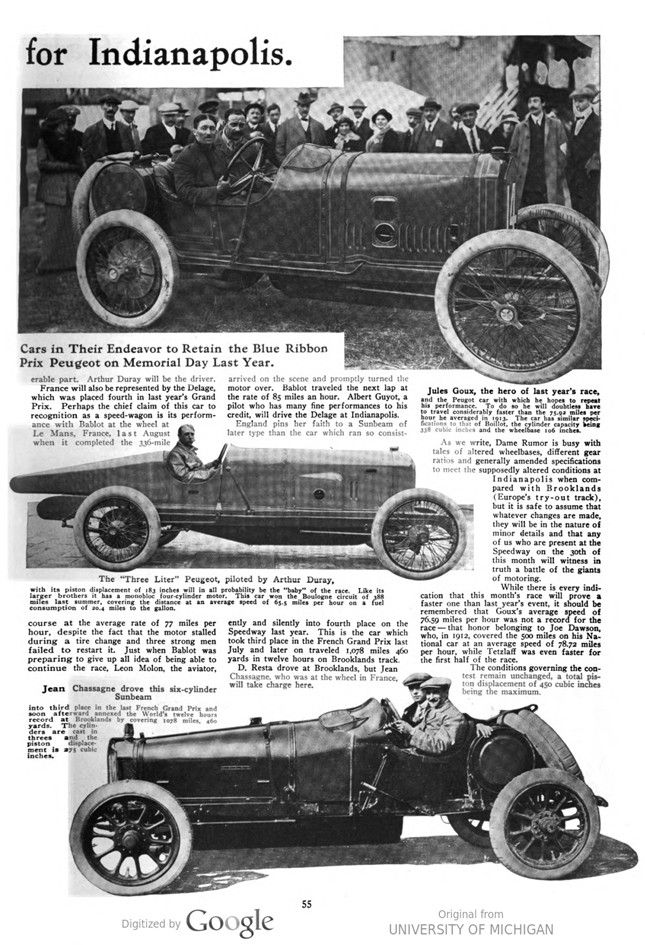
Jules Goux, the hero of last year’s race, and the Peugot car with which he hopes to repeat his performance. To do so he will doubtless have to travel considerably faster than the 75.92 miles per hour he averaged in 1913. The car has similar specifications to that of Boillot, the cylinder capacity being 338 cubic inches and the wheelbase 106 inches.
The “Three Liter” Peugeot, piloted by Arthur Duray, with its piston displacement of 183 inches will in all probability be the “baby” of the race. Like its larger brothers it has a monobloc four-cylinder motor. This car won the Boulogne circuit of 388 miles last summer, covering the distance at an average speed of 65.5 miles per hour on a fuel consumption of 20.4 miles to the gallon.
Jean Chassagne drove this six-cylinder Sunbeam into third place in the last French Grand Prix and soon afterward annexed the World’s twelve hours record at Brooklands by covering 1078 miles, 460 yards. The cylinders are cast in threes and the piston displacement is 275 cubic inches