June 2026: comment still to be written; is on it’s way. (GrocerJack)
With permission of hathitrust hathitrust.org == Text and fotos compiled by motorracinghistory motorracinghistory.com
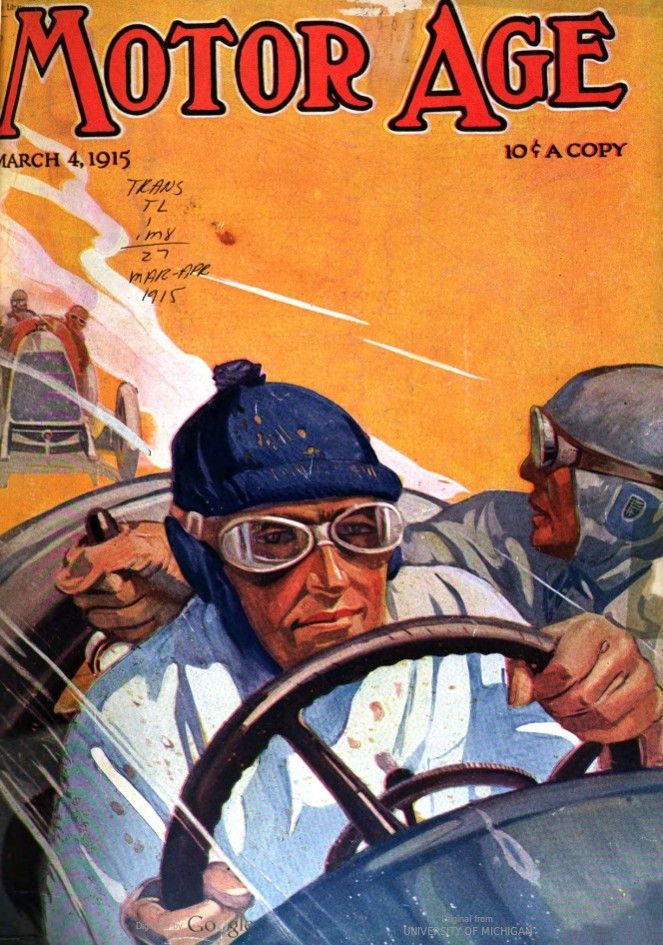
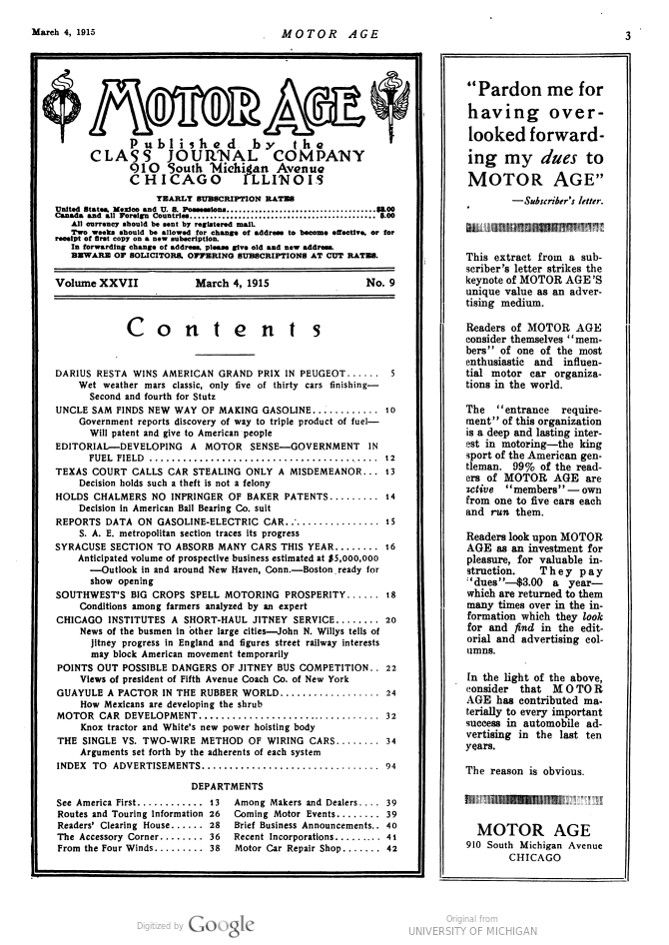
MOTOR AGE Vol. XXVIII, No. 9, March 4, 1915
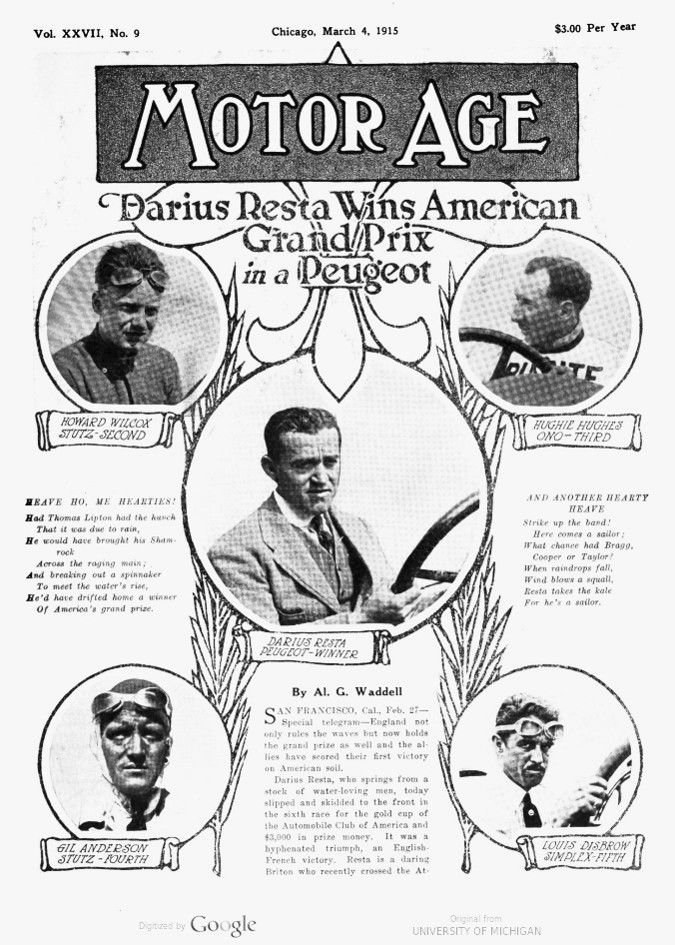
Darius Resta Wins American Grand Prix in a Peugeot
By Al. G. Waddell
HEAVE HO, ME HEARTIES!
Had Thomas Lipton had the hunch – That it was due to rain,
He would have brought his Shamrock – Across the raging main;
And breaking out a spinnaker – To meet the water’s rise,
He’d have drifted home a winner – Of America’s grand prize.
AND ANOTHER HEARTY HEAVE
Strike up the band! Here comes a sailor;
What chance had Bragg, Cooper or Taylor?
When raindrops fall, Wind blows a squall,
Resta takes the kale, For he’s a sailor.
SAN FRANCISCO, Cal., Feb. 27 – Special telegram – England not only rules the waves but now holds the grand prize as well and the allies have scored their first victory on American soil.
Darius Resta, who springs from a stock of water-loving men, today slipped and skidded to the front in the sixth race for the gold cup of the Automobile Club of America and $3,000 in prize money. It was a hyphenated triumph, an English French victory. Resta is a daring Briton who recently crossed the Atlantic to pursue fortune and fame in a neutral nation. The car in which he achieved his hazardous feat is a Gallic speed creation and bears the trademark of Peugeot on its hood.
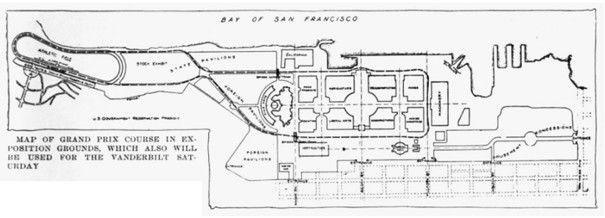
Resta’s racing debut in America was a veritable baptism. The speed carnival of the Panama-Pacific exposition was suddenly changed into a water fete 1 hour after the grand prize contenders were sent away. Rain fell during 5 of the 7 hours that the cars were careening around the course, and the race was run under the most grueling conditions imaginable. The 3.84-mile track, part of which was covered with heavy planks, was so dangerous that ten of the thirty drivers who started withdrew, refusing to take further chances in the driving downpour. Resta, however, was made of sterner stuff. His ancestors have sailed the sea in heavy storms and faced unflinchingly the deadly fire of the enemy’s ships. With such tradition behind him, he could not well abandon the contest because of leaking clouds.
Slowest Time in Race’s History
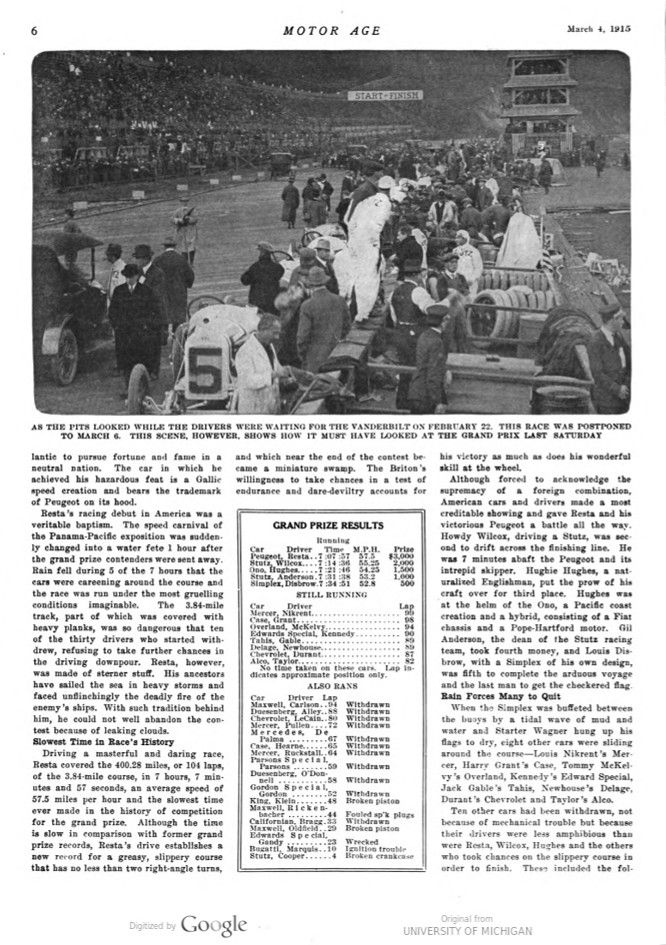
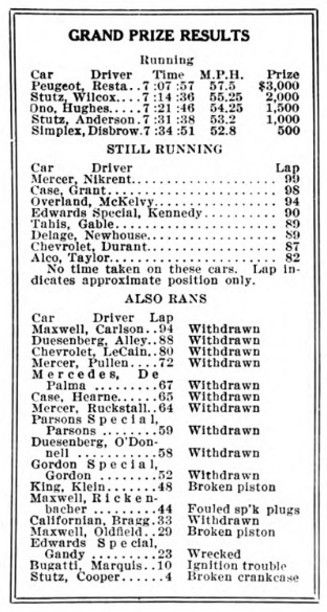
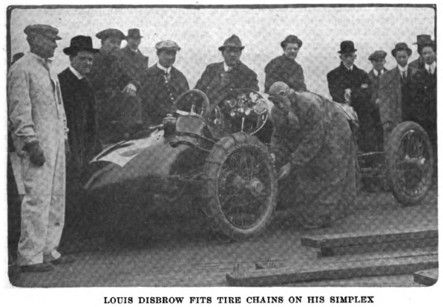
Driving a masterful and daring race, Resta covered the 400.28 miles, or 104 laps, of the 3.84-mile course, in 7 hours, 7 minutes and 57 seconds, an average speed of 57.5 miles per hour and the slowest time ever made in the history of competition for the grand prize. Although the time is slow in comparison with former grand prize records, Resta’s drive establishes a new record for a greasy, slippery course that has no less than two right-angle turns, and which near the end of the contest be- came a miniature swamp. The Briton’s willingness to take chances in a test of endurance and dare-deviltry accounts for his victory as much as does his wonderful skill at the wheel. Although forced to acknowledge the supremacy of a foreign combination, American cars and drivers made a most creditable showing and gave Resta and his victorious Peugeot a battle all the way. Howdy Wilcox, driving a Stutz, was second to drift across the finishing line. He was 7 minutes abaft the Peugeot and its intrepid skipper. Hughie Hughes, a naturalized Englishman, put the prow of his craft over for third place. Hughes was at the helm of the Ono, a Pacific coast creation and a hybrid, consisting of a Fiat chassis and a Pope-Hartford motor. Gil Anderson, the dean of the Stutz racing team, took fourth money, and Louis Disbrow, with a Simplex of his own design, was fifth to complete the arduous voyage and the last man to get the checkered flag
Rain Forces Many to Quit
When the Simplex was buffeted between the buoys by a tidal wave of mud and water and Starter Wagner hung up his flags to dry, eight other cars were sliding around the course-Louis Nikrent’s Mercer, Harry Grant’s Case, Tommy McKelvy’s Overland, Kennedy’s Edward Special, Jack Gable’s Tahis, Newhouse’s Delage, Durant’s Chevrolet and Taylor’s Alco.
Ten other cars had been withdrawn, not because of mechanical trouble but because their drivers were less amphibious than were Resta, Wilcox, Hughes and the others who took chances on the slippery course in order to finish. These included the following: Carlson, Maxwell; Alley, Duesenberg; Le Cain, Chevrolet; Pullen, Mercer; de Palma, Mercedes; Hearne, Case; Ruckstall, Mercer; Parsons, Parsons Special; O’Donnell, Duesenberg; Gordon, Gordon Special, and Bragg, Californian.
Cooper First to Go Out
Six cars were docked with irreparable injuries by their pilots. Earl Cooper, one of the heavily-backed favorites, was the first to abandon the contest, his Stutz sustaining a broken crankcase after completing four laps. The German Bugatti, tooled by Marquis, went out on the tenth lap with ignition trouble. Lou Gandy wrecked the Edwards Special on the twenty-third circuit of the track, skidding into a straw bank on the northwest corner of the course and breaking his steering gear. A broken piston on the Maxwell forced Barney Oldfield’s retirement on the twenty-ninth lap. Caleb Bragg, winner of the grand prize in 1912, abandoned the Californian after driving 126 miles, as he had no non-skid tires in his pit. Fouled spark plugs are given as the reason for the withdrawal of Rickenbacher’s Maxwell on the forty-fourth lap and a broken piston put Klein’s King in the discard on the forty-eighth circuit.
Although thirty cars went to the tape, the field was not as large as the original entry list showed. There were five scratches before the race started. The drivers who had a premonition of the dangers that were seen to be encountered were Erwin and Grover Bergdoll, the brother team in a Benz and Erwin Special, respectively; Tomasini, pilot of the Tomasini Special; Gates, who was slated to handle a Renault, and Francis, up on a Francis-Blackman Special.
The field was sent away at 10:30 o’clock by Starter Wagner in tiers of three, as follows:
Oldfield’s Maxwell, Alley’s Duesenberg and Gable’s Tahis.
Pullen’s Mercer, Anderson’s Stutz and Ruckstall’s Mercer.
Gandy’s Edward Special, Cooper’s Stutz and Resta’s Peugeot.
Nikren’s Mercer, Kennedy’s Edward Special and Disbrow’s Simplex.
Bragg’s Californian, New- house’s Delage and Klien’s King.
Rickenbacher’s Maxwell, LeCain’s Chevrolet and O’Donnell’s Duesenberg.
Durant’s Chevrolet, Hearne’s Case and de Palma’s Mercedes.
Parson’s Parson special, Wilcox Stutz and Marquis’ Bugatti.
Hughes’ Ono, Taylor’s Alco and Grant’s Case.
McKelvy’s Overland, Carlson’s Maxwell and Gordon’s Gordon Special.
Clouds Leak; Drivers Slow Up
The clouds were threatening as the cars and drivers lined up for the speed battle, but they did not burst until after about 100 miles had been turned by the leaders.
On the dry macadam and boards, Resta opened up and at the completion of the twenty-fifth lap was hitting 68 miles an hour and his desperate pursuers were tearing splinters from the planks at a 60-mile an hour clip. Then the nimbus clouds collided and the deluge started. The speed of the leaders dropped 10 miles an hour when the rain came pouring down and the ears began to act unruly. Drivers became cautious and throttled down to 25 miles an hour in taking the turns.
Cars Sway Like Tango Artists
In the slippery going, the cars behaved as if their tanks were filled with champagne or bourbon instead of gasoline. It was a race of reels and staggers, slips and skids. Jim Parsons turned completely around in attempting to steer clear of a statue on the course. His car was headed for San Francisco bay of song fame when he brought it to a stop. On another circuit of the course he threw a tire on the turn but was successful in fighting his obdurate mount and drove it around to his pit without further damage.
Lou Gandy figured in the most serious accident of the day of minor misfortunes. He went head-on into a bank of straw and broke his steering gear. Neither he nor his mechanic was injured, however, although their escape was miraculous. Pullen and de Palma went into the hay bulwarks so often that the crowds on the turns began to expect it. Accidents of this kind were regarded as trivial, and the marvel of the race is that nothing really serious occurred. The drivers themselves are amazed that to- night they are all sound and that the race is over without the ominous clang of the ambulance gong sounding once. With the rain, Providence must have sent a Safety First fairy to guard the course.
Ralph de Palma withdrew after completing sixty-seven laps. Although his Mercedes was in condition to continue, he declared that he believed it was foolhardy to take any more chances on the hazardous course. The Italian also was prompted to quit because of the fact that he is after his third successive victory in the Vanderbilt cup race, to be run next Saturday, and he did not wish to injure his prospects by putting his car under the severe strain of today’s most strenuous grind.
The withdrawal of Barney Oldfield, Ed Pullen and Ralph de Palma, the prime favorites of the day, turned the race over to the dark horses. Resta had never driven in America before, but he was known to be dangerous through his driving of the Sunbeam at Brooklands and his victory in the 1912 French Coupe l’Auto. Before the start, however, he was not regarded as a probable winner. It was only when he started to consistently lead the field that the spectators woke up to the fact that a newcomer, an invader from Europe, was showing up the American drivers in a new way. He was teaching them the art of wet-weather driving on the curves and showing them dare-deviltry par excellence. The manner in which he handled his torpedo-shaped car in the rain and on the slippery roads was a revelation. His daring was splendid He was absolutely fearless. He drove with the utmost confidence in himself and in his mount.
The other dark horse of the day was Hughie Hughes. Like Resta, he was not a feared competitor before the starting bomb exploded. He was a driver with a reputation, but has done little of note of late. Lord Hughie was only reinstated within a week by the American Automobile Association and he came back” in a way that left no doubt of his ability.
Hughes was Resta’s most dangerous rival in the fight for first money. He was always close up to the driver from across the Atlantic and for ten laps showed the Briton the way. He put the nose of the Ono in front at the start of the eighty-fifth lap and had a lead of a lap and a half on the ninty-fourth circuit of the course when he ran out of gasoline on the back stretch. The mechanician qualified as a sprinter in his race to the pits for fuel, but the lost minutes were far more fleet than Hughie’s lithe-limbed helper, and both Resta and Wilcox passed the Ono, gaining an advantage that Hughes never was able to recover. At the finish Wilcox led Hughes by 7 minutes. The difference between second and third prize money was $500. Thus it can be seen that gasoline is a very expensive commodity on the exposition grounds.
Anderson and Disbrow Show Speed
Anderson and Disbrow began to figure in the Big Five only after the fortieth lap was turned. Ed Pullen, winner of the cup in 1914, was running in fourth place before that time and was showing the way to both the Stutz and Simplex at the completion of its sixtieth circuit. Pullen with- drew on his seventy-second lap, however, and this gave Anderson and Disbrow their opportunity to cut into the prize money. They both drove furiously and reeled off lap after lap at a heart-breaking clip near the end. At first, the officials gave Disbrow fourth place, but after the tables were rechecked, he was relegated to fifth and the Stutz was put forward to fourth in the order of finish.
Resta’s Victory Upholds Tradition
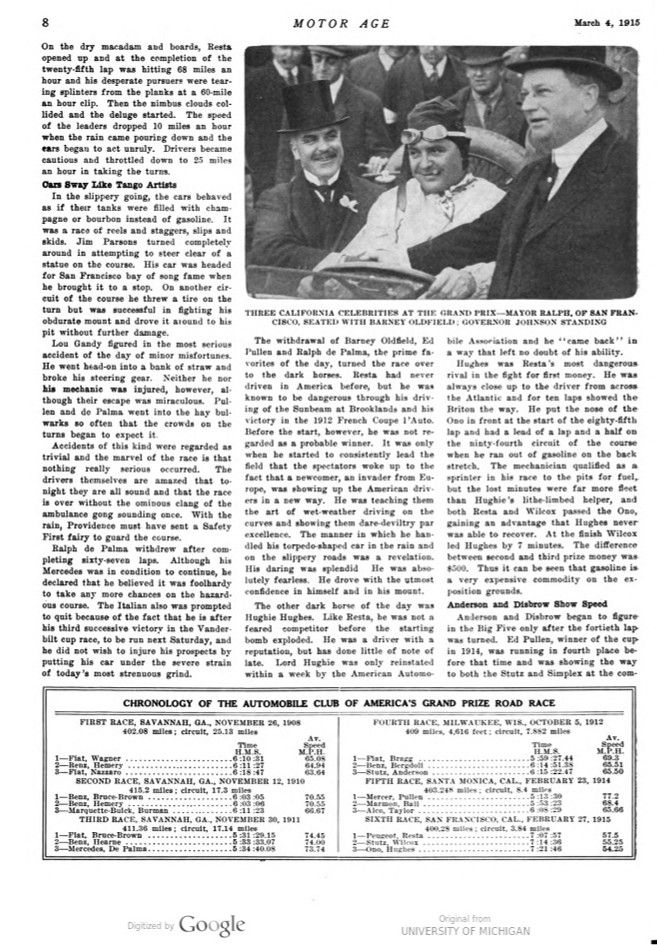
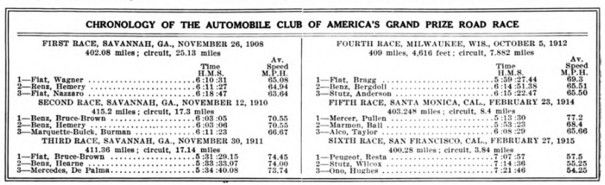
The victory of Resta and the Peugeot is in keeping with grand prize tradition, for foreign-built cars have won it five out of the six times that it has been contested for, counting today’s battle in the mud and rain. The lone American triumph was scored last February, when Eddie Pullen, pilot of the Mercer, captured the international trophy at Santa Monica. Previous to 1914, the winners were Caleb Bragg in an Italian Fiat in 1912; the late David Bruce-Brown in a Fiat in 1911, and a German Benz in 1910, and Louis Wagner in a Fiat in 1909.
The wet course and the consequent slow time made the grand prize contest of 1915 one of the easiest races on tires ever held on the coast. After the rain commenced to fall, stops to change casings were very few and far between. The pit attendants had very little to do after they had covered the gasoline, tools, tires and spare equipment with canvas or other material and sat huddled in overcoats and sweaters and under raised umbrellas. The energy that they might have spent working the jacks and tire tools was exhausted in dodging rain drops.
Most of the drivers that went out simply quit. Rain put the Maxwell out of commission, the air intake of the carbureter, which projects outside of the hood, catching the water and fouling the spark plugs. Earl Cooper retired when the web that holds the center bearing in the crankcase of the Stutz broke. It was well that he abandoned the race as he was in no condition to drive. Mrs. Cooper was ill at the hotel and Earl had been up with her all night. He, too, was sick before the start of the race from loss of sleep and nervousness but gamely refused to withdraw. Two of the laps that he made were among the three fastest of the day.
Hughie Hughes drove a wonderful race, using his head as well as his hands. The Ono proved to be a well-balanced car and held exceedingly well to the slippery roads. It was equipped with nonskid tires. The Ono also showed more speed than was expected of it and its showing was one of the surprises of the day. Had not Hughes ran out of gasoline when he did, it is probable that he would have given Resta a wheel to wheel and hood to hood fight to the finishing line and cut in for a bigger piece of the prize money.
When it started to rain, Howdy Wilcox put on non-skid tires but after a few laps, came in and changed back to his original cords.
Although he was announced as a driver of the Case, Bob Burman did not start. He came to San Francisco intending to take the mount but could not reach an agreement with Alex Sloan, manager of the Case team, and Harry Grant was signed instead.
A Success, Yet a Failure
As a racing spectacle, the grand prize of 1915 was both a failure and a success. Surely, spectators never were treated to more thrilling sights on any motor course. Cars skidded and dipped with all the verve and dash of tango artists. Frequently, they would disappear entirely, enveloped in a shower of mud and water as they tore through a small lake. Over the boarded portion of the course the cars bounced and throbbed as though shaken from beneath by a colossal vibrator. As the water ran under the planks, each machine was sprayed by a miniature geyser shooting through the cracks.
Several drivers were too exhausted to continue the race, and relief pilots had an opportunity to get a mud bath. All the drivers complained of terrific headaches caused by the rain beating in their faces. The endurance, hardiness and gameness of the contenders who stuck it out to the finish was appreciated in a small way by the drizzled spectators who sat through the downpour for eight or more hours. As far as the management and talent went, the grand prize was a success, but when the weather conditions and consequent trials to drivers and spectators are considered, it was a damp, dismal failure. The race attracted a huge crowd. The official attendance was given at 68,000 persons and had the weather been auspicious, the contest would have been one of the most notable events in the history of the sport of motor car racing.
Photos.
Page 5
DARIUS RESTA PEUGEOT-WINNER / HOWARD WILCOX STUTZ-SECOND / HUGHIE HUGHES ONO-THIRD / GIL ANDERSON STUTZ-FOURTH / LOUIS DISBROW SIMPLEX-FIFTH
Page 6
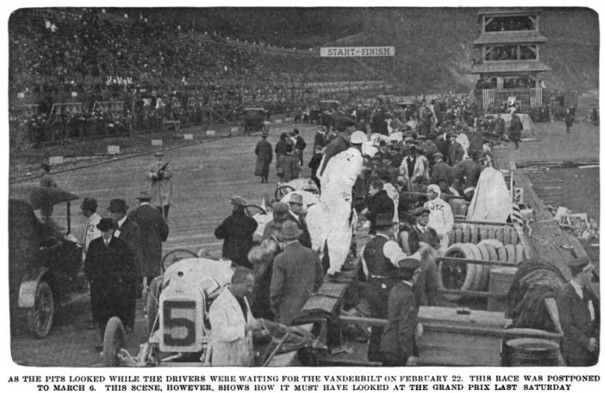
AS THE PITS LOOKED WHILE THE DRIVERS WERE WAITING FOR THE VANDERBILT ON FEBRUARY 22. THIS RACE WAS POSTPONED TO MARCH 6.
THIS SCENE, HOWEVER, SHOWS HOW IT MUST HAVE LOOKED AT THE GRAND PRIX LAST SATURDAY
Page 7.
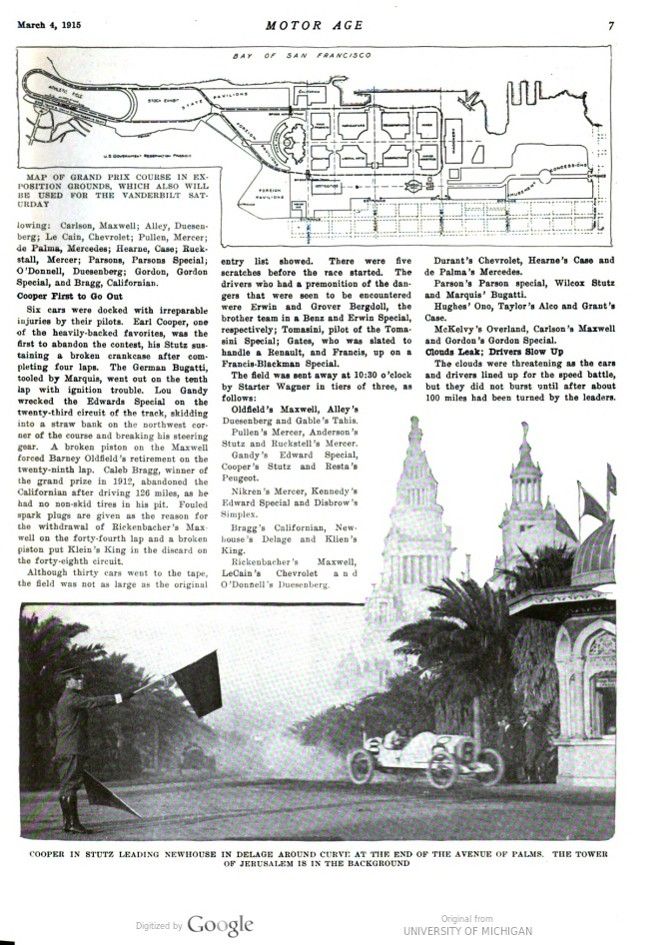
MAP OF GRAND PRIX COURSE IN EXPOSITION GROUNDS, WHICH ALSO WILL BE USED FOR THE VANDERBILT SATURDAY
COOPER IN STUTZ LEADING NEWHOUSE IN DELAGE AROUND CURVE AT THE END OF THE AVENUE OF PALMS. THE TOWER OF JERUSALEM IS IN THE BACKGROUND
Page 8.
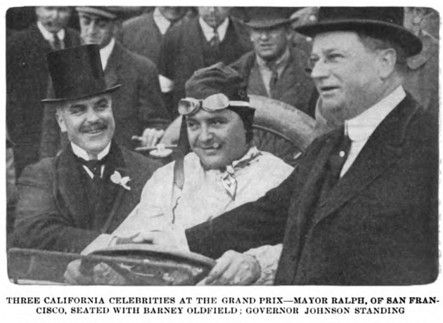
THREE CALIFORNIA CELEBRITIES AT THE GRAND PRIX-MAYOR RALPH, OF SAN FRANCISCO, SEATED WITH BARNEY OLDFIELD GOVERNOR JOHNSON STANDING.
CHRONOLOGY OF THE AUTOMOBILE CLUB OF AMERICA’S GRAND PRIZE ROAD RACE
Page 9.
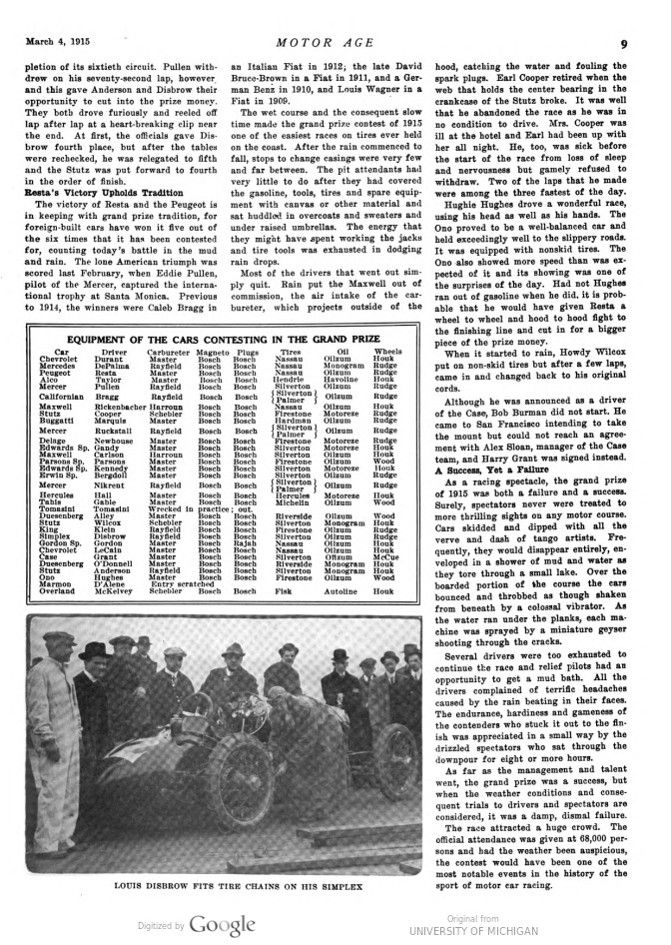
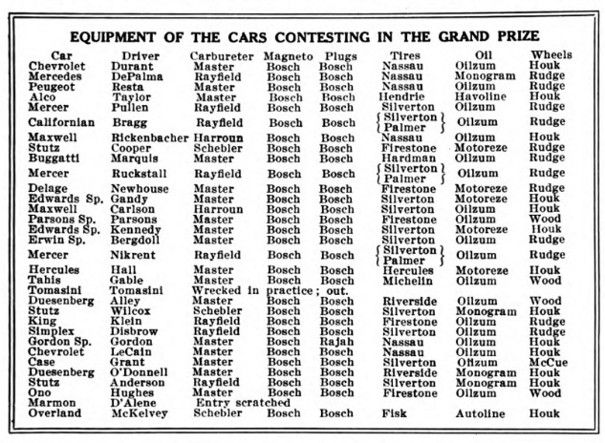
EQUIPMENT OF THE CARS CONTESTING IN THE GRAND PRIZE
LOUIS DISBROW FITS TIRE CHAINS ON HIS SIMPLEX