In 1910, the American automotive industry was still eying on what was going on in Europeit on the comparable field. Logically, as some kind of, well You might even call it, „passive competitor-spotting“, still wil help You further on the way. Chester Ricker not only was a reporter, but he also was technical very well experienced. TZhis article summarizes the latest 1910 engine- and car developements. Examples are silent chains for camshaft drives, the so-called cylinder casings „en bloc“, exhaust manifolds, two ball bearings for the crankshaft, new clutches and volve cases. The attached drawings are most probably made by the author himself.
Text and jpegs by courtesy of hathitrust.org www.hathitrust.org, compiled by motorracinghistory
THE HORSELESS AGE Vol. XXVI, No. 26, November 23, 1910
Some of the Latest European Creations.
Silencing New Cars – Silent Chains Instead of Timing Gears – Six Cylinder „Bloc Castings – Two Bearing Crank Shafts – New Clutch.
By Chester S. Ricker.
Among the chief characteristics of the car of the day, especially in Europe, are that it is silent, inaudible or noiseless – to use the synonym most often applied and that it is wonderfully powerful for its small size. The wonderful ability attributed to the motors is due to the very high rotative speeds of which they are capable. Take the new Bugatti gentlemen’s roadster. This has a motor with 2.5 inch bore and 4.3 inch stroke. Under ordinary conditions this motor would not be expected to turn up more than 1,500 revolutions per minute, but the designer of this car has run the speed up to 2,300 revolutions per minute normal and allows for an acceleration to 3,800. To better compare this with standard practice it is well to convert it into terms of feet per minute piston speed. The A.L.A.M.-rating is based on a piston speed of 1,000 feet per minute, which is considered good practice. In the above case, however, the normal speed would be 1,650 feet per minute and the maximum 2,720. This increased piston speed, in fact, is the largest factor contributing toward the abnormal power which these pigmy engines can develop. It is, on the other hand, accompanied by certain disadvantages which have necessitated several important changes in motor design. Chief among these is the excessive vibration which results if the reciprocating parts are only a few ounces too heavy and if the balance is imperfect. Lubrication also become a serious question and to satisfy its requirements the full mechanical force feed system is now being adopted on even the smallest cars. When we take into consideration the fact that only a couple of years ago the same class of car would have had only splash lubrication, we can appreciate the advance which has been made.
Give the average owner a car which is powerful, but noisy, and see how long his patience will last. In a long drive, unquestionably the most trying thing to the nerves of the driver and those of the other occupants of the car, is undue noise. That this fact has been recognized by the manufacturers abroad is well shown by the changes made this year, especially in connection with the small high-speed motor.
Silencing of the car as well as the motor has been accomplished by eliminating the timing gears, instead of further trying to perfect the processes of their manufacture. Two methods have thus far been applied, one being to use silent chains and the other to use worm gears. Valves are being enlarged, both to obtain greater power and also to give more nearly noiseless action. The quieter action with a large valve is due to the fact that the lift may be much less than with a smaller valve of equivalent valve opening.
QUIETING TRANSMISSIONS.
A number of small cars also have herringbone gears in the change gear box. These gears, however, can only be used on the pair of gears which are constantly in mesh. The reason why this type of gear was adopted, rather than the helical gear, is that it has no end thrust. Continuing further in the direction of power transmission, we find that for small cars the worm drive is growing very popular. The high engine speeds used and the proportionately greater reduction required make it desirable. For example, a rear axle gear reduction of 6 to 1 is not at all uncommon with the present car. Heretofore 4½ to 1 was the low limit in small cars. This limit was fixed to a certain extent by the size of the crown gear which would give the necessary road clearance. With the demand for a still higher gear reduction the bevel gear became almost out of the question. Either the gear reduced road clearance too much or the pinion became too small and too noisy. It was then only a logical step to adopt the worm drive, the latter combining noiselessness and the possibility of low gear ratios with added clearance, especially when the worm is placed above the worm wheel.
THE APPLICATION OF THE SILENT CHΛΙΝ.
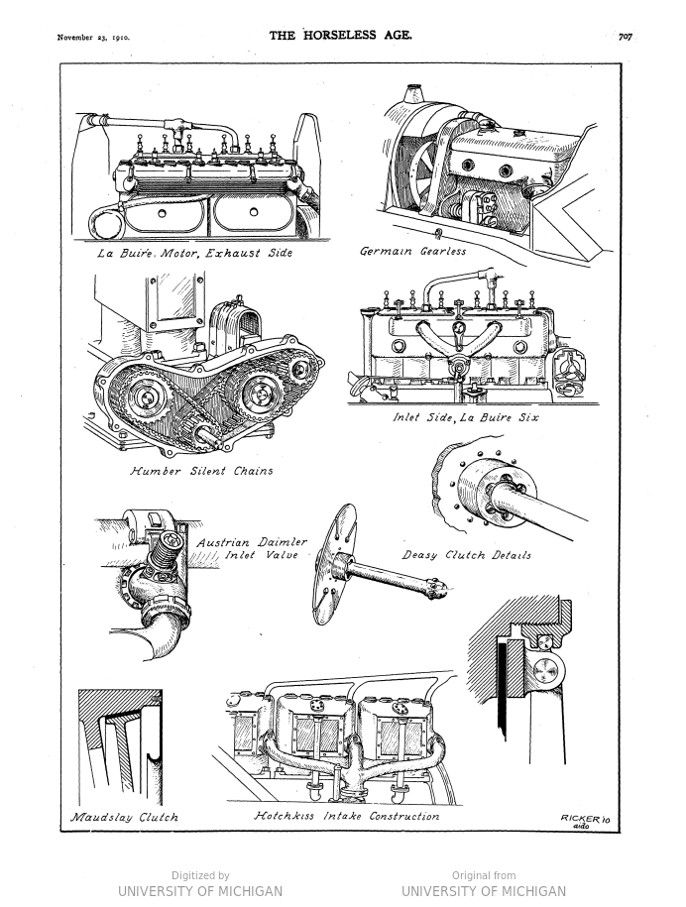
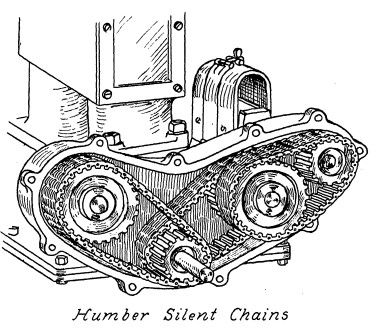
In some of the appended sketches, various types of chain driven cam shaft motors are shown. The combination of chains required to drive the two cam shafts and the magnetos, as on the Humber, presents a formidable appearance. However, the silent chain in general has been well tried out, and it is only this particular application that is new. With its high efficiency and its noiselessness, it should prove a boon to those who desire a noiseless car. Although Daimler has used it for two years, this is the first time that it has been applied to poppet valve motors. The Humber represents the most usual type of engine, where the valves are on opposite sides of the cylinder. The La Buire, here sketched, is an example of an „L“ motor with a Renold chain cam shaft drive.
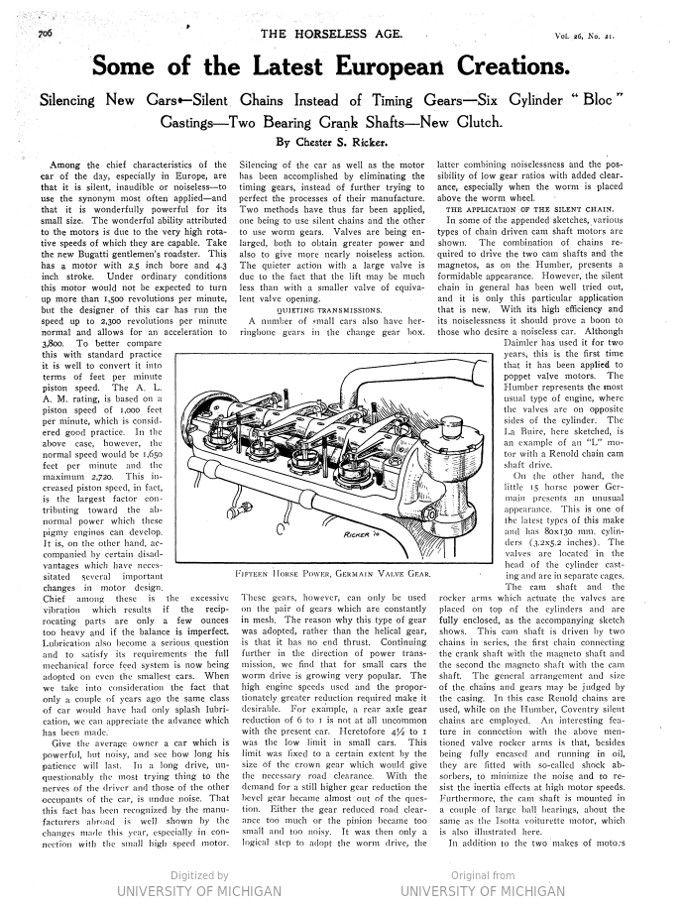
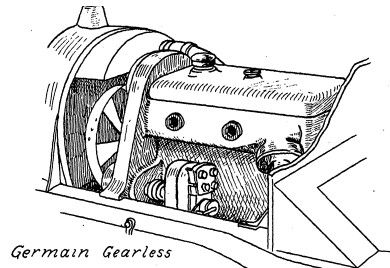
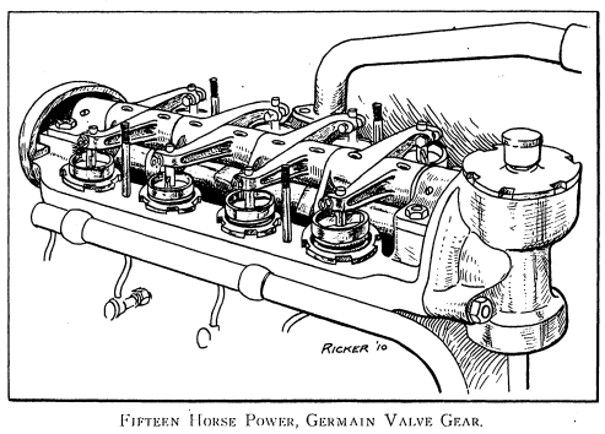
On the other hand, the little 15 horsepower Germain presents an unusual appearance. This is one of the latest types of this make and has 80×130 mm. cylinders (3.2×5.2 inches). The valves are located in the head of the cylinder casting and are in separate cages. The cam shaft and the rocker arms which actuate the valves are placed on top of the cylinders and are fully enclosed, as the accompanying sketch shows. This cam shaft is driven by two chains in series, the first chain connecting the crank shaft with the magneto shaft and the second the magneto shaft with the cam shaft. The general arrangement and size of the chains and gears may be judged by the casing. In this case Renold chains are used, while on the Humber, Coventry silent chains are employed. An interesting feature in connection with the above mentioned valve rocker arms is that, besides being fully encased and running in oil, they are fitted with so-called shock absorbers, to minimize the noise and to resist the inertia effects at high motor speeds. Furthermore, the cam shaft is mounted in a couple of large ball bearings, about the same as the Isotta voiturette motor, which is also illustrated here.
In addition to the two makes of motors mentioned above as being fitted with silent chains for driving the cam shafts, all „Silent Knight“ Daimlers have been so equipped for the past two years. The Vauxhall and Coventry Simplex firms are this year also adopting this form of cam shaft drive.
In the Vauxhall car there is also another unique application of the chain – for driving the fan. An enclosed chain is used for this purpose, instead of a pair of gears or a belt, the former of which is liable to make unpleasant noises and the latter to slip under unfavorable conditions.
„EN BLOC“ CYLINDER CASTINGS.
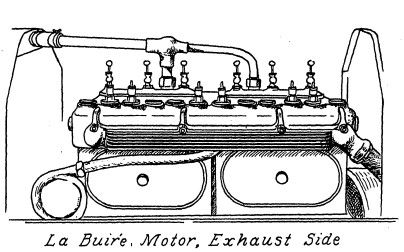
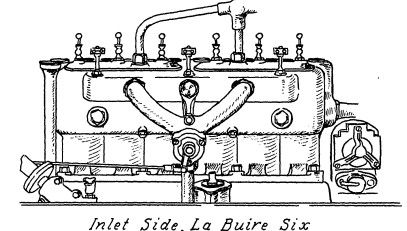
Four-cylinder motors with the cylinders cast in a single block are no longer uncommon; in fact, even six cylinders are now so cast. Last year at the Palace Show the Delaunay-Belleville firm exhibited a small „six“ of this description which commanded the interest of all those who saw it. An unusually neat arrangement of this kind is now presented in the new La Buire „Six.“ This unique motor, however, has other features of originality. Its cylinders are 85×140 mm. in dimensions (3.4×5.6 inches). The unusually long stroke is evidenced by the fact that the lower portion of the cylinder wall had to be recessed in order to permit the connecting rod to clear at its point of greatest angularity. The drive of the cam shaft is by means of a single silent chain furnished by Renold. The magneto and water pump are operated from the cam shaft by means of worm gears. These, it will be noticed, are placed across the frame and are particularly accessible.
In most motors which have all valves on the same side with cover plates over the valve springs, and which have both manifolds on the valve side, there is a lack of space on that side. For this reason the majority of designers now provide cored inlet passages between the cylinders and place the carburetor on the side opposite the valves. In the La Buire, a detachable „Y“ conveys the gas from the carburetor to a cast manifold upon the side of the cylinder opposite the valves. From this three passages extend to the valves, one between the first and second cylinders, another between the third and fourth, and the last between the fifth and sixth. By placing the carburetor on the offside the exhaust or valve side of the motor may be made very neat and accessible, as may be seen from the sketch.
Attention should be called to the peculiar exhaust manifold attachment. Instead of using two bolts on opposite sides of the manifold, or a single one passing through it centrally, one bolt is placed at the side of the manifold and is made to serve the purpose of two, by simply casting a projection at one side, as the sketch indicates. This gives practically the same effect as is obtained when a yoke is used. The detachable manifold is rather unusual in combination with „bloc“ construction. This company, however, in common with the Metallurgique firm, has discarded the integral construction first employed for the detachable or separate manifold.
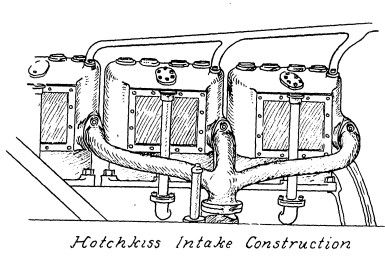
In the endeavor to silence valve gears by covering up the valve springs and push rods, some difficulty is experienced if the valves are all on one side, and both manifolds are also on this side. As mentioned before, this difficulty is overcome in „en bloc“ motors by coring passages between the cylinders so as to remove the carburetor from the exhaust side. The new 20-30 horsepower six-cylinder Hotchkiss is similarly arranged, although the cylinders are cast in pairs. This is shown in the accompanying sketch. The passage for the gas is carried around one end of the cylinders, at the bottom of the water jacket. It is claimed that the running of the motor is thereby greatly improved, especially at low speeds. The cylinders of this engine are 95×110 mm, or 3.8×4.4 inches. In this motor only plain bearings are used, which is interesting in view of the fact that Hotchkiss was one of the first Continental builders to adopt ball bearings. However, present tendency seems to be toward ball bearings even on the crank shaft in small motors.
TWO-BEARING BALL-BEARING CRANK SHAFT.
Two years ago, when Howard E. Coffin first inaugurated the two-bearing ball-bearing crank shaft in this country for as large a motor as 30 horsepower, he was criticised for his step, but the success of his car has confirmed his practical wisdom. Several of the leading manufacturers of Europe have now adopted this type of construction. Among them is Darracq, who not only uses two bearings but divides the cast steel crank case in the middle in a plane at right angles to the axis of the crank shaft. The inlet valves are located above the exhaust and are operated by means of rocker arms. Both valves are operated from the same cam shaft and are of exceptionally large diameter.
Delage is likewise an advocate of two bearings on the „four“ and uses only three in the six-cylinder motor. The „Six“ has 66×125 mm. cylinders and develops 30 horsepower at 2,000 revolutions per minute. Sizaire & Naudin use a double instead of a single race bearing. Otherwise, there is scarcely any difference between their motor and the Darracq, aside from cylinder dimensions. The fours of this firm are made in two sizes, 2.7×5.5 and 2.7×6.69 inches. The six has a 2.7 inch bore and 5.5-inch stroke. This is the first time that Sizaire turns out a six-cylinder car.
ISOTTA VOITURETTE MOTOR.
A type of motor which is largely copied in the small car line is that made by Isotta Fraschini. The valves are located in the head and have an overhead cam shaft. This model was first introduced nearly three years ago, when it was out of the ordinary, but as the demand for economical powerful small motors increased this form of valve valve gear has become popular. In the sketch accompanying, the cover which encloses the valves and cam shaft is removed. It is held in place by means of four studs and can be removed in a minute when desired. With the cover in place the appearance of the motor is similar to that of the Germain, also shown.
SOME CLUTCH IDEAS.
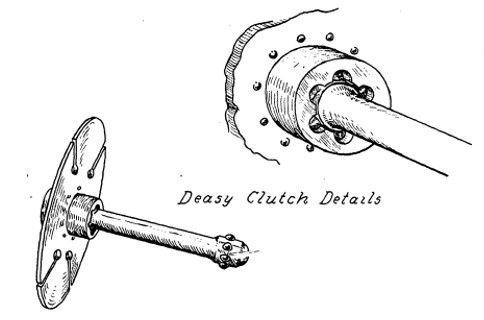
The new 1911 Deasy cars will have a clutch notable for simplicity. It consists of a single plate of phosphor bronze running in oil and gripped between cast iron faces. The details of the ring and the method of pinching it between the flywheel and a separate ring are clearly shown. By screwing in the fulcrum, the clutch may be very quickly adjusted for tightness. The principle is the same that has so long been used by De Dion in France and Autocar and Thomas in this country. The unusual ball bearing universal joint at the clutch is worthy of consideration.
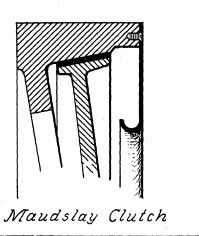
The Maudslay „Seventeen,“ a 90×130 mm. motor, has a special contrivance on the flywheel which serves the purpose of retaining a quantity of neatsfoot oil. The makers advise the replenishment of this oil at frequent intervals, and claim that it greatly adds to the sweet operation of the clutch which, as will be seen, is of the leather faced cone variety.
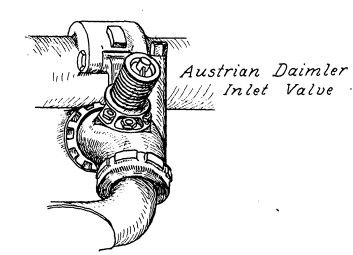
AUSTRIAN DAIMLER VALVE CAGE CONSTRUCTION.
In the long stroke motor it is difficult to place the cam shaft above the cylinders and yet keep the hood reasonably low. The Austrian Daimler Prince Henry model has the valves in the head at an angle of 45 degrees and an overhead cam shaft. Despite this it is not excessively high for a 105×165 mm, motor. To reduce the height, the rocker arms are placed below the valve springs, thus lowering the cam shaft. On the exhaust side of the motor this arrangement also contributes considerably to keeping the valve springs cool. The only difference between the exhaust valve cage and that here shown is that the former has a number of vertical ribs cast upon it to promote the cooling of the cage.
Photos.
Page 706. FIFTEEN HORSEPOWER, GERMAIN VALVE GEAR. (RICKER ‘10)
Page 707. La Buire. Motor, Exhaust Side – Germain Gearless – Humber Silent Chains – Inlet Side, La Buire Six – Austrian Daimler, Inlet Valve – Deasy Clutch Details – Maudslay Clutch – Hotchkiss Intake Construction (RICKER ‘10 aido)