Comment is on the way. (Translation included at the end)
With permission of the Bibliothèque national francais gallica.bnf.fr
Text and photos compiled by motorracinghistory, translation by DeepL deepl.com
Le Monde Illustré (Illustrated World) – 43e Année, No. 2209, 29 Juillet 1899
The Tour de France Race
(Photographs Borie.)
The automobile race known as the Tour de France is undoubtedly the sporting event of the year.
From the standpoint of automobile construction as well as the art of driving these formidable race cars, this event has surpassed all expectations in terms of significance.
Organized by one of our leading daily newspapers, under the auspices of the Automobile Club de France, the Tour de France race consisted of seven stages to be completed in nine days, with a 24-hour rest period following the two most grueling stages.
The first stage was Paris–Nancy (290 kilometers), the second, Nancy–Aix-les-Bains (441 kilometers), the third, Aix-les-Bains–Vichy (382 kilometers), the fourth, Vichy–Périgueux (299 kilometers), the fifth, Périgueux to Nantes (339 kilometers), the sixth, Nantes to Cabourg (348 kilometers), and finally, the seventh stage took the riders from Cabourg to Paris—or rather, to Saint-Germain-en-Laye, since the Seine department was off-limits to them; this last stage, the shortest, was only 190 kilometers.
The race began in Champigny on July 16, and most of the registered riders set off on the road to Nancy.
Twenty automobiles, twenty-five motorcycles, and four small cars competed for speed right from the start, which was staggered in 30-second intervals.
The first day, like the ones that followed, was full of surprises—both in terms of the engines’ endurance and the breakneck pace maintained on a route that was at times very difficult.
It would take too long to recount the countless incidents that occurred over the seven days of this memorable race; suffice it to say that the leading competitors fought fiercely for first place at every stage, and that accidents repaired along the way—causing delays for one group or another—kept the outcome in doubt at all times.
The lead was held by seasoned drivers such as: de Knyff, Girardot, Pinson, Chasseloup-Laubat, Charron, etc. But the most remarkable performance came from the motorcycles, which, against all odds, kept up with the 60-kilometer-per-hour pace set by the cars; as we can see, this is a far cry from the “one-and-a-quarter-horse” tricycle that, two years ago, laboriously covered its thirty kilometers per hour. Here again, the most famous names took to the course, and Gleize, Williams, Tart, Corre, Teste, Béconnais, Osmont, and Rivierre set off in pursuit of the cars.
While every finish in the various towns marking the end of the stages was thrilling, the one that concluded the race and determined the final standings sparked a surge of curiosity among Parisians whom summer resorts have not yet lured away from the capital.
Saint-Germain-en-Laye is the starting or finishing point for many bicycle and automobile races, but never before had a finish stirred such excitement in this peaceful resort town.
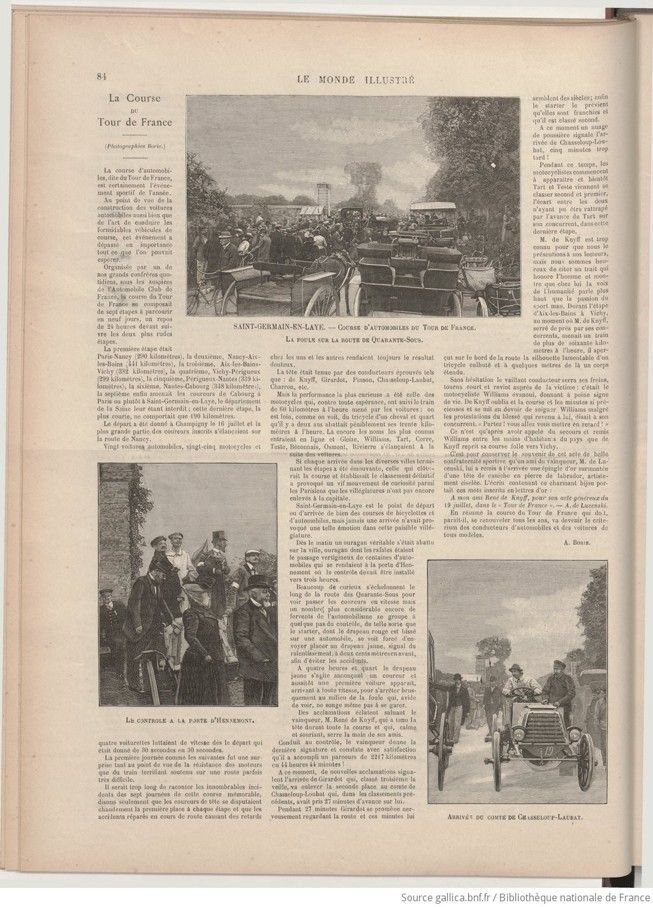
From early morning, a veritable hurricane had swept through the town—a hurricane whose gusts were the dizzying rush of hundreds of cars heading toward the Porte d’Hennemont, where the checkpoint was to be set up around three o’clock.
Many onlookers lined the Route des Quarante-Sous to watch the racers speed by, but an even even greater number of motorsports enthusiasts gathered just a few steps from the checkpoint, so much so that the starter—whose red flag was hoisted on a car—was forced to have a yellow flag, signaling a slowdown, placed two hundred meters ahead to prevent accidents.
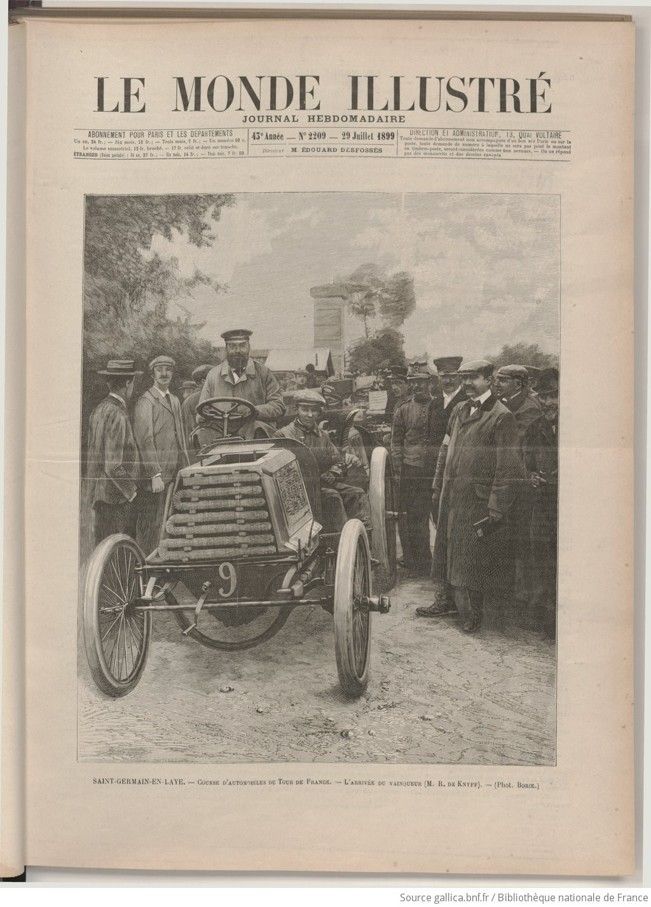
At a quarter past four, the yellow flag is waved to signal an approaching racer, and immediately the first car appears, coming at full speed, only to come to an abrupt halt in the middle of the crowd, which, eager to watch, doesn’t even think to move out of the way.
Cheers erupt in honor of the winner, Mr. René de Knyff, who led the entire race and who, calm and smiling, shakes hands with his friends.
Taken to the checkpoint, the winner signs the final document and notes with satisfaction that he has completed a 2,217-kilometer course in 44 hours and 44 minutes!
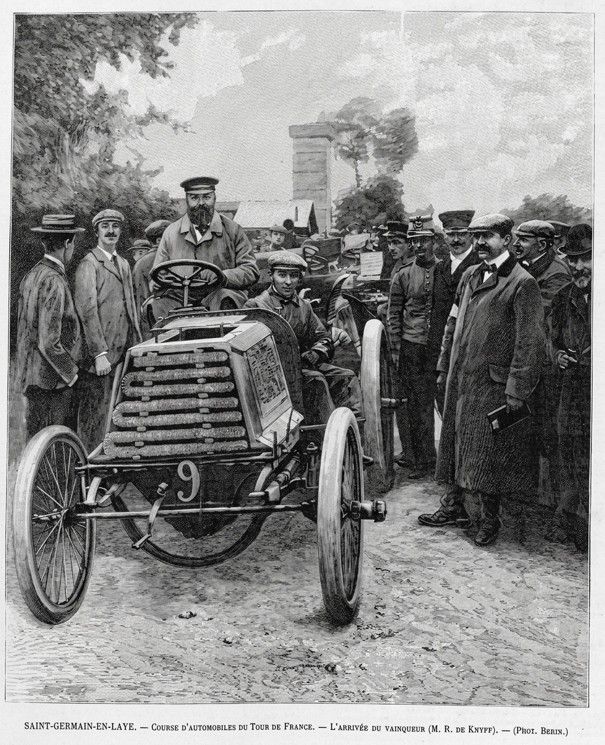
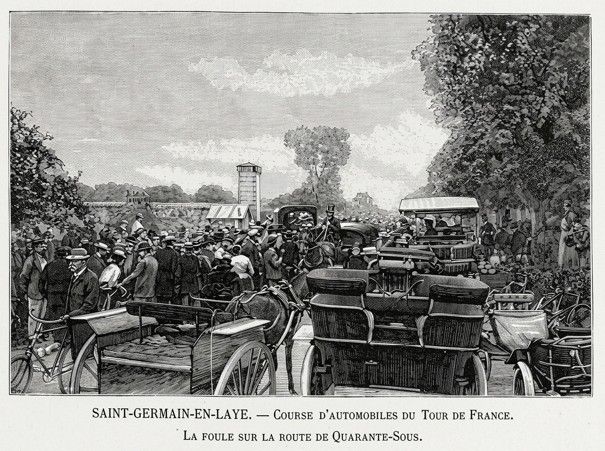
<– SAINT-GERMAIN-EN-LAYE, — TOUR DE FRANCE AUTOMOBILE RACE. — THE WINNER’S ARRIVAL (Mr. R. DE KNYFF). — (Photo: BORIE.)
ARRIVAL OF THE COUNT OF CHASSELOUP-LAUBAT. —>
gallica.bnf.fr, photos modified by AI
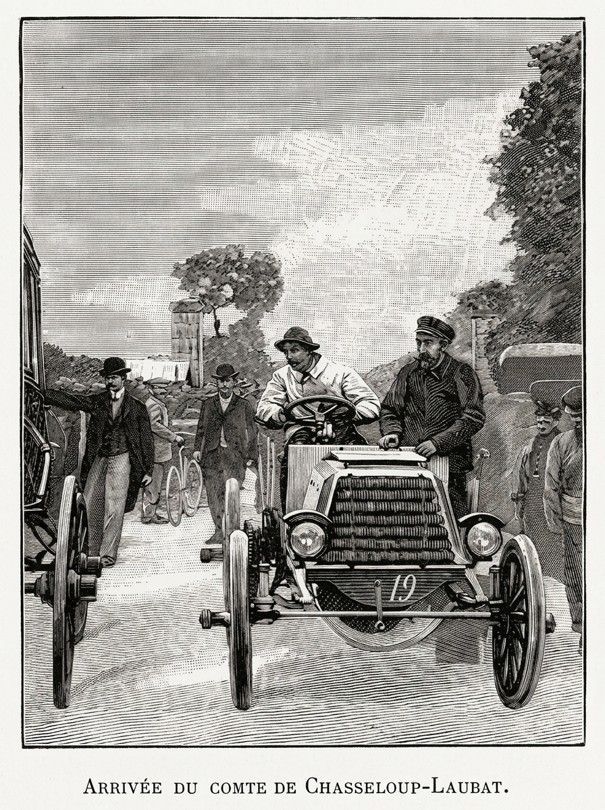
At that moment, fresh cheers signaled the arrival of Girardot, who—having finished third the day before—was about to take second place from the Count of Chasseloup-Laubat, who, in the previous standings, had held a 27-minute lead over him.
For 27 minutes, Girardot paces nervously, watching the road, and those minutes seem like centuries to him; finally, the starter informs him that the time has elapsed and that he is ranked second.
At that moment, a cloud of dust signals the arrival of Chasseloup-Laubat—five minutes too late!
Meanwhile, the motorcyclists begin to appear, and soon Tart and Teste take second and first place, respectively; the gap between them could not be closed, as Tart’s lead over his competitor in this final stage proved insurmountable.
Mr. de Knyff is too well-known for us to introduce him to our readers, but we are pleased to mention a trait that honors the man and shows that, for him, the voice of humanity speaks louder than the passion for the sport. During the stage from Aix-les-Bains to Vichy, just as Mr. de Knyff—closely pursued by his competitors—was riding at a speed of over sixty kilometers per hour, he spotted on the side of the road the pitiful sight of an overturned tricycle and, a few meters away, a body lying on the ground.
Without hesitation, the valiant rider slammed on his brakes, made a sharp turn, and returned to the victim’s side: it was the motorcyclist Williams, who had fainted and was barely showing any signs of life. De Knyff forgot all about the race and those precious minutes and set about tending to Williams, despite the protests of the injured man, who, having regained consciousness, said to his competitor, “Go on! You’ll fall behind!”
It was only after calling for help and entrusting Williams to the care of local residents that de Knyff resumed his frantic race toward Vichy.
To commemorate this act of fine sporting camaraderie, a friend of the winner, Mr. de Lucenski, presented him at the finish line with a gold pin topped by a head of a Labrador stone poodle, artfully carved. The case containing this charming piece of jewelry bore the following words inscribed in gold letters:
To my friend René de Knyff, for his generous act on July 19, in the “Tour de France.” — A. de Lucenski.
In short, the Tour de France race, which is reportedly to be held annually, is set to become the benchmark event for drivers and cars of all models.
A. BORIE.
Photos.
Page 81: SAINT-GERMAIN-EN-LAYE, — TOUR DE FRANCE AUTOMOBILE RACE. — THE WINNER’S ARRIVAL (Mr. R. DE KNYFF). — (Photo: BORIE.)
Page 84: THE CHECKPOINT AT THE ENTRANCE TO HENNEMONT. / SAINT-GERMAIN-EN-LAYE. — TOUR DE FRANCE AUTOMOBILE RACE. / THE CROWD ON THE ROAD TO QUARANTE-SOUS. / ARRIVAL OF THE COUNT OF CHASSELOUP-LAUBAT.