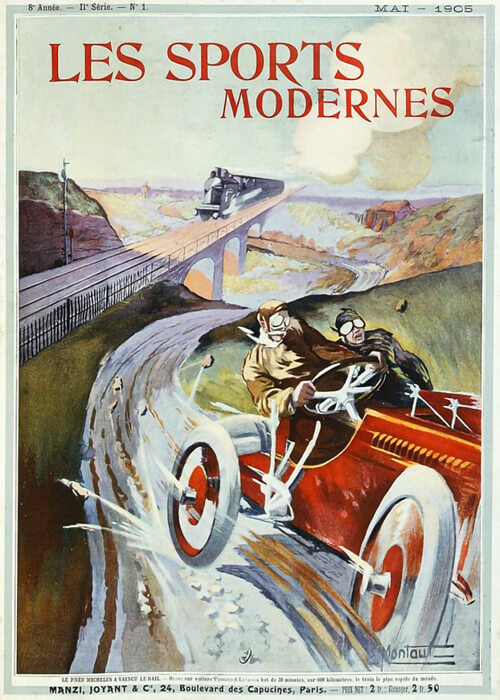
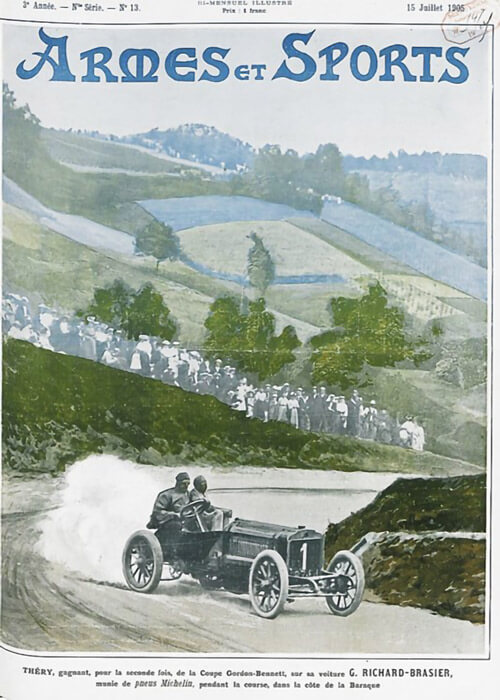
Comment is on the way.
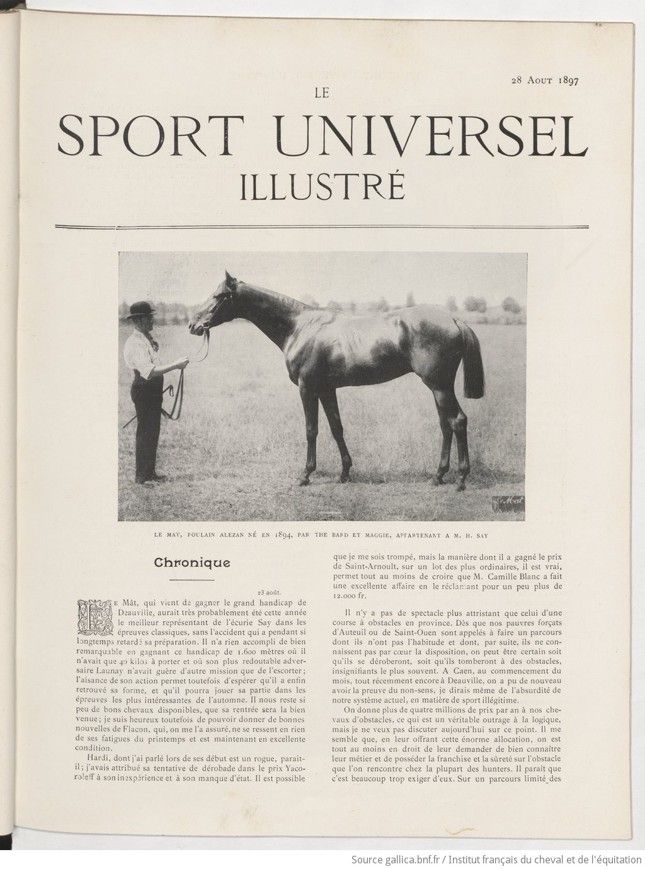
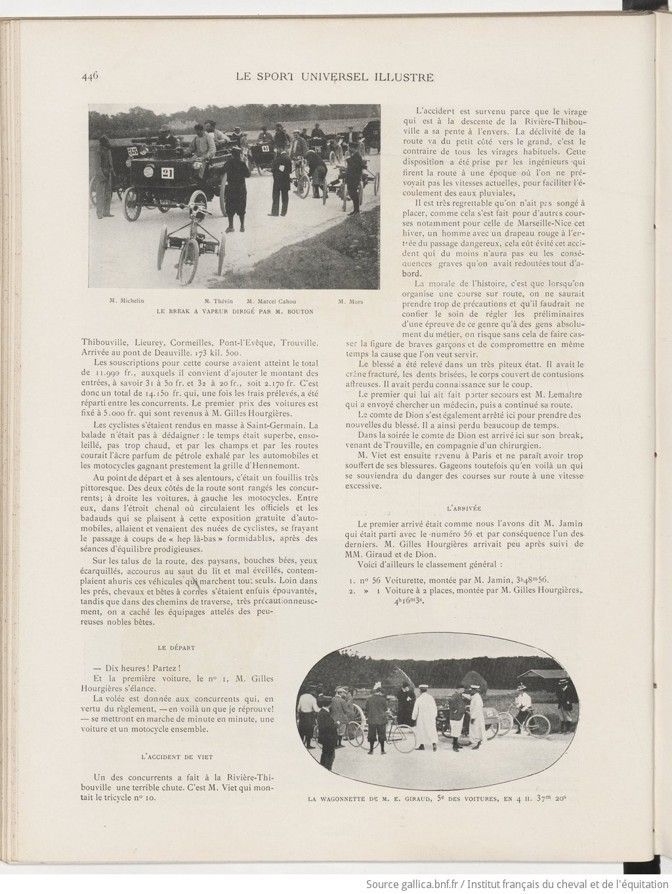
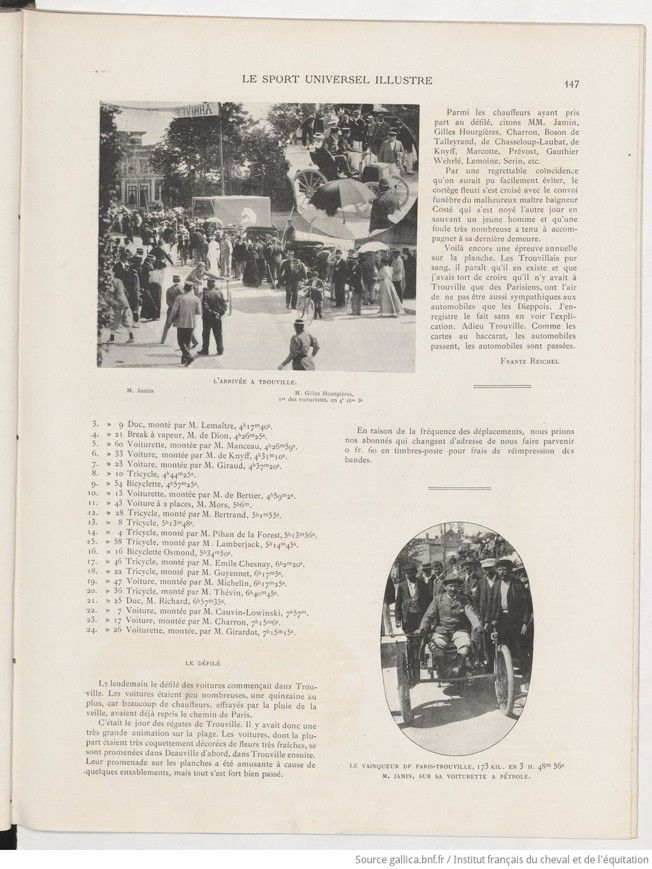
With permission of the Bibliothèque national francais gallica.bnf.fr
Text and photos compiled by motorracinghistory, Tramslation by DeepL deepl.com
Le Sport Universel Illustré – 2e Année, 28 August 1897
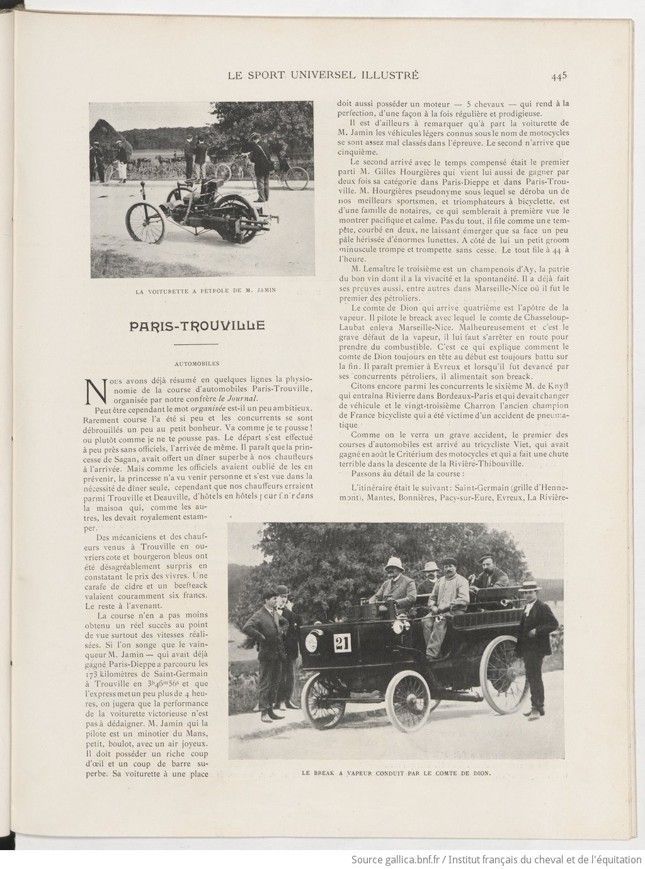
PARIS-TROUVILLE – AUTOMOBILES
WE have already summarized in a few lines the nature of the Paris-Trouville automobile race, organized by our colleague Le Journal.
Perhaps, however, the word organized is a bit ambitious. Rarely has a race been so poorly organized, and the competitors had to fend for themselves as best they could. “Go as I push you!”—or rather, “Go as I don’t push you.” The start took place with virtually no officials present, and the finish was much the same. It seems that the Princess of Sagan had offered a superb dinner to our drivers at the finish line. But since the officials had forgotten to let them know, the princess saw no one coming and found herself having to dine alone, while our drivers wandered through Trouville and Deauville, from hotel to hotel, only to end up at the inn that, like the others, charged them a king’s ransom. Mechanics and drivers who had come to Trouville dressed in blue work overalls and jackets were unpleasantly surprised by the cost of food. A carafe of cider and a steak typically cost six francs. The rest was similarly priced.
The race was nonetheless a real success, especially in terms of the speeds achieved. When one considers that the winner, Mr. Jamin—who had already won the Paris-Dieppe race—covered the 173 kilometers from Saint-Germain to Trouville in 3 hours, 46 minutes, and 56 seconds, and that the express train takes a little over 4 hours, one will agree that the performance of the winning car is nothing to be sneezed at. Mr. Jamin, who drives it, is a miller from Le Mans—a small, hard-working man with a cheerful demeanor. He must have a keen eye and superb steering skills. His single-seater car must also have an engine—5 chevaux—that performs flawlessly, in a manner that is both consistent and remarkable. It is also worth noting that, apart from Mr. Jamin’s car, the light vehicles known as motorcycles fared rather poorly in the race. The runner-up finished only fifth.
The runner-up based on adjusted time was the first to start, Mr. Gilles Hourgières, who has also won his category twice in the Paris-Dieppe and Paris-Trouville races. Mr. Hourgières—a pseudonym behind which one of our finest sportsmen and cycling champions hides—comes from a family of notaries, which at first glance might suggest he is peaceful and calm. Not at all; he races like a storm, bent double, with only his slightly pale face—framed by enormous glasses—visible. Beside him, a tiny little bell boy rings his bell incessantly. The whole group races along at 44 per hour.
Mr. Lemaître, in third place, is from Ay in Champagne, the homeland of fine wine, from which he derives his liveliness and spontaneity. He has already proven himself as well, notably in the Marseille-Nice race, where he was the first among the “petroliers.”
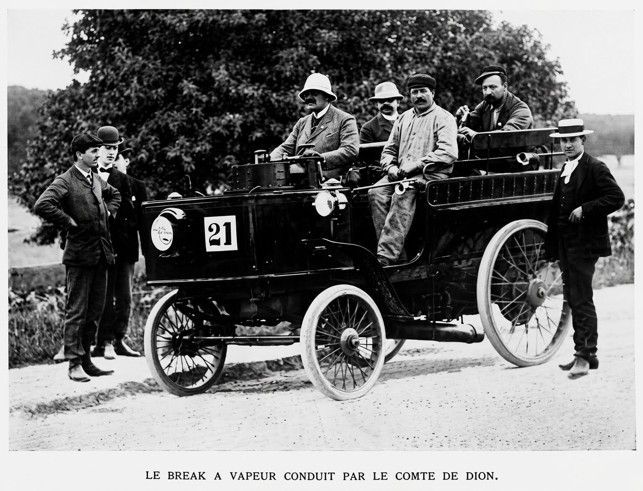
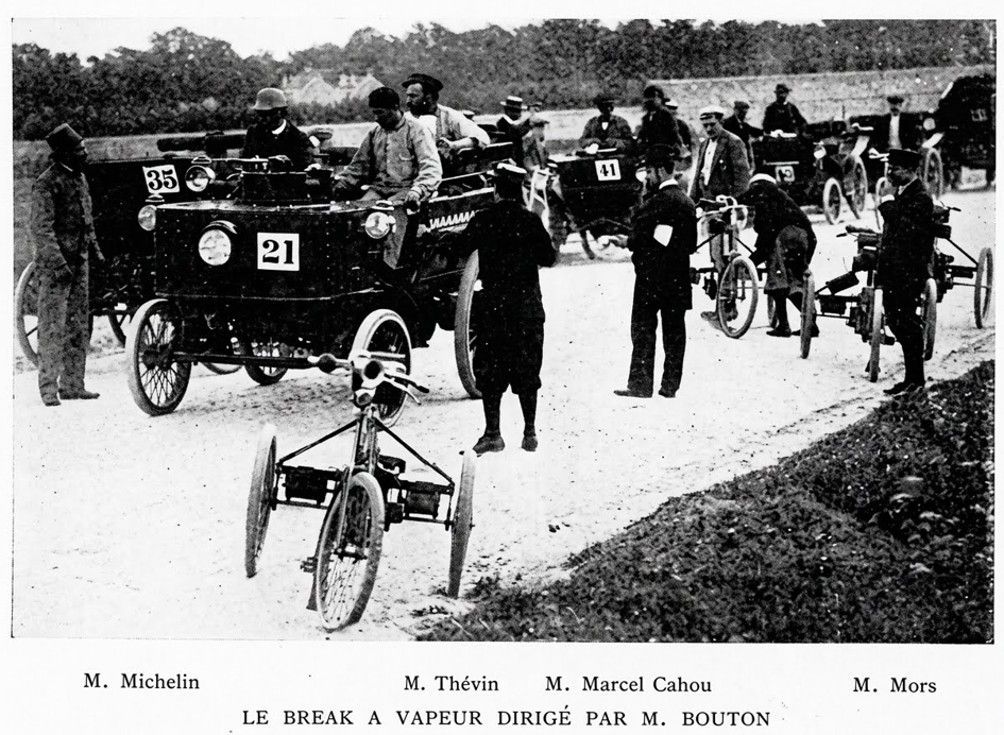
The Count de Dion, who finishes fourth, is a champion of steam power. He drives the “breack” with which the Count de Chasseloup-Laubat won the Marseille-Nice race. Unfortunately—and this is the major drawback of steam power—he must stop along the way to refuel. This explains why the Count de Dion, though always in the lead at the start, is consistently overtaken in the final stretch.
He was in first place at Evreux, and when he was overtaken by his gasoline-powered competitors, he was refueling his station wagon.
Among the other competitors, we should also mention Mr. de Knyff, who finished sixth—he had driven Rivierre in the Bordeaux-Paris race and had to change vehicles—and Charron, the former French cycling champion, who finished twenty-third and was the victim of a tire accident.
As we shall see, a serious accident—the first in the history of automobile racing—befell the tricycle rider Viet, who had won the Motorcycle Criterium in August and who suffered a terrible fall on the descent from La Rivière-Thibouville.
Let us now look at the details of the race:
The route was as follows: Saint-Germain (Hennemont starting gate), Mantes, Bonnières, Pacy-sur-Eure, Evreux, La Rivière-Thibouville, Lieurey, Cormeilles, Pont-l’Evêque, Trouville. Finish at the Deauville bridge. 173.500 km.
Bets placed on this race totaled 11,990 francs, to which must be added the amount from admission fees—namely, 31 tickets at 50 francs and 32 at 20 francs, totaling 2,170 francs. This brings the total to 14,150 francs, which, after expenses were deducted, was distributed among the competitors. The first prize for the car category was set at 5,000 francs, which went to Mr. Gilles Hourgières.
Cyclists had flocked to Saint-Germain in droves. The ride was nothing to sneeze at: the weather was superb—sunny, not too hot—and the acrid scent of gasoline wafted through the fields and along the roads, emitted by the automobiles and motorcycles speeding toward the starting line in Hennemont.
At the starting point and its surroundings, it was a very picturesque jumble. On both sides of the road, the competitors were lined up; on the right, the cars; on the left, the motorcycles. Between them, in the narrow passageway where officials and onlookers—who were enjoying this free car show—moved about, swarms of cyclists came and went, clearing a path with thunderous shouts of “Hey, over there!” after performing astonishing balancing acts. On the roadside embankments, farmers—mouths agape, eyes wide open, having rushed out of bed and still half-asleep—stared in bewilderment at these vehicles that moved all on their own. Far out in the meadows, horses and cattle had fled in terror, while on the side roads, the harnessed teams of these timid, noble beasts had been carefully hidden away.
THE START
— Ten o’clock! Go!
And the first vehicle, No. 1, driven by Mr. Gilles Hourgières, speeds off.
The starting signal is given to the competitors who, according to the rules—and this is one I disapprove of! —will set off one minute at a time, with one car and one motorcycle starting together.
VIET’S ACCIDENT
One of the competitors suffered a terrible crash at Rivière-Thibouville. It was Mr. Viet, riding tricycle No. 10.
The accident occurred because the curve on the descent from Rivière-Thibouville has its slope reversed. The road slopes from the narrow side toward the wide side, which is the opposite of all standard curves. This design was implemented by the engineers who built the road at a time when current speeds were not anticipated, in order to facilitate the flow of rainwater. It is very regrettable that no one thought to station a man with a red flag at the entrance to the dangerous stretch—as was done for other races, notably the Marseille-Nice race this winter—as this would have prevented this accident, which, at least, did not have the serious consequences initially feared.
The moral of the story is that when organizing a road race, one can never take too many precautions, and the task of arranging the logistics for such an event should be entrusted only to true professionals; otherwise, one risks putting brave young men in harm’s way and, at the same time, compromising the very cause one seeks to serve.
The injured man was found in a very pitiful condition. He had a fractured skull, broken teeth, and his body was covered with horrific bruises. He had lost consciousness immediately upon impact.
The first person to come to his aid was Mr. Lemaître, who sent for a doctor and then continued on his way.
The Count de Dion also stopped here to inquire after the injured man. He thus lost a great deal of time.
In the evening, the Count de Dion arrived here in his station wagon, coming from Trouville, accompanied by a surgeon. Mr. Viet then returned to Paris and does not appear to have suffered too much from his injuries. We can be sure, however, that this is one person who will remember the danger of driving at excessive speeds on public roads.
THE FINISH
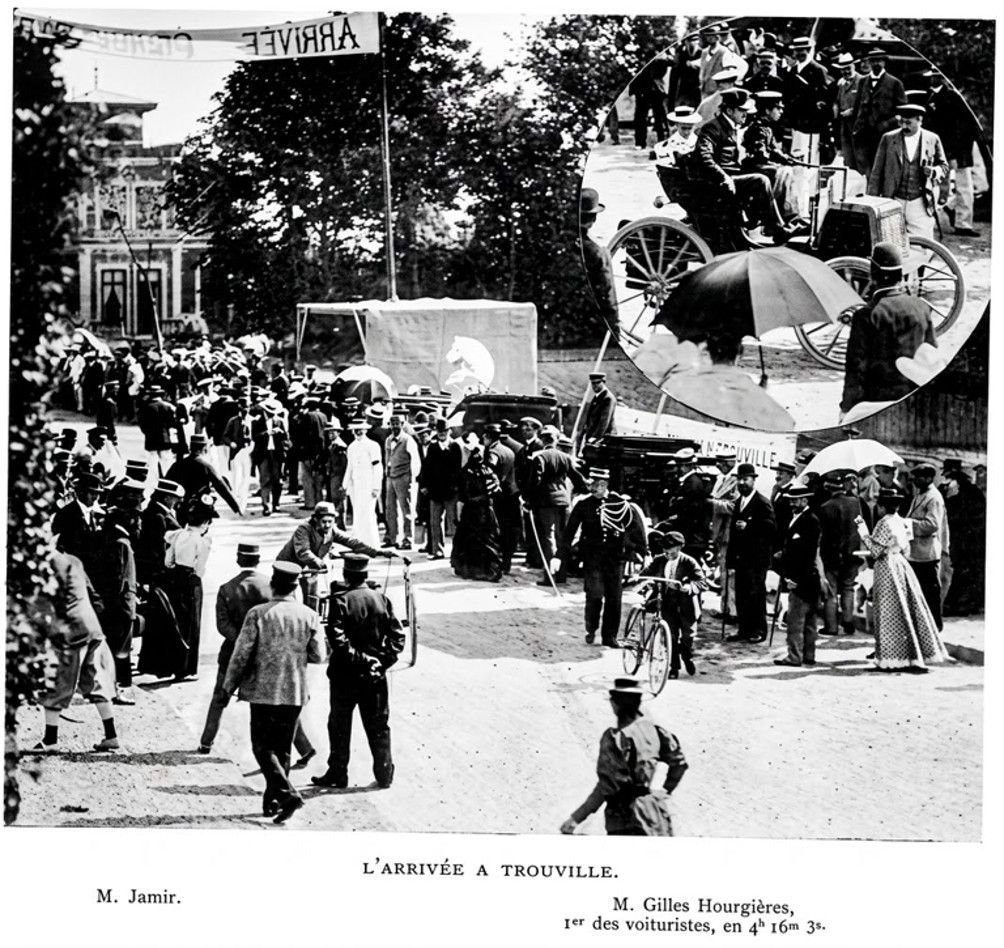
As we mentioned, the first to finish was Mr. Jamin, who had started with number 56 and was therefore one of the last to begin. Mr. Gilles Hourgières arrived shortly afterward, followed by Messrs. Giraud and de Dion.
Here, in fact, is the overall standings:
I. No. 56 Voiturette, driven by Mr. Jamin, 3h 48m 56.
2. » I Two-seater car, driven by Mr. Gilles Hourgières, 4h 16m 3s.
3. » 9 Duc, driven by Mr. Lemaître, 4h 17m 40s.
4. » 21 Steam station wagon, Mr. de Dion, 4h 26m 25s.
5. » 60 Microcar, driven by Mr. Manceau, 4h 26m 59s.
6. » 33 Car, driven by Mr. de Knyff, 4h 31m 10s.
7. » 23 Car, driven by Mr. Giraud, 4h 37m 20s.
8. » 10 Tricycle, 4h 44m 25s.
9. » 54 Bicycle, 4h 57m 25s.
10. » 13 Microcar, driven by Mr. de Bertier, 4h 59m 2s.
11. » 43 Two-seater car, Mr. Mors, 5h 6m.
12. » 28 Tricycle, driven by Mr. Bertrand, 5h 1m 55s.
13. » 8 Tricycle, 5h 13m 48s.
14. » 4 Tricycle, driven by Mr. Pihan de la Forest, 5h 13m 56s.
15. » 58 Tricycle, driven by Mr. Lamberjack, 5h 14m 45s.
16. » 16 Osmond Bicycle, 5h 34m 50s.
17. » 46 Tricycle, ridden by Mr. Emile Chesnay, 6h 2m 20s.
18. » 22 Tricycle, ridden by Mr. Guyennet, 6h 17m 15s.
19. » 47 Car, driven by Mr. Michelin, 6h 17m 25s.
20. » 36 Tricycle, driven by Mr. Thévin, 6h 40m 45s.
21. » 25 Duc, Mr. Richard, 6h 57m 35s.
22. » 7 Car, driven by Mr. Cauvin-Lowinski, 7h 57m.
23. » 17 Car, driven by Mr. Charron, 7h 15m 6s.
24. » 26 Microcar, driven by Mr. Girardot, 7h 15m 15s.
THE PARADE
The next day, the car parade began in Trouville. There were only a few cars—fifteen at most—because many drivers, put off by the previous day’s rain, had already headed back to Paris.
It was the day of the Trouville regattas. Consequently, the beach was bustling with activity. The cars, most of which were very charmingly decorated with fresh flowers, drove first through Deauville and then through Trouville. Their drive along the boardwalk was entertaining due to a few instances of the cars getting stuck in the sand, but everything went very smoothly.
Among the drivers who took part in the parade were Messrs. Jamin, Gilles Hourgières, Charron, Boson de Talleyrand, de Chasseloup-Laubat, de Knyff, Marcotte, Prévost, Gauthier Wehrlé, Lemoine, Serin, etc.
By an unfortunate coincidence that could easily have been avoided, the flower-bedecked procession crossed paths with the funeral procession of the unfortunate lifeguard Costé, who drowned the other day while saving a young man and whom a very large crowd insisted on accompanying to his final resting place.
Here’s yet another annual event on the boardwalk. It seems there are indeed “true-blue” Trouville locals—and that I was wrong to believe there were only Parisians in Trouville—who do not seem to be as fond of automobiles as the people of Dieppe. I note this fact without understanding the reason behind it. Farewell, Trouville. Like cards in baccarat, automobiles come and go; the automobiles have come and gone.
FRANTZ REICHEL
Photos.
Page 445. MR. JAMIN’S PETROL-POWERED CAR / THE STEAM-POWERED STATION WAGON DRIVEN BY THE COUNT DE DION.
Page 446. Mr. Michelin – Mr. Thévin – Mr. Marcel Cahou – Mr. Mors / THE STEAM STATION WAGON DRIVEN BY MR. BOUTON / MR. E. GIRAUD’S WAGON, 5TH AMONG THE CARS, IN 4h 37m 20s
Page 147. THE FINISH IN TROUVILLE: Mr. Jamin – Mr. Gilles Hourgières, – 1st among car drivers, in 4h 16m 3s / THE WINNER OF THE PARIS-TROUVILLE RACE, 173 KILOMETERS IN 3h 48m 56s. / MR. JAMIN, IN HIS PETROL-POWERED CAR.