Text and jpegs by courtesy of hathitrust.org www.hathitrust.org, compiled by motorracinghistory.com
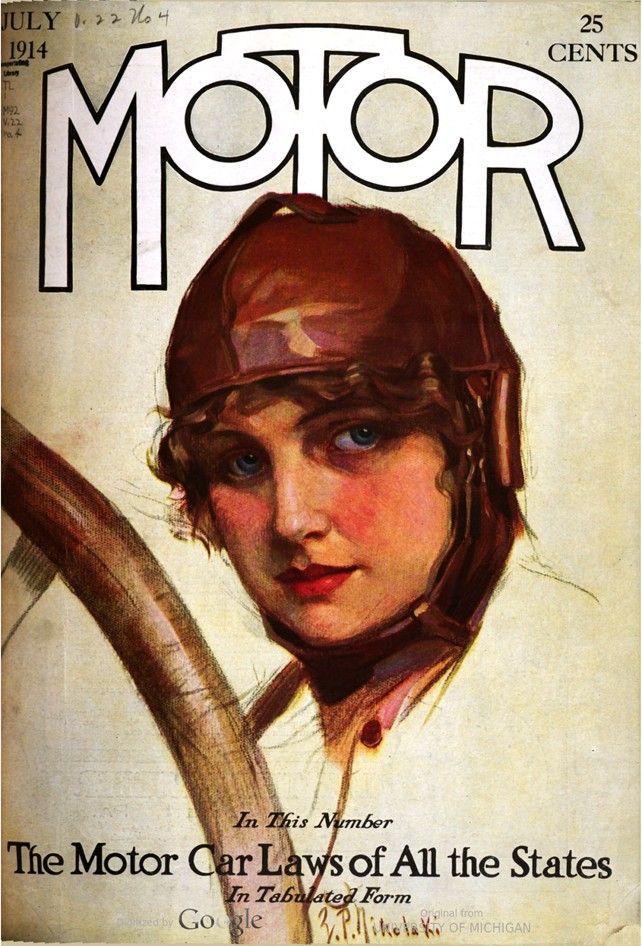
MOTOR – THE NATIONAL MAGAZINE OF MOTORING – Vol. XXII, No. 4, July 1914
Should American Makers Race?
A Critical Analysis of the Indianapolis Race and a Consideration of Its Lessons for America. How the American Motor Car May Benefit by the Makers’ Interest in Racing.
By Julian C. Chase.
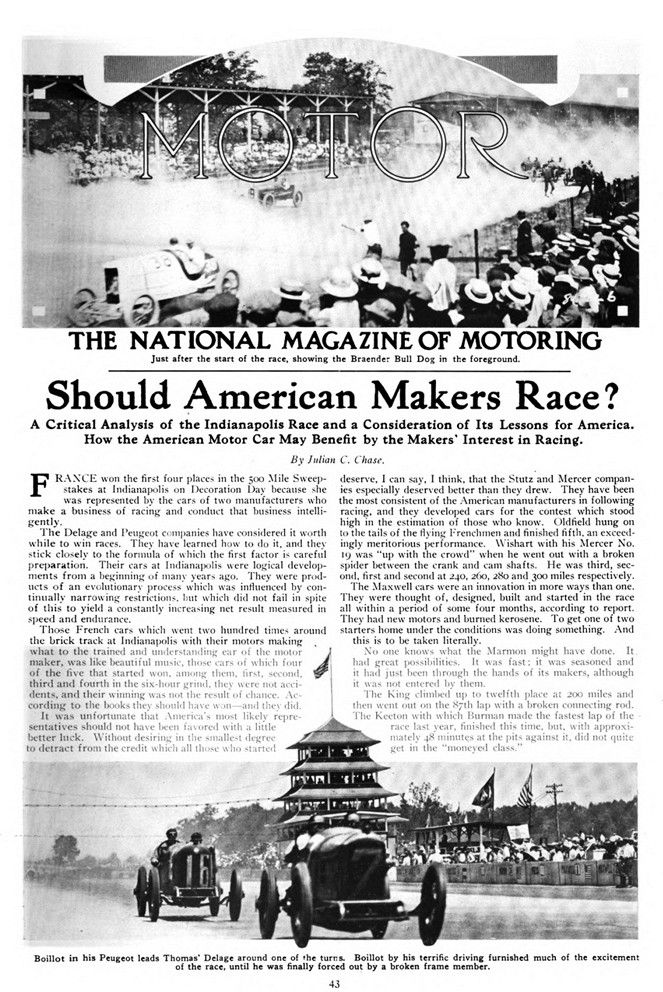
FRANCE won the first four places in the 500 Mile Sweep- stakes at Indianapolis on Decoration Day because she was represented by the cars of two manufacturers who make a business of racing and conduct that business intelligently.
The Delage and Peugeot companies have considered it worthwhile to win races. They have learned how to do it, and they stick closely to the formula of which the first factor is careful preparation. Their cars at Indianapolis were logical developments from a beginning of many years ago. They were products of an evolutionary process which was influenced by continually narrowing restrictions, but which did not fail in spite of this to yield a constantly increasing net result measured in speed and endurance.
Those French cars which went two hundred times around the brick track at Indianapolis with their motors making what to the trained and understanding ear of the motor maker, was like beautiful music, those cars of which four of the five that started won, among them, first, second, third and fourth in the six-hour grind, they were not accidents, and their winning was not the result of chance. According to the books they should have won – and they did.
It was unfortunate that America’s most likely representatives should not have been favored with a little better luck. Without desiring in the smallest degree to detract from the credit which all those who started, deserve, I can say, I think, that the Stutz and Mercer companies especially deserved better than they drew. They have been the most consistent of the American manufacturers in following racing, and they developed cars for the contest which stood high in the estimation of those who know. Oldfield hung on to the tails of the flying Frenchmen and finished fifth, an exceedingly meritorious performance. Wishart with his Mercer No. 19 was “up with the crowd” when he went out with a broken spider between the crank and cam shafts. He was third, second, first and second at 240, 260, 280 and 300 miles respectively.
The Maxwell cars were an innovation in more ways than one. They were thought of, designed, built and started in the race all within a period of some four months, according to report. They had new motors and burned kerosene. To get one of two starters home under the conditions was doing something. And this is to be taken literally.
No one knows what the Marmon might have done. It. had great possibilities. It was fast; it was seasoned and it had just been through the hands of its makers, although it was not entered by them.
The King climbed up to twelfth place at 200 miles and then went out on the 87th lap with a broken connecting rod. The Keeton with which Burman made the fastest lap of the race last year, finished this time, but, with approximately 48 minutes at the pits against it, did not quite get in the “moneyed class”
The 1914 International Sweepstakes undoubtedly held a significant lesson for American motor car manufacturers. Authorities will differ as to exactly what the lesson was, but I believe that the American maker will be wrong if he holds merely that it is one of a French triumph to be wiped out next year. If it teaches him, on the other hand, to accept the Indianapolis Speedway as a great laboratory, a test room for the working out of engineering problems, then the race will not have been run in vain, from our point of view. In the last analysis the value of such a contest as the one in question, is that it adds the stimulus of competition to the solution of engineering problems. It furnishes the test of strength and weakness in comparatively narrow space and in doing so concentrates the attention of builders on those very points. There was a time when racing was considered an important part of almost every maker’s business. Then came a time when racing wasn’t needed either for the lessons it taught or for the advertising it brought. The makers dropped it – all except a few who still saw something in it for them. Now the question arises as to whether things have Swung around in such a way that racing can be made of use again. Racing, undoubtedly through their own or through the experience of others, did much to help manufacturers produce the reliable car when reliability was still something to be attained. Can not racing now teach us how to get economy?
I raise this issue in what is ostensibly some sort of an account of what happened at Indianapolis because next year the race there will be run on slightly different lines and to win it a maker must show that he can not only produce speed, but that he can do so economically. The piston displacement limit will be 300 cubic inches instead of 450. It is announced that this limit will stand for three years and then be lowered again.
The Frenchmen have learned a lot from restricted racing and in the coming Grand Prix, in which at least as high speeds as ever before attained will undoubtedly be made, the piston displacement limit is lower than the new figure for Indianapolis. And getting back to preparation again it may be said parenthetically that the Delage and Peugeot cars for the Grand Prix have been on the road for two months now and the race is to be held next month. Whether measured in miles per gallon or gallons per passenger miles, it is believed to be true that the economy of the average French car is much greater than that of the average American product. The American people are demanding economical operation with greater persistency and in greater numbers. American manufacturers will eventually give it to them. Won’t racing help?
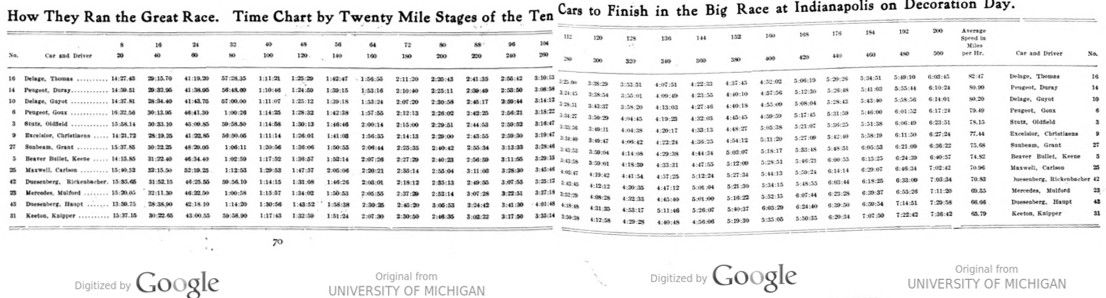
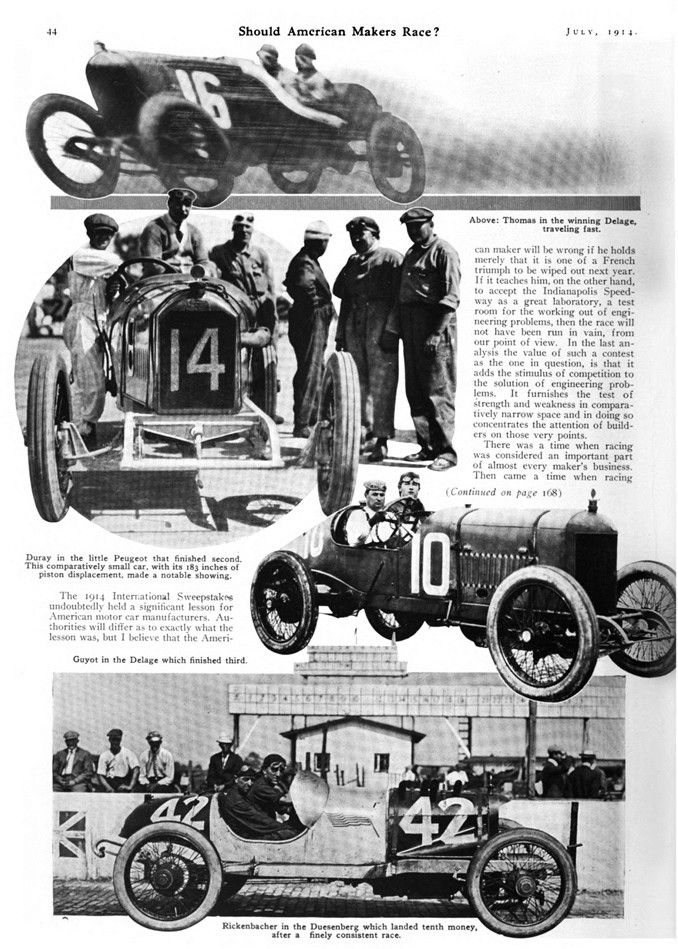
Everyone knows that Thomas with his Delage No. 16 won the Sweepstakes of 1914 and in doing so set up a new record of 82.47 miles per hour. Everyone knows that Duray with the little Peugeot No. 14 came in second, and everyone could figure out that the first four cars-all French-completed the 500 miles at a higher rate of speed than had ever been attained in this contest before.
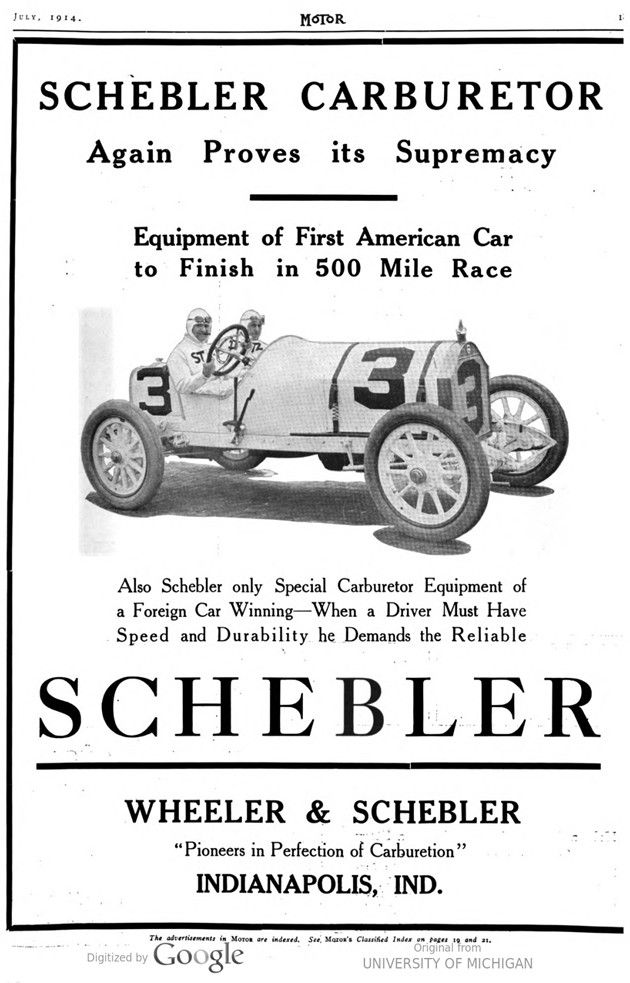
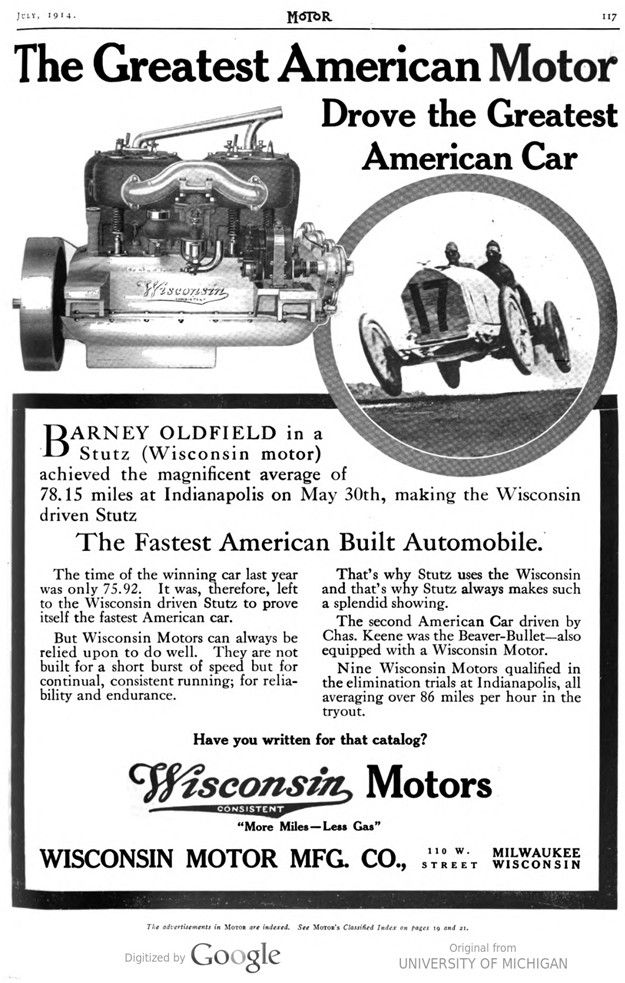
Everyone knows that Barney Oldfield with his Stutz No. 3 was the first American to finish.
Goux, winner of the race in 1913 and fourth finisher in this year’s event, had more trouble with tires than any other of the first five winners, but if all of his pit stops had been taken from his elapsed time, he would still have been in the trail of Rene Thomas.
On other pages of this issue will be found a table giving the elapsed time by 20-mile stages of all of the winners and an itemization of the equipment used. Below is given a list of those who qualified for the race in the elimination trials and the speeds which they made:
No. Cars Nationality Driver Lap Speed
7 Peugeot French Boillot 1:30:13 99.85
6 Peugeot French Goux 1:31:71 98
8 Maxwell American Tetzlaff 1:33:40 96.75
16 Delage French Thomas 1:35:20 94.75
26 Marmon American Dawson 1:36:20 94
25 Maxwell American Carlson 1:36:60 93.5
21 Mercer American Bragg 1:36:80 93.25
19 Mercer American Wishart 1:37:10 92.25
9 Excelsior Belgian Christiaens 1:38:67 91.5
4 Gray Fox American Wilcox 1:39:16 91.1
24 Stutz American Anderson 1:39:46 90.75
17 Burman American Burman 1:39:55 90.55
14 Peugeot French Duray 1:40 90
31 Keeton American Knipper 1:40:48 89.75
43 Duesenberg American Haupt 1:40:68 89.5
10 Delage French Guyot 1:40:95 89.1
12 Sunbeam English Chassagne 1:41:91 88.4
23 Mercedes German Mulford 1:42:03 88.25
42 Duesenberg American Rickenbacker 1:42:11 88.1
18 Mercedes German DePalma 1:42:12 88.1
2 Stutz American Cooper 1:42:25 88
48 Ray American Brock 1:42:47 87.75
34 Bugatti German Friedrich 1:42:59 87.65
38 Braender American Chandler 1:42:81 87.5
3 Stutz American Oldfield 1:43:15 87.1
13 Mason American Mason 1:43:22 87
5 Beaver American Keene 1:43:60 86.75
15 King American Klein 1:43:60 86.75
15 Burman American Disbrow 1:43:70 86.7
27 Sunbeam English Grant 1:44:09 86.4
Photo captions.
Page 43
Just after the start of the race, showing the Braender Bull Dog in the foreground.
Boillot in his Peugeot leads Thomas’ Delage around one of the turns. Boillot by his terrific driving furnished much of the excitement of the race, until he was finally forced out by a broken frame member.
Page 44
Above: Thomas in the winning Delage, traveling fast. Duray in the little Peugeot that finished second. This comparatively small car, with its 183 inches of piston displacement, made a notable showing.
Guyot in the Delage which finished third.
Rickenbacher in the Duesenberg which landed tenth money, after a finely consistent race.
Page 45
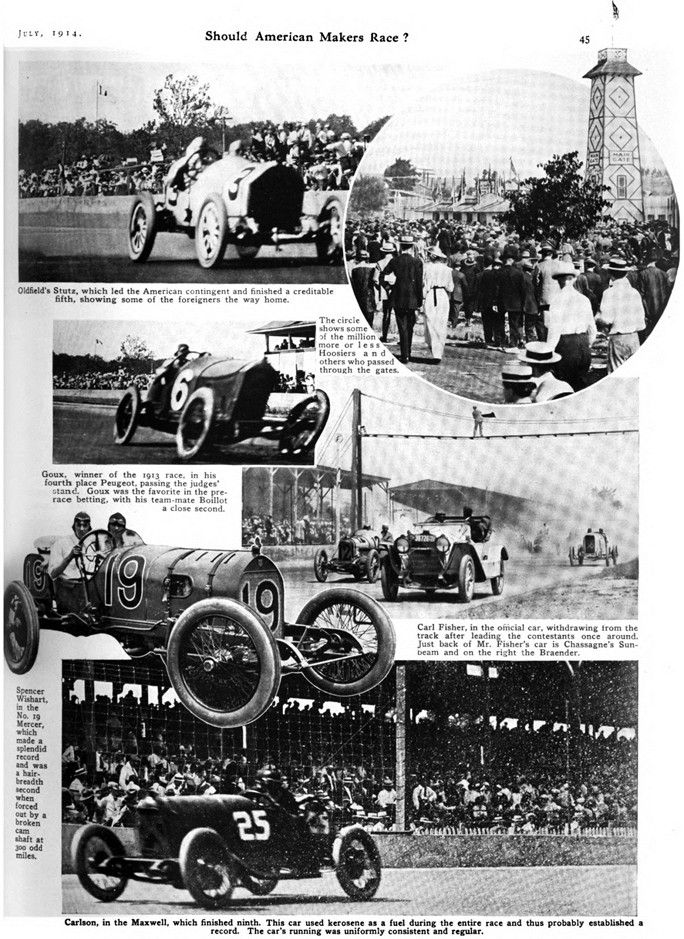
Oldfield’s Stutz, which led the American contingent and finished a creditable fifth, showing some of the foreigners the way home.
Goux, winner of the 1913 race, in his fourth place Peugeot, passing the judges’ stand. Goux was the favorite in the pre-race betting, with his team-mate Boillot a close second.
The circle shows some of the million more or less Hoosiers and others who passed through the gates.
Carl Fisher, in the official car, withdrawing from the track after leading the contestants once around. Just back of Mr. Fisher’s car is Chassagne’s Sunbeam and on the right the Braender.
Spencer Wishart, in the No. 19 Mercer, which made a splendid record and was a hairbreadth second when forced out by a broken cam shaft at 300 odd miles. Carlson, in the Maxwell, which finished ninth. This car used kerosene as a fuel during the entire race and thus probably established a record. The car’s running was uniformly consistent and regular.