IThe first day of the complete event, July 19th 1894, saw the first of three elimination events. It must have been quite an astonishing view for inhabitants of the towns and villages, that the sans-chevaux’s were traveling through. All kinds of festivities were organised the welcome the new era of transport and „locomotion“. Out of 102 original paid registrations, the vast majority of conceptual or unbuilt designs failed to appear. In all, some 17 vehicles started these first elimination trials in five groups. The organisers established five different radial test loops of about 50 km heading outward from Paris, so as to limit the number of competitors on each route. At the end of this first elimination day, 13 vehicles qualified for the „grand concours“. (Translation separately).
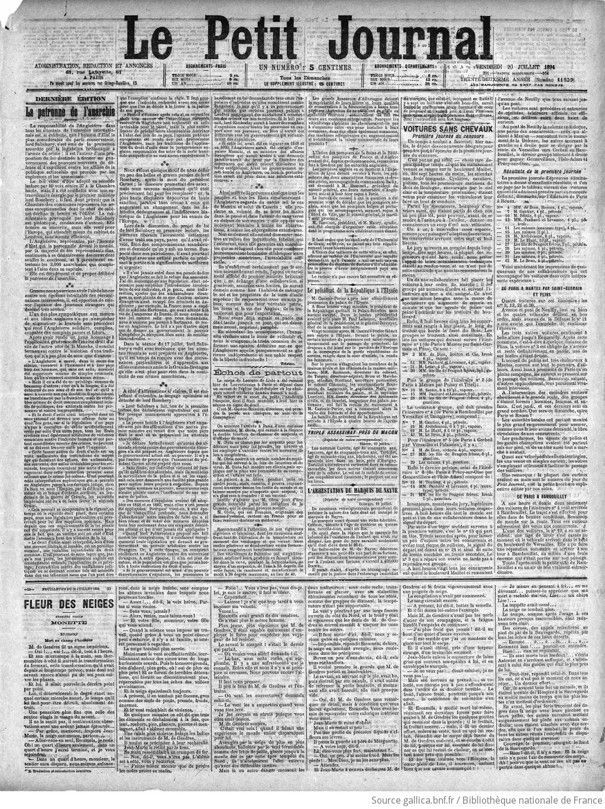
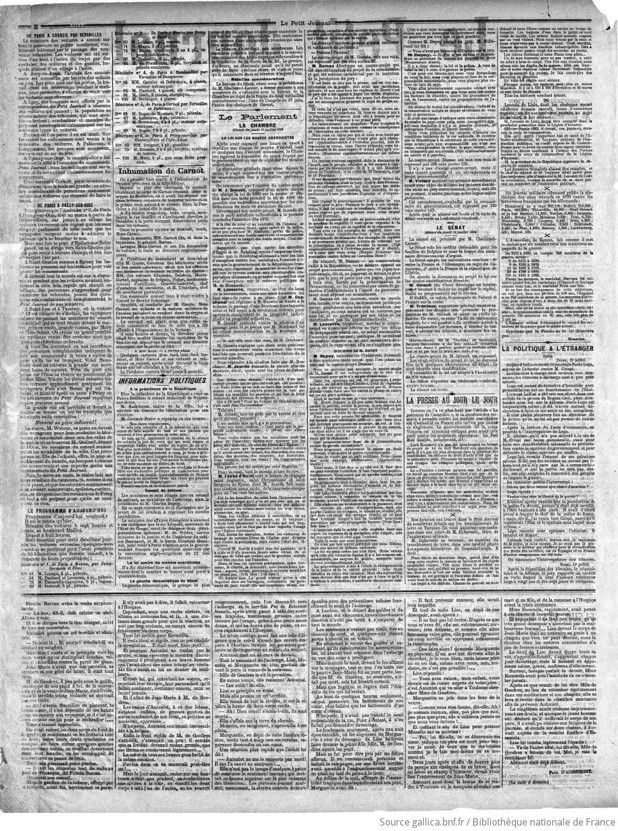
By courtesy of the Bibliothèque national français, gallica.bnf.fr/ https://www.bnf.fr/fr
Text and photos compiled by motorracinghistory.com, translation by DeepL deepl.com
Le Petit Journal, Vol. 32, No. 11529, July 20, 1894
HORSELESS CARRIAGES – First Day of the Competition
Perfect weather yesterday morning set the stage for the start of the competitors selected to take part in the first day’s event.
Under bright sunshine—a rare sight of late—the carriages lined up on Boulevard Maillot, where a dense crowd had been waiting for them since seven o’clock in the morning. Cyclists, horseback riders, pedestrians—all the early morning strollers in the Bois de Boulogne, encouraged by the clear skies and spring-like temperatures—had come to examine the vehicles and take them for a short test drive.
Among the spectators were also many workers who had left home a little earlier so that, before heading to the factory or workshop, they could take a connoisseur’s look at the vehicles.
One by one, at fairly spaced intervals, as if to spare the curiosity of onlookers, the competitors arrived between seven and eight o’clock.
The judging panel had been assembled for quite some time. By seven o’clock, most of the engineers who had kindly offered us the support of their technical expertise were already present, and we cannot thank them enough for their punctuality.
One of our staff members had the cars arranged in their starting order; he grouped them by serial number and according to the route assigned to them. This is no small task, given the crowd of spectators growing by the minute, which the police officers are struggling to contain on the boulevard’s sidewalks.
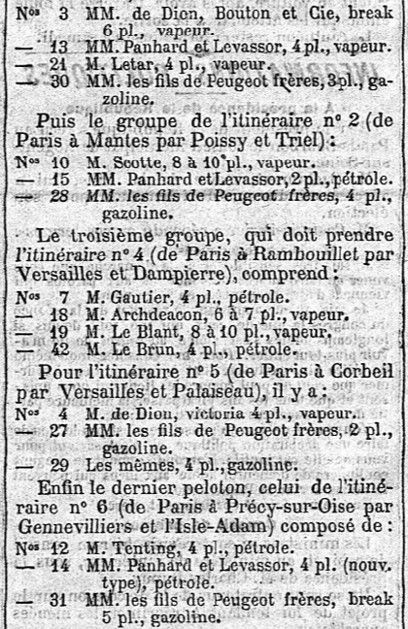
Finally, at 8:05 a.m., all the competitors are lined up in their places along the sidewalk bordering the Bois ditch. The groups are thus formed. Leading the way are the cars that are to follow Route No. 1 (from Paris to Mantes via Saint-Germain and Flins).
They are:
No. 3: Messrs. de Dion, Bouton & Co., 6-passenger station wagon, steam.
— 13: Messrs. Panhard and Levassor, 4-passenger, steam.
— No. 21: Mr. Letar, 4-seater, steam.
— No. 30: The Sons of Peugeot Brothers, 3-seater, gasoline.
Next, the group for Route No. 2 (from Paris to Mantes via Poissy and Triel):
No. 10: Mr. Scotte, 8–10-seater, steam.
—- No. 15, Messrs. Panhard and Levassor, 2-passenger, gasoline.
—- No. 28, Messrs. the sons of the Peugeot brothers, 4-passenger, gasoline.
The third group, which is to take Route No. 4 (from Paris to Rambouillet via Versailles and Dampierre), includes:
No. 7 Mr. Gautier, 4-passenger, gasoline.
—- 18 Mr. Archdeacon, 6–7-passenger, steam.
—- 19 Mr. Le Blant, 8–10-passenger, steam.
—- 42 Mr. Le Brun, 4-passenger, gasoline.
For Route No. 5 (from Paris to Corbeil via Versailles and Palaiseau), the following are listed:
Nos. 4 Mr. de Dion, 4-seater victoria, steam.
— 27 The Peugeot brothers’ sons, 2-seater, gasoline.
— 29 The same, 4-seater, gasoline.
Finally, the last group, that of Route No. 6 (from Paris to Précy-sur-Oise via Gennevilliers and l’Isle-Adam), consists of:
Nos. 12 Mr. Tenting, 4-seater, gasoline.
—- 14 Messrs. Panhard and Levassor, 4-seater (new model), gasoline.
—- No. 31: The sons of the Peugeot brothers, 5-passenger station wagon, gasoline.
Inventors, jury members, and engineers take their seats in their respective cars. At 8:10 a.m., everyone is ready, and one of our staff members gives the starting signal. Due to a minor accident involving the first car, No. 13 takes the lead. Thirty seconds later, to allow some space between the competitors and avoid any risk of collision, the starting signal is given to No. 21, and so on at thirty-second intervals. No. 3, having repaired its damage, soon rejoins its group.
At 8:20 a.m., all competitors have left Boulevard Maillot and are heading up Avenue de Neuilly, which everyone follows all the way to the bridge. The cars are preceded and flanked by cyclists—official or unofficial scouts—and pass between two lines of onlookers.
At the Neuilly Bridge, the column breaks up: some of the competitors—those headed for Mantes—head back toward the La Défense monument, while others turn left or right to take the Route de Versailles toward Corbeil or Rambouillet, and the last group turns right toward Gennevilliers, L’Isle-Adam, and Précy-sur-Oise.
——————————-
Results from the First Day
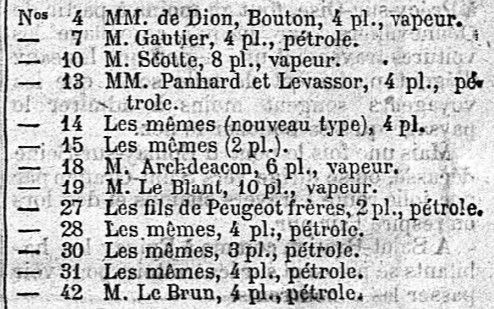
The first day of qualifying rounds yielded excellent results, as shown in the following table of the cars that qualified to compete in the final race on Sunday on the route from Paris to Rouen.
No. 4: Messrs. de Dion and Bouton, 4-seater, steam.
— 7: Mr. Gautier, 4-seater, gasoline.
— 10: Mr. Scotte, 8-seater, steam.
— 13: Messrs. Panhard and Levassor, 4-seater, gasoline.
— 14 The same (new model), 4-seater.
— 15 The same (2-seater).
— 18 Mr. Archdeacon, 6-seater, steam.
— 19 Mr. Le Blant, 10-seater, steam.
— 27 The sons of Peugeot Brothers, 2-seater, gasoline.
— 28 The same, 4-seater, gasoline.
— 30 The same, 3-seater, gasoline.
— 31 The same, 4-seater, gasoline.
— 42 Mr. Le Brun, 4-seater, gasoline.
Here are the impressions of some of our staff members who accompanied the cars on this interesting test drive:
FROM PARIS TO MANTES VIA SAINT-GERMAIN AND FLINS
Four cars on this route: Nos. 3, 13, 21, and 30.
On Avenue de Neuilly and the Neuilly Bridge, everything is going smoothly, and the four vehicles are proceeding in good order, but on Avenue de la Défense, No. 21 suffers a breakdown that prevents it from continuing the race. The other three cars continue at a brisk pace to Ecquevilly. After passing through that town—that is, some distance from Flins—car No. 3 is forced to stop and breaks down completely, as one of its connecting rods has snapped.
The public gave a very warm welcome in Mantes, as they did along the entire route. Both near Paris and out in the countryside, onlookers crowded the roadside as the cars passed. Many waved, others applauded; all seemed deeply interested. At the junctions of even the smallest paths leading to the main road, groups had formed: men, women, and children. It is Thursday, and there are large crowds. What will it be like on Sunday, between Paris and Rouen?
Local authorities everywhere have shown the greatest willingness to ensure, as we had requested, the free passage of our competitors. Gendarmes, police officers, and rural constables had been deployed everywhere, and in this regard, too, everything went according to plan.
As for the cyclists, they were legion—some had come simply out of curiosity, while others were helping to facilitate the passage of the cars.
One observation: most of the onlookers were holding either that day’s issue of the Petit Journal or the small explanatory brochure we had published.
————————————-
FROM PARIS TO RAMBOUILLET
At just a little past 1:30, two of the cars on Route No. 4 arrived in Rambouillet. The journey had gone smoothly for them. There were large crowds along the road. All these onlookers were cheering on the competitors.
One of the cars, No. 19, had an accident: a drawer rod broke just as the vehicle was reaching the top of Boulevard de Versailles. The crew was able to make a quick repair and, in turn, reach Rambouillet amid a huge crowd that had gathered along its route.
All afternoon, the small town of Rambouillet had a truly extraordinary festive atmosphere.
————————————————
FROM PARIS TO CORBEIL VIA VERSAILLES
The aircar race drew large crowds along the entire route, who were clearly interested in watching the new vehicles pass by. The cars were followed the entire way by cyclists, other cars, and children, who traveled from one village to the next.
In Jouy-en-Josas, the competitors’ arrival was greeted by the shouts of joyful children. People were standing in their doorways—work had been suspended for the morning to allow everyone to come see the horseless carriages.
In Igny, the correspondent for the Petit Journal presented bouquets to each passing car; the crowd gathered around the vehicles, which stopped for a moment; the driver and a member of the jury were questioned in detail about the new car models.
It was the same everywhere the procession passed. Along the roads, farmers came out to meet the cars.
In Palaiseau and Longjumeau, large crowds have gathered, and the streets have a festive atmosphere.
In Epinay-sur-Orge, the city has decked out the town in celebration of the Petit Journal competition; all the residents are lining the streets and warmly welcoming the competitors.
It is especially in Corbeil, the final stop on the route, that the crowd is largest; a considerable number of people are gathered around the cars that have just completed the journey.
—————————————
FROM PARIS TO PRÈCY-SUR-OISE
Route No. 6, from Paris to Précy-sur-Oise, is very picturesque—at least from Gennevilliers onward—because up to that village, cars pass through a region so heavily perfumed by sewage that travelers are less inclined to admire the scenery than to hold their noses.
But once past the bridge at Epinay-sur-Seine, the route heads toward Saint-Gratien along a lovely road through the fields, and from then on, one breathes in the fresh air.
In Saint-Gratien, as in Epinay, residents crowd the sidewalks to watch the competitors pass by.
In Ermont, everyone is on the road, and as the cars slowly climb the steep hill leading to the village, people approach to examine the vehicles, ask the drivers questions, and compliment the Petit Journal on its initiative.
In Saint-Leu and Taverny, where car No. 12 is forced to stop, the passengers wave as they pass the members of the town council who have gathered in front of City Hall, then continue on at high speed through Mery and L’Isle-Adam. We pass a large number of cyclists from the surrounding area as well as a few local residents in station wagons. At every turn or intersection, helpful people signal the route to the competitors from a distance, lest they take a wrong turn. Here is Beaumont, where we cross the main street between two lines of onlookers. Near the bridge over the Oise River stands a girls’ boarding school. All the students, gathered on a terrace, cheer the travelers warmly. Next, we pass through Boran, and soon after we enter Précy, where the competitors from *Le Petit Journal* receive the warmest welcome.
The main street is decked with flags, and in front of city hall stands a triumphal arch topped by the inscription: Honor to industrial genius!
The mayor, Mr. Wateau, steps forward to welcome the travelers and leads them into one of the town hall’s rooms, where Mr. Gaillard, the deputy for the Oise department, the members of the city council, and the town’s dignitaries are waiting. A young woman, the deputy mayor’s daughter, most graciously presents a bouquet to each of the competitors and a magnificent wreath to the representatives of the Petit Journal.
Then, glass in hand, the mayor proposes a toast to the competition’s success, and, since it is past noon and stomachs are starting to growl, competitors, cyclists, onlookers, and others head toward the restaurants in Précy, where everything has been prepared to ensure they lack for nothing.
——————————–
TODAY’S SCHEDULE
Today’s schedule (Friday): It is the same as yesterday’s.
Cars will meet at 7:30 a.m. on Maillot Boulevard.
Departure at 8:00 a.m.
The following cars are registered for this second day (though some will not depart for the preliminary 50-kilometer test until tomorrow, Saturday, at their owners’ request):
Route No. 1, from Paris to Mantes, via Saint-Germain and Flins:
No. 51 Mr. Lepape, 4-seater, gasoline.
—- No. 64, Mr. Panhard and Levassor, 4-seater, gasoline.
—- No. 72, Mr. Tamarelle-Capeyron, 5-seater, steam.
—- No. 88, Mr. Jentaud, 5-seater, gasoline.
Route No. 2. — From Paris to Mantes via Poissy and Triet:
Nos. 60 Mr. Leblanc, 9-seater, steam.
—- 71 Mr. Klaus, 2-seater, gasoline.
—- 74 Mr. Meyer, 2- or 4-seater quadricycle, combined steam and gasoline.
—- No. 99 Mr. Bonnefils, 2-seater, gasoline.
—- No. 44 Mr. de Pradières, 6-seater, combined Serpollet and gasoline.
Route No. 4, from Paris to Rambouillet via Versailles and Dampierre.
Nos. 68 Messrs. Garnier and Delarmoix, 4-seater, internal combustion engine.
—- 84 Mr. Plantard, 4-seater, compressed air.
—- 91 Mr. Carli, 2-seater, electric.
—- 100 Mr. Bellanger, 4-seater.
Route No. 5, from Paris to Corbeil via Versailles and Palaiseau:
Nos. 61 Mr. Roger de Montais, 2-seater, gasoline.
—- 67 Mr. Lebesque, 4-seater, gasoline.
—- 77 Mr. Reverseau, 4–6-seater, automatic engine.
—- 85 Mr. Roger, 2–4-seater, gasoline.
Route No. 6, from Paris to Précy-sur-Oise via Gennevilliers and l’Isle-Adam:
Nos. 65 Messrs. Peugeot, 4-seater, gasoline.
—- 75 Mr. Dessaux, 2–4-seater, tricycle, lever system.
—- 101 Mr. Mary, 4-seater, high-pressure gas.