June 2026: Additional comment to be written still.

With permission of hathitrust hathitrust.org == Text and fotos compiled by motorracinghistory motorracinghistory.com
MOTOR WORLD Vol. XXXIII 33, No. 2, October 2, 1912
CONSISTENCY NETS BRAGG THE GRAND PRIZE
Covers the 410-Mile Hay-Protected Course in 359 Minutes – De Palma, Always a Dangerous Contender, Again Victim of Misfortune – Roberts and Endicott Take Minor Events.
It is a far cry from the baled cotton which played such an important part at the battle of New Orleans, nearly 100 years ago, to the baled hay which constituted a not inconspicuous and not invaluable feature of the Grand Prize and other races which marked the Milwaukee speed carnival which was brought to a close on Saturday last, 5th inst., when the Grand Prize was gathered in by Caleb Bragg, driving a Fiat. The baled cotton and the baled hay, however, were utilized for the same purpose to save American lives.
Hay as a preserver of life and limb luring automobile races first was employed during the Elgin speed carnival in August last, but it remained for Milwaukee to put race on to its fullest use. It formed the “breast-works” on all turns of the somewhat treacherous course and served alike to preserve spectators and competitors, forming a most efficient bumper. It did not avail to save Ralph De Palma, who won the Vanderbilt Cup the previous Wednesday, but it saved Louis Fontain, who twice ran wild when rounding two of the treacherous turns and charged full tilt to the baled hay. He somewhat mussed the hay, but his life and his limbs were preserved and his car escaped with little damage, as did the spectators and the Wisconsin militiamen who were on duty there.
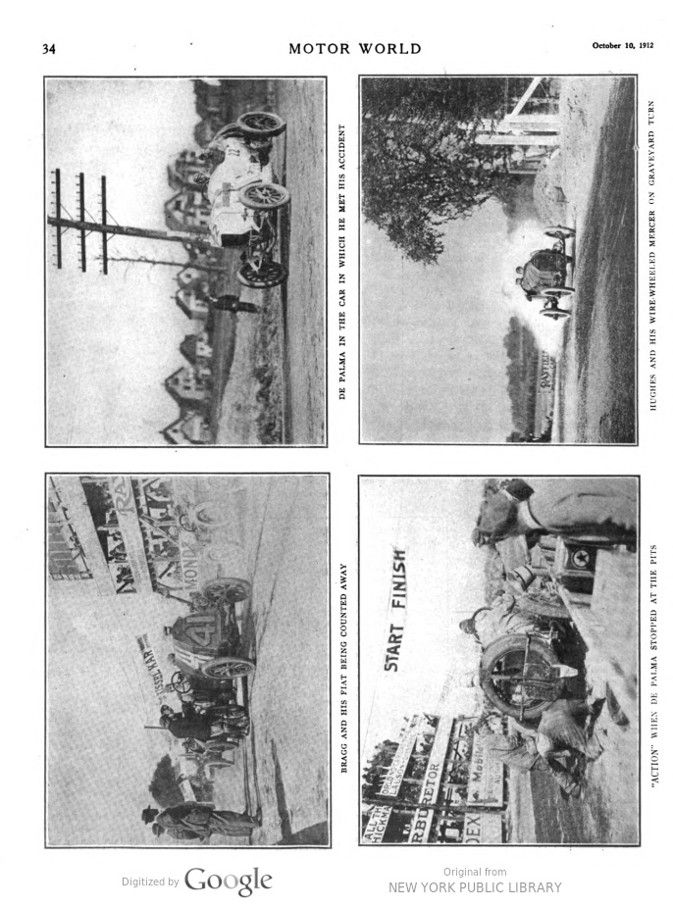
De Palma sustained his accident on a comparatively straight stretch of the bumpy and undulating course. On the very last lap, when he endeavored to pass Bragg, the road proved too narrow, and in consequence he grazed Caleb Bragg’s Fiat and flew the course with disastrous results. His car overturned and both driver and mechanician were badly injured. De Palma suffered a broken leg and a wound in the abdomen, which latter promised sad results but which, at last accounts, it was believed happily had been averted. His mechanician was less seriously hurt, bruises and a severe shaking up being his portion.
SUMMARY OF RESULTS MILWAUKEE SPEED CARNIVAL.
Wednesday, October 2d For the Vanderbilt Cup, 299.5 Miles.
1. Ralph De Palma (Mercedes)… 4:20:31.54
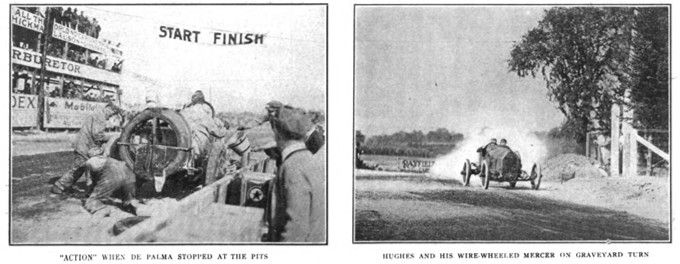
2. Hughie Hughes (Mercer)… 4:21:14.34
3. Spencer Wishart (Mercedes)… 4:36:37.75
Friday, October 4th For the Pabst Trophy, 220.6 Miles.
1. M. Roberts (Mason)… 3:45:08
2. H. L. Hastings (Fal)… 4:15:05
Friday, October 4th For the Wisconsin Challenge Trophy, 173.5 Miles.
1. Harry Endicott (Mason)… 3:05:44
2. George Mason (Mason)… 3:42:40
Saturday, October 5th For the Grand Prize, 409.9 Miles.
1. Caleb Bragg (Fiat)… 5:59:27.49
2. Erwin Bergdoll (Benz)…. 6:14:58.38
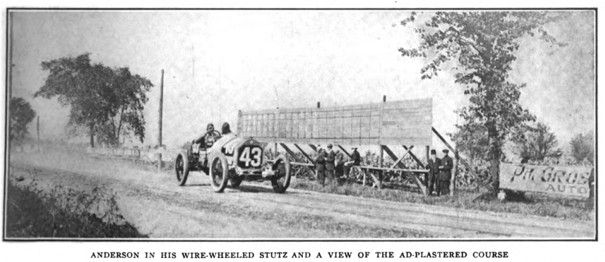
3. Gil Anderson (Stutz)… 6:15:22.47.
Caleb Bragg won the Grand Prize handily. He covered the 409.76 miles, which represent 52 circuits of the 7.88-mile course, in 5:59:27.49, or at an average of 68.45 miles an hour. Second place went to Erwin Bergdoll, who brought the Benz car over the tape 15.31 minutes later; third and fourth places went to Gil Anderson (Stutz) and Barney Oldfield (Fiat), respectively. Anderson finished less than a minute later than Bergdoll, while an interval of four minutes separated Oldfield from the Stutz pilot. George Clark (Mercedes) and Robert Burman, who took Joe Horan’s place in the Benz, were flagged while on their 49th and 48th laps, respectively.
As for the smaller car races for the Pabst and Wisconsin trophies, which were run on Thursday last, 3d inst., and which went for 220.64 and 173.36 miles, respectively, Mortimer Roberts took the longer of the two, covering the 28 laps in a Mason car in 3:45:08, and Harry Endicott, also in a Mason, took the other in 3:06:44. Roberts’s average was 58.8 miles an hour; Endicott averaged 55.6 miles an hour for the 22 laps. Second place in the contest for the Pabst trophy went to Hastings (Fal), who finished in 4:15:04, and third money, although darkness prevented his finishing, to Chandler, also in a Fal car. Endicott’s victory was in a measure a hollow one, for he finished over half an hour ahead of the only other contender, George Mason, his team mate, who completed the distance.
Entries in the smaller car events were not numerous. When, after delays occasioned by wet weather, which made the none too good course even more dangerous, the races were started at 1:30 p. m., but eight were lined up to contend for the Pabst trophy, and three only started in the smaller car event, Frank Kulick (Ford) having dropped out because of ill health, and John Heber (Studebaker 30) failing to put in an appearance.
Joe Nikrent (Case), J. Rooney (Bergdoll), Spencer Wishart (Mercer), H. Hartings (Fal), M. Roberts (Mason), and Ed. Pullen (Mercer), Chandler (Fal), and Hughie Hughes (Mercer) started in the Pabst event in the order named. Hughes early assumed the lead and held it until he was forced to retire during the 22nd lap with a broken differential pinion. Pullen, who had held second place as consistently as Hughes had clung to the leading position, assumed the lead when Hughes retired. His triumph was short lived, however, for he too was forced to retire during the 24th lap with transmission trouble. Roberts, who had trailed along after the two Mercer drivers throughout the major portion of the race, fell heir to the premier position and was not displaced throughout the remaining four laps. Spencer Wishart (Mercer) had been retired during the third lap with a broken crankshaft and a broken connecting rod had done similar duty for Rooney (Bergdoll) on his fifth lap. Joe Nikrent (Case) completed seven circuits, when he too was forced to quit with motor trouble. Hastings had had very little trouble and drove a consistent but slow race. Chandler had about decided to retire when the announcement of the retirement of Hughes and Pullen opened the way for him to collect the “small change,” provided he finished. He limped around the course at a 20 mile an hour pace and still was limping when darkness intervened, and those in charge decided to give him third place, although he had completed but 22 laps.
Endicott had it all his own way throughout the contest for the Wisconsin trophy. He took the lead during the first round of the course and held it to the end. Snyder (Mason), the only other contender besides Endicott and George Mason, quit on the second lap with a frozen clutch. So great was Endicott’s lead over Mason after Synder’s retirement that he had time to stop at the pit and smoke a cigarette before resuming his course.
Loafing did not characterize the running of the Grand Prize race. Sharply at 10:30 on Saturday morning the starting bomb was fired, and Burman led off in the Benz. He was followed at half-minute intervals by Fontain (Lozier), Tetzlaff (Fiat), Hughes (Mercer), De Palma (Mercedes), Wishart (Mercedes), Clark (Mercedes), Bergdoll (Benz), Horan (Benz), Anderson (Stutz), Oldfield (Fiat). Tetzlaff immediately set up a terrific pace, passed Fontaine on the first lap and completing the circuit in 6:20, he assumed the lead, which he held for 80 miles. Burman held second place throughout the second lap, but was forced to retire with a broken piston. Bragg then went up and was running 14 seconds behind the leader. The other ten contenders were strung out, with De Palma running third and Fontain (Lozier) in fourth place.
The end of the sixth lap saw Tetzlaff and Bragg in the same relative positions. Bergdoll had nosed out De Palma for third place and Anderson was running fourth. The others were strung out in the following order: Fontain (Lozier), Horan (Benz), Oldfield (Fiat), Clark (Mercedes), Hughes (Mercer). Spencer Wishart had been forced to retire while on his fifth round by a broken crankshaft.
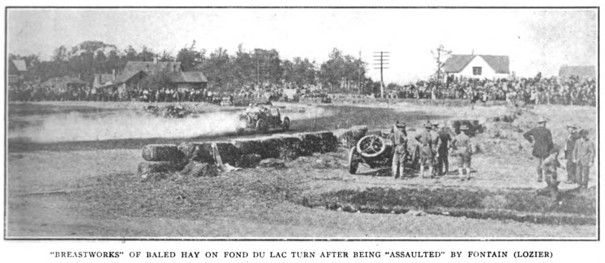
Tetzlaff maintained his pace and increased his lead over Bragg. At the end of the eighth lap, when 63.04 miles had been reeled off, he was 42 seconds ahead of his most formidable rival. It was on this lap that Fontain swerved into the hay bunkers which protected the curve at Fond du Lac. Happily no serious damage was done, and after passing through the straw wall the driver piloted the car back onto the course and proceeded. The delay cost him his position, however, and he fell back to eighth place.
Forty seconds taken for a tire replacement at the end of the tenth lap cost Tetzlaff first place; it was then that Bragg went to the front and completed the 11th lap eight seconds ahead of Tetzlaff. Bragg did not long hold the position. The 12th lap saw Tetzlaff again at the head of the field with a lead over Bragg of 32 seconds. From this point until Tetzlaff finally was forced out of the race by a broken piston on his 30th round of the circuit, it was a case of see-saw between the two Fiat pilots. Bragg showed up in front at the end of the 14th lap, but was again passed in the 15th. Again in the 17th lap Bragg took advantage of Tetzlaff’s stop for tire and fuel replacement and forged ahead and held the lead until half of the distance had been covered. At the end of the 26th lap, however, Tetzlaff again was leading the field.
When half of the 410 miles had been completed the contenders were running in the following order:
Tetzlaff (Fiat) Bragg (Fiat) De Palma (Mercedes) Bergdoll (Benz) Oldfield (Fiat) Anderson (Stutz) Horan (Benz) Clark (Mercedes) Fontain (Lozier) Hughes (Mercer).
Fontain broke a steering knuckle during the 29th circuit, due to the strain which had been placed upon the member when he went through the straw barrier for a second time during the 20th lap, and was forced out of the contest; Hughes also retired with motor trouble.
Tetzlaff pulled away from Bragg and was leading by over three minutes at the end of the 30th lap, but the end of the 31st saw him pull up at the pits with a cracked piston, which forced him down and out. Bragg then assumed the lead and never was headed. At the end of the 33rd lap he had increased his lead over De Palma, who, in turn, had widened the gap between Bergdoll and himself to 7 minutes. Anderson, Oldfield, Clark and Horan were strung out in the order named. Burman replaced Horan at the wheel of the Benz at the end of the 32nd lap.
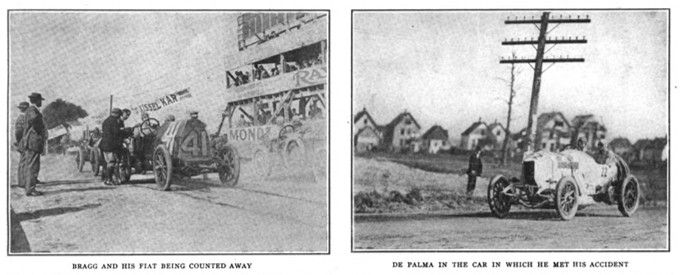
Anderson ran into third place during the 37th lap and see-sawed for the position with Bergdoll until the end of the 44th lap, when he finally nosed out the Benz driver and took the place “for keeps.” Bragg had in the meantime been increasing his lead over De Palma until the interval separating them was over 6 minutes. De Palma increased his speed considerably during the 48th lap, however, in a final effort to gather the laurels. At the end of the 51st lap, when Bragg had received the green flag denoting the beginning of the last lap, De Palma had cut down the lead of the Fiat driver to 2 minutes 20 seconds, and throwing all caution to the winds, the plucky Italian “let out” on the last lap and, overtaking Bragg at a point of the road which really was too narrow for two machines to pass, misjudged the distance, touched the Fiat car and spilled all over the road. Fortunately both De Palma and his mechanician were thrown clear of the car as it turned several rapid somersaults before it finally brought up at the roadside. De Palma, however, was seriously injured. He received, besides a broken leg – the same limb which was injured at Danbury, Conn., in 1910 — a wound in the abdomen which aroused grave fears. His mechanician escaped with a few cuts and bruises and a very severe shaking up. Bragg went on and, receiving the checkered flag, reported the accident to the officials.
Considering the condition of the course, which was bumpy and trying and too narrow on the straight aways, Bragg’s time of 5 hours 59 minutes 27.49 seconds, although by no means record breaking, was fast. Fortunately, balmy weather prevailed, so that the surface of the course was at its best, which, as before stated, was far from perfect.
The fastest lap of the day – and, indeed, the fastest lap on the newly constructed course – was made by Tetzlaff, who completed his 26th lap in 6 minutes and 8.3 seconds, or at a rate of 77.2 miles an hour.
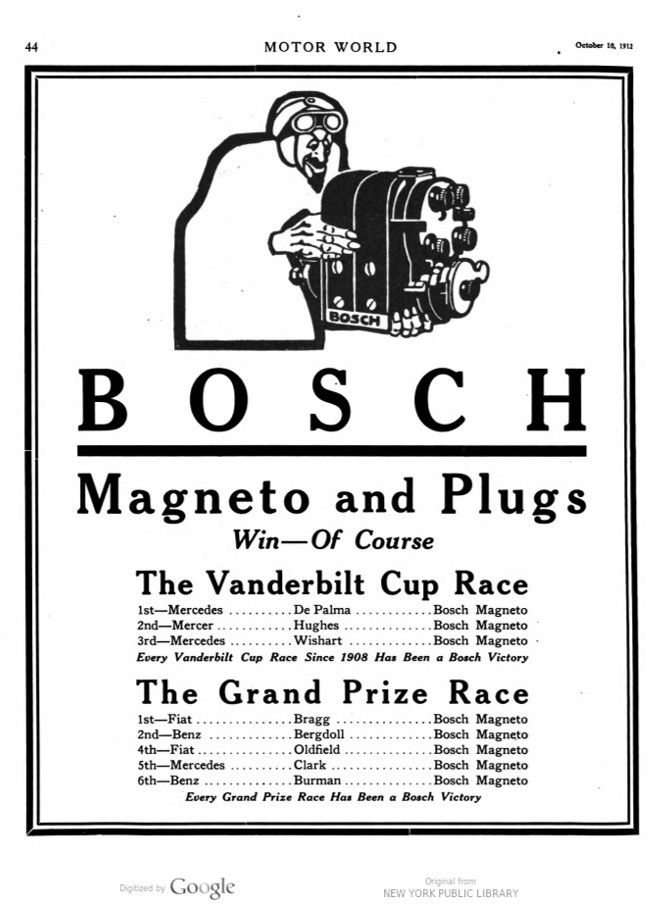
Bragg’s Fiat was Michelin equipped, as were also both Robert’s and Endicott’s Mason cars. Bergdoll rode on Fisk tires. Both Bragg and Bergdoll used Bosch magnetos and plugs, as did also De Palma and Tetzlaff. Anderson used a Mea instrument, and a Rayfield carburetter. Bragg and Tetzlaff also used Rayfield carburetters, and Mort Robert’s Mason was similarly equipped. Roberts used a Splitdorf magneto.
Photos.
Page 33.
“BREASTWORKS” OF BALED HAY ON FOND DU LAC TURN AFTER BEING “ASSAULTED” BY FONTAIN (LOZIER)
Page 34.
BRAGG AND HIS FIAT BEING COUNTED AWAY – DE PALMA IN THE CAR IN WHICH HE MET HIS ACCIDENT – “ACTION” WHEN DE PALMA STOPPED AT THE PITS – HUGHES AND HIS WIRE-WHEELED MERCER ON GRAVEYARD TURN
Page 35.
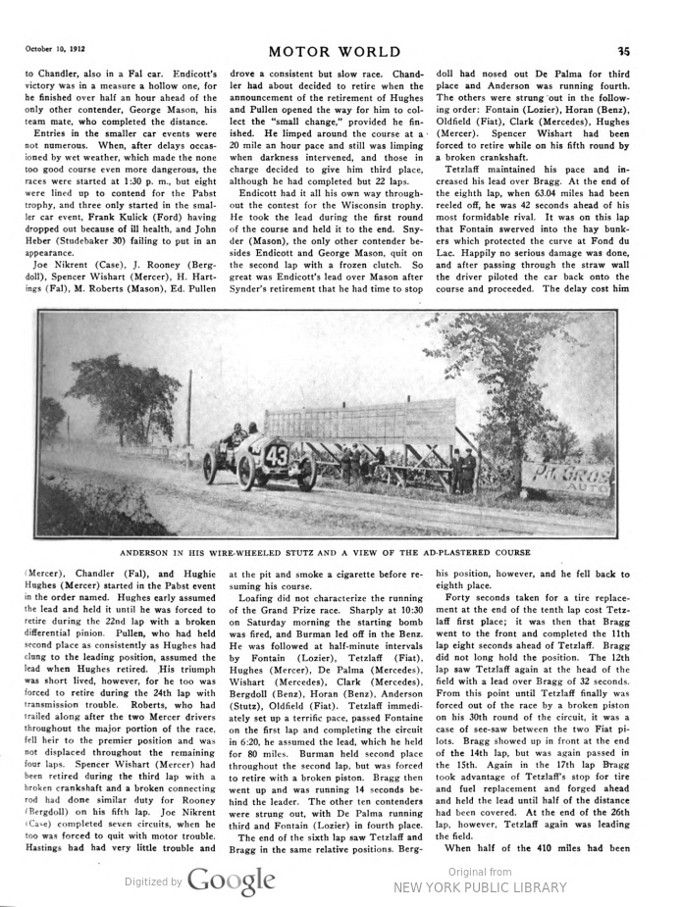
ANDERSON IN HIS WIRE-WHEELED STUTZ AND A VIEW OF THE AD-PLASTERED COURSE
Page 36.
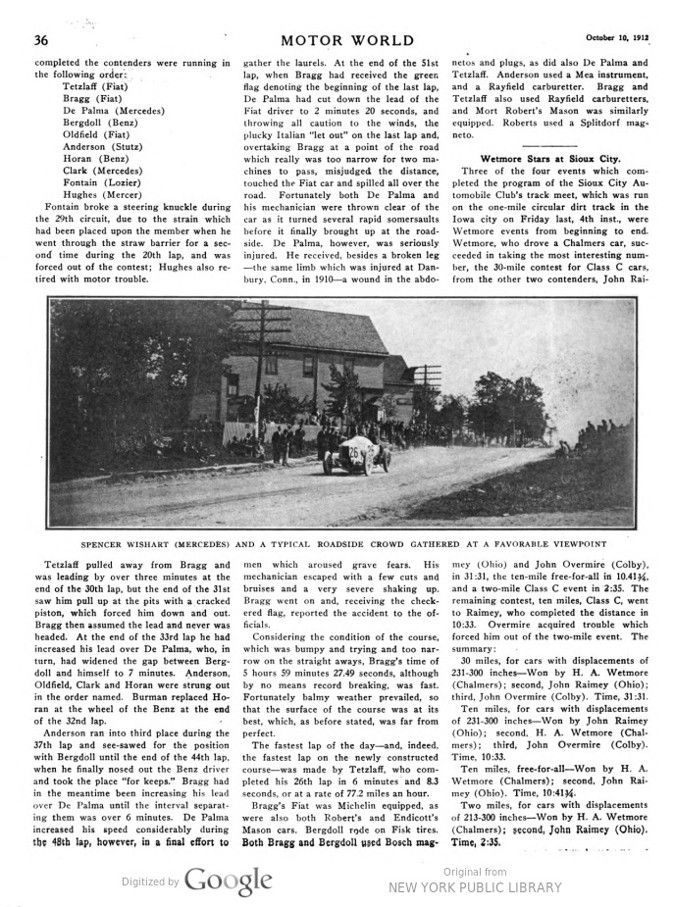
SPENCER WISHART (MERCEDES) AND A TYPICAL ROADSIDE CROWD GATHERED AT A FAVORABLE VIEWPOINT