In this second of two articles in the scientific magazine La Nature on the 1894 Concours, the journalist E. Hospitalier describes the vehicles that won in one of the difference categories. There were the gasoline-powered Panhard-Levassors, the Peugeots. The gasoline-powered cars of Vacheron (the only with a steering wheel instead of a steering tiller) and Lebrun. The steam-powered De Dion & Bouton Victoria style vehicle; the one of Maurice le Blant and of Scotte.

With permission of the Conservatoire numérique et des Arts et Métiers, cnum.cnam.fr
Text and fotos compiled by motorracinghistory.com. Translation by DeepL.com
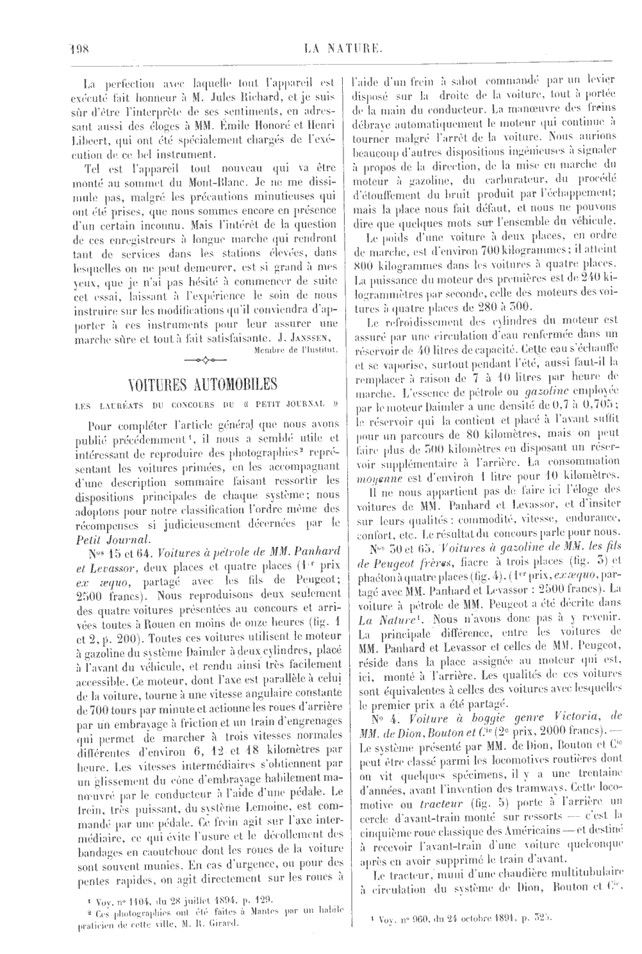
La Nature, Vol. 22, second half, No. 1096, August 25, 1894
AUTOMOBILES
THE WINNERS OF THE “PETIT JOURNAL” CONTEST
To supplement the general article we published previously (1), we thought it would be useful and interesting to reproduce photographs (2) of the winning cars, accompanied by a brief description highlighting the main features of each system; for our classification, we follow the very order of the awards so judiciously bestowed by the Petit Journal.
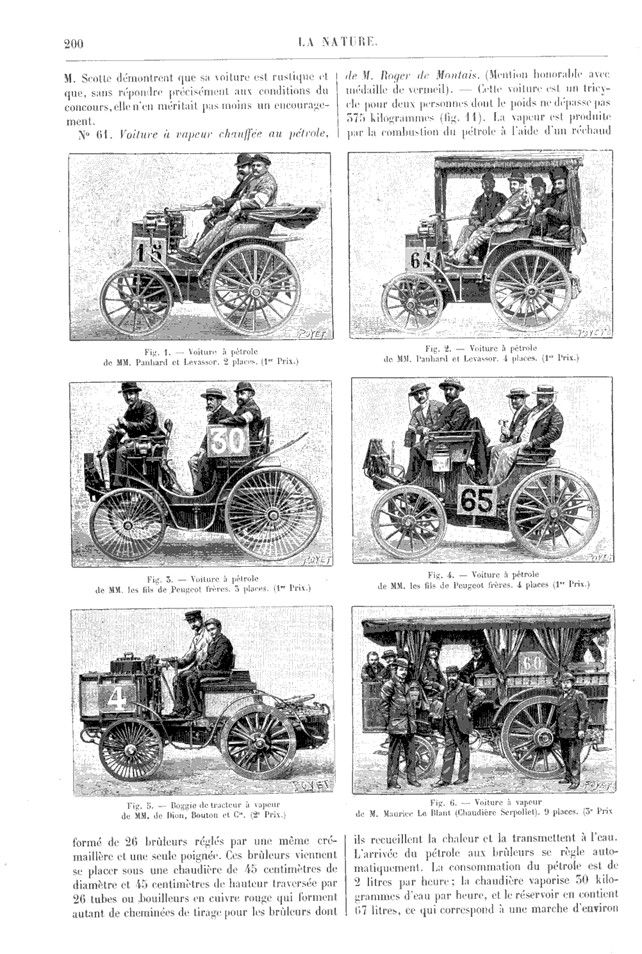
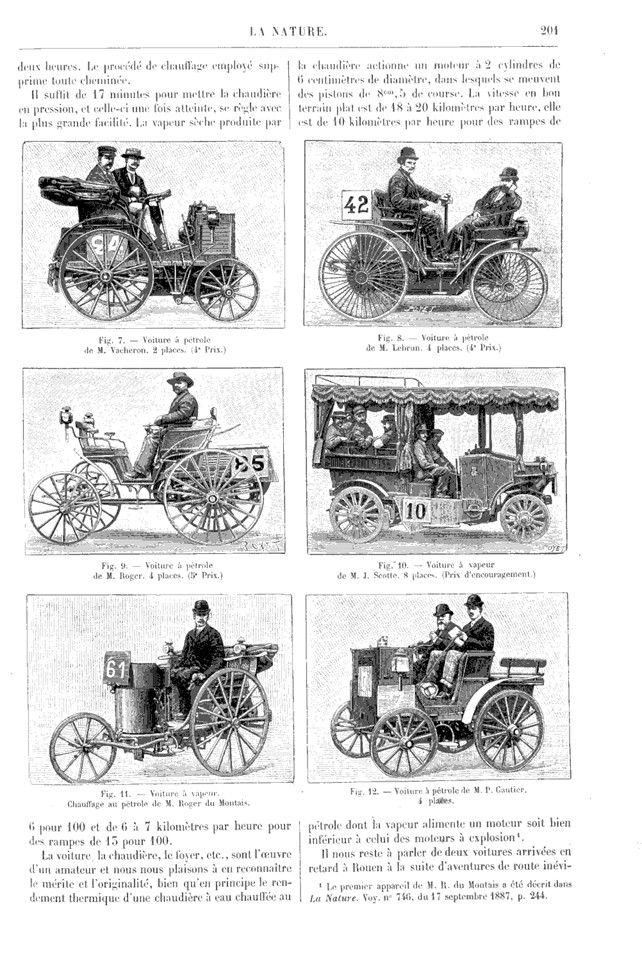
Nos. 15 and 64. Petroleum-powered cars by Messrs. Panhard and Levassor, two-seaters and four-seaters (1st prize ex aequo, shared with the Peugeot sons; 2,500 francs). We reproduce only two of the four cars entered in the competition, all of which arrived in Rouen in less than eleven hours (Figs. 1 and 2, p. 200). All these cars use the Daimler two-cylinder gasoline engine, mounted at the front of the vehicle, and thus made very easily accessible. This engine, whose axis is parallel to that of the car, rotates at a constant angular speed of 700 revolutions per minute and drives the rear wheels via a friction clutch and a gear train that allows for three different normal speeds of approximately 6, 12, and 18 kilometers per hour. Intermediate speeds are achieved by slipping the clutch cone, which the driver skillfully operates using a pedal. The Lemoine system’s very powerful brake is controlled by a pedal. This brake acts on the intermediate axle, which prevents wear and detachment of the rubber tires with which the car’s wheels are often equipped. In an emergency, or on steep slopes, the wheels are braked directly using a shoe brake operated by a lever located on the right side of the car, within easy reach of the driver. Applying the brakes automatically disengages the engine, which continues to run even after the car has stopped. We would have many other ingenious features to mention regarding the steering, the starting of the gasoline engine, the carburetor, and the process of muffling the noise produced by the exhaust; but space is limited, and we can say only a few words about the vehicle as a whole.
The weight of a two-seater car, fully loaded, is approximately 700 kilograms; it reaches 800 kilograms in four-seater cars. The engine power of the former is 240 kilogram-meters per second, while that of the four-seater cars ranges from 280 to 500.
The engine cylinders are cooled by a water circulation system contained in a 40-liter tank. This water heats up and evaporates, especially during the summer, so it must be replenished at a rate of 7 to 10 liters per hour of operation. The petroleum spirit or gasoline used by the Daimler engine has a density of 0.7 to 0.705; the tank that holds it, located at the front, is sufficient for a range of 80 kilometers, but one can travel more than 500 kilometers by installing an additional tank at the rear. The average fuel consumption is approximately 1 liter per 10 kilometers.
It is not our place here to praise the cars of Messrs. Panhard and Levassor, nor to emphasize their qualities: convenience, speed, endurance, comfort, etc. The results of the competition speak for themselves
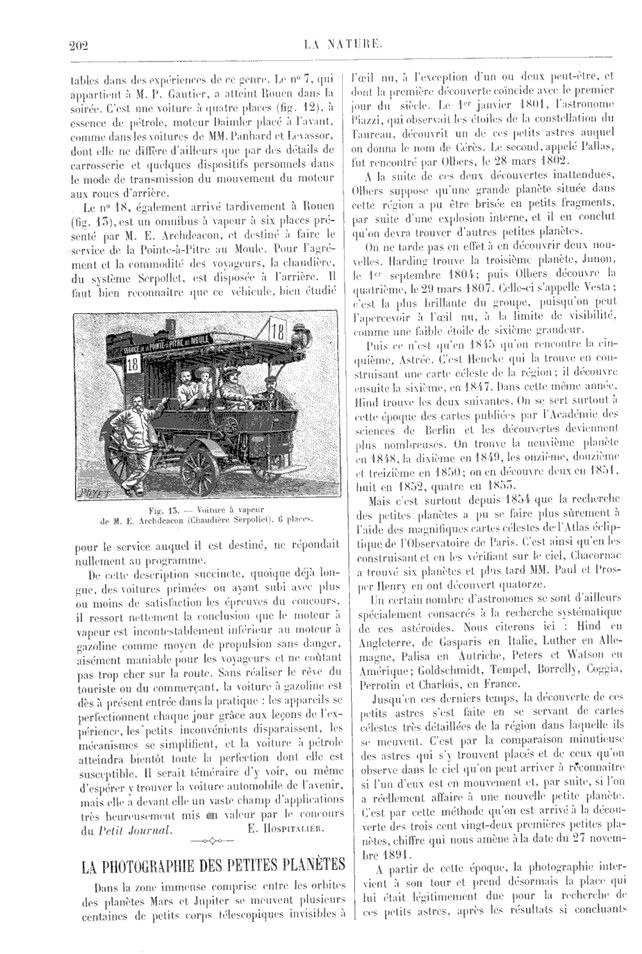
Our 50 and 65. Gasoline-powered cars by Messrs. the sons of the Peugeot brothers, a three-seater fiacre (fig. 5) and a four-seater phaeton (fig. 4). (1st prize, tied, shared with Messrs. Panhard and Levassor: 2,500 francs). The Peugeot brothers’ gasoline-powered car has been described in „La Nature“ (1). We therefore need not revisit it here. The main difference between the cars of Messrs. Panhard and Levassor and those of Messrs. Peugeot lies in the placement of the engine, which is mounted at the rear in the latter. The qualities of these cars are equivalent to those of the cars with which the first prize was shared.
No. 4. Victoria-style bogie car, by Messrs. de Dion, Bouton & Co. (2nd prize, 2,000 francs). — The system presented by Messrs. de Dion, Routon, and Clc can be classified among the road locomotives, a few examples of which were seen some thirty years ago, before the invention of streetcars. This locomotive or tractor (Fig. 5) carries at the rear a spring-mounted front-end assembly — the classic American fifth wheel — designed to accommodate the front end of any carriage after its front running gear has been removed.
The tractor, equipped with a multi-tube boiler with circulation of the Dion, Bouton & Co. system, powers a 20-horsepower engine, a compound engine that can switch to direct-fire operation in difficult terrain. The tractor, in running order, weighs 2,000 kilograms and carries a supply of 80 kilograms of coke and 400 kilograms of water. Control is provided by a system of Cardan-type articulated shafts that pass through the steering knuckles and drive the wheels from the outside, thus allowing the wheels to respond to all changes in terrain and the springs to flex without locking their respective movements, which remain perfectly independent.
When towing 4,000 kilograms, the tractor can reach a speed of 50 kilometers per hour on flat, favorable terrain, and 18 kilometers per hour when climbing a grade of 8 to 10 percent. More powerful and slower tractors based on the same principle can tow up to 10,000 kilograms at a speed of 8 kilometers per hour. This system could be useful in wartime for transporting ammunition and supplies, for heavy-duty trucking, moving trucks, etc. In the race from Paris to Rouen, the tractor from Dion, Bouton & Co. finished first, demonstrating qualities of endurance and speed that gasoline-powered cars do not match to the same degree; but it lacks the lightness, elegance, and convenience offered by the gasoline-powered vehicle, so it was awarded only second prize.
No. 60. Steam-powered vehicle by Mr. Maurice Le Blant. (Third prize: 1,500 francs). — This vehicle only partially met the conditions of the competition program. It is a nine-seat omnibus, equipped with a Serpollet boiler, rather heavy in appearance and form (fig. 0) and, it seems to us, better suited to public transportation service, as the vehicle in running order weighs over 4 tons, distributed as follows:
Empty car……………….. . 2660 kg
Tools and brakes. …… 100
10 passengers at 70 kilograms. 700
Drivers……………….. 70
Water (600 liters) …… 600
Coal……………………… 200
Total…….. 4,350 kg
According to Mr. Le Blant, consumption is estimated at 8 kilograms of water and 2.5 to 5 kilograms of coal per kilometer, which seems to indicate rather inefficient use of the boiler, as it vaporizes only 3 kilograms of water per kilogram of coal. It should be noted that this is superheated steam at a fairly high temperature. The grate of the tested model had an insufficient surface area and became clogged with slag rather quickly.
No. 24. Mr. Vachéron’s gasoline-powered car, two-seater. (Fourth prize of 1,000 francs shared with Mr. Lebrun). — This car (Fig. 7) features only minor modifications to the model from which it is derived (Panhard and Levassor), particularly the replacement of the steering wheel with a lever in the steering system.
No. 42. Mr. Lebrun’s gasoline-powered car, four-seater. (Fourth prize of 1,000 francs shared with Mr. Vacheron). — It is, with a few minor details, identical to the cars built by Messrs. Peugeot (fig. 8).
No. 85. Mr. E. Roger. Gasoline-powered car, two-seater. (Fifth prize: 500 francs). — Mr. Roger’s car is the only gasoline-powered car that does not use the Daimler engine (fig. 9); it is replaced by a Benz-type engine with electric ignition, mounted in a compartment at the rear. The two-seater Victoria model, which can accommodate a small front seat for a third person, uses a three-horsepower engine and can normally reach 18 to 20 kilometers per hour on level ground. By appropriately reducing speed, it can climb gradients of 10 per cent. The vehicle is 2.8 meters high, 1.5 meters wide overall, 1.5 meters high without the hood, has a track width of 1.25 meters, and weighs approximately 650 kilograms. The fuel supply is sufficient to cover 100 to 120 kilometers. The drive system and steering mechanism feature interesting design elements that we cannot elaborate on here without going beyond the scope of this article. After the cars that competed for first prize, this was one of those that best met the competition’s requirements: it richly deserved the rather modest award it received.
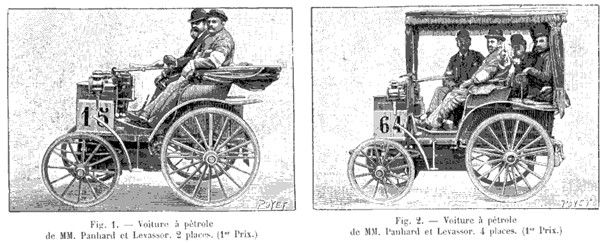

Fig. 1. — Gasoline-powered car by Messrs. Panhard and Levassor. 2-seater. (1st Prize.) Fig. 2. — Gasoline-powered car by Messrs. Panhard and Levassor. 4-seater. (1st Prize.)
Fig. 3. — Gasolinel-powered car by the sons of the Peugeot brothers. 3-seater. (1st Prize.) Fig. 4. — Gasoline-powered car by the sons of the Peugeot brothers, 4-seater (1st Prize.)
No. 10. Steam car by Mr. J. Sotte, eight-seater. (Encouragement Prize: 500 francs). — The boiler is of the vertical type, Field system, rated at 8 kilograms per square centimeter, with a feedwater descaler that enters the boiler at 80 degrees C. (Fig. 10). The two-cylinder engine with slide valve timing runs at 500 to 500 revolutions per minute and develops 5 horsepower. Power is transmitted to the rear drive wheels via a Gall chain and differential gear. The car is 5.9 meters long, 1.75 meters wide, and weighs 1,680 kilograms unloaded. With 300 kilograms of water, 200 kilograms of coal, seven passengers, and the driver, the total loaded weight reaches 2,700 kilograms. The car takes the form of a station wagon equipped with a roof and curtains that can be replaced with windows, transforming the vehicle into a closed omnibus. An upper rack allows for the storage of luggage on long journeys. Water consumption is 6 to 8 liters per kilometer on flat terrain, 8 to 10 liters in the mountains; coal consumption is 1.5 kilograms per kilometer on flat terrain, and 2 to 2.5 kilograms per kilometer in the mountains. A minor accident involving one of the boiler tube plugs put the engine out of service near Vernon and prevented it from reaching its destination during the final trials. The results obtained in other trips undertaken by Mr. Sotte demonstrate that his car is robust and that, while not strictly meeting the competition’s requirements, it nonetheless deserved encouragement.
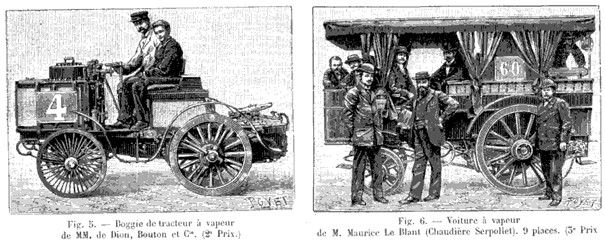
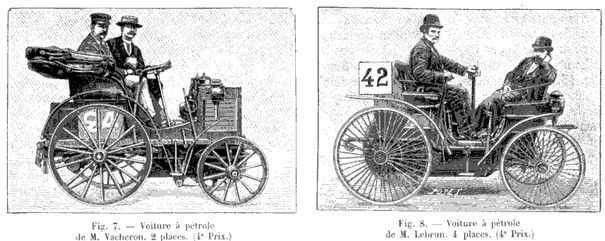
Fig. 5. — Steam tractor bogie by Messrs. de Dion, Bouton, and Cie. (2nd Prize.) Fig. 6. — Steam car by Mr. Maurice Le Blant (Serpollet boiler). 9-seater. (3rd Prize)
Fig. 7. — Mr. Vacheron’s gasoline-powered carriage. 2-seater. (4th Prize.) Fig. 8. — Mr. Lebrun’s gasoline-powered carriage. 4-seater. (4th Prize.)
No. 61. Petroleum-fired steam car, by Mr. Roger de Moulais. (Honorable mention with a vermeil medal). — This vehicle is a two-seater tricycle weighing no more than 575 kilograms (fig. 11). Steam is produced by burning petroleum using a stove consisting of 26 burners controlled by a single rack and a single handle. These burners are positioned beneath a boiler 45 centimeters in diameter and 45 centimeters in height, through which run 26 red copper tubes or boilers that serve as draft chimneys for the burners, collecting their heat and transferring it to the water. The flow of oil to the burners is automatically regulated. Oil consumption is 2 liters per hour; the boiler vaporizes 50 kilograms of water per hour, and the tank holds 67 liters, which corresponds to approximately two hours of operation. The heating process used eliminates the need for a chimney.
It takes only 17 minutes to bring the boiler up to pressure, and once pressure is reached, it can be regulated with the greatest of ease. The dry steam produced by the boiler drives a 2-cylinder engine with cylinders 6 centimeters in diameter, in which 8-centimeter pistons with a 5-centimeter stroke move. The speed on good flat terrain is 18 to 20 kilometers per hour; it is 10 kilometers per hour on gradients of 6 per 100, and 6 to 7 kilometers per hour on gradients of 10 per 100.
The boiler car, the furnace, etc., are the work of an amateur, and we are pleased to acknowledge their merit and originality, although in principle the thermal efficiency of an oil-fired water boiler whose steam powers an engine is far lower than that of internal combustion engines (1).
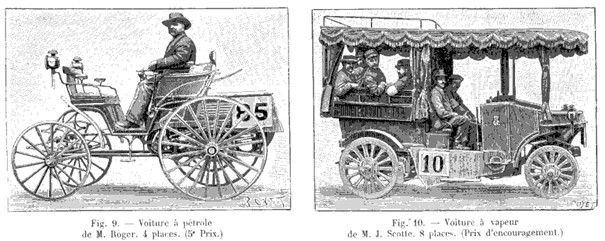
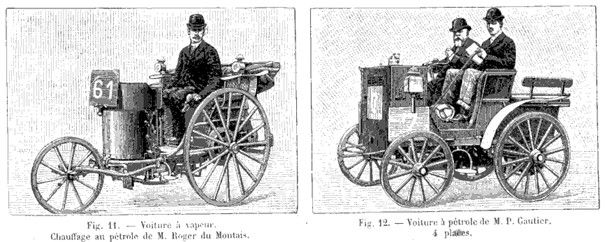
Fig. 9. — Mr. Roger’s gasoline-powered carriage. 4-seater. (5th Prize.) Fig. 10. — Steam-powered carriage by Mr. J. Scotte, 8-seater. (Encouragement Prize.)
Fig. 11. — Steam-powered carriage. Oil-fired by Mr. Roger du Montais. Fig. 12. — Oil-powered carriage by Mr. P. Gautier. 4-seater.
We have yet to mention two cars that arrived late in Rouen following the inevitable road mishaps that occur in experiments of this kind. No. 7, owned by Mr. P. Gautier, reached Rouen in the evening. It is a four-seater car (fig. 12), powered by petroleum, with a Daimler engine mounted at the front, as in the cars of Messrs. Panhard and Levassor, from which it differs only in details of the bodywork and a few unique features in the method of transmitting power from the engine to the rear wheels.
No. 18, which also arrived late in Rouen (fig. 15), is a six-seater steam omnibus, presented by Mr. E. Archdeacon, and intended for service between Pointe-à-Pitre and Le Moule. For the comfort and convenience of passengers, the boiler, of the Serpollet system, is located at the rear. It must be acknowledged that this vehicle, though well-designed for the service for which it was intended, did not meet the requirements of the competition in any way.
From this brief — though already lengthy — description of the cars that won prizes or passed the competition’s tests with varying degrees of success, it is clear that the steam engine is undeniably inferior to the gasoline engine as a means of propulsion that is safe, easy for passengers to use, and not too expensive to operate. Without fulfilling the dream of the tourist or the merchant, the gasoline-powered car has already entered practical use: the vehicles are improving every day thanks to lessons learned from experience, minor drawbacks are disappearing, mechanisms are being simplified, and the gasoline-powered car will soon reach the full perfection of which it is capable. It would be rash to see in it, or even to hope to find in it, the automobile of the future, but it has before it a vast field of applications very happily highlighted by the Petit Journal.
E. Hospitalier.
Notes.
1 See No. 1104, July 28, 1894, p. 129.
2 These photographs were taken in Mantes by a skilled practitioner from that city, Mr. R. Girard.
1 See No. 960, October 24, 1891, p. 323.
Photos.
Fig. 1. — Gasoline-powered car by Messrs. Panhard and Levassor. 2-seater. (1st Prize.)
Fig. 2. — Petrol-powered car by Messrs. Panhard and Levassor. 4-seater. (1st Prize.)
Fig. 3. — Petrol-powered car by the sons of the Peugeot brothers. 3-seater. (1st Prize.)
Fig. 4. — Petrol-powered car by the sons of the Peugeot brothers, 4-seater (1st Prize.)
Fig. 5. — Steam tractor bogie by Messrs. de Dion, Bouton, and C*‘. (2nd Prize.)
Fig. 6. — Steam car by Mr. Maurice Le Blant (Serpollet boiler). 9-seater. (3rd Prize)
Fig. 7. — Mr. Vacheron’s gasoline-powered carriage. 2-seater. (4th Prize.)
Fig. 8. — Mr. Lebrun’s gasoline-powered carriage. 4-seater. (4th Prize.)
Fig. 9. — Mr. Roger’s gasoline-powered carriage. 4-seater. (5th Prize.)
Fig. 10. — Steam-powered carriage by Mr. J. Scotte, 8-seater. (Encouragement Prize.)
Fig. 11. — Steam-powered carriage. Oil-fired by Mr. Roger du Montais.
Fig. 12. — Oil-powered carriage by Mr. P. Gautier. 4-seater.
Fig. 13. — Steam-powered vehicle by Mr. E. Archdeacon (Serpollet boiler). 6-seater.
———————————–