These two articles of the magazine The Automobile Review and Automobile News here are cropped in one. It shows a very clear and neat reporting of both the 1902 Paris-Vienna Race and the accompanying 1902 Gordon Bennett Cup race. The latter still was at that time much less popular than the original city-to-city races. From next year on however, that would change completely.
Text and jpegs by courtesy of hathitrust.org www.hathitrust.org, compiled by motorracinghistory
Automobile Review and Automobile News Vol. 7, No. 1, July 1 + No. 3, August 1, 1902
The Paris-Vienna Race + the Gordon Bennett Cup
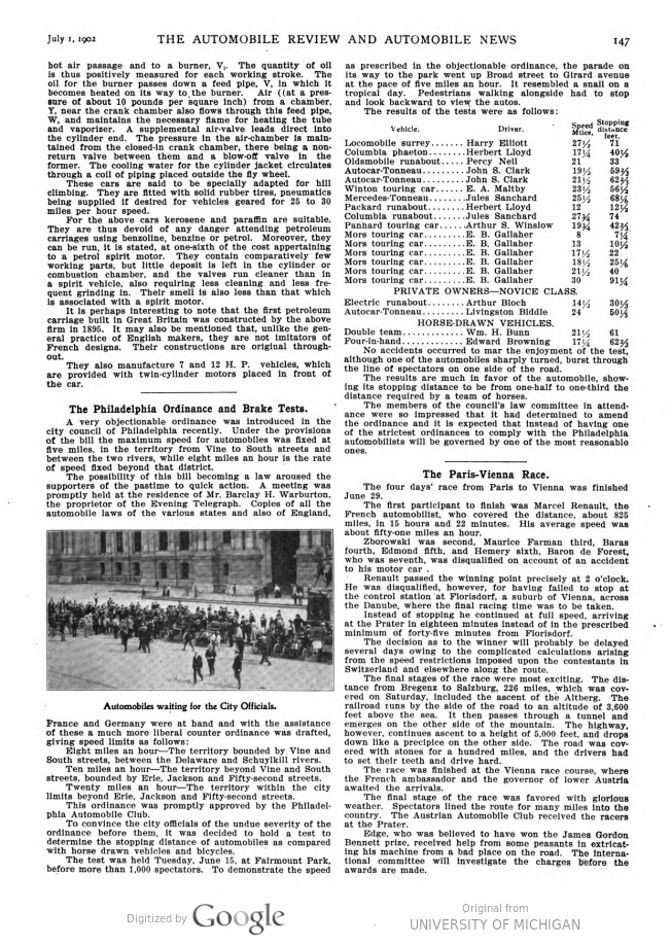
The Paris-Vienna Race. No.1, July 1, 1902.
The four days’ race from Paris to Vienna was finished June 29.
The first participant to finish was Marcel Renault, the French automobilist, who covered the distance, about 825 miles, in 15 hours and 22 minutes. His average speed was about fifty-one miles an hour.
Zborowski was second, Maurice Farman third, Baras fourth, Edmond fifth, and Hemery sixth, Baron de Forest, who was seventh, was disqualified on account of an accident to his motor car.
Renault passed the winning point precisely at 2 o’clock. He was disqualified, however, for having failed to stop at the control station at Florisdorf, a suburb of Vienna, across the Danube, where the final racing time was to be taken.
Instead of stopping he continued at full speed, arriving at the Prater in eighteen minutes instead of in the prescribed minimum of forty-five minutes from Florisdorf.
The decision as to the winner will probably be delayed several days owing to the complicated calculations arising from the speed restrictions imposed upon the contestants in Switzerland and elsewhere along the route.
The final stages of the race were most exciting. The distance from Bregenz to Salzburg, 226 miles, which was covered on Saturday, included the ascent of the Altberg. The railroad runs by the side of the road to an altitude of 3,600 feet above the sea. It then passes through a tunnel and emerges on the other side of the mountain. The highway, however, continues ascent to a height of 5,000 feet, and drops down like a precipice on the other side. The road was covered with stones for a hundred miles, and the drivers had to set their teeth and drive hard.
The race was finished at the Vienna race course, where the French ambassador and the governor of lower Austria awaited the arrivals.
The final stage of the race was favored with glorious weather. Spectators lined the route for many miles into the country. The Austrian Automobile Club received the racers at the Prater. Edge, who was believed to have won the James Gordon Bennett prize, received help from some peasants in extricating his machine from a bad place on the road. The international committee will investigate the charges before the awards are made.
Paris to Vienna. No.3, August 1, 1902
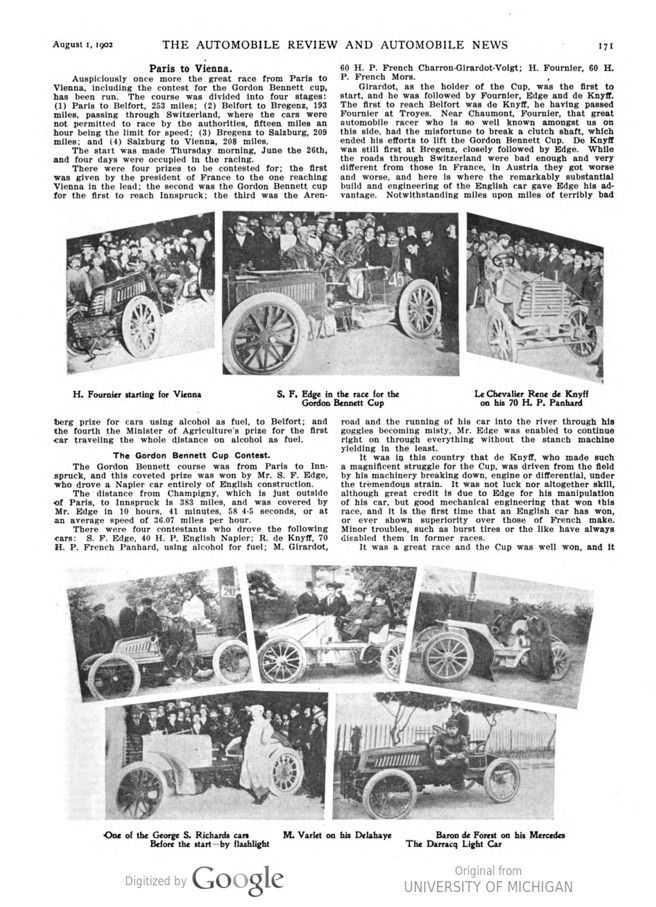
Auspiciously once more the great race from Paris to Vienna, including the contest for the Gordon Bennett cup, has been run. The course was divided into four stages: (1) Paris to Belfort, 253 miles; (2) Belfort to Bregenz, 193 miles, passing through Switzerland, where the cars were not permitted to race by the authorities, fifteen miles an hour being the limit for speed; (3) Bregenz to Salzburg, 209 miles; and (4) Salzburg to Vienna, 208 miles.
The start was made Thursday morning, June the 26th, and four days were occupied in the racing.
There were four prizes to be contested for; the first was given by the president of France to the one reaching Vienna in the lead; the second was the Gordon Bennett cup for the first to reach Innspruck; the third was the Arenberg prize for cars using alcohol as fuel, to Belfort; and the fourth the Minister of Agriculture’s prize for the first car traveling the whole distance on alcohol as fuel.
The Gordon Bennett Cup Contest.
The Gordon Bennett course was from Paris to Innspruck, and this coveted prize was won by Mr. S. F. Edge, who drove a Napier car entirely of English construction.
The distance from Champigny, which is just outside of Paris, to Innspruck is 383 miles, and was covered by Mr. Edge in 10 hours, 41 minutes, 58 4-5 seconds, or at an average speed of 36.07 miles per hour.
There were four contestants who drove the following cars: S. F. Edge, 40 H. P. English Napier; R. de Knyff, 70 H. P. French Panhard, using alcohol for fuel; M. Girardot, 60 H. P. French Charron-Girardot-Voigt; H. Fournier, 60 H. P. French Mors.
Girardot, as the holder of the Cup, was the first to start, and he was followed by Fournier, Edge and de Knyff. The first to reach Belfort was de Knyff, he having passed Fournier at Troyes. Near Chaumont, Fournier, that great automobile racer who is so well known amongst us on this side, had the misfortune to break a clutch shaft, which ended his efforts to lift the Gordon Bennett Cup. De Knyff was still first at Bregenz, closely followed by Edge. While the roads through Switzerland were bad enough and very different from those in France, in Austria they got worse and worse, and here is where the remarkably substantial build and engineering of the English car gave Edge his ad- vantage. Notwithstanding miles upon miles of terribly bad road and the running of his car into the river through his goggles becoming misty, Mr. Edge was enabled to continue right on through everything without the stanch machine yielding in the least.
It was in this country that de Knyff, who made such a magnificent struggle for the Cup, was driven from the field by his machinery breaking down, engine or differential, under the tremendous strain. It was not luck nor altogether skill, although great credit is due to Edge for his manipulation of his car, but good mechanical engineering that won this race, and it is the first time that an English car has won, ever shown superiority over those of French make. Minor troubles, such as burst tires or the like have always disabled them in former races.
It was a great race and the Cup was well won, and it will now have to be contested for in England over a 310-mile course, unless by mutual agreement it be held in France again on account of the English laws against road races. This cup was won in 1900 by Charron; and in 1901 by Girardot.
The Paris to Vienna Contest.
The number of cars entered for the complete course, Paris to Vienna, was large and included in addition to the racing cars, a large number of tourist ones which for a portion of the way took a different route. The winner of the Paris-Vienna race was M. Marcel Renault, who drove a 16 H. P. Renault Freres car. The second to arrive was Count Zborowski, on a 40 H. P. Mercedes, and his time would have been second to Renault’s but 40 minutes were added because of his infringement of a rule while crossing Switzerland. H. Farman and Maurice Farman were third and fourth on 70 H. P. Panhards.
The times of these contestants are given as follows: Marcel Renault, 26 hours, 10 minutes; Henry Farman, 26 hours, 34 minutes; Maurice Farman, 26 hours, 51 minutes; Zborowski, 26 hours, 58 minutes. These figures, including the time spent in traversing controls. The full official figures will not be given for some time.
There were a number of Darracqs entered in the race, and all of them were in at the finish. Five Gardner-Serpollet cars, which are of the flash boiler type steam machines, completed the entire course and finished well, showing what can be accomplished by steam over long distances.
The fact that one of the light cars should have reached Vienna first and made the quickest time, is quite a recommendation for this class of machine. It shows conclusively what very fine construction in the light vehicle is able to accomplish even over very bad roads. We are indebted for the illustrations to the Automotor Journal and Motoring Illustrated.
Photos.
Page 171.
H. Fournier starting for Vienna – S. F. Edge in the race for the Gordon Bennett Cup – Le Chevalier Rene de Knyff on his 70 H. P. Panhard
One of the George S. Richards cars – Before the start-by flashlight – M. Varlet on his Delahaye – Baron de Forest on his Mercedes – The Darracq Light Car