This basically two-part article of Charles Osborn gives an account on the 1902 Paris-Vienna race. It is a short, comprised but yet complete summary of that 1902 city-to-city race. In the second part of this article, a more extensive description of the winning light.weight Renault car is given, as well as of some of the other competing vehicles. This part II can be viewed in this website’s chapter “Cars & Engines 1895-1905” of “Men & Machine”.

Text and jpegs by courtesy of hathitrust.org www.hathitrust.org, compiled by motorracinghistory
Automobile Review and Automobile News Vol. 7, No. 6, September 15, 1902
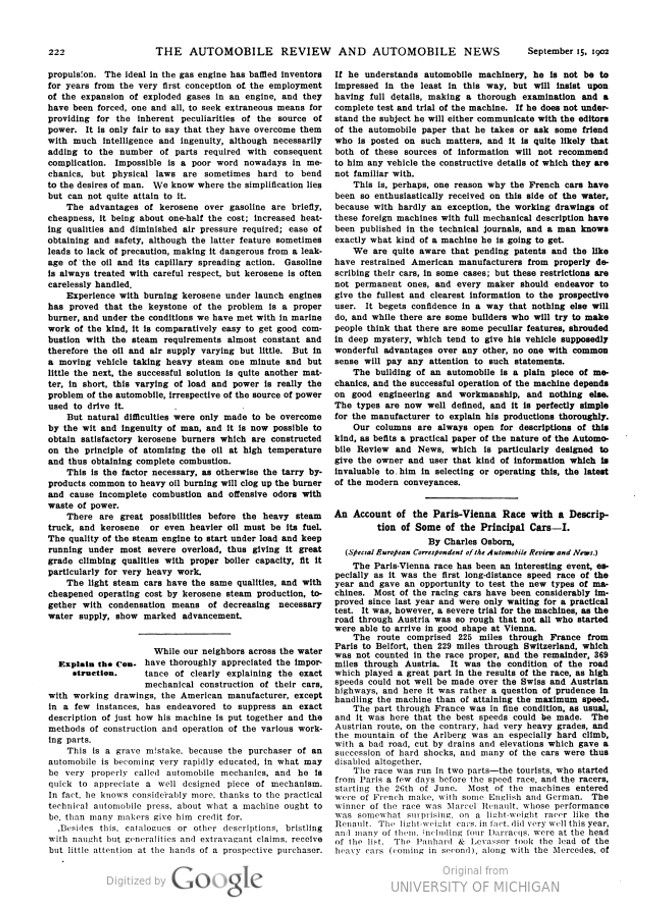
An Account of the Paris-Vienna Race with a Description of Some of the Principal Cars – I.
By Charles Osborn, (Special European Correspondent of the Automobile Review and News.)
The Paris-Vienna race has been an interesting event, especially as it was the first long-distance speed race of the year and gave an opportunity to test the new types of machines. Most of the racing cars have been considerably improved since last year and were only waiting for a practical test. It was, however, a severe trial for the machines, as the road through Austria was so rough that not all who started were able to arrive in good shape at Vienna.
The route comprised 225 miles through France from Paris to Belfort, then 229 miles through Switzerland, which was not counted in the race proper, and the remainder, 369 miles through Austria. It was the condition of the road which played a great part in the results of the race, as high speeds could not well be made over the Swiss and Austrian highways, and here it was rather a question of prudence in handling the machine than of attaining the maximum speed.
The part through France was in fine condition, as usual, and it was here that the best speeds could be made. The Austrian route, on the contrary, had very heavy grades, and the mountain of the Arlberg was an especially hard climb, with a bad road, cut by drains and elevations which gave a succession of hard shocks, and many of the cars were thus disabled altogether.
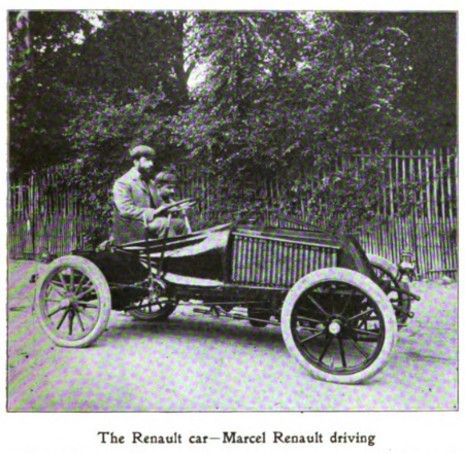
The race was run in two parts — the tourists, who started from Paris a few days before the speed race, and the racers, starting the 26th of June. Most of the machines entered were of French make, with some English and German. The winner of the race was Marcel Renault, whose performance was somewhat surprising, on a light-weight racer like the Renault. The light-weight cars, in fact, did very well this year, and many of them, including four Darracqs, were at the head of the list. The Panhard & Levassor took the lead of the heavy cars (coming in second), along with the Mercedes, of German make, using the Daimler system, which took third place. The steam racers were represented by four Serpollets, which came high in the list.
The actual racing distance was 594 miles, which Renault covered in 15 hours 47 minutes 43 seconds; the next best time, by H. Farman (Panhard car) being 16 hours 0 minutes 30 seconds. Edmond (Darracq car) made 16 hours 10 minutes 16 seconds, and Zborowski, on a Mercedes car, 16 hours 13 minutes 29 seconds. Thus, the French machines carried off the honors of the race, except in the Gordon Bennett cup race, which was run at the same time. The cup went for the first time from France to Great Britain, as it was won by S. F. Edge, on a Napier car. The champions for France were Fournier, Girardot and De Knyff, but the two former had accidents before reaching Belfort, and so the contest over the Austrian part for the final heat lay between De Knyff and Edge. The former had a breakdown not for from Innsbruck, which allowed Edge, who was far behind, to pass him and reach the finish. The total racing distance was 371 miles.
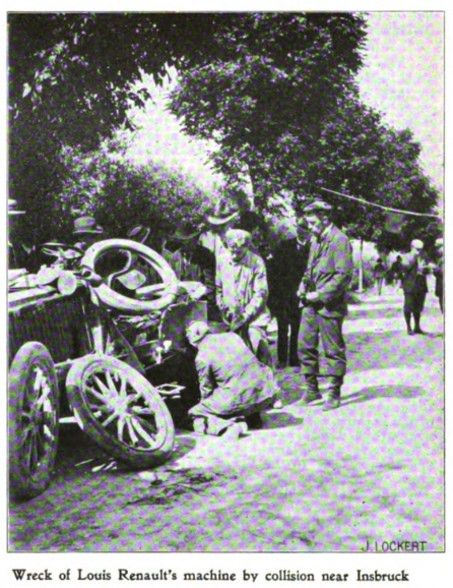
The first part of the race, over the level roads of France, allowed the best speeds to be made, and is the most instructive in this respect. Here De Knyff made the best performance and covered the racing distance from Paris to Belfort, 225 miles, in 4 hours 18 minutes, which makes an average of 50 miles an hour. He thus won the cup offered by the Prince d’Arenberg for the alcohol cars. Fournier, who was a general favorite, started out well, reaching 70 miles an hour in some places, but had an accident on the first part of the road and could not finish. It was difficult to obtain the exact time of the race, owing to the great number of points which were neutralized, and the official results were not published until the 22nd of July. The engraving shows the arrival of Marcel Renault on his lightweight racer just after he crossed the finish at Vienna. As might be expected, a great number of accidents occurred to the machines over the rough road, which was bordered in many places by precipices and steep slopes. The photograph shows an accident which happened to Louis Renault, brother of the winner. Renault arrived at a control station near Innsbruck and was stationed in the middle of the road when Baron de Caters, who came up behind him at full speed, dashed into his machine and broke the front wheels and otherwise damaged it. The accident was repaired, but later on a second mishap put Renault hors de combat.
The top of the Arlberg was covered with snow and the road wound along the side of the mountain. Thery’s machine fell down a slope of 300 feet and was totally smashed at the bottom, but he escaped without injury. Achille Fournier conducted his car over the last part of the route with half the steering wheel broken.
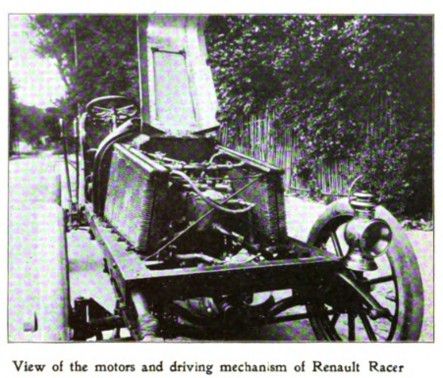
It will be of interest to describe one of the machines of the speed race and one of the touring class. Of the former the Renault machine claims the first attention, while of the latter the Ader system may be chosen, as this type had several machines entered, all of which made good performances.

Photos.
Page 223. Marcel Renault crossing the line at Vienna-Winner of the great race – The Renault car-Marcel Renault driving – View of the motors and driving mechanism of Renault Racer – Wreck of Louis Renault’s machine by collision near Insbruck (pictures by J. LOCKERT)