This second article in a series of three of the Automobile Review on the 1904 Gordon Bennett Race gives an overall account as well as a sharp analysis of times, realized by the two most important drivers of this race, winner Leon Théry and second finisher Camille Jenatzy.
Text and photos with courtesy of hathitrust.org hathitrust.org, compiled by motorracingistory.com
Automobile Review, Vol. 11, No. 1, July 2, 1904
THE GORDON BENNETT CUP RACE
BY EDWARD KENEALY
Written expressly for the Automobile Review by Mr. Kenealy, the well-known writer of motoring stories
The Race. Homburg, June 16th, 9 p. m.
On Thursday bright sunshine and sultry weather succeeded the steady downpour of the day before.
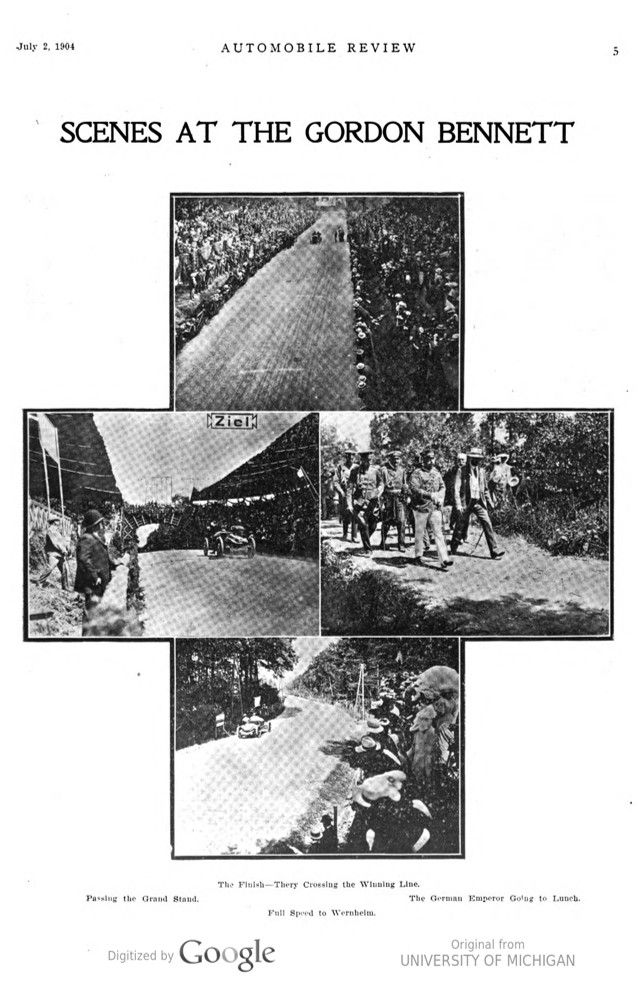
At 8 a. m. the German Emperor, dressed in a general’s uniform, drove in a plain 4-horsed carriage with no outriders or ceremony, through Homburg, en route for Saalburg, where he inspected all the arrangements of the grandstands.
He was accompanied by the Empress, and both looked well, the Emperor a magnificent specimen of the finest Teutonic type.
Everybody rose early to see the Emperor and to attend the weighing-in ceremonies, though the exact hour at which these were to take place was shrouded in mystery. All the British newspaper representatives were eloquent with the old complaint that nobody at the club knew anything about anything. Not one of the British competitors was able to discover from club officials the whereabouts of the weighing-in and they had to drive haphazard through Hom- burg asking all the police of the town.
The Weighing-in.
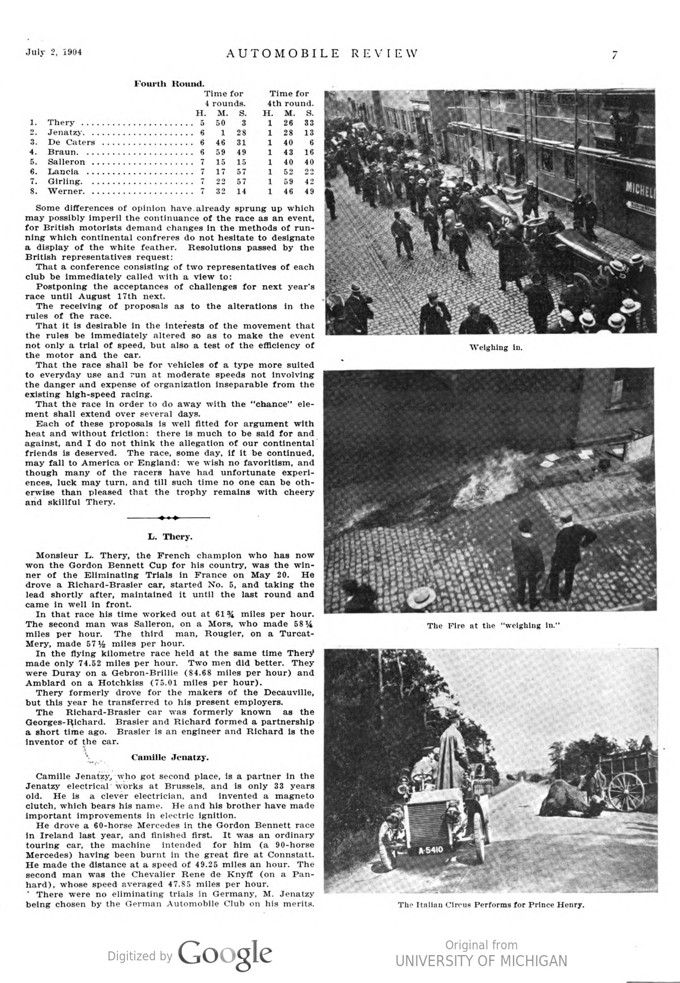
Mr. Edge’s Napier was first on the scene in the Elizabeth-Strassen, a narrow by-street possessing a weigh-bridge. The narrow lane was thronged with men of the street; no cordon was established nor exclusion of any sort. Gamins and idle sightseers monopolized the vantage points, and presently when a serious fire broke out and three racing cars were in imminent danger, the lack of wisdom shown in the open and public nature of the weighing-in ceremonies disclosed itself.
The Opel-Darracq was drawing off the petrol from its tank as a preliminary to weighing-in, when a bystander threw a lighted match down quite close to the stream of “essence.“ In a moment a conflagration took place, and flames rose high. A wild, disorganized stampede took place, people were thrown down and trampled on, but fortunately these were more frightened than hurt.
One elderly English lady was knocked down, and several persons rushed on and over her, till a plucky English girl, who accompanied her, stood in front and held off some panic-stricken men. It was a strange scene of each for himself, and a remarkable revelation of the inherent excitability of an apparently stolid, unemotional crowd.
Mr. Edge’s Napier was hurriedly rushed off to the right, the Turcat-Mery, which was in line behind the Opel-Darracq, was turned with a lightning-like flank movement to the left to make room for the Darracq, which stood between the Napier and the French car, and by now was enveloped in flames and smoke.
Curiously enough, the scene took place right in front of the fire-station, but the cars blocked the doors and the firemen inside were not able to emerge and do their duty. Luckily the mechanics kept their heads and by means of sand managed to put out the fire, not before it had spread some distance, blackening the doors of the fire-station.
Mr. Frederick Coleman, of the White Steam Car Company, who was very close to the racers, had his hands very badly scorched and his camera so much injured that it took a couple of hours to repair it.
With wisdom teeth cut after the event, the fire brigade was now called out, the hose laid down, and around the street the space cleared, and – no admittance except on business strictly enforced – indeed so strictly and unintelligently that only the most dogged persistence on Mr. Austin’s part resulted in his being allowed within the charmed and corded circle to view the weighing-in of his two Wolseleys.
Everybody hoped the race arrangements would not be quite so casual as those which marked the weighing-in regulations.
During the fire panic the Swiss car, the Dufaux, was being driven to the weighing-in, when the steering yoke snapped in two as though it were of tinder, and it could not be repaired in time to run tomorrow.
Homburg, June 17th.
Despite the fact that the German Emperor honored the Motor Derby with his presence and that all the world followed in his wake, victory deserted the Fatherland and rested with France, and gave opportunity for a graceful message from the Kaiser to President Loubet, which assuredly will be keenly appreciated by the French people. International courtesies are seldom thrown away and so we see again how sport bridges difficulties and heals old-times sores and indirectly we find motoring becoming a great factor in the making of peace. This of course is no suddenly arrived at conclusion; we have consistently held that automobiling, which enlists the sympathy of all nationalities, must tend to cement ties of friendship and that it thus becomes a sport of first rank, invested with a dignity whose importance can hardly be exaggerated.
Homburg was full, ah, yes, very full, and yet former experiences at Queen Victoria’s Diamond Jubilee in England was repeated, there had been so much talk of congestion that when the time came there was room enough and to spare. Ireland found this out last year, but the lesson was evidently thrown away and the people who over-boomed the Homburg meeting were responsible for the comfort which attended those who gathered there and for the reasonable prices that prevailed in place of the prohibitive charges which had been predicted. It is an old story that people will not be wise until after an event, yet those who gathered at Homburg will scarcely regret a misconception which certainly added greatly to their enjoyment.
However much German people may regret that the trophy has passed from their keeping and that Jenatzy has failed over a course which he knew thoroughly well, they cannot but be gratified that the prize has gone to so consummate a sportsman as M. Thery, who commenced motor racing in 1898, when he competed in the Paris-Amsterdam race, driving a Decauville voiturette. He was second in the Tour de France race in 1899 and won the Coupe des Voiturettes in 1900 and in the next year was fifth in the light car section of the Paris-Bordeaux race, still driving a Decauville. He was unfortunate in the Paris-Vienna contest and in the Circuit des Ardennes, but his pluck and resource never deserted him, and he finished the season by winning the Gaillon Kilometre race in record time, reaching a speed of 120 kilometres per hour. In the Paris-Madrid race of 1903 he finished fourth in the light car section and is now the winner of what may justly be considered the blue ribbon of the motoring world.
Disappointed as both Germans and Americans must be that Jenatzy, who won last year with a 60 h. p. Mercedes car, should have failed this year with an American-owned 90 h. p. Mercedes and that de Caters on a car of the same make and power should also be worsted, they must rejoice in the fact that the trophy has gone to a thorough sportsman who deserves every grain of honor that he is likely to receive.
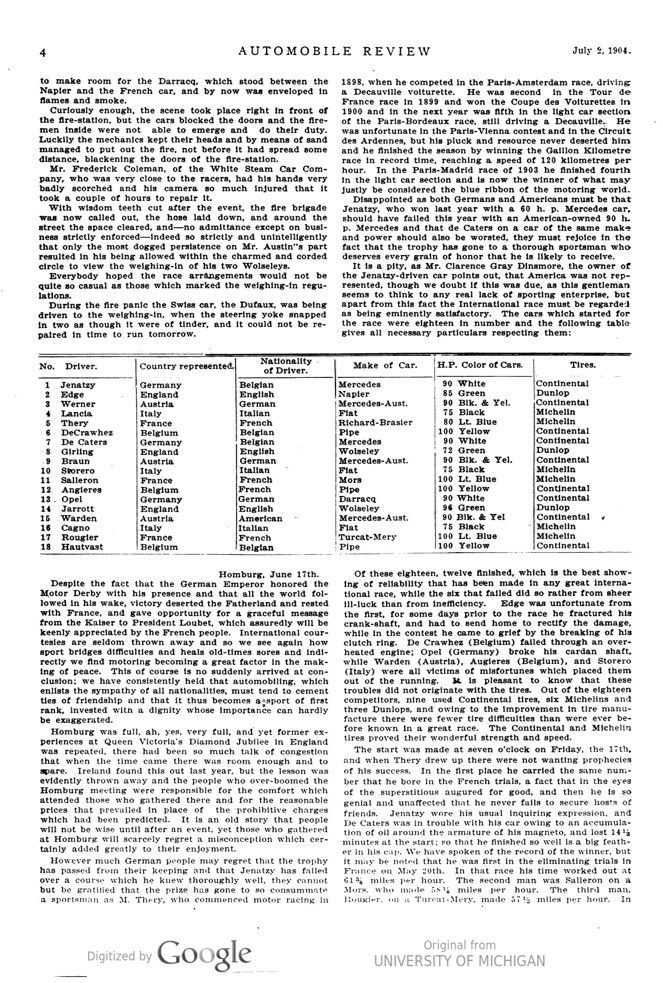
It is a pity, as Mr. Clarence Gray Dinsmore, the owner of the Jenatzy-driven car points out, that America was not represented, though we doubt if this was due, as this gentleman seems to think to any real lack of sporting enterprise, but apart from this fact the International race must be regarded as being eminently satisfactory. The cars which started for the race were eighteen in number and the following table gives all necessary particulars respecting them:
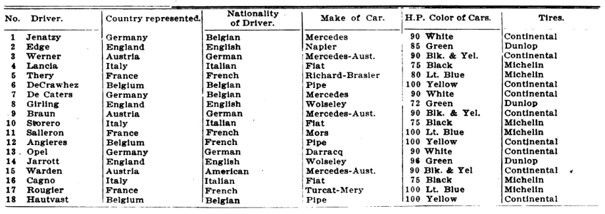
Of these eighteen, twelve finished, which is the best showing of reliability that has been made in any great international race, while the six that failed did so rather from sheer ill-luck than from inefficiency. Edge was unfortunate from the first, for some days prior to the race he fractured his crank-shaft, and had to send home to rectify the damage, while in the contest he came to grief by the breaking of his clutch ring. De Crawhez (Belgium) failed through an overheated engine; Opel (Germany) broke his cardan shaft, while Warden (Austria), Augieres (Belgium), and Storero (Italy) were all victims of misfortunes which placed them out of the running. It is pleasant to know that these troubles did not originate with the tires. Out the eighteen competitors, nine used Continental tires, six Michelins and three Dunlops, and owing to the improvement in tire manufacture there were fewer tire difficulties than were ever before known in a great race. The Continental and Michelin tires proved their wonderful strength and speed.
The start was made at seven o’clock on Friday, the 17thi, and when Thery drew up there were not wanting prophecies of his success. In the first place he carried the same number that he bore in the French trials, a fact that in the eyes of the superstitious augured for good, and then he is so genial and unaffected that he never fails to secure hosts of friends. Jenatzy wore his usual inquiring expression, and De Caters was in trouble with his car owing to an accumulation of oil around the armature of his magneto, and lost 14½ minutes at the start; so that he finished so well is a big feather in his car. We have spoken of the record of the winner, but it may be noted that he was first in the eliminating trials in France on May 20th. In that race his time worked out at 61 34 miles per hour. The second man was Salleron on a Mors, who made 5814 miles per hour. The third man, Rougier, on a Turcat-Mery, made 57 142 miles per hour. In the flying kilometer race held at the same time, Thery made only 74.52 miles per hour, while Duray, on a Gobron-Brillie made 84.68 miles per hour, and Amblard, on a Hotchkiss, 75.01 miles per hour.
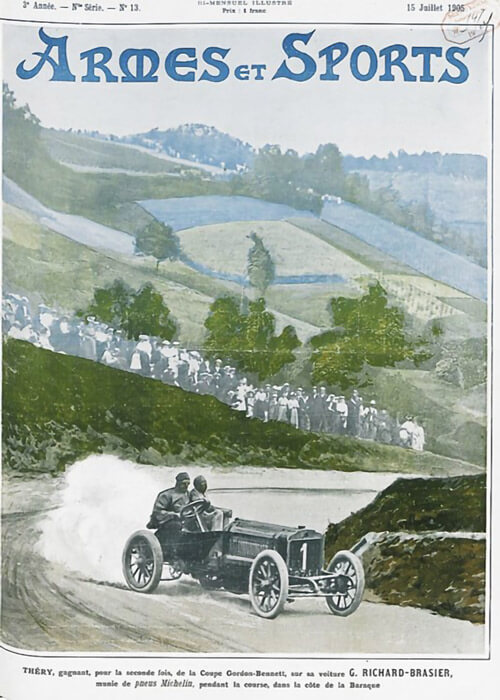
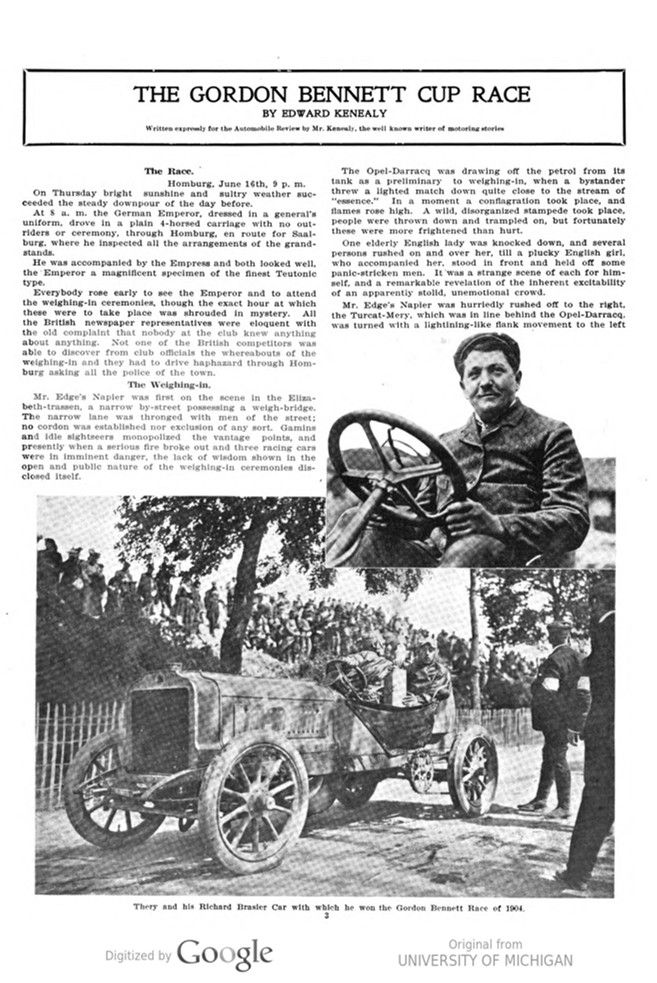
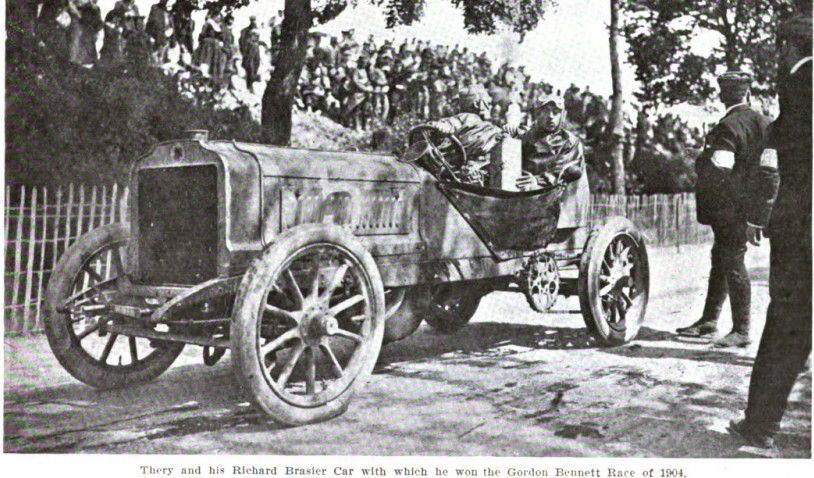
Thery transferred from the Decauville to his present employers this year, and drove a car which was formerly known as the Georges-Richard. Brasier, an engineer, and Richard, the inventor of the car, formed a partnership a short time ago, hence the Richard-Brasier vehicle, which has outdistanced the Mercedes.
The car driven by Thery has an 80-horsepower, four-cylinder vertical engine, and side chains are employed for the transmission of the power to the rear wheels. It has a square-shaped bonnet, of which the radiator with its fan forms the front, while Brasier magneto ignition is used. The magneto, which lies to the left of the engine, runs at the same speed as the crank shaft.
The car has three speeds, with a direct drive on the top gear. The valves are mechanically operated. The wheelbase and track are 2 m. 60 mm. (6 ft. 912 ins. approx.) and 1 m. 25 mm. (3 ft. 4 ins.), respectively. The front wheels have a diameter of 810 mm. (32 ins.), and those at the rear 820 mm. (32 142 ins.).
The steering connecting rods are in front of the axle carrying the front wheels. The weight of the car is 988 kilogs., and the frame is of pressed steel.
The winning car was fitted with the Truffault system of suspension, a device which is fitted to the springs and has a braking effect on them. When the road wheel meets an obstacle the spring contracts, and the Truffault brake allows the spring to resume its normal position slowly, and thus prevents the car from bouncing along the road.
The Georges Richard-Brasier is made in four standard models, which are of practically the same design throughout: the 12-horse, two-cylinder; 16-horse, four-cylinder; 24- horse, four-cylinder; and 8-horse, two-cylinder. A live axle type of transmission is employed for these four types, and the three cars of higher power have four speeds and a reverse, the 8-horse car, however, having but three speeds forward. The chassis have pressed steel main frames, with tubular under frames for carrying the engines and gearboxes. The cylinders are cast in pairs, and the inlet valves, which are mechanically operated, are opposite the exhausts. No pump is used for circulating the cooling water, and the radiator, with which is combined a tank, forms the front of the bonnet and is constructed with long, finned, vertical tubes. A fan is employed. The automatic carburettor has a plunger, which is operated by the suction of the engine. An enclosed governor, mounted on the front end of the inlet cam-shaft, controls the engine; it is connected with the throttle valve, also with an accelerator pedal and small hand lever above the steering wheel. The engine lubricator is driven by enclosed bevel-gearing from the engine, and is fixed behind the dash. The feature of the main clutch, which is of the cone type, is that the inner member can be removed without disturbing the gear box or the engine, and a double universal joint connects it with the clutch. A single lever operates all the speeds, the drive on the top speed being direct. The foot-operated brake is metal-to-metal construction, and the hub brakes are of the internal expanding type. No brakes are inter-connected with the clutch. Ball bearings are employed on the live rear axle; radius rods are dispensed with. Each cylinder is connected to the exhaust-box by a separate pipe. These constructors also make a 40-horse model, in which, unlike those described above, a pump is used for circulating the cooling water, the hubs have hand brakes, and the countershaft is fitted with a foot operated brake.
There was a wonderful regularity in the time made by Thery on his rounds, which was as follows:

It is noteworthy that the difference in time between Thery and Jenatzy on the first round was one second only, so that had they started abreast Jenatzy would have been leading by about 25 yards, and if it were possible to arrange a race on such conditions a most exciting time would assuredly supervene.
From the sportsman’s point of view the win by Thery was most popular. He is, as I have said, so modest a man, with no ambition save to have a house which he can ca his own in the country, so unobtrusive and yet so determined, that he cannot fail to impress favorably all who meet him. With Jenatzy the reverse is noticed; ego is writ large on all he does, and he was constantly threatening not to run unless his retaining fee was increased, and the trouble was only stopped by a polite intimation that it was within the resources of civilization to fill his place. He started with water flowing from the filling nozzle of his radiator, and when he crossed the finishing line at top speed found that he had not an ounce of petrol left and that had the track been a mile longer he would have been stopped for want of power. Jenatzy received quite an ovation, which he richly deserved, and both he and M. Thery were afterwards received by the Duke of Ratibor on behalf of the German emperor.
When all was over, I carefully examined Jenatzy’s car, and ascertained that its front wheels were out of alignment, due to the car taking a dos d’ane at too great a speed. The friction on the tires had largely worn the outer covers, and Jenatzy gives this as the reason why he was not able to maintain his speed throughout, and consequently why he lost the race.
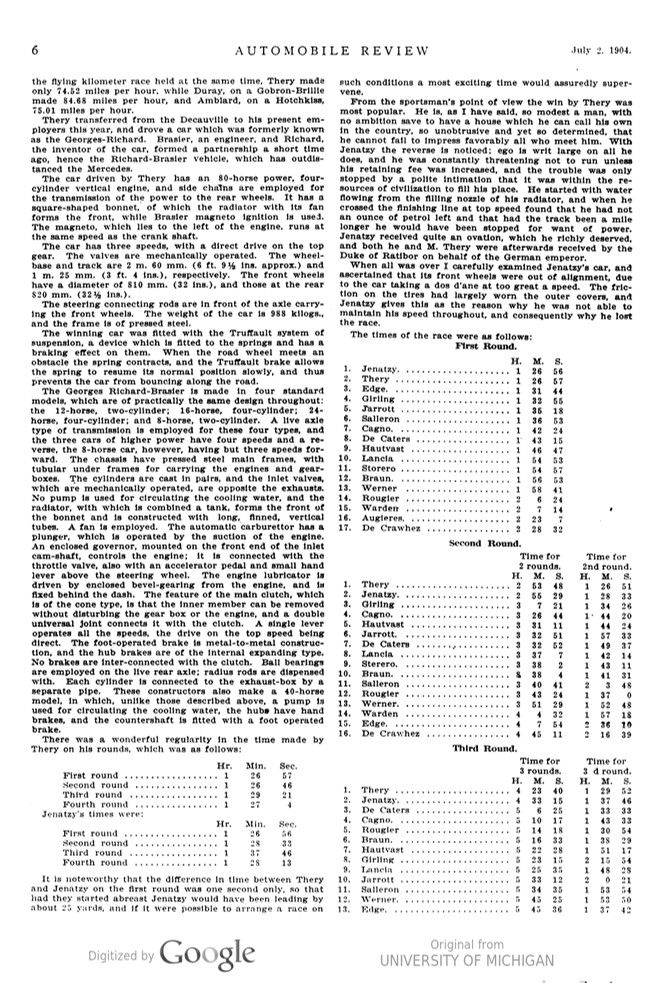
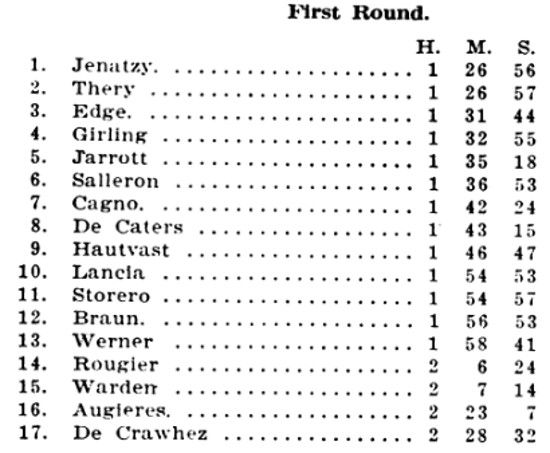
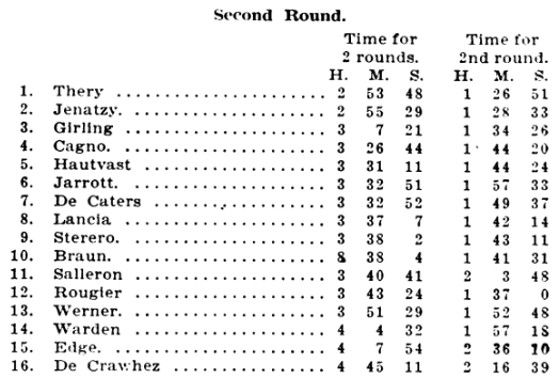
The times of the race were as follows: (First Round. – Second Round. – Third Round. – Fourth Round).
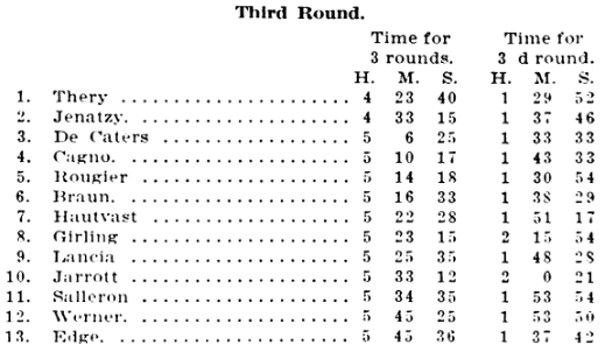
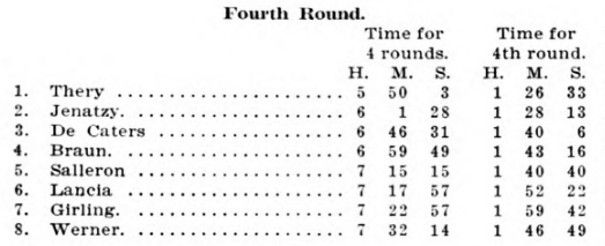
Some differences of opinion have already sprung up which may possibly imperil the continuance of the race as an event, for British motorists demand changes in the methods of running which continental confreres do not hesitate to designate a display of the white feather. Resolutions passed by the British representatives request:
That a conference consisting of two representatives of each club be immediately called with a view to:
Postponing the acceptances of challenges for next year’s race until August 17th next.
The receiving of proposals as to the alterations in the rules of the race.
That it is desirable in the interests of the movement that the rules be immediately altered so as to make the event not only a trial of speed, but also a test of the efficiency of the motor and the car.
That the race shall be for vehicles of a type more suited to everyday use and run at moderate speeds not involving the danger and expense of organization inseparable from the existing high-speed racing.
That the race in order to do away with the „chance“ ele- ment shall extend over several days.
Each of these proposals is well fitted for argument with heat and without friction: there is much to be said for and against, and I do not think the allegation of our continental friends is deserved. The race, someday, if it be continued, may fall to America or England: we wish no favoritism, and though many of racers have had unfortunate experiences, luck may turn, and till such time no one can be otherwise than pleased that the trophy remains with cheery and skillful Thery.
———
L. Thery.
Monsieur L. Thery, the French champion who has now won the Gordon Bennett Cup for his country, was the winner of the Eliminating Trials in France on May 20. He drove a Richard-Brasier car, started No. 5, and taking the lead shortly after, maintained it until the last round and came in well in front.
In that race his time worked out at 61¾ miles per hour. The second man was Salleron, on a Mors, who made 58¼ miles per hour. The third man, Rougier, on a Turcat-Mery, made 57½ miles per hour.
In the flying kilometre race held at the same time Thery made only 74.52 miles per hour. Two men did better. They were Duray on a Gebron-Brillie (84.68 miles per hour) and Amblard on a Hotchkiss (75.01 miles per hour).
Thery formerly drove for the makers of the Decauville, but this year he transferred to his present employers.
The Richard-Brasier car was formerly known as the Georges-Richard. Brasier and Richard formed a partnership a short time ago. Brasier is an engineer and Richard is the inventor of the car.
Camille Jenatzy.
Camille Jenatzy, who got second place, is a partner in the Jenatzy electrical works at Brussels, and is only 33 years old. He is a clever electrician, and invented a magneto clutch, which bears his name. He and his brother have made important improvements in electric ignition.
He drove a 60-horse Mercedes in the Gordon Bennett race in Ireland last year, and finished first. It was an ordinary touring car, the machine intended for him (a 90-horse Mercedes) having been burnt in the great fire at Cannstatt. He made the distance at a speed of 49.25 miles an hour. The second man was the Chevalier Rene de Knyff (on a Panhard), whose speed averaged 47.85 miles per hour.
There were no eliminating trials in Germany, M. Jenatzy being chosen by the German Automobile Club on his merits.
Fotos.
Page 3.
Thery and his Richard Brasier Car with which he won the Gordon Bennett Race of 1904.
Page 5.
SCENES AT THE GORDON BENNETT: The Finish-Thery Crossing the Winning Line. – Passing the GrandStand. – Full Speed to Wernheim – The German Emperor Going to Lunch.
Page 7.
Weighing in – The Fire at the „weighing in.“ – the Italian Circus Performs for Prince Henry.