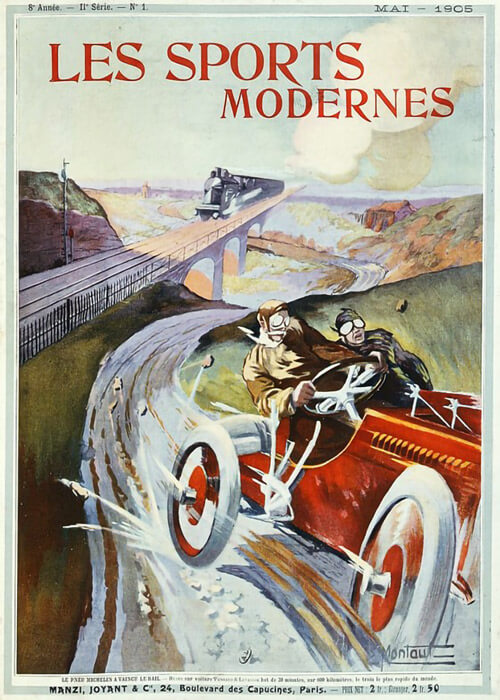
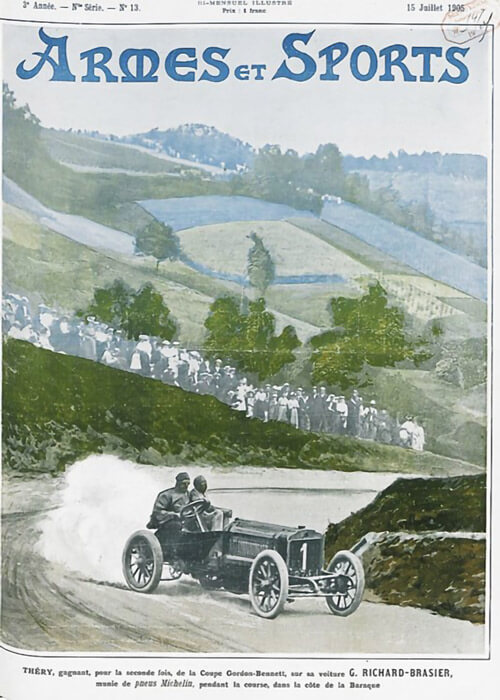
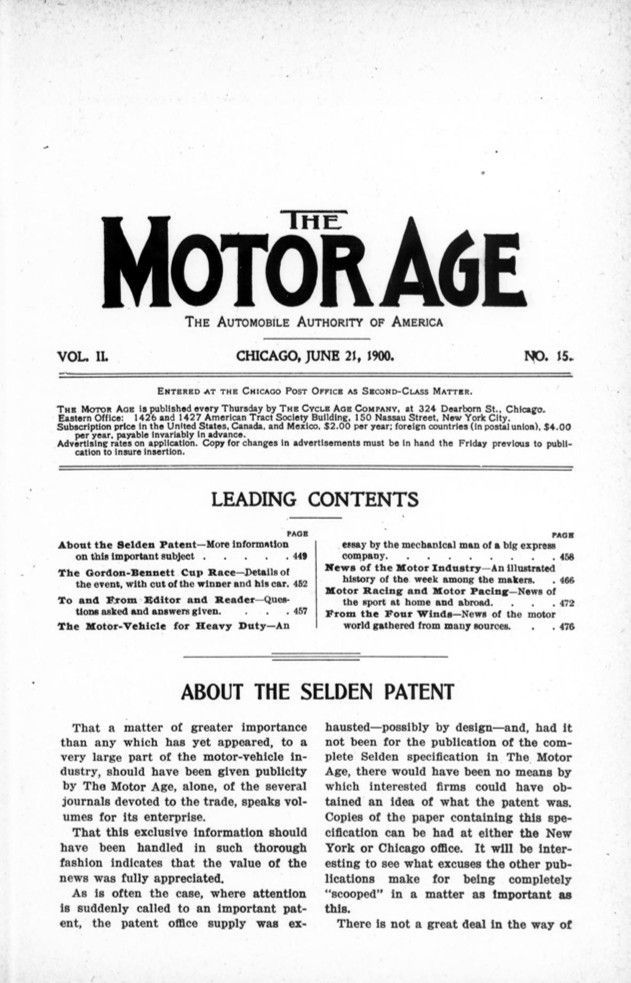
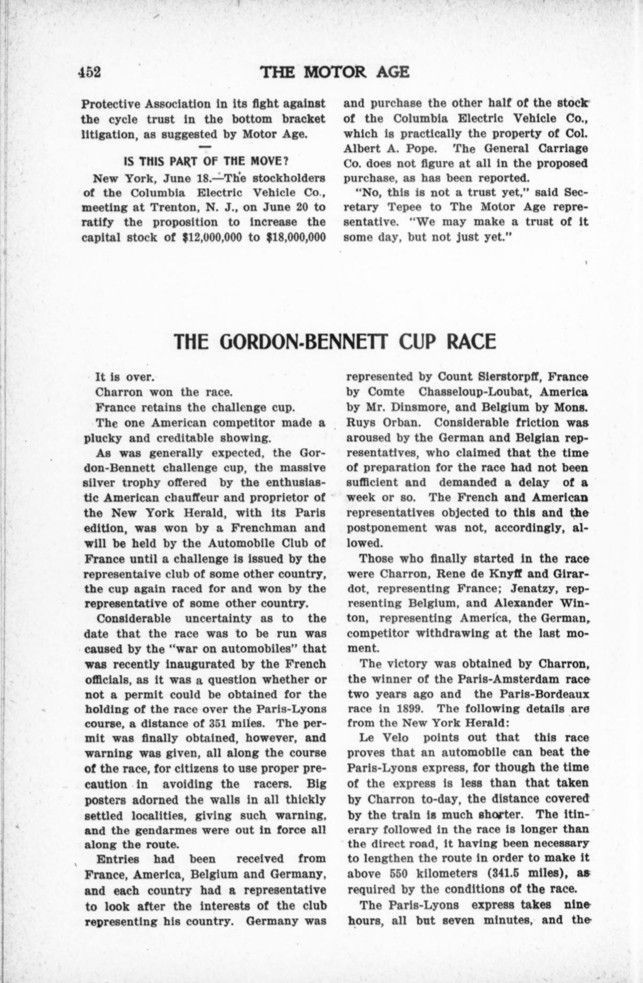
The automotive magazine Motor Age in his second year of existence (and that would be quite longer) reorted for the first time, the first Gordon Bennet Cup race Paris-Lyon. For a young magazine, quite an extensive report, with many details on running times.

With courtesy of Internet Archive archive.org Text and photoscompiled by motorracingistory
MOTOR AGE VOL. II. NO. 15. JUNE 21, 1900.
THE GORDON-BENETT CUP RACE
It is over.
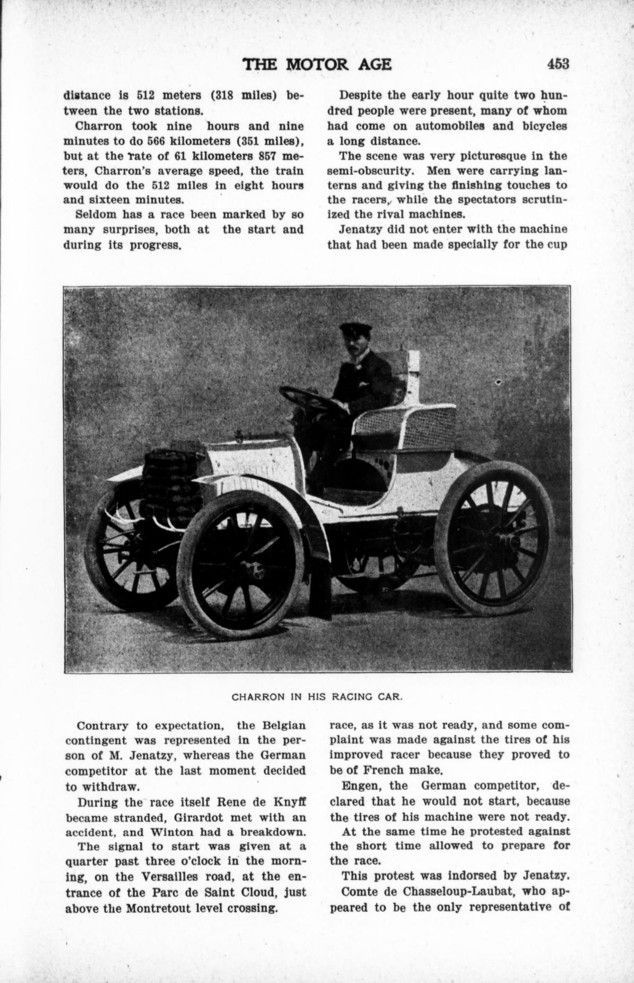
Charron won the race.
France retains the challenge cup.
The one American competitor made a plucky and creditable showing
As was generally expected, the Gordon-Bennett challenge cup, the massive silver trophy offered by the enthusiastic American chauffeur and proprietor of the New York Herald, with its Paris edition, was won by a Frenchman and will be held by the Automobile Club of France until a challenge is issued by the representative club of some other country, the cup again raced for and won by the representative of some other country.
Considerable uncertainty as to the date that the race was to be run was caused by the “war on automobiles” that was recently inaugurated by the French officials, as it was a question whether or not a permit could be obtained for the holding of the race over the Paris-Lyons course, a distance of 351 miles. The permit was finally obtained, however, and warning was given, all along the course of the race, for citizens to use proper precaution in avoiding the racers. Big posters adorned the walls in all thickly settled localities, giving such warning, and the gendarmes were out in force all along the route.
Entries had been received from France, America, Belgium and Germany, and each country had a representative to look after the interests of the club representing his country. Germany was represented by Count Sierstorpff, France by Comte Chasseloup-Loubat, America by Mr. Dinsmore, and Belgium by Mons. Ruys Orban. Considerable friction was aroused by the German and Belgian representatives, who claimed that the time of preparation for the race had not been sufficient and demanded a delay of a week or so. The French and American representatives objected to this, and the postponement was not, accordingly, allowed.
Those who finally started in the race were Charron, Rene de Knyff and Girardot, representing France; Jenatzy, representing Belgium, and Alexander Winton, representing America, the German, competitor withdrawing at the last moment.
The victory was obtained by Charron, the winner of the Paris-Amsterdam race two years ago and the Paris-Bordeaux race in 1899. The following details are from the New York Herald:
Le Velo points out that this race proves that an automobile can beat the Paris-Lyons express, for though the time of the express is less than that taken by Charron today, the distance covered by the train is much shorter. The itinerary followed in the race is longer than the direct road, it having been necessary to lengthen the route in order to make it above 550 kilometers (341.5 miles), as required by the conditions of the race.
The Paris-Lyons express takes nine hours, all but seven minutes, and the distance is 512 (kilo)meters (318 miles) between the two stations.
Charron took nine hours and nine minutes to do 566 kilometers (351 miles), but at the rate of 61 kilometers 857 meters, Charron’s average speed, the train would do the 512 miles in eight hours and sixteen minutes.
Seldom has a race been marked by so many surprises, both at the start and during its progress.
Contrary to expectation, the Belgian contingent was represented in the person of M. Jenatzy, whereas the German competitor at the last moment decided to withdraw.
During the race itself Rene de Knyff became stranded, Girardot met with an accident, and Winton had a breakdown.
The signal to start was given at a quarter past three o’clock in the morning, on the Versailles road, at the entrance of the Parc de Saint Cloud, just above the Montretout level crossing.
Despite the early hour quite two hundred people were present, many of whom had come on automobiles and bicycles a long distance.
The scene was very picturesque in the semi-obscurity. Men were carrying lanterns and giving the finishing touches to the racers, while the spectators scrutinized the rival machines.
Jenatzy did not enter with the machine that had been made specially for the cup race, as it was not ready, and some complaint was made against the tires of his improved racer because they proved to be of French make.
Engen, the German competitor, declared that he would not start, because the tires of his machine were not ready.
At the same time, he protested against the short time allowed to prepare for the race. This protest was indorsed by Jenatzy.
Comte de Chasseloup-Laubat, who appeared to be the only representative of the organizing committee, acted as starter.
M. Edouard de Perrodil’s chronometer marked 3:14 a. m. when the signal was given.
Instantly there was a terrific snorting and the racers’ started at their best speed, going up the sharp incline which follows the tunnel at a rate of sixty kilometers (37¼ miles) an hour.
Rene de Knyff and Girardot led, followed by Charron, Jenatzy and Winton. In a few seconds they were out of sight.
Le Velo publishes the telegrams which its correspondent posted along the route.
At the Picardie gate, entering Versailles, the times were:
Girardot, 3 hours, 23 minutes.
Jenatzy, 3 hours, 23 minutes, 2 seconds.
Charron, 3 hours, 24 minutes.
Winton, 3 hours, 24 minutes, 1 second.
Rene de Knyff, 3 hours, 24 minutes 2 seconds.
At the Buc gate, leaving Versailles, the times were:
Girardot, 3:26:00.
Jenatzy, 3:26:02.
Charron, 3:26:30.
Rene de Knyff, 3:27:00.
Winton, 3:27:04.
At Limours, a distance of thirty kilometers (18.6 miles), the times were:
Girardot, 3:49:15.
Charron, 3:52:00.
Rene de Knyff, 3:53:30.
Winton, 3:59:00.
Jenatzy, 4:29:00.
Levegh, the unofficial competitor, who had started in front of the regular contingent, was noted passing Lemours at a rate of 100 kilometers (62 miles) an hour.
Comte Chasseloup-Laubat passed four hours and fifteen minutes after the start, taking a short cut to rejoin the racers.
At Chateudun, 125 kilometers (95.6 miles), the following times were noted:
Levegh, 4:32:00.
Charron, 5:40:55.
Girardot, 5:41:44.
Jenatzy, 5:51:56.
Winton, 6:28:50.
Mr. Winton went by with a bent wheel in front and one of his rear tires punctured.
At Les Ormes, 154 kilometers (95.6 miles), the times taken were:
Girardot, 5:49:00.
Charron, 5:55:00.
Rene de Knyff, 6:41:00.
Jenatzy, 6:46:00.
From Orleans the correspondent of Le Velo telegraphed that the utmost uncertainty prevailed as to the course which the competitors would take in passing through the city, and it was only by a lucky accident that he was able to catch sight of them.
Girardot arrived in five hours and 53 minutes, and Charron reached the same point in six hours and ten minutes, slowing up to show his rear axle, which had been bent in crossing a gutter three Kilometers away, but nevertheless determined to persevere.
Rene de Knyff turned up in six hours and forty-nine minutes at a walking pace. His fourth speed having been broken shortly after leaving Chartres, he withdrew.
Three minutes later Jenatzy came up with several punctures and two broken fuses but still determined to go on.
On leaving Orleans, Girardot broke a rear wheel against the curbstone in trying to avoid a frightened horse. The damage was hastily repaired at a neighboring blacksmith shop and Girardot resumed the race at five minutes to eight o’clock, thus losing more than an hour.
Mr. Winton reached Orleans at half past eight o’clock. One of his front wheels was buckled and his rear left tire punctured. It was not expected that he would continue.
Levegh had passed Orleans at a tremendous gait at twenty-five minutes after five o’clock.
Reports from Gien, 236 kilometers (146.5 miles) timed:
Charron at quarter past seven.
Jenatzy, twenty-eight minutes past eight.
Girardot, a quarter of nine.
At twenty-five minutes past eleven o’clock Rene de Knyff abandoned the race at this point and returned to Paris, with M. Krebs and Comte de Chasseloup-Laubat.
Nevers, 322 kilometers (200 miles) was passed by Charron at eighteen minutes of nine. Girardot came in at ten minutes past ten.
Charron was still leading at Moulins, 376. kilometers (233% miles), where he arrived at 9:28, going at full speed and running over a dog. He stopped there for supplies. Girardot arrived at 11:04.
At La Palisse, 427 kilometers miles), Charron passed at 10:09, lowed by Girardot at 11:44. This being market day, there was quite a crowd to watch the race.
At Ronne, 476 kilometers (286% miles), Charron passed at 11:03. Girardot reached there at 11:41.
Telegraphing from Lyons, Le Velo’s correspondent announces the receipt of a telegram from Mr. Winton, then at Orleans, declaring his intention to withdraw from the race and return to Paris. Mr. Winton’s return was, however, postponed till he could get a new tire. M. Jenatzy, who was traveling at lightning speed at an early stage of the race, burst his front tires at Chevreuse.
The finish of the international automobile race was placed at the Restaurant des Delices de la Demi Lune, which is a hostelry some ten kilometers out of Lyons. Thither proceeded a perfect swarm of chauffeurs to welcome the victor.
Charron arrived very much exhausted. Another accident to his machine had occurred twelve kilometers (7144 miles) before the finish. This time it was his pump that had been broken by a dog.
Over the festive board, Charron told the story of his exploits while the company was discussing the dessert.
At two o’clock Girardot arrived, and the official times at Lyons are as follows:
1. Charron, 9:09:49.
2. Girardot, 10:30:28.
In the evening the Automobile Bicycle Club of Lyons entertained the two successful chauffeurs. The difficulty which the American automobilist experienced in the contest was that his machine skidded in going round a corner and bumped into an embankment. The effect of this was that although the wheels were left intact, the steering head, made of forged steel, bent to an angle of forty-five degrees, and yet Mr. Winton continued the race. It was only when one of the tires of his rear wheel collapsed that the American automobilist was forced to abandon the race,
“The machine,” said Mr. Shanks, his companion, “developed twenty-three horsepower. It weighed 1,450 pounds. It had too much power and was too light to successfully compete with the high-speed French machines,
“But the fact was demonstrated beyond question that the single cylinder motor, our peculiar type, is practical and does not limit the power to the minimum degree, as is the case with other machines which have been constructed with single cylinders.”
Charron said:
“Future races of this kind must be made much shorter. It is impossible to race at the high speed attained at the recent contest without risking one’s life.
“If this kind of thing continues the result will be that someday there will be for each competing automobile two chauffeurs less in the world. “Now, the Course du Trefle is much more reasonable in this respect.
“I left my automobile to be brought back to Paris by train. Girardot, however, is returning to Paris on his racing machine.
“My automobile requires some adjustment. You remember that near Orleans I ran over a dog. The animal’s body became entangled in the wheels and springs and caused my automobile to bound along in a rather strange fashion. I was going at the rate of ninety kilometers an hour (nearly fifty-six miles).
“Had De Knyff been able to continue, I should have been very much inclined to give up the contest. The springs of my automobile were started, and the pump was carried away by the accident which I have described.
“The speed obtained was perhaps the best that I have ever Officially accomplished, the maximum being at a rate of about 100 kilometers (sixty-two miles) an hour. This was just before entering Lyons, but I am prepared to bet that I can do the distance between Paris and Lyons in about eight hours, providing I take the direct route.
“The road was, taking it as a whole, not bad, but after leaving La Palisse it was impossible to make more than forty-eight kilometers (thirty miles) an hour. This was due to the sharp turnings and gradients.
“The race proves that the Panhard & Levassor machines must be pretty solid to stand the wear and tear of such a speed on such a road.
“The race also shows that the higher the speed the more frequent the accidents and hence the fewer to arrive at the winning post.”
In regard to Levegh’s trip, Charron remarked that it was an easy matter to race when not entered officially, since failure to win did not entail criticism.
As to Jenatzy’s performance, Charron was rather sarcastic. So far as the machine was concerned, it was not a machine selected at a late hour, as was reported, but one originally intended for the race.
Charron values the automobile in which he won at 75,000 francs ($15,000).
Photos.
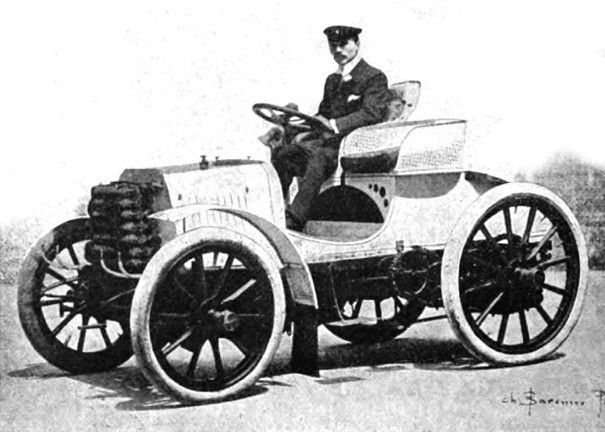
Page 453. CHARRON IN HIS RACING CAR.
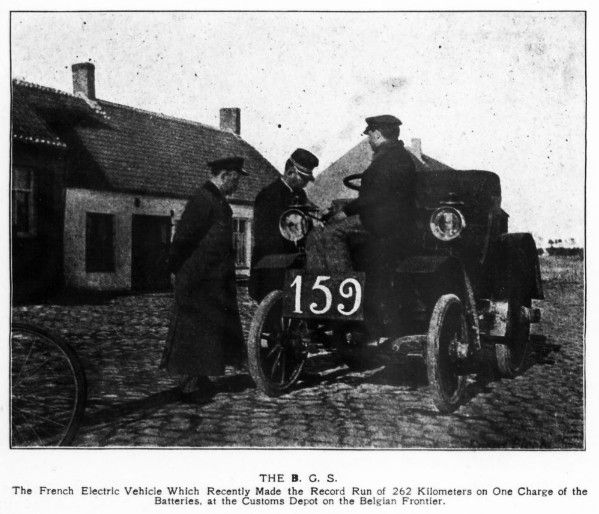
Page 456. THE B. G. S. The French Electric Vehicle Which Recently Made the Record Run of 262 Kilometers on One Charge of the Batteries, at the Customs Depot on the Belgian Frontier.