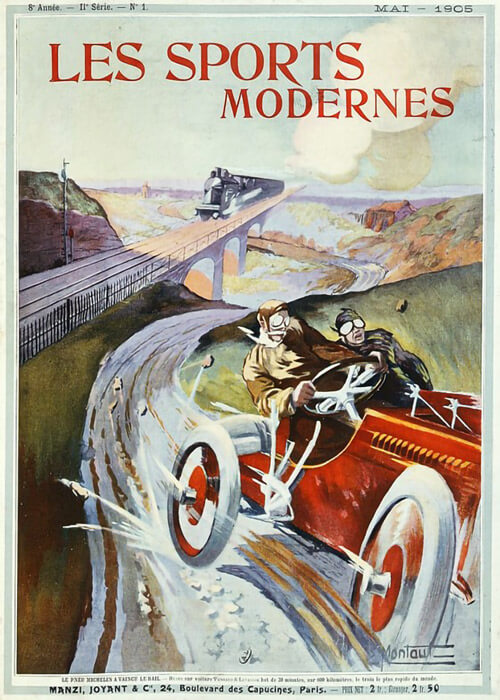
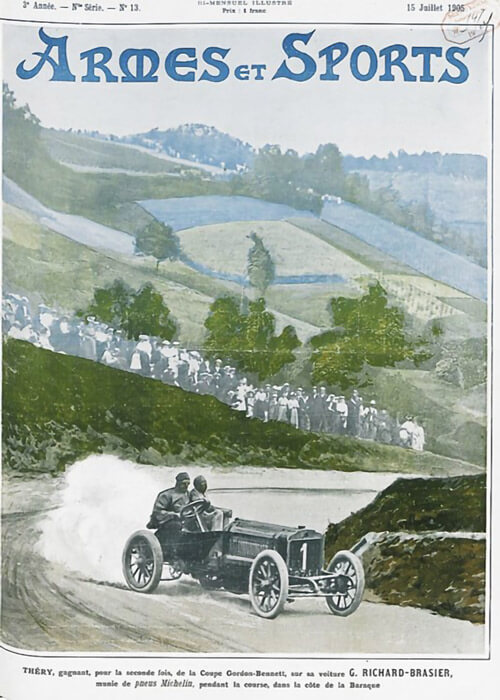
This last article in a series of three of the Automobile Review on the 1904 Gordon Bennett Race gives an overall account being a comparison of several technical features. With this, Automobile Review has completed it’s accounts, written by three different correspondents.
Text and photos with courtesy of hathitrust.org hathitrust.org, compiled by motorracingistory.com
Automobile Review, Vol. 11, No. 2, July 9, 1904
THE GORDON BENNETT CUP RACE
BY GEO. DE OSBORN
Another Account Written expressly for the Automobile Review by our Special French Correspondent
This year’s race for the Gordon Bennett cup will long be remembered as a most exciting event, and at the same time a most satisfactory one as regards the performances of the cars. Never before has the race seen so many competitors assembled, nor has it been held under better conditions than this year. One reason was that it took place in Germany, seeing that country held the cup after Jenatzy’s victory of last year, and the Kaiser, who takes a great interest in automobile matters, personally supervised the preparations for the race and saw that the proper accommodations were afforded, as well as assuring the safety of the route. In this way the accidents which usually accompany high speed races were avoided and the event came off in the most brilliant manner. Thousands of spectators crowded the immense grand stand which had been erected at the starting point, in the middle of which was the Emperor’s box.
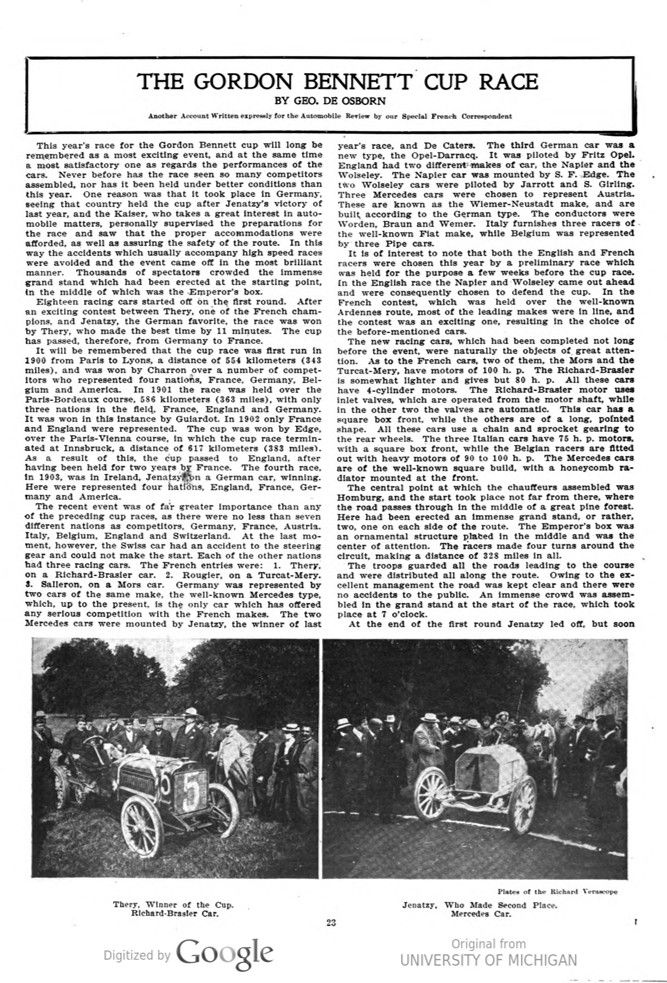
Eighteen racing cars started off on the first round. After an exciting contest between Thery, one of the French champions, and Jenatzy, the German favorite, the race was won by Thery, who made the best time by 11 minutes. The cup has passed, therefore, from Germany to France.
It will be remembered that the cup race was first run in 1900 from Paris to Lyons, a distance of 554 kilometers (343 miles), and was won by Charron over a number of competitors who represented four nations, France, Germany, Belgium and America. In 1901 the race was held over the Paris-Bordeaux course, 586 kilometers (363 miles), with only three nations in the field, France, England and Germany. It was won in this instance by Guiardot. In 1902 only France and England were represented. The cup was won by Edge, over the Paris-Vienna course, in which the cup race terminated at Innsbruck, a distance of 617 kilometers (383 miles). As a result of this, the cup passed to England, after having been held for two years by France. The fourth race, in 1903, was in Ireland, Jenatzy o on a German car, winning. Here were represented four nations, England, France, Ger- many and America. The recent event was of far greater importance than any of the preceding cup races, as there were no less than seven different nations as competitors, Germany, France, Austria. Italy, Belgium, England and Switzerland. At the last moment, however, the Swiss car had an accident to the steering gear and could not make the start. Each of the other nations had three racing cars. The French entries were:
1. Thery, on a Richard-Brasier car.
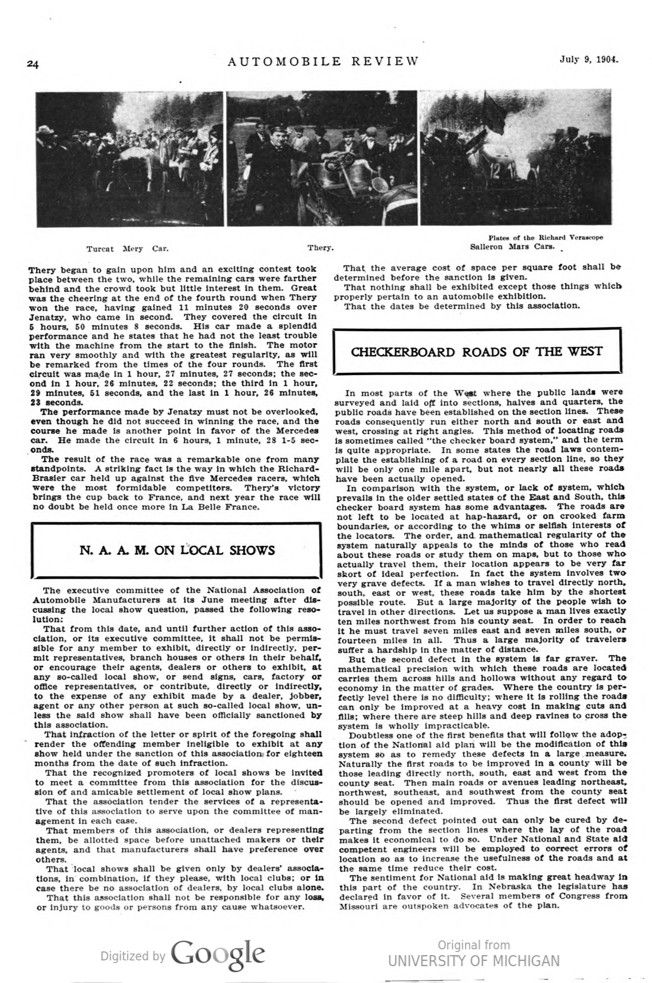
2. Rougier, on a Turcat-Mery.
3. Salleron, on a Mors car.
Germany was represented by two cars of the same make, the well-known Mercedes type, which, up to the present, is the only car which has offered any serious competition with the French makes. The two Mercedes cars were mounted by Jenatzy, the winner of last year’s race, and De Caters. The third German car was a new type, the Opel-Darracq. It was piloted by Fritz Opel. England had two different makes of car, the Napier and the Wolseley. The Napier car was mounted by S. F. Edge. The two Wolseley cars were piloted by Jarrott and S. Girling. Three Mercedes cars were chosen to represent Austria. These are known as the Wiener-Neustadt make, and are built according to the German type. The conductors were Worden, Braun and Wemer. Italy furnishes three racers of the well-known Fiat make, while Belgium was represented by three Pipe cars.
It is of interest to note that both the English and French racers were chosen this year by a preliminary race which was held for the purpose a few weeks before the cup race. In the English race the Napier and Wolseley came out ahead and were consequently chosen to defend the cup. In the French contest, which was held over the well-known Ardennes route, most of the leading makes were in line, and the contest was an exciting one, resulting in the choice of the before-mentioned cars.
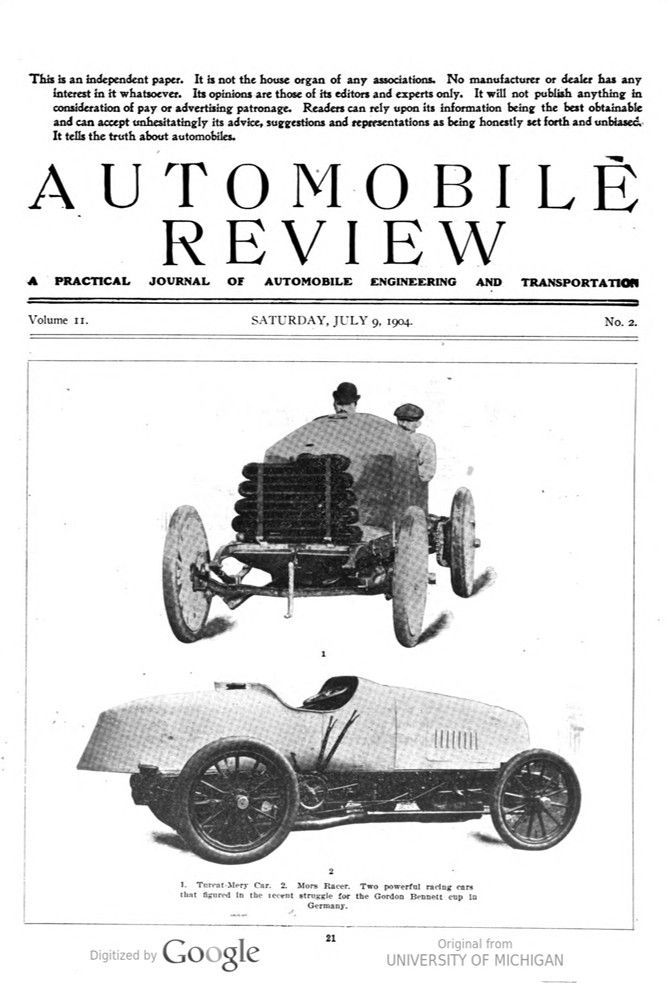
The new racing cars, which had been completed not long before the event, were naturally the objects of great attention. As to the French cars, two of them, the Mors and the Turcat-Mery, have motors of 100 h. p. The Richard-Brasier is somewhat lighter and gives but 80 h. p. All these cars have 4-cylinder motors. The Richard-Brasier motor uses inlet valves, which are operated from the motor shaft, while in the other two the valves are automatic. This car has a square box front, while the others are of a long, pointed shape. All these cars use a chain and sprocket gearing to the rear wheels. The three Italian cars have 75 h. p. motors, with a square box front, while the Belgian racers are fitted out with heavy motors of 90 to 100 h. p. The Mercedes cars are of the well-known square build, with a honeycomb radiator mounted at the front.
The central point at which the chauffeurs assembled was Homburg, and the start took place not far from there, where the road passes through in the middle of a great pine forest. Here had been erected an immense grand stand, or rather, two, one on each side of the route. The Emperor’s box was an ornamental structure placed in the middle and was the center of attention. The racers made four turns around the circuit, making a distance of 328 miles in all.
The troops guarded all the roads leading to the course and were distributed all along the route. Owing to the excellent management the road was kept clear and there were no accidents to the public. An immense crowd was assembled in the grand stand at the start of the race, which took place at 7 o’clock.
At the end of the first round Jenatzy led off, but soon Thery began to gain upon him and an exciting contest took place between the two, while the remaining cars were farther behind and the crowd took but little interest in them. Great was the cheering at the end of the fourth round when Thery won the race, having gained 11 minutes 20 seconds over Jenatzy, who came in second. They covered the circuit in 5 hours, 50 minutes 8 seconds. His car made a splendid performance and he states that he had not the least trouble with the machine from the start to the finish. The motor ran very smoothly and with the greatest regularity, as will be remarked from the times of the four rounds. The first circuit was made in 1 hour, 27 minutes, 27 seconds; the second in 1 hour, 26 minutes, 22 seconds; the third in 1 hour, 29 minutes, 51 seconds, and the last in 1 hour, 26 minutes, 23 seconds.
The performance made by Jenatzy must not be overlooked, even though he did not succeed in winning the race, and the course he made is another point in favor of the Mercedes car. He made the circuit in 6 hours, 1 minute, 28 1-5 seconds.
The result of the race was a remarkable one from many standpoints. A striking fact is the way in which the Richard-Brasier car held up against the five Mercedes racers, which were the most formidable competitors. Thery’s victory brings the cup back to France, and next year the race will no doubt be held once more in La Belle France.
Photos.
Page 23.
Thery, Winner of the Cup. Richard-Brasler Car. – Jenatzy, Who Made Second Place. Mercedes Car. (Plates of the Richard Verascope)
Page 24.
Turcat Mery Car. – Thery. – Salleron Mors Cars. (Plates of the Richard Verascope)