Shortly after the 1904 Gordon Bennett Cup Race in the Taunus mountainous area was held, the Scientific American here postst a short and concise summary of that race. That was quick! A week later, a more comprehesive account of that race would follow.
Text and photos with courtesy of hathitrust hathitrust.org, compiled by motorracingistory.com.
Scientific American Vol. 91, No. 1, July 2, 1904.
THE FIFTH INTERNATIONAL AUTOMOBILE CUP RACE.
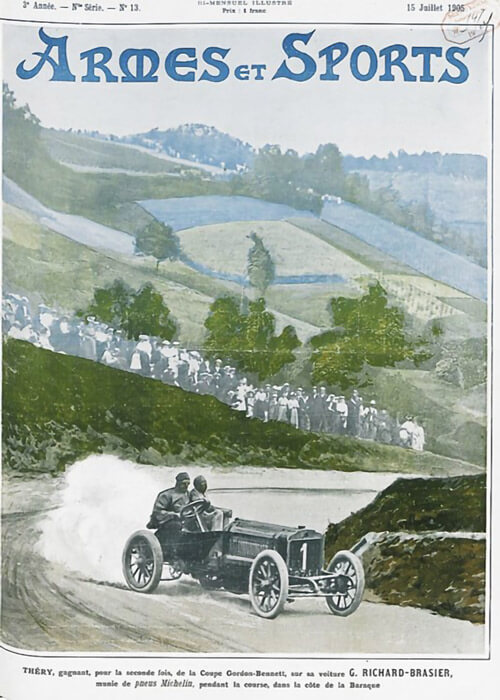
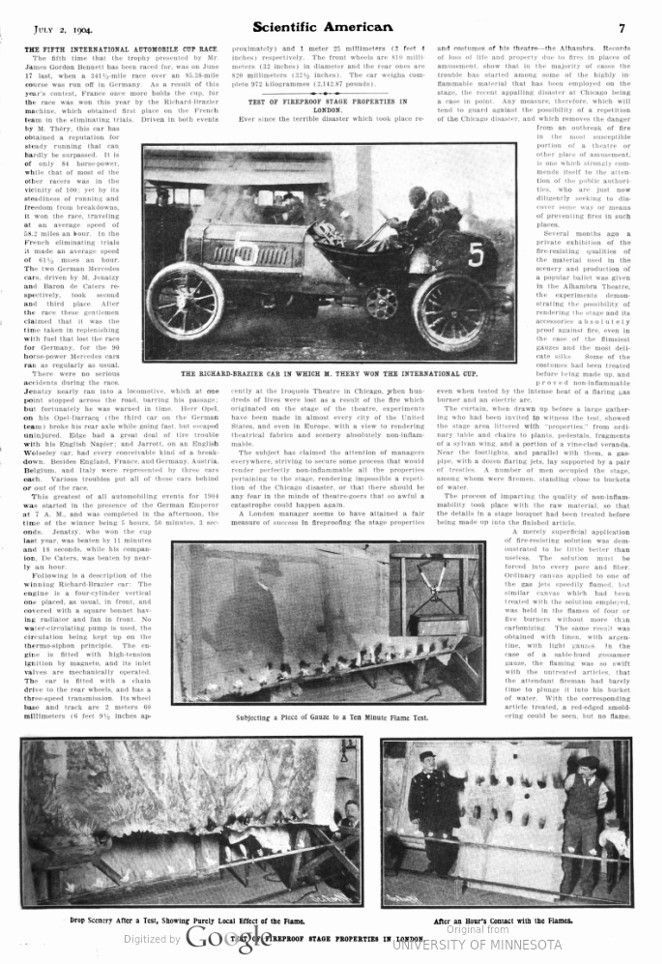
The fifth time that the trophy presented by Mr. James Gordon Bennett has been raced for, was on June 17 last, when a 341½-mile race over an 85.38-mile course was run off in Germany. As a result of this year’s contest, France once more holds the cup, for the race was won this year by the Richard-Brazier machine, which obtained first place on the French team in the eliminating trials.
Driven in both events by M. Théry, this car has obtained a reputation for steady running that can hardly be surpassed. It is of only 84 horsepower, while that of most of the other racers was in the vicinity of 100; yet by its steadiness of running and freedom from breakdowns, it won the race, traveling at an average speed of 58.2 miles an hour. In the French eliminating trials it made an average speed of 61½ miles an hour. The two German Mercedes cars, driven by M. Jenatzy and Baron de Caters respectively, took second and third place. After the race these gentlemen claimed that it was the time taken in replenishing with fuel that lost the race for Germany, for the 90 horse-power Mercedes cars ran as regularly as usual.
There were no serious accidents during the race. Jenatzy nearly ran into a locomotive, which at one point stopped across the road, barring his passage; but fortunately, he was warned in time. Herr Opel, on his Opel-Darracq (the third car on the German team) broke his rear axle while going fast, but escaped uninjured. Edge had a great deal of tire trouble with his English Napier; and Jarrott, on an English Wolseley car, had every conceivable kind of a breakdown. Besides England, France, and Germany, Austria, Belgium, and Italy were represented by three cars each. Various troubles put all of these cars behind or out of the race.
This greatest of all automobiling events for 1904 was started in the presence of the German Emperor at 7 A. M., and was completed in the afternoon, the time of the winner being 5 hours, 50 minutes, 3 seconds. Jenatzy, who won the cup last year, was beaten by 11 minutes and 18 seconds, while his companion, De Caters, was beaten by nearly an hour.
Following is a description of the winning Richard-Brazier car: The engine is a four-cylinder vertical one placed, as usual, in front, and covered with a square bonnet having radiator and fan in front. No water-circulating pump is used, the circulation being kept up on the thermo-siphon principle. The engine is fitted with high-tension ignition by magneto, and its inlet valves are mechanically operated. The car is fitted with a chain drive to the rear wheels, and has a three-speed transmission. Its wheel base and track are 2 meters 60 millimeters (6 feet 9½ inches approximately) and 1 meter 25 millimeters (3 feet 4 inches) respectively. The front wheels are 810 milli- meters (32 inches) in diameter and the rear ones are 820 millimeters (32½ inches). The car weighs complete 972 kilogrammes (2,142.87 pounds).
Photo.
Page 7. THE RICHARD-BRAZIER CAR IN WHICH M. THERY WON THE INTERNATIONAL CUP.