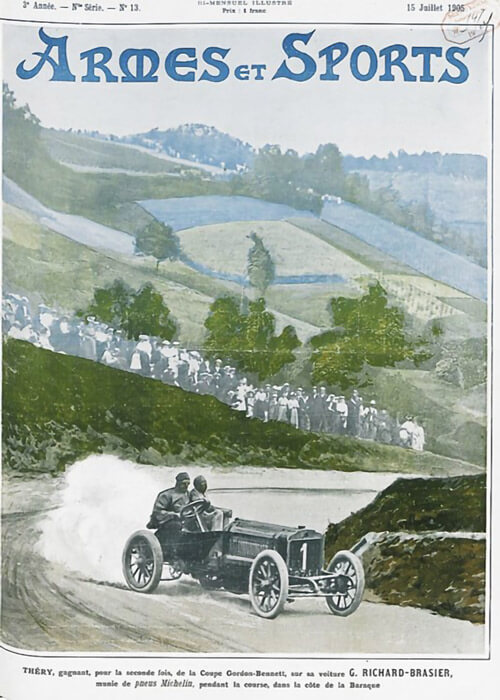
This now is the extended version for the 1904 Gordon Bennett Cup Race in Germany, around the Kaiser’s summer residence. The start, the envelopping of the race as well as various finishing times are given here. And then, technical descriptions of some of the most interesting French cars are given, such as the Richard-Brasier, the Turcat-Méry and the Mors. Finally, Belgian and Italian cars are briefly discussed.
Text and photos with courtesy of hathitrust hathitrust.org, compiled by motorracingistory.com.
Scientific American Vol. 91, No. 2, July 9, 1904.
THE GORDON BENNETT CUP RACE.
BY SPECIAL CORRESPONDENT OF THE SCIENTIFIC AMERICAN.
No less than six different nations were represented in the cup race this year, and it proved an event of the greatest interest. The race was held in Germany, and the Kaiser took an active hand in carrying out the arrangements.
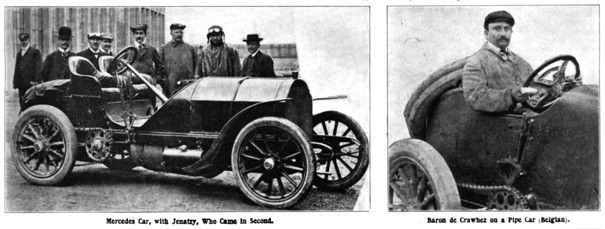
The starters in the race were as follows: Germany had three representatives, Jenatzy and Baron De Caters, each on a Mercedes car, and Fritz Opel on an Opel-Darracq. England was championed by Edge on a Napier car, and Sidney Girling and Jarratt, each on a Wolseley. The three Austrian cars were also of the Mercedes type but were built at the Vienna works. They were mounted by Werner, Braun, and Warden. The latter is the well-known American chauffeur. Belgium was represented by three racers of the Pipe make, piloted by Baron de Crawhez, Hautvast, and Angieres. The three French racers are of different makes and these cars were the winners in the eliminating trials, which were held before the cup race. The Richard-Brasier car was mounted by Théry, the Mors car by Salleron, and the Turcat-Méry (De Dietrich make) by Rougier. Italy had also three cars, all of the Fiat make, piloted by Cagno, Lancia, and Storero. The Swiss car of the Dufaux make was unable to start at the last minute on account of an accident.
This gave a formidable array of eighteen racing cars, which is by far the largest number which has yet entered the Cup race. This made the race of greater interest this year than ever before, and it thus represented a great industrial battle between the different nations, some of which were already in the front rank, while the others were making their début. The cars were all weighed just before the start, and all came very close to the limit weight of 2,200 pounds. The German cars were painted white, the English green, the Austrian black and yellow, the Italian black, the French blue, and the Belgian yellow.
The route which was chosen for the Cup race lies in the Taunus region, to the north of Frankfort and not far from the Rhine. The route makes a somewhat elliptical circuit, passing through Limburg, Weilburg, Usingen, and Homburg, besides a number of smaller towns. The starting point of the race was chosen at a point near Homburg, known as the Saalburg. The part of the road which lies through the towns was neutralized, and did not count in the racing distance. There were ten control points on the route. The total racing distance for the four rounds which the cars had to make is 528 kilometers (327 miles). The condition of the road in the circuit is reasonably good, but there are some very steep grades and a number of short turns, which gave a severe strain on the cars.
One of the main points to be noticed in this year’s event is the large proportion of well-tried racers, representing the leading makes. It was not so in last year’s race; although there were as many as twelve competitors, many of them had not made much of a record on the road. In the front rank this year were six Mercedes cars. Three of these had been built in Austria, but on the same lines as the German cars. The French team was represented by three of the leading makes, each of which had already distinguished itself in the different races, and these cars were only chosen after a severe contest in the eliminating trials, where they came out ahead of other competitors, who were also record-winners. It seemed certain from the start that the struggle would be between the French and German teams; then came the English, Belgian, and Italian, which are in the second rank.
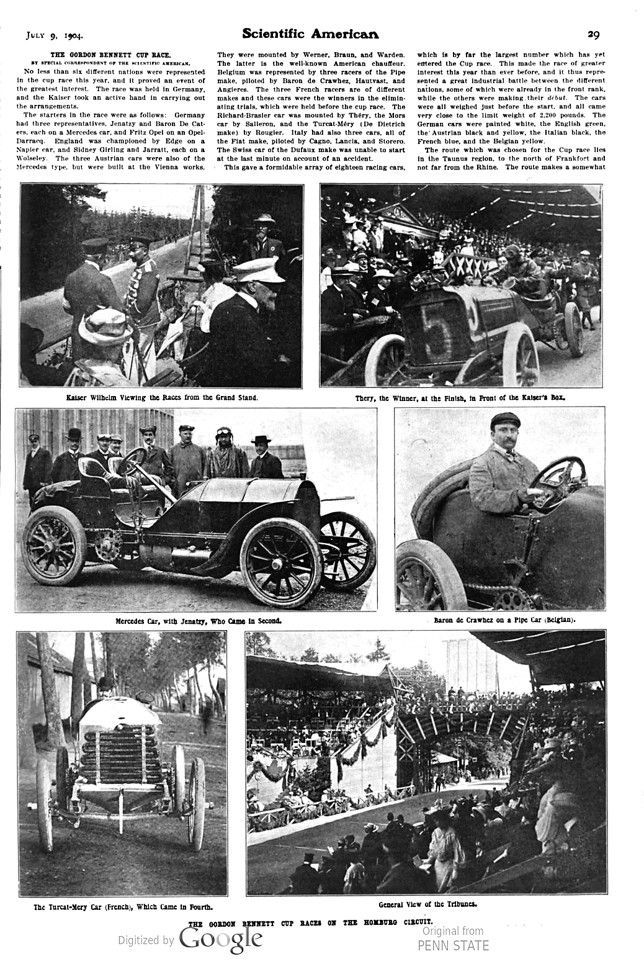
The start was to take place from the Saalburg at 7 o’clock in the morning. At daybreak everybody was up, and the starting point was the scene of great animation. The chauffeurs looked after their cars and made the final preparations, while an immense crowd began to assemble, and take their places in the tribunes or along the track. Excellent order was maintained among the crowds by the large number of troops, which had been called out for the occasion. The Kaiser arrived from the neighboring town, where he had spent the night. He appeared on horseback, while the Empress accompanied him in a carriage. With him came the Crown Prince and other members of the royal family. The Kaiser took his place in the imperial tribune amid great cheering and shook hands with the principal competitors. The tribunes were filled to overflowing with an immense crowd, among which were chauffeurs from all parts of the world. The excitement increased as the time approached for the start. Jenatzy was the first in line with his Mercedes car. At the signal he made a superb start amid wild cheering and was soon out of sight.
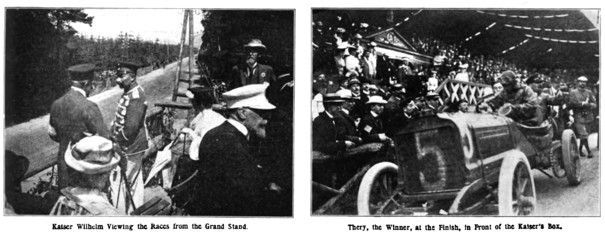
Edge, on his Napier car, followed at an interval of seven minutes, and after him came Werner, and so on for the eighteen competitors. In general, all the cars made a good start, except that of De Caters, which had some difficulty with the ignition, and was thereby delayed some minutes. Jenatzy was the first to make the turn. He appeared in sight and passed at lightning speed. Shortly after him came Edge, who appeared to be in good form. He was followed very closely by Théry, who had started fifth in order, but passed two of the other competitors en route. His time for the first round was but one-half second behind that of Jenatzy.
The time for each round was posted on an immense bulletin board as each car passed the line. On the first round the English team held a good place, followed by Salleron on his Mors car. However, the interest of the race was centered in the match between Théry and Jenatzy, as it seemed certain that one or the other would win.
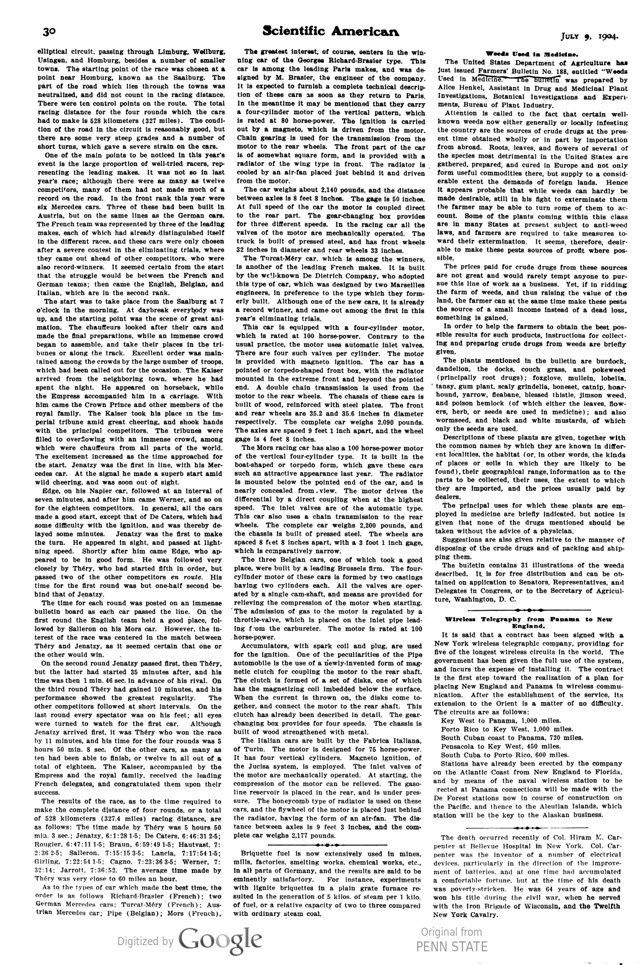
On the second round Jenatzy passed first, then Théry, but the latter had started 35 minutes after, and his time was then 1 min. 46 sec. in advance of his rival. On the third round Théry had gained 10 minutes, and his performance showed the greatest regularity. The other competitors followed at short intervals. On the last round every spectator was on his feet; all eyes were turned to watch for the first car. Although Jenatzy arrived first, it was Théry who won the race by 11 minutes, and his time for the four rounds was 5 hours 50 min. 8 sec. Of the other cars, as many as ten had been able to finish, or twelve in all out of a total of eighteen. The Kaiser, accompanied by the Empress and the royal family, received the leading French delegates, and congratulated them upon their success.
The results of the race, as to the time required to make the complete distance of four rounds, or a total of 528 kilometers (327.4 miles) racing distance, are as follows: The time made by Théry was 5 hours 50 min. 3 sec.; Jenatzy, 6:1:28 1-5; De Caters, 6:46:31 2-5; Rougier, 6:47:11 1-5; Braun, 6:59:49 1-5; Hautvast, 7: 2:36 2-5; Salleron, 7:15:15 3-5; Lancia, 7:17:54 1-5; Girling, 7:22:54 1-5; Cagno, 7:23:36 3-5; Werner, 7: 32:14; Jarrott, 7:36:52. The average time made by Théry was very close to 60 miles an hour.
As to the types of car which made the best time, the order is as follows Richard-Brasier (French); two German Mercedes cars; Turcat-Méry (French); Austrian Mercedes car; Pipe (Belgian); Mors (French).
The greatest interest, of course, centers in the winning car of the Georges Richard-Brasier type. This car is among the leading Paris makes, and was designed by M. Brasier, the engineer of the company. It is expected to furnish a complete technical description of these cars as soon as they return to Paris, In the meantime it may be mentioned that they carry a four-cylinder motor of the vertical pattern, which is rated at 80 horsepower. The ignition is carried out by a magneto, which is driven from the motor. Chain gearing is used for the transmission from the motor to the rear wheels. The front part of the car is of somewhat square form and is provided with a radiator of the wing type in front. The radiator is cooled by an air-fan placed just behind it and driven from the motor.
The car weighs about 2,140 pounds, and the distance between axles is 8 feet 8 inches. The gage is 50 inches. At full speed of the car the motor is coupled direct to the rear part. The gear-changing box provides for three different speeds. In the racing car all the valves of the motor are mechanically operated. The truck is built of pressed steel and has front wheels 32 inches in diameter and rear wheels 33 inches.
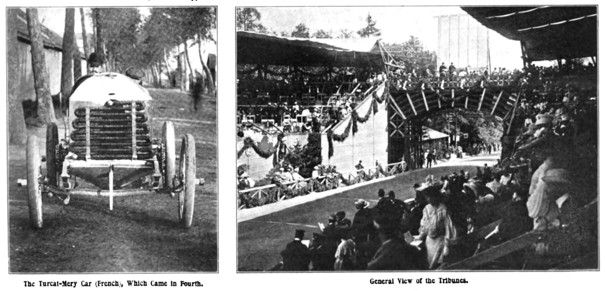
The Turcat-Méry car, which is among the winners, is another of the leading French makes. It is built by the well-known De Dietrich Company, who adopted this type of car, which was designed by two Marseilles engineers, in preference to the type which they formerly built. Although one of the new cars, it is already a record winner, and came out among the first in this year’s eliminating trials.
This car is equipped with a four-cylinder motor, which is rated at 100 horse-power. Contrary to the usual practice, the motor uses automatic inlet valves. There are four such valves per cylinder. The motor is provided with magneto ignition. The car has a pointed or torpedo-shaped front box, with the radiator mounted in the extreme front and beyond the pointed end. A double chain transmission is used from the motor to the rear wheels. The chassis of these cars is built of wood, reinforced with steel plates. The front and rear wheels are 35.2 and 35.6 inches in diameter respectively. The complete car weighs 2,090 pounds. The axles are spaced 9 feet 1 inch apart, and the wheel gage is 4 feet 8 inches.
The Mors racing car has also a 100 horse-power motor of the vertical four-cylinder type. It is built in the boat-shaped or torpedo form, which gave these cars such an attractive appearance last year. The radiator is mounted below the pointed end of the car, and is nearly concealed from view. The motor drives the differential by a direct coupling when at the highest speed. The inlet valves are of the automatic type. This car also uses a chain transmission to the rear wheels. The complete car weighs 2,200 pounds, and the chassis is built of pressed steel. The wheels are spaced 8 feet 8 inches apart, with a 3-foot 1 inch gage, which is comparatively narrow.
The three Belgian cars, one of which took a good place, were built by a leading Brussels firm. The four-cylinder motor of these cars is formed by two castings having two cylinders each. All the valves are operated by a single camshaft, and means are provided for relieving the compression of the motor when starting. The admission of gas to the motor is regulated by a throttle-valve, which is placed on the inlet pipe leading from the carbureter. The motor is rated at 100 horse-power.
Accumulators, with spark coil and plug, are used for the ignition. One of the peculiarities of the Pipe automobile is the use of a newly invented form of magnetic clutch for coupling the motor to the rear shaft. The clutch is formed of a set of disks, one of which has the magnetizing coil imbedded below the surface. When the current is thrown on, the disks come together, and connect the motor to the rear shaft. This clutch has already been described in detail. The gear- changing box provides for four speeds. The chassis is built of wood strengthened with metal.
The Italian cars are built by the Fabrica Italiana, of Turin. The motor is designed for 75 horse-power. It has four vertical cylinders. Magneto ignition, of the Jucisa system, is employed. The inlet valves of the motor are mechanically operated. At starting, the compression of the motor can be relieved. The gasoline reservoir is placed in the rear, and is under pressure. The honeycomb type of radiator is used on these cars, and the flywheel of the motor is placed just behind the radiator, having the form of an air-fan. The distance between axles is 9 feet 3 inches, and the complete car weighs 2,177 pounds.
Photos.
Page 29.
Kaiser Wilhelm Viewing the Races from the Grand-Stand. – Thery, the Winner, at the Finish, in Front of the Kaiser’s Box.
Mercedes Car, with Jenatzy, Who Came in Second. – Baron de Crawhez on a Pipe Car (Belgian).
Turcat-Mery Car (French), Which Came in Fourth. – General View of the Tribunes.
THE GORDON BENNETT CUP RACES ON THE HOMBURG CIRCUIT.