This Scientific American description, published a few months after the 1894 Paris-Rouen Trials, refers to a French article of E. Hospitalier in a July 1895 issue of “La Nature”. It shows a fine summary of some of the most signifcant carriages, of the trial.
Text and fotos by courtesy of hathitrust.org, USA hathitrust.org, compiled by motorracinghistory.com
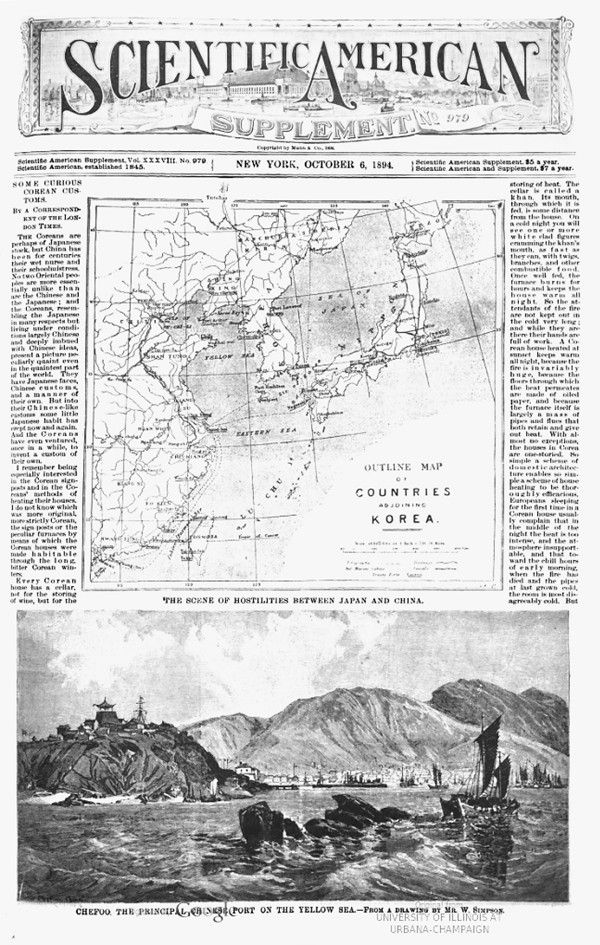
Scientific American Supplement, Vol. XXXVIII. No. 979, October 6, 1894.
Automobile Carriages. The Competition organized by the Petit Journal.
IN organizing the competition of carriages without horses, the Petit Journal has taken a happy and interesting initiative, which, moreover, is in conformity with those constant endeavors to which the success of this popular organ is due, viz., to urge forward the development of open air exercises by cycling and walking, and the development of the social well-being by locomotion, individual or collective, facilitated upon the highways at the will of each. After the cycle race of Paris-Brest in 1891 and that of Paris-Belfort in the same year, the race of carriages without horses of 1894 was the third test of a series that we trust may be long and prosperous. The announcement of this competition was made on the 19th of December with a most simple programme, which in substance was as follows: The competition to be international; mechanical propellers of all sorts; carriages of all forms: number of seats ad libitum, with a minimum accommodation for two passengers; preliminary experiments over a distance of about 30 miles with a speed of 7.5 miles an hour, without a greater speed being taken into account; definitive test upon the road from Paris to Rouen, a distance of 75 miles; engagements accepted from December 29, 1893, to April 30, 1894; competition reserved exclusively for inventors and builders of mechanical carriages; the first prize to be awarded to the carriage that shall fulfill the conditions of being free from danger, easily manageable by the occupants, and not costing too much upon the route.
The carriages were judged exclusively by the editorial and business staff of the Petit Journal, in connection, in an advisory way, with a certain number of engineers who were witnesses of the experiments and gave their technical opinions and the results of their observations to the juries that they accompanied in the different tests.
Ten thousand francs were to be distributed in prizes. The first prize of 5,000 francs was offered by the Petit Journal; four other prizes of the respective values of 2,000, 1.500, 1,000 and 500 francs, were due to the liberality of Mr. Marinoni.
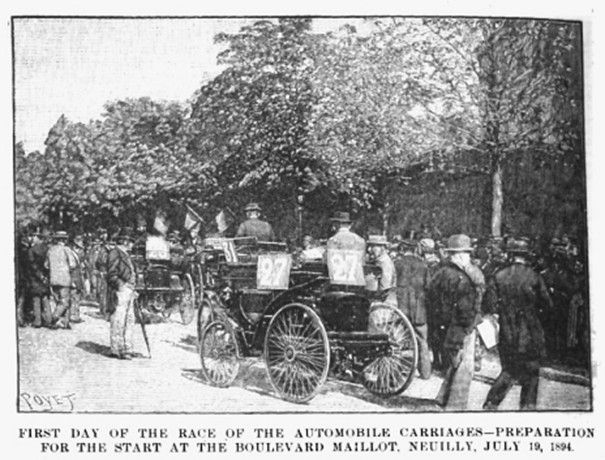
The entries registered up to the date of April 30 reached the imposing number of one hundred and two vehicles, but at the moment of the tests that took place on the 19th, 20th, 21st and 22d of July, only Time, forty-seven competitors presented themselves. which is a great master, successively eliminated all the fanciful contrivances, such as gravity motors, with levers, utilizing the weight of the passengers, carriages utilizing steam, compressed air or gas indistinctly (sic), and all the competitors whose systems were ill adapted for undergoing the severe tests imposed by the Petit Journal. Time eliminated likewise all those who, having presumed too much upon their forces, were not ready after the delay asked for, despite a first postponement of the date of the experiments, made at the request of those interested, the competition having been fixed in the first place for the 9th of June. The programme was faithfully and punctually carried out.
The first day of the preliminary test (July 18) saw 23 competitors entered, 17 of which took part in the race over four distinct courses drawn by lot. Thirteen carriages were admitted to take part in the definitive tests.
On the second day the 27 competitors that had entered a few days before were reduced to 20, only six of which started and were all admitted to the definitive tests. The third day, which was reserved for those late on the preceding days, saw present but two competitors that were admitted. This carried the total number of vehicles capable of participating in the final tests to 21.
This is a most satisfactory result when we take into account the special difficulties of the problem.
What, in fact, are the motive systems, few in number, to which recourse can be had for the propulsion of an autonomous vehicle? They can be divided into two classes, according as the energy necessary for such propulsion is stored up in a reservoir ready to produce its action at any given moment, with a power instantly variable at will, or as such energy is produced at every instant through the utilization (generally in the form of fuel) of an energy of chemical affinity or of combination which finds, right in the air that surrounds us, the complementary combustive indispensable.
In the first class may be arranged springs, compressed air and electric accumulators. The feeble storage power of springs renders them inapplicable. The age is the case with compressed air, and also, taking distance into account, with electric accumulators.
It requires, moreover, for all reservoirs of energy, charging works, that are now, and will be for a long time, lacking, whatever be the process employed. Every time the carriage, by destination, will be obliged to furnish long trips without re-entering the station. This explains the absence of electric carriages from the Petit Journal’s competition. The carriage with electric accumulators is, in our opinion, the coach of the future, but of a remote one. It cannot pretend to the role of an excursion carriage.
In the second class may be arranged the motive systems that produce their energy directly without previous storage, and that utilize the energy of chemical affinity of a combustible in passing through heat either directly (petroleum, gasoline and hot air motors) or indirectly, in passing through steam produced by the combustion of coal, coke or petroleum, or even through of petroleum produced by the combustion of the vapor such vapor.
Petroleum vapor motors are not yet much employed, and hot air motors heated by coke are too heavy and too cumbersome and lack flexibility in their power. They are, therefore, naturally eliminated.
Nothing more that is possible remains (and the competition has demonstrated it) but the following systems: (1) Petroleum motors; (2) steam motors heated with coke; (3) steam motors heated with petroleum.
Coke and petroleum are fuels that are met with everywhere, and are easily stored, and of a reasonable price, and water is rarely wanting. These three systems are, therefore, sensibly equivalent from this point of view.
It is the ingenuity of the amateur and the skill of the builder that can establish differences that it is well not to prejudge. It is necessary to know all the conditions of the operation of the system.
The vehicles that underwent all the tests successfully were fifteen in number, thus divided: Petroleum and gasoline motors, 13; steam motors heated with coke, 2.
The fifteen fortunate competitors, starting from Paris at 8 o’clock in the morning, reached Rouen within the limits fixed by the competition, with a genuine speed much greater than 7.5 miles an hour, since the commercial speed (stoppages included) of the slowest vehicle exceeded this figure.
The following is a list of these fifteen carriages, by order of arrival and by hour:
No. 4 De Dion, 4-passenger, steam,………. 5 h. 40 m.
“ 65 Peugeot, petroleum,…………………….. 5 h. 40 m.
“ 28 ” “ ………………………… 5 h. 50 m.
“ 13 Penhard & Levassor, 4-pas., pet.,…. 6 h. 3 m.
“ 31 Peugeot, 5-passenger, petroleum,. 6 h. 7 m.
“ 42 Le Brun, 4 “ “ …….. 6 h. 24 m.
“ 15 Penhard & Levassor, 2-pas., pet.,…. 6 h. 30 m.
“ 64 “ “ “ “ ……… 6 h. 49 m
“ 53 De Bourmont, 4 “ “ ……. 7 h. 1 m.
“ 30 Peugeot, 3 “ “ ……. 7 h. 2 m.
“ 24 Vacheron, 2 “ gasol……… 7 h. 3 m.
“ 27 Peugeot, 2 “ “ ……… 7 h. 5 m.
“ 14 Penhard & Lavassor, 4 “ pet.,…… 7 h. 10 m.
“ 85 Roger, 4 “ “ …….. 8 h. 9 m.
“ 60 Le Blaut, 8 “ steam,…… 8 h. 50 m.
These are the systems, which have already been seen and have for a long time been experimented with, that divided the prize of 10,000 francs. Such a result had long been foreseen.
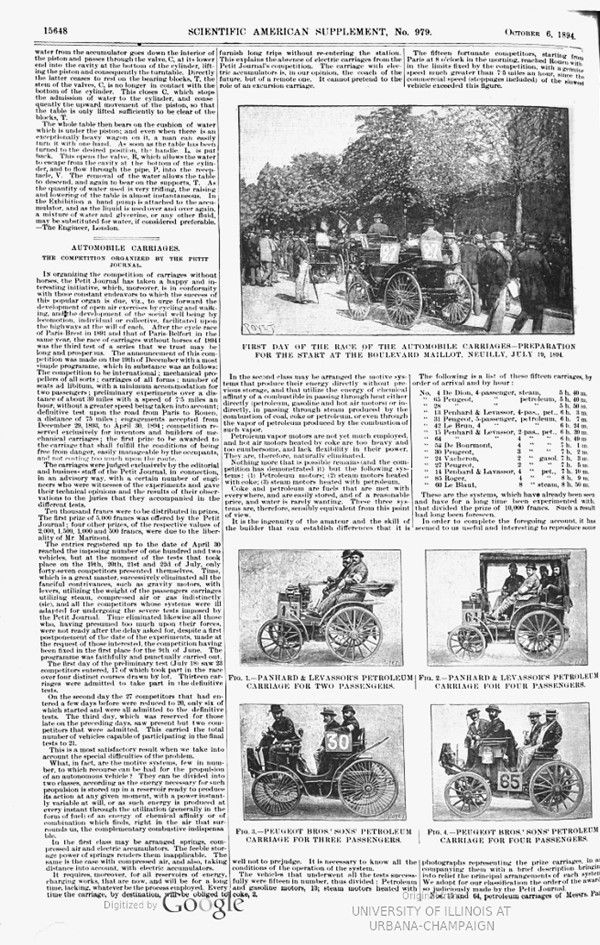
In order to complete the foregoing account, it has seemed to us useful and interesting to reproduce some photographs representing the prize carriages, in accompanying them with a brief description bringing into relief the principal arrangements of each system. We adopt for our classification the order of the awards so judiciously made by the Petit Journal.
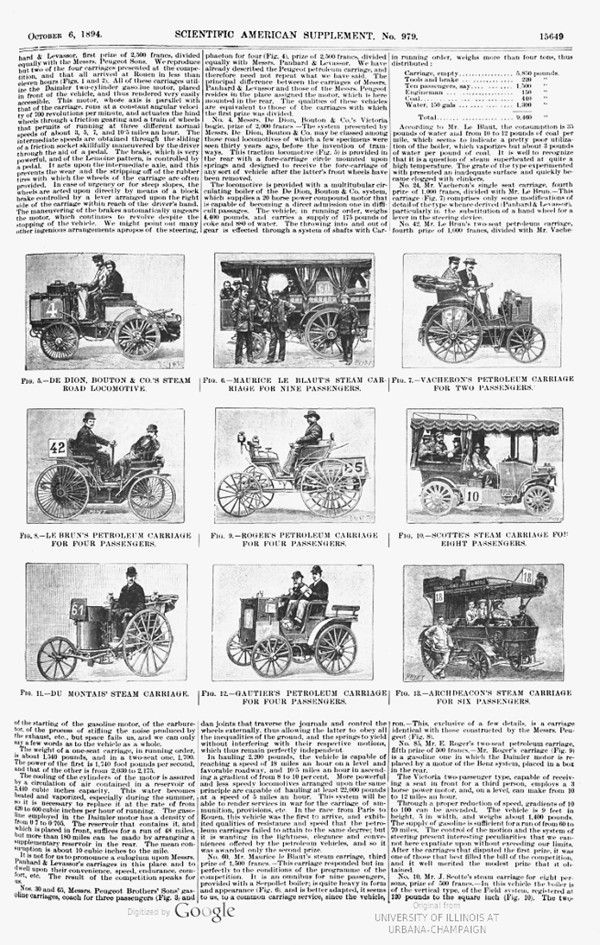
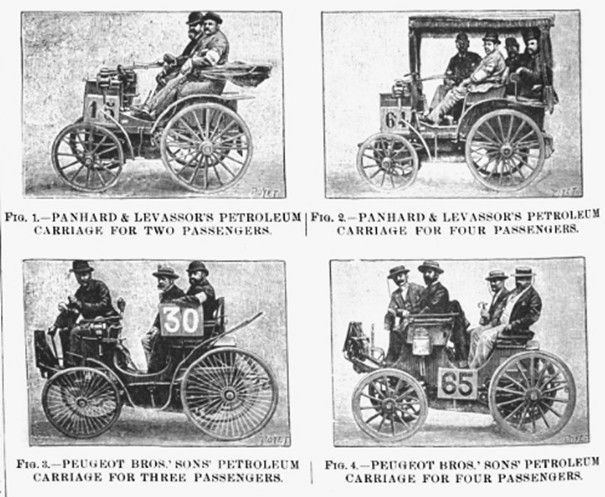
Nos. 15 and 64, petroleum carriages of Messrs. Panhard & Levassor, first prize of 2,500 francs, divided equally with the Messrs. Peugeot Sons. We reproduce but two of the four carriages presented at the competition, and that all arrived at Rouen in less than eleven hours (Figs. 1 and 2). All of these carriages utilize the Daimler two-cylinder gasoline motor, placed in front of the vehicle, and thus rendered very easily accessible. This motor, whose axis is parallel with that of the carriage, runs at a constant angular velocity of 700 revolutions per minute, and actuates the hind wheels through a friction gearing and a train of wheels that permits of running at three different normal speeds of about 3, 5, 7, and 10.5 miles an hour. The intermediate speeds are obtained through the sliding of a friction socket skillfully maneuvered by the driver through the aid of a pedal. The brake, which is very powerful, and of the Lemoine pattern, is controlled by a pedal. It acts upon the intermediate axle, and this prevents the wear and the stripping off of the rubber tires with which the wheels of the carriage are often provided. In case of urgency or for steep slopes, the wheels are acted upon directly by means of a block brake controlled by a lever arranged upon the right side of the carriage within reach of the driver’s hand.
The maneuvering of the brakes a automatically ungears the motor, which continues to revolve despite the stopping of the vehicle. We might point out many other ingenious arrangements apropos of the steering, of the starting of the gasoline motor, of the carburetor, of the process of stifling the noise produced by the exhaust, etc., but space fails us, and we can only say a few words as to the vehicle as a whole.
The weight of a one-seat carriage, in running order, is about 1,540 pounds, and in a two-seat one, 1,700. The power of the first is 1,740-foot pounds per second, and that of the other is from 2,030 to 2.175.
The cooling of the cylinders of the motor is assured by a circulation of air contained in a reservoir of 2,440 cubic inches capacity. This water becomes heated and vaporized, especially during the summer, so it is necessary to replace it at the rate of from 420 to 600 cubic inches per hour of running. The gasoline employed in the Daimler motor has a density of from 0.7 to 0.705. The reservoir that contains it, and which is placed in front, suffices for a run of 48 miles, but more than 180 miles can be made by arranging a supplementary reservoir in the rear. The mean consumption is about 10 cubic inches to the mile.
It is not for us to pronounce a eulogium upon Messrs. Panhard & Levassor’s carriages in this place. and to dwell upon their convenience, speed, endurance, comfort, etc. The result of the competition speaks for us.
Nos. 30 and 65, Messrs. Peugeot Brothers’ Sons’ gasoline carriages, coach for three passengers (Fig. 3) and phaeton for four (Fig. 4), prize of 2,500 francs, divided equally with Messrs. Panhard & Levassor. We have already described the Peugeot petroleum carriage, and therefore need not repeat what we have said. The principal difference between the carriages of Messrs. Panhard & Levassor and those of the Messrs. Peugeot resides in the place assigned the motor, which is here mounted in the rear. The qualities of these vehicles are equivalent to those of the carriages with which the first prize was divided.
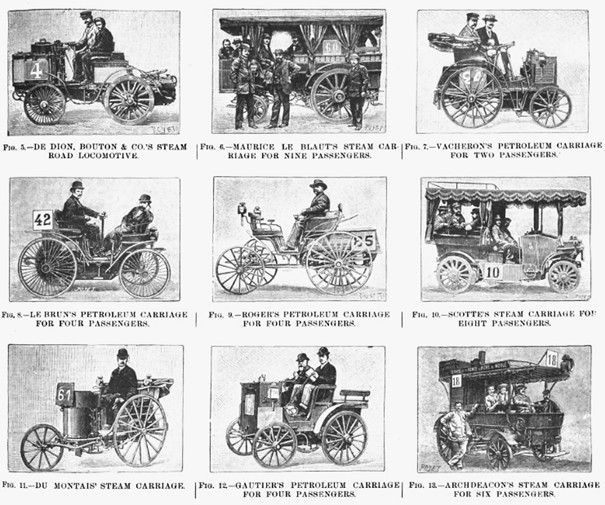
No. 4, Messrs. De Dion, Bouton & Co.’s Victoria bogie, prize of 2,000 francs -The system presented by Messrs. De Dion, Bouton & Co. may be classed among those road locomotives of which a few specimens were seen thirty years ago, before the invention of tramways. This traction locomotive (Fig. 5) is provided in the rear with a fore-carriage circle mounted upon springs and designed to receive the fore-carriage of any sort of vehicle after the latter’s front wheels have been removed.
The locomotive is provided with a multitubular circulating boiler of the De Dion, Bouton & Co. system, which supplies a 20-horsepower compound motor that is capable of becoming a direct, admission one in difficult passages. The vehicle, in running order, weighs 4,400 pounds, and carries a supply of 175 pounds of coke and 880 of water. The throwing into and out of gear is effected through a system of shafts with Cardan joints that traverse the journals and control the wheels externally, thus allowing the latter to obey all the inequalities of the ground, and the springs to yield without interfering with their respective motions, which thus remain perfectly independent.
In hauling 2,200 pounds, the vehicle is capable of reaching a speed of 18 miles an hour on a level and favorable roadway, and 10.5 miles an hour in ascending a gradient of from 8 to 10 per cent. More powerful and less speedy locomotives arranged upon the same principle are capable of hauling at least 22,000 pounds at a speed of 5 miles an hour. This system will be able to render services in war for the carriage of ammunition, provisions, etc. In the race from Paris to Rouen, this vehicle was the first to arrive, and exhibited qualities of resistance and speed that the petroleum carriages failed to attain to the same degree; but it is wanting in the lightness, elegance and conveniences offered by the petroleum vehicles, and so it was awarded only the second prize.
No. 60. Mr. Maurice le Blaut’s steam carriage, third prize of 1.500 francs. -This carriage responded but imperfectly to the conditions of the programme of the competition. It is an omnibus for nine passengers, provided with a Serpollet boiler; is quite heavy in form and appearance (Fig. 6), and is better adapted, it seems to us, to a common carriage service, since the vehicle, in running order, weighs more than four tons, thus distributed:
Carriage, empty. 5,850 pounds.
Tools and brake 220 “
Ten passengers, say. 1,500 “
Engineman 150 “
Coal. 440 “
Water, 150 gals. 1,300 “
Total 9,460 “
According to Mr. Le Blaut, the consumption is 35 pounds of water and from 10 to 12 pounds of coal per mile, which seems to indicate a pretty poor utilization of the boiler, which vaporizes but about 3 pounds of water per pound of coal. It is well to recognize that it is a question of steam superheated at quite a high temperature. The grate of the type experimented with presented an inadequate surface and quickly became clogged with clinkers.
No. 24, Mr. Vacheron’s single seat carriage, fourth prize of 1,000 francs, divided with Mr. Le Brun. – This carriage (Fig. 7) comprises only some modifications of detail of the type whence derived (Panhard & Levassor), particularly in the substitution of a hand wheel for a lever in the steering device.
No. 42, Mr. Le Brun’s two-seat petroleum carriage, fourth prize of 1,000 francs, divided with Mr. Vacheron. – This, exclusive of a few details, is a carriage identical with those constructed by the Messrs. Peugeot (Fig. 8).
No. 85, Mr. E. Roger’s two-seat petroleum carriage, fifth prize of 500 francs. – Mr. Roger’s carriage (Fig. 9) is a gasoline one in which the Daimler motor is replaced by a motor of the Benz system, placed in a box in the rear.
The Victoria two-passenger type, capable of receiving a seat in front for a third person, employs a 3-horsepower motor, and, on a level, can make from 10 to 12 miles an hour.
Through a proper reduction of speed, gradients of 10 to 100 can be ascended. The vehicle is 9 feet in height, 5 in width, and weighs about 1,400 pounds. The supply of gasoline is sufficient fora run of from 60 to 70 miles. The control of the motion and the system of steering present interesting peculiarities that we cannot here expatiate upon without exceeding our limits. After the carriages that disputed the first prize, it was one of those that best filled the bill of the competition, and it well merited the modest prize that it obtained.
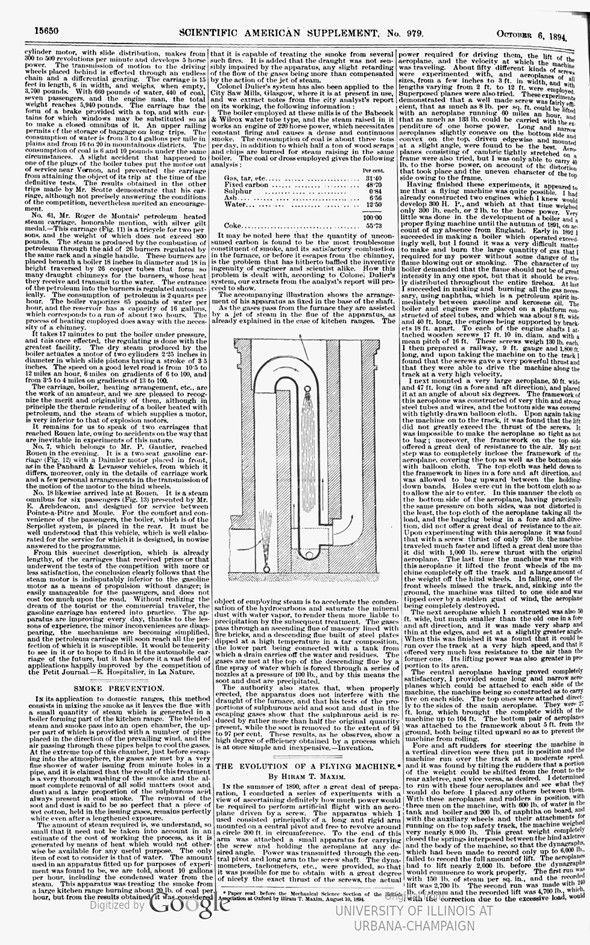
No. 10, Mr. J. Scotte’s steam carriage for eight persons, prize of 500 francs .- In this vehicle the boiler is of the vertical type, of the Field system, registered at 120 pounds to the square inch (Fig. 10). The two-cylinder motor, with slide distribution, makes from 300 to 500 revolutions per minute and develops 5 horsepower. The transmission of motion to the driving wheels placed behind is effected through an endless chain and a differential gearing. The carriage is 15 feet in length, 6 in width, and weighs, when empty, 3,700 pounds. With 660 pounds of water, 440 of coal, seven passengers, and the engine man, the total weight reaches 5,940 pounds. The carriage has the form of a brake provided with a top, and with curtains for which windows may be substituted so as to make a closed omnibus of it. An upper railing permits of the storage of baggage on long trips. The consumption of water is from 3 to 4 gallons per mile in plains and from 16 to 20 in mountainous districts. The consumption of coal is 6 and 10 pounds under the same circumstances. A slight accident that happened to one of the plugs of the boiler tubes put the motor out of service near Vernon and prevented the carriage from attaining the object of its trip at the time of the definitive tests. The results obtained in the other trips made by Mr. Scotte demonstrate that his carriage, although not precisely answering the conditions of the competition, nevertheless merited an encouragement.
No. 61, Mr. Roger de Montais’ petroleum heated steam carriage, honorable mention, with silver gilt medal. – This carriage (Fig. 11) is a tricycle for two persons, and the weight of which does not exceed 800 pounds. The steam is produced by the combustion of petroleum through the aid of 26 burners regulated by the same rack and a single handle. These burners are placed beneath a boiler 18 inches in diameter and 18 in height traversed by 26 copper tubes that form so many draught chimneys for the burners, whose heat they receive and transmit to the water. The entrance of the petroleum into the burners is regulated automatically. The consumption of petroleum is 2 quarts per hour. The boiler vaporizes 65 pounds of water per hour, and the reservoir has a capacity of 16 gallons, which corresponds to a run of about two hours. The process of heating employed does away with the necessity of a chimney.
It takes 17 minutes to put the boiler under pressure, and this once effected, the regulating is done with the greatest facility. The dry steam produced by the boiler actuates a motor of two cylinders 2.25 inches in diameter in which slide pistons having a stroke of 3-5 inches. The speed on a good level road is from 10.5 to 12 miles an hour, 6 miles on gradients of 6 to 100, and from 3.5 to 4 miles on gradients of 13 to 100.
The carriage, boiler, heating arrangement, etc., are the work of an amateur, and we are pleased to recognize the merit and originality of them, although in principle the thermic rendering of a boiler heated with petroleum, and the steam of which supplies a motor, is very inferior to that of explosion motors.
It remains for us to speak of two carriages that reached Rouen late, owing to accidents on the way that are inevitable in experiments of this nature.
No. 7, which belongs to Mr. P. Gautier, reached Rouen in the evening. It is a two-seat gasoline carriage (Fig. 12) with a Daimler motor placed in front, as in the Panhard & Levassor vehicles, from which it differs, moreover, only in the details of carriage work and a few personal arrangements in the transmission of the motion of the motor to the hind wheels.
No. 18 likewise arrived late at Rouen. It is a steam omnibus for six passengers (Fig. 13) presented by Mr. E. Archdeacon and designed for service between Pointe-a-Pitre and Moule. For the comfort and convenience of the passengers, the boiler, which is of the Serpollet system, is placed in the rear. It must be well understood that this vehicle, which is well elaborated for the service for which it is designed, in nowise answered to the programme.
From this succinct description, which is already lengthy, of the carriages that received prizes or that underwent the tests of the competition with more or less satisfaction, the conclusion clearly follows that the steam motor is indisputably inferior to the gasoline motor as a means of propulsion without danger; is easily manageable for the passengers and does not cost too much upon the road. Without realizing the dream of the tourist or the commercial traveler, the gasoline carriage has entered into practice. The apparatus are improving every day, thanks to the lessons of experience, the minor inconveniences are disappearing, the mechanisms are becoming simplified, and the petroleum carriage will soon reach all the perfection of which it is susceptible. It would be temerity to see in it or to hope to find in it the automobile carriage of the future, but it has before it a vast field of applications happily improved by the competition of the Petit Journal.
– E. Hospitalier, in La Nature.
Photos.
Pages 15648 – 15650
FIRST DAY OF THE RACE OF THE AUTOMOBILE CARRIAGES-PREPARATION FOR THE START AT THE BOULEVARD MAILLOT, NEUILLY, JULY 19, 1894.
FIG. 1.-PANHARD & LEVASSOR’S PETROLEUM CARRIAGE FOR TWO PASSENGERS.
FIG. 2.-PANHARD & LEVASSOR’S PETROLEUN CARRIAGE FOR FOUR PASSENGERS.
FIG. 3.-PEUGEOT BROS.’ SONS’ PETROLEUM CARRIAGE FOR THREE PASSENGERS.
FIG. 4.-PEUGEOT BROS.’ SONS’ PETROLEUM CARRIAGE FOR FOUR PASSENGERS.
FIG. 5.-DE DION, BOUTON & CO.’S STEAM ROAD LOCOMOTIVE.
FIG. 6.-MAURICE LE BLAUT’S STEAM CARRIAGE FOR NINE PASSENGERS.
FIG. 7.-VACHERON’S PETROLEUM CARRIAGE FOR TWO PASSENGERS.
FIG. 8.-LE BRUN’S PETROLEUM CARRIAGE FOR FOUR PASSENGERS.
FIG. 9.-ROGER’S PETROLEUM CARRIAGE FOR FOUR PASSENGERS.
FIG. 10.-SCOTTE’S STEAM CARRIAGE FOR EIGHT PASSENGERS.
FIG. 11.-DU MONTAIS’ STEAM CARRIAGE.
FIG. 12.-GAUTIER’S PETROLEUM CARRIAGE FOR FOUR PASSENGERS.
FIG. 13.-ARCHDEACON’S STEAM CARRIAGE FOR SIX PASSENGERS.