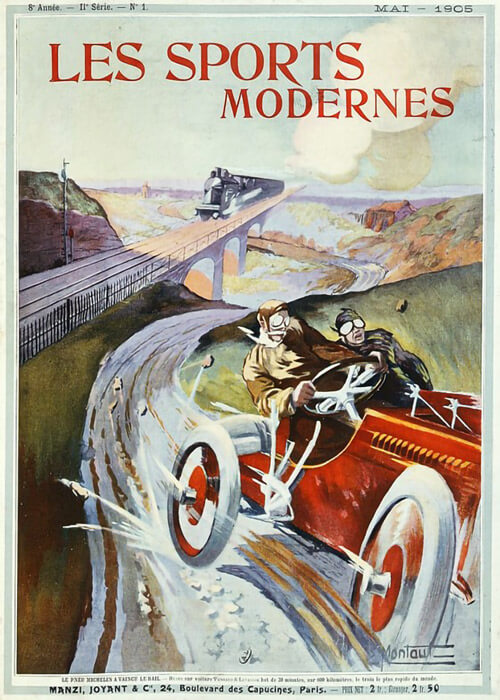
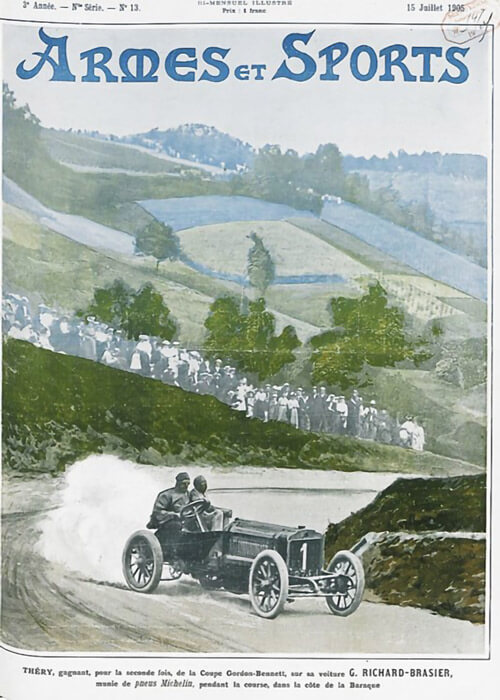
The Frenchman Victor Breyer had been responsible for organizing the 1908 French Grand Prix at Dieppe. For the 1908 Savannah Grand Prize, he visited on site and he gave his comments after the race, as documented in this article. Compared with to two earlier race events of that year, the French Grand Prix and the Italian Targa Florio, he concluded that the Savannah Grand Prize is favorably „in regard to sporting interest and management“. Now, here’s to Savannah!
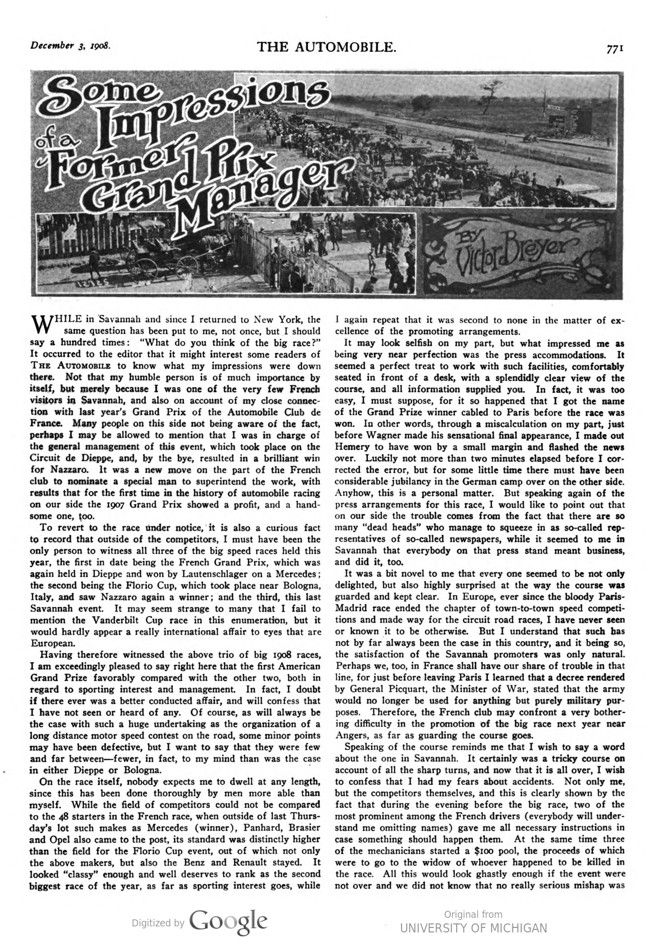
By courtesy of hathitrust.org www.hathitrust.org, Text and jpegs compiled by motorracinghistory.
THE AUTOMOBILE Vol. XIX, No. 23, December 3, 1908
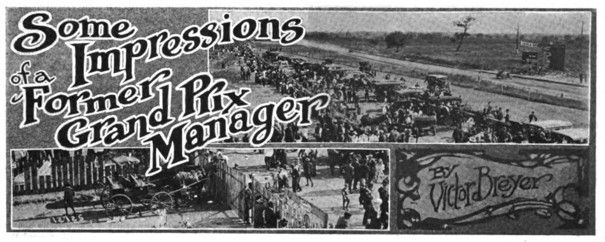
Some Impressions of a Former Grand Prix Manager
BY Victor Breyer
WHILE in Savannah and since I returned to New York, the same question has been put to me, not once, but I should say a hundred times: „What do you think of the big race?“ It occurred to the editor that it might interest some readers of THE AUTOMOBILE to know what my impressions were down there. Not that my humble person is of much importance by itself, but merely because I was one of the very few French visitors in Savannah, and also on account of my close connection with last year’s Grand Prix of the Automobile Club de France. Many people on this side not being aware of the fact, perhaps I may be allowed to mention that I was in charge of the general management of this event, which took place on the Circuit de Dieppe, and, by the bye, resulted in a brilliant win for Nazzaro. It was a new move on the part of the French club to nominate a special man to superintend the work, with results that for the first time in the history of automobile racing on our side the 1907 Grand Prix showed a profit, and a handsome one, too.
To revert to the race under notice, it is also a curious fact to record that outside of the competitors, I must have been the only person to witness all three of the big speed races held this year, the first in date being the French Grand Prix, which was again held in Dieppe and won by Lautenschlager on a Mercedes; the second being the Florio Cup, which took place near Bologna, Italy, and saw Nazzaro again a winner; and the third, this last Savannah event. It may seem strange to many that I fail to mention the Vanderbilt Cup race in this enumeration, but it would hardly appear a really international affair to eyes that are European.
Having therefore witnessed the above trio of big 1908 races, I am exceedingly pleased to say right here that the first American Grand Prize favorably compared with the other two, both in regard to sporting interest and management. In fact, I doubt if there ever was a better conducted affair, and will confess that I have not seen or heard of any. Of course, as will always be the case with such a huge undertaking as the organization of a long distance motor speed contest on the road, some minor points may have been defective, but I want to say that they were few and far between – fewer, in fact, to my mind than was the case in either Dieppe or Bologna.
On the race itself, nobody expects me to dwell at any length, since this has been done thoroughly by men more able than myself. While the field of competitors could not be compared to the 48 starters in the French race, when outside of last Thursday’s lot such makes as Mercedes (winner), Panhard, Brasier and Opel also came to the post, its standard was distinctly higher than the field for the Florio Cup event, out of which not only the above makers, but also the Benz and Renault stayed. It looked „classy“ enough and well deserves to rank as the second biggest race of the year, as far as sporting interest goes, while I again repeat that it was second to none in the matter of excellence of the promoting arrangements.
It may look selfish on my part, but what impressed me as being very near perfection was the press accommodations. It seemed a perfect treat to work with such facilities, comfortably seated in front of a desk, with a splendidly clear view of the course, and all information supplied you. In fact, it was too easy, I must suppose, for it so happened that I got the name of the Grand Prize winner cabled to Paris before the race was won. In other words, through a miscalculation on my part, just before Wagner made his sensational final appearance, I made out Hemery to have won by a small margin and flashed the news over. Luckily not more than two minutes elapsed before I corrected the error, but for some little time there must have been considerable jubilancy in the German camp over on the other side. Anyhow, this is a personal matter. But speaking again of the press arrangements for this race, I would like to point out that on our side the trouble comes from the fact that there are so many „dead heads“ who manage to squeeze in as so-called representatives of so-called newspapers, while it seemed to me in Savannah that everybody on that press stand meant business, and did it, too.
It was a bit novel to me that everyone seemed to be not only delighted, but also highly surprised at the way the course was guarded and kept clear. In Europe, ever since the bloody Paris-Madrid race ended the chapter of town-to-town speed competitions and made way for the circuit road races, I have never seen or known it to be otherwise. But I understand that such has not by far always been the case in this country, and it being so, the satisfaction of the Savannah promoters was only natural. Perhaps we, too, in France shall have our share of trouble in that line, for just before leaving Paris I learned that a decree rendered by General Picquart, the Minister of War, stated that the army would no longer be used for anything but purely military purposes. Therefore, the French club may confront a very bothering difficulty in the promotion of the big race next year near Angers, as far as guarding the course goes.
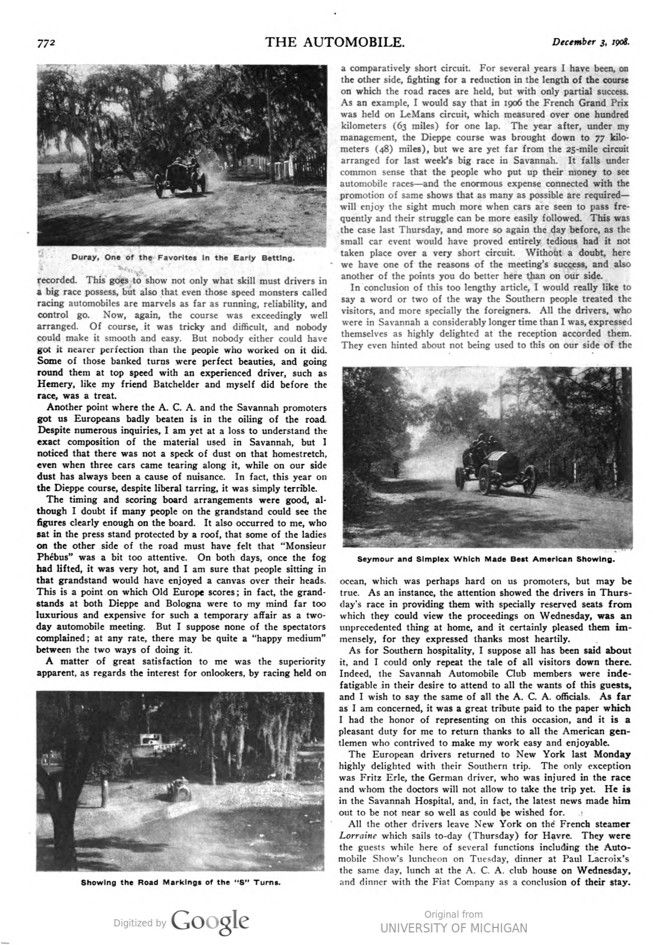
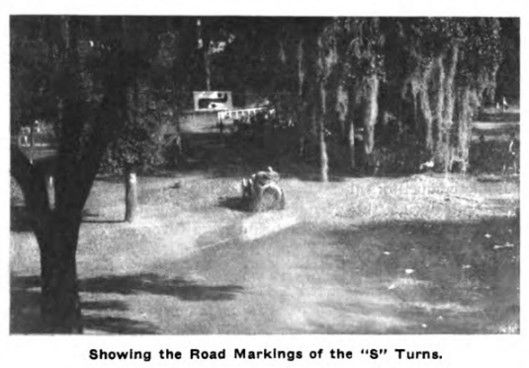
Speaking of the course reminds me that I wish to say a word about the one in Savannah. It certainly was a tricky course on account of all the sharp turns, and now that it is all over, I wish to confess that I had my fears about accidents. Not only me, but the competitors themselves, and this is clearly shown by the fact that during the evening before the big race, two of the most prominent among the French drivers (everybody will understand me omitting names) gave me all necessary instructions in case something should happen them. At the same time three of the mechanicians started a $100 pool, the proceeds of which were to go to the widow of whoever happened to be killed in the race. All this would look ghastly enough if the event were not over and we did not know that no really serious mishap was recorded. This goes to show not only what skill must drivers in a big race possess, but also that even those speed monsters called racing automobiles are marvels as far as running, reliability, and control go. Now, again, the course was exceedingly well arranged. Of course, it was tricky and difficult, and nobody could make it smooth and easy. But nobody either could have got it nearer perfection than the people who worked on it did. Some of those banked turns were perfect beauties, and going round them at top speed with an experienced driver, such as Hemery, like my friend Batchelder and myself did before the race, was a treat.
Another point where the A. C. A. and the Savannah promoters got us Europeans badly beaten is in the oiling of the road. Despite numerous inquiries, I am yet at a loss to understand the exact composition of the material used in Savannah, but I noticed that there was not a speck of dust on that homestretch, even when three cars came tearing along it, while on our side dust has always been a cause of nuisance. In fact, this year on the Dieppe course, despite liberal tarring, it was simply terrible.
The timing and scoring board arrangements were good, although I doubt if many people on the grandstand could see the figures clearly enough on the board. It also occurred to me, who sat in the press stand protected by a roof, that some of the ladies on the other side of the road must have felt that „Monsieur Phébus“ was a bit too attentive. On both days, once the fog had lifted, it was very hot, and I am sure that people sitting in that grandstand would have enjoyed a canvas over their heads. This is a point on which Old Europe scores; in fact, the grandstands at both Dieppe and Bologna were to my mind far too luxurious and expensive for such a temporary affair as a two-day automobile meeting. But I suppose none of the spectators complained; at any rate, there may be quite a „happy medium“ between the two ways of doing it.
A matter of great satisfaction to me was the superiority apparent, as regards the interest for onlookers, by racing held on a comparatively short circuit. For several years I have been, on the other side, fighting for a reduction in the length of the course on which the road races are held, but with only partial success. As an example, I would say that in 1906 the French Grand Prix was held on Le Mans circuit, which measured over one hundred kilometers (63 miles) for one lap. The year after, under my management, the Dieppe course was brought down to 77 kilometers (48) miles), but we are yet far from the 25-mile circuit arranged for last week’s big race in Savannah. It falls under common sense that the people who put up their money to see automobile races – and the enormous expense connected with the promotion of same shows that as many as possible are required – will enjoy the sight much more when cars are seen to pass frequently and their struggle can be more easily followed. This was the case last Thursday, and more so again the day before, as the small car event would have proved entirely tedious had it not taken place over a very short circuit. Without a doubt, here we have one of the reasons of the meeting’s success, and also another of the points you do better here than on our side.
In conclusion of this too lengthy article, I would really like to say a word or two of the way the Southern people treated the visitors, and more specially the foreigners. All the drivers, who were in Savannah a considerably longer time than I was, expressed themselves as highly delighted at the reception accorded them. They even hinted about not being used to this on our side of the ocean, which was perhaps hard on us promoters, but may be true. As an instance, the attention showed the drivers in Thursday’s race in providing them with specially reserved seats from which they could view the proceedings on Wednesday, was an unprecedented thing at home, and it certainly pleased them immensely, for they expressed thanks most heartily.
As for Southern hospitality, I suppose all has been said about it, and I could only repeat the tale of all visitors down there. Indeed, the Savannah Automobile Club members were indefatigable in their desire to attend to all the wants of this guests, and I wish to say the same of all the A. C. A. officials. As far as I am concerned, it was a great tribute paid to the paper which I had the honor of representing on this occasion, and it is a pleasant duty for me to return thanks to all the American gentlemen who contrived to make my work easy and enjoyable.
The European drivers returned to New York last Monday highly delighted with their Southern trip. The only exception was Fritz Erle, the German driver, who was injured in the race and whom the doctors will not allow to take the trip yet. He is in the Savannah Hospital, and, in fact, the latest news made him out to be not near so well as could be wished for.
All the other drivers leave New York on the French steamer Lorraine which sails today (Thursday) for Havre. They were the guests while here of several functions including the Automobile Show’s luncheon on Tuesday, dinner at Paul Lacroix’s the same day, lunch at the A. C. A. club house on Wednesday, and dinner with the Fiat Company as a conclusion of their stay.
Photos.
Page 772.
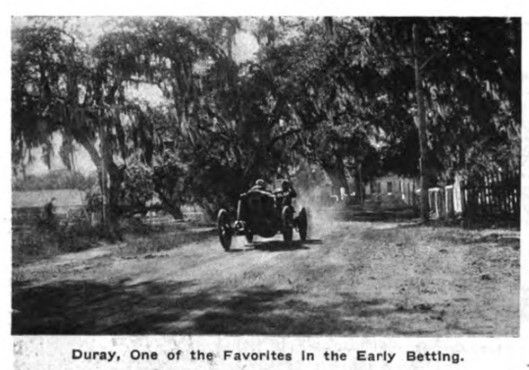
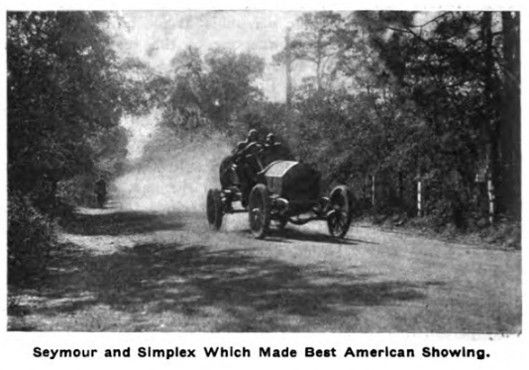
Duray, One of the Favorites In the Early Betting. – Showing the Road Markings of the „S“ Turns. – Seymour and Simplex Which Made Best American Showing.