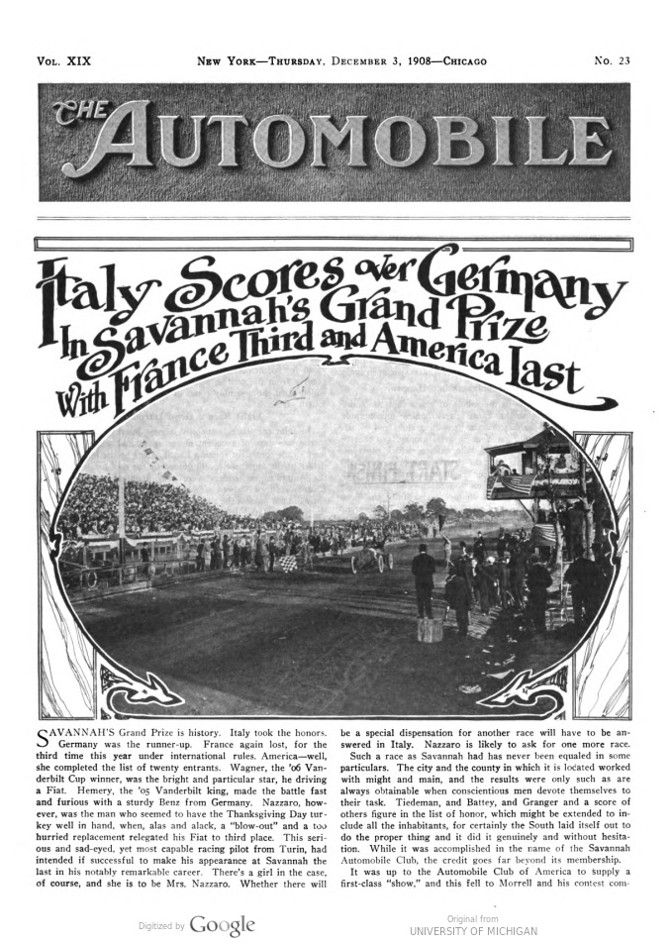
The result of the 1908 Thanksgiving Day Savannian Grand Prize was that Italy won, Wagner in a Fiat. Germany came second, Hémery in a Benz. Italy also third with Nazzaro on a Fiat. France and America really didn’t feel well after the race. But the real winner of that day was the Savannah Grand Prize itself. The race was an overwhelming success, in avery aspect. To summarize this issue of The Automobile: no catastrophies, an excellent guarding of the course, a good light-car race and racing protests that were withdrawn.
By courtesy of hathitrust.org www.hathitrust.org, Text and jpegs compiled by motorracinghistory.
THE AUTOMOBILE Vol. XIX, No. 23, December 3, 1908
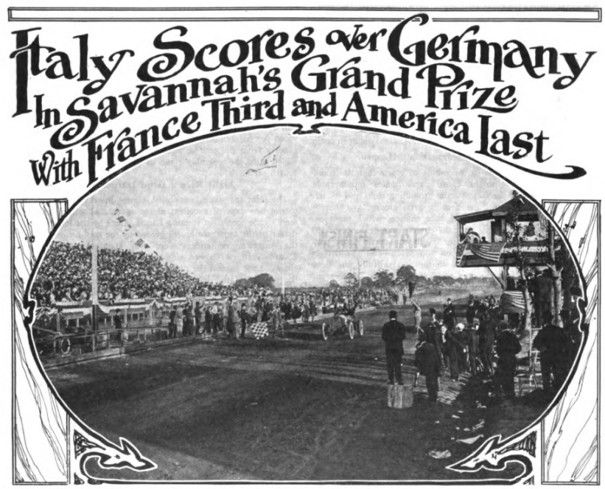
Italy Scores over Germany with France Third and America Last
SAVAVANNAH’S Grand Prize is history. Italy took the honors. Germany was the runner-up. France again lost, for the third time this year under international rules. America – well, she completed the list of twenty entrants. Wagner, the ’06 Vanderbilt Cup winner, was the bright and particular star, he driving a Fiat. Hemery, the ’05 Vanderbilt king, made the battle fast and furious with a sturdy Benz from Germany. Nazzaro, however, was the man who seemed to have the Thanksgiving Day turkey well in hand, when, alas and alack, a „blow-out“ and a too hurried replacement relegated his Fiat to third place. This serious and sad-eyed, yet most capable racing pilot from Turin, had intended if successful to make his appearance at Savannah the last in his notably remarkable career. There’s a girl in the case, of course, and she is to be Mrs. Nazzaro. Whether there will be a special dispensation for another race will have to be answered in Italy. Nazzaro is likely to ask for one more race.
Such a race as Savannah had has never been equaled in some particulars. The city and the county in which it is located worked with might and main, and the results were only such as are always obtainable when conscientious men devote themselves to their task. Tiedeman, and Battey, and Granger and a score of others figure in the list of honor, which might be extended to include all the inhabitants, for certainly the South laid itself out to do the proper thing and it did it genuinely and without hesitation. While it was accomplished in the name of the Savannah Automobile Club, the credit goes far beyond its membership.
It was up to the Automobile Club of America to supply a first-class „show,“ and this fell to Morrell and his contest committee associates. Circumstances may have helped, but the fact remains that fourteen of the world’s best drivers, supplied with superb racing crafts, came from Europe for the „Grand Prix“ on American soil. To this contingent were added six American starters, who recognized the handicaps against them and sought experience and did not delude themselves with the idea of winning the A. C. A. cup. To enter into a game at which you are a novice and your opponent is an expert, isn’t the best kind of judgment. ‚Tis possible that nothing of the kind may happen again.
Expected Catastrophies Didn’t Happen.
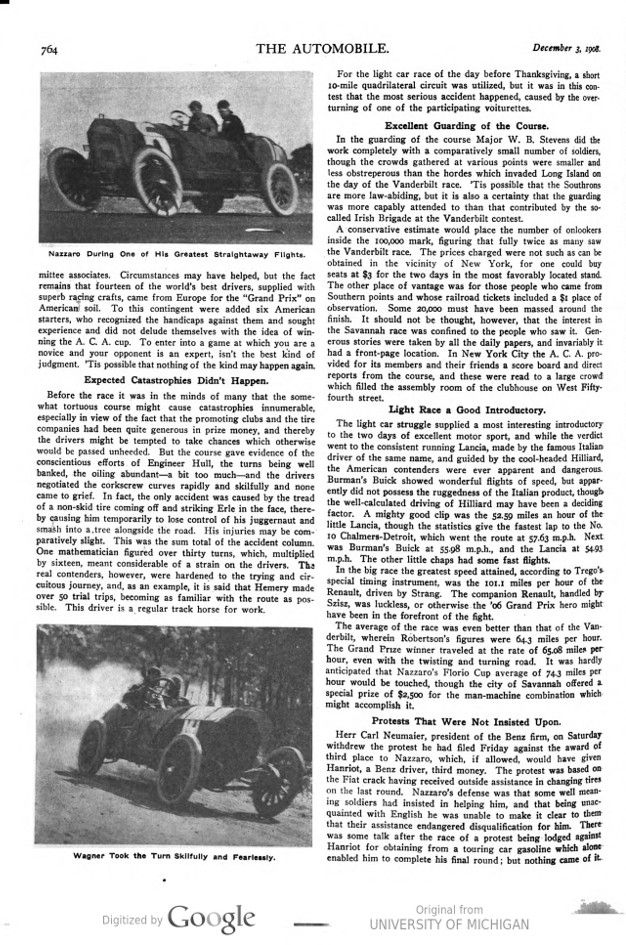
Before the race it was in the minds of many that the some- what tortuous course might cause catastrophies innumerable, especially in view of the fact that the promoting clubs and the tire companies had been quite generous in prize money, and thereby the drivers might be tempted to take chances which otherwise would be passed unheeded. But the course gave evidence of the conscientious efforts of Engineer Hull, the turns being well banked, the oiling abundant – a bit too much – and the drivers negotiated the corkscrew curves rapidly and skilfully and none came to grief. In fact, the only accident was caused by the tread of a non-skid tire coming off and striking Erle in the face, thereby causing him temporarily to lose control of his juggernaut and smash into a tree alongside the road. His injuries may be comparatively slight. This was the sum total of the accident column. One mathematician figured over thirty turns, which, multiplied by sixteen, meant considerable of a strain on the drivers. The real contenders, however, were hardened to the trying and circuitous journey, and, as an example, it is said that Hemery made over 50 trial trips, becoming as familiar with the route as possible. This driver is a regular track horse for work.
For the light car race of the day before Thanksgiving, a short 10-mile quadrilateral circuit was utilized, but it was in this contest that the most serious accident happened, caused by the overturning of one of the participating voiturettes.
Excellent Guarding of the Course.
In the guarding of the course Major W. B. Stevens did the work completely with a comparatively small number of soldiers, though the crowds gathered at various points were smaller and less obstreperous than the hordes which invaded Long Island on the day of the Vanderbilt race. ‚Tis possible that the Southrons are more law-abiding, but it is also a certainty that the guarding was more capably attended to than that contributed by the so-called Irish Brigade at the Vanderbilt contest.
A conservative estimate would place the number of onlookers inside the 100,000 mark, figuring that fully twice as many saw the Vanderbilt race. The prices charged were not such as can be obtained in the vicinity of New York, for one could buy seats at $3 for the two days in the most favorably located stand. The other place of vantage was for those people who came from Southern points and whose railroad tickets included a $1 place of observation. Some 20,000 must have been massed around the finish. It should not be thought, however, that the interest in the Savannah race was confined to the people who saw it. Generous stories were taken by all the daily papers, and invariably it had a front-page location. In New York City the A. C. A. provided for its members and their friends a score board and direct reports from the course, and these were read to a large crowd which filled the assembly room of the clubhouse on West Fifty-fourth street.
Light Race a Good Introductory.
The light car struggle supplied a most interesting introductory to the two days of excellent motor sport, and while the verdict. went to the consistent running Lancia, made by the famous Italian driver of the same name, and guided by the cool-headed Hilliard, the American contenders were ever apparent and dangerous. Burman’s Buick showed wonderful flights of speed, but apparently did not possess the ruggedness of the Italian product, though the well-calculated driving of Hilliard may have been a deciding factor. A mighty good clip was the 52.59 miles an hour of the little Lancia, though the statistics give the fastest lap to the No. 10 Chalmers-Detroit, which went the route at 57.63 m.p.h. Next was Burman’s Buick at 55.98 m.p.h., and the Lancia at 54-93 m.p.h. The other little chaps had some fast flights.
In the big race the greatest speed attained, according to Trego’s special timing instrument, was the 101.1 miles per hour of the Renault, driven by Strang. The companion Renault, handled by Szisz, was luckless, or otherwise the ’06 Grand Prix hero might. have been in the forefront of the fight. The average of the race was even better than that of the Vanderbilt, wherein Robertson’s figures were 64.3 miles per hour. The Grand Prize winner traveled at the rate of 65.08 miles per hour, even with the twisting and turning road. It was hardly anticipated that Nazzaro’s Florio Cup average of 74.3 miles per hour would be touched, though the city of Savannah offered a special prize of $2,500 for the man-machine combination which might accomplish it.
Protests That Were Not Insisted Upon.
Herr Carl Neumaier, president of the Benz firm, on Saturday withdrew the protest he had filed Friday against the award of third place to Nazzaro, which, if allowed, would have given Hanriot, a Benz driver, third money. The protest was based on the Fiat crack having received outside assistance in changing tires on the last round. Nazzaro’s defense was that some well meaning soldiers had insisted in helping him, and that being unacquainted with English he was unable to make it clear to them that their assistance endangered disqualification for him. There was some talk after the race of a protest being lodged against Hanriot for obtaining from a touring car gasoline which alone- enabled him to complete his final round; but nothing came of it.
Photos.
Page 764. Nazzaro During One of His Greatest Straightaway Flights – Wagner Took the TurnSkilfully and Fearlessly