The third Savannah Grand Prize, of 1911, after 1908 and 1910, was again a smashing succes. David Bruce-Brown in a Benz was the winner, followed by a Benz, a Mercedes and again a Fiat. Victor Hémery in a Benz set the fastest lap at a speed of 81.6 mph. This report of Mr. Beecroft mentions that it was an exciting race – contest a spectacular one – with relatievely low margins at the finish line after some 411 miles. Other parts like a contest analysis and the elimination story are also dealt with.
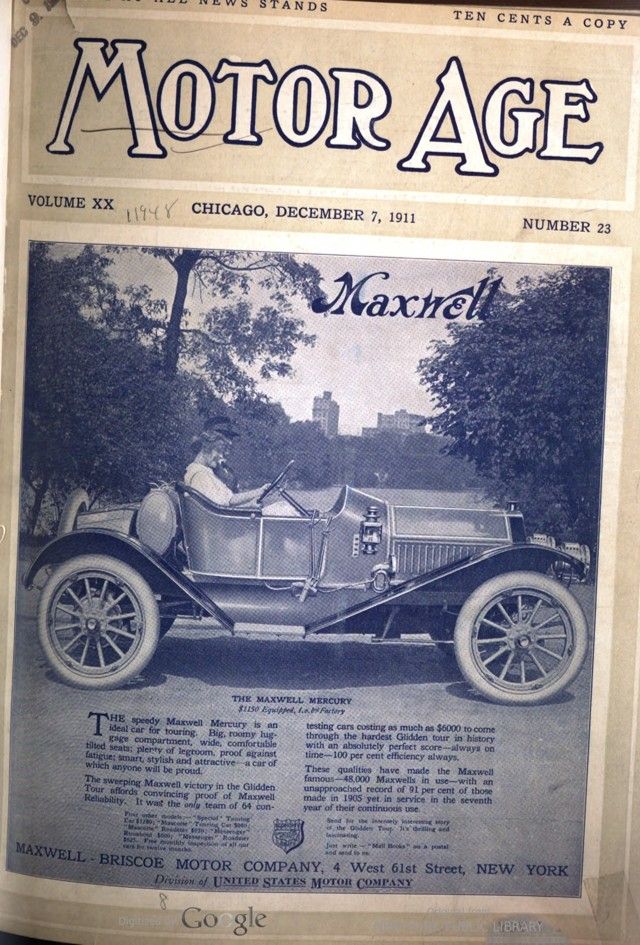
Text and jpegs by courtesy of hathitrust.org www.hathitrust.org, compiled by motorracinghistory
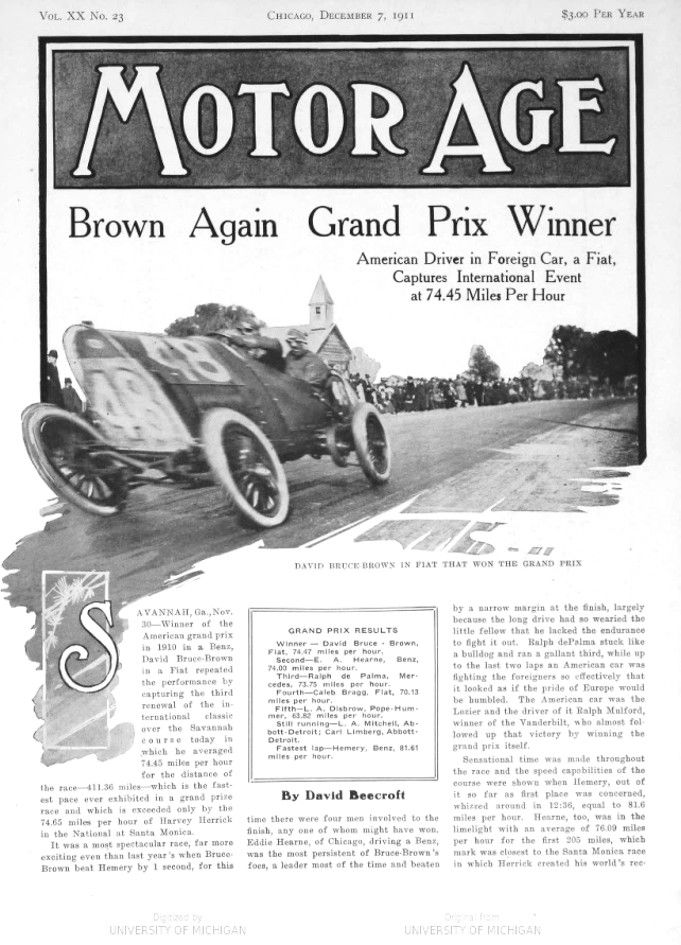
MOTOR AGE Vol. XX, No. 23, December 7, 1911
Brown Again Grand Prix Winner
American Driver in Foreign Car, a Fiat, Captures International Event at 74.45 Miles Per Hour
By David Beecroft
SAVANNAH, Ga., Nov. 30 – Winner of the American grand prix in 1910 in a Benz, David Bruce-Brown in a Fiat repeated the performance by capturing the third renewal of the international classic over the Savannah course today in which he averaged 74.45 miles per hour for the distance of the race – 411.36 miles – which is the fastest pace ever exhibited in a grand prize race and which is exceeded only by the 74.65 miles per hour of Harvey Herrick in the National at Santa Monica.
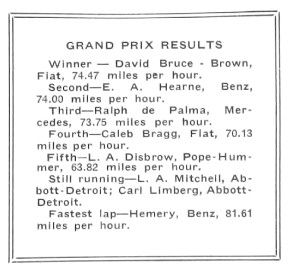
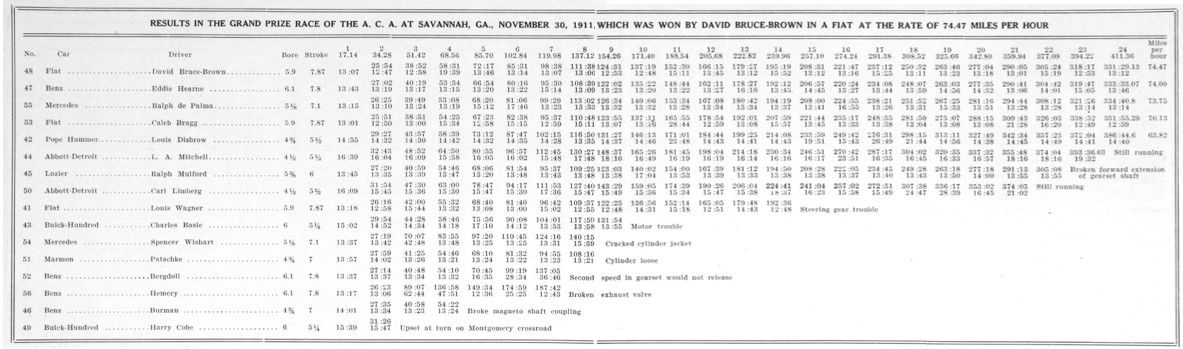
GRAND PRIX RESULTS
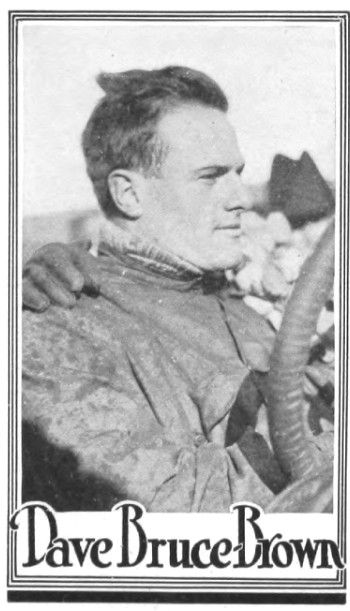
Winner – David Bruce Brown, Fiat, 74.47 miles per hour.
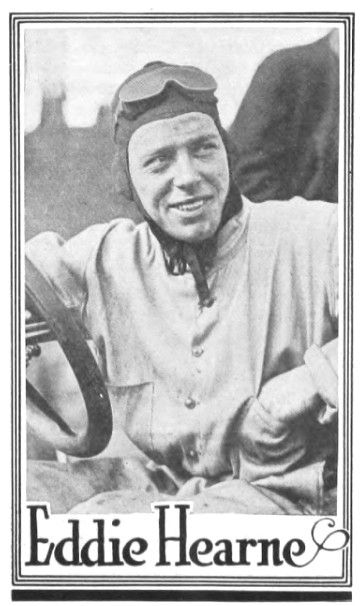
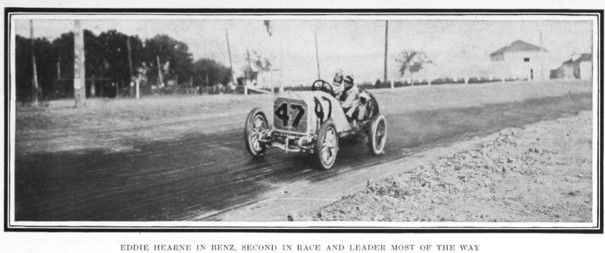
Second – E. A. Hearne, Benz, 74.00 miles per hour.
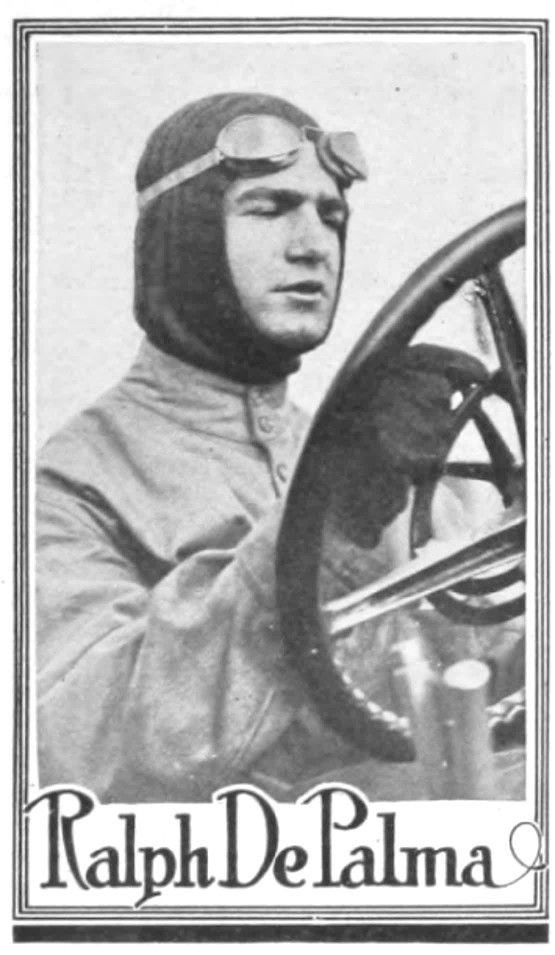
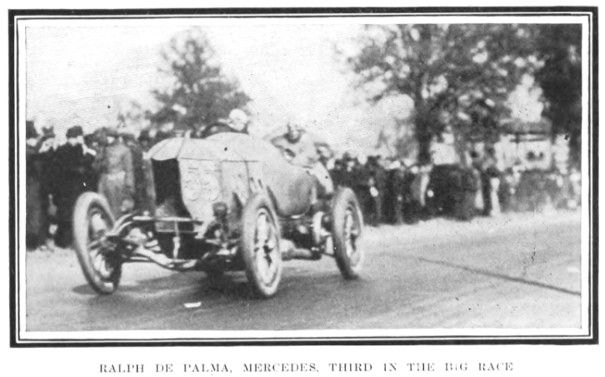
Third – Ralph de Palma, Mercedes, 73.75 miles per hour.
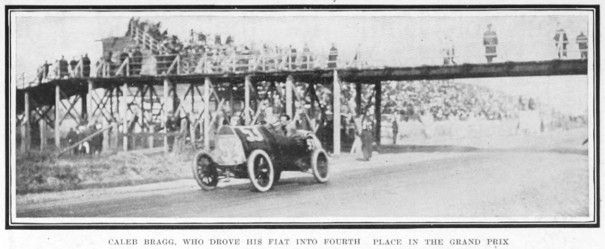
Fourth – Caleb Bragg, Fiat, 70.13 miles per hour.
Fifth – L. A. Disbrow, Pope-Hummer, 63.82 miles per hour.
Still running – L. A. Mitchell, Abbott-Detroit; Carl Limberg, Abbott-Detroit.
Fastest lap – Hemery, Benz, 81.61 miles per hour.
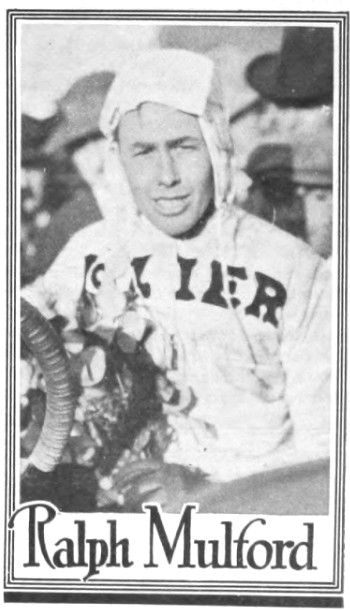
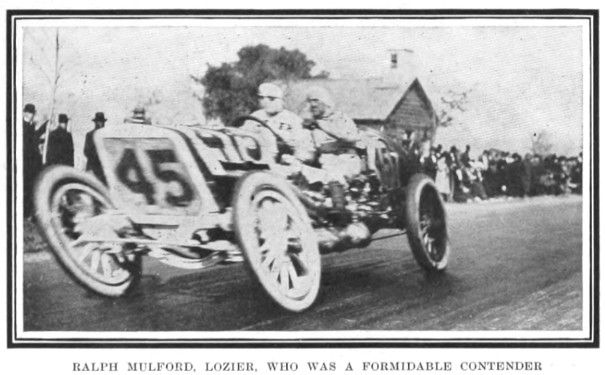
It was a most spectacular race, far more exciting even than last year’s when Bruce- Brown beat Hemery by 1 second, for this time there were four men involved to the finish, any one of whom might have won. Eddie Hearne, of Chicago, driving a Benz, was the most persistent of Bruce-Brown’s foes, a leader most of the time and beaten by a narrow margin at the finish, largely because the long drive had so wearied the little fellow that he lacked the endurance to fight it out. Ralph DePalma stuck like a bulldog and ran a gallant third, while up to the last two laps an American car was fighting the foreigners so effectively that it looked as if the pride of Europe would be humbled. The American car was the Lozier and the driver of it Ralph Mulford, winner of the Vanderbilt, who almost followed up that victory by winning the grand prix itself.
Sensational time was made throughout the race, and the speed capabilities of the course were shown when Hemery, out of it so far as first place was concerned, whizzed around in 12:36, equal to 81.6 miles per hour. Hearne, too, was in the limelight with an average of 76.09 miles per hour for the first 205 miles, which mark was closest to the Santa Monica race in which Herrick created his world’s record. Hearne’s mark, though, will not stand as record, the A. A. A. taking no cognizance of an intermediate distance such as this was.
Close Finish of Race
Brown won by the narrow margin of 2 minutes and 2 seconds over Hearne in the Benz; DePalma in his Mercedes was third, being but 3 minutes and 9 seconds back of the Fiat. Bragg, who finished fourth in a Fiat, was 20 minutes, or nearly two laps, back of Brown. Mulford in the Lozier was less than 2 minutes behind Brown at the end of the twenty-second lap, but he went out in the first part of the twenty-third, due to breaking the part of the gearset shaft which extends through the forward end of the gearbox and connects with the clutch through a universal joint. The shaft had a slight flaw in it, but it had made thirty-nine laps of the course, the seventeen of the Vanderbilt and twenty-two in the grand prize before breaking. By today’s victory Brown is to claim equal honors as a road race repeater with Harry Grant, winner of the Vanderbilt cup race last year, when he won it for the second successive time; and also with Thery, the celebrated European driver, who won the Gordon-Bennett race in 1904 and also in 1905 in a Brasier car.
Brown’s victory this year was a popular one. Being the winner of the grand prize last year, he was a strong favorite with the masses, and much speed was expected from his Fiat racer. His great rivals today before the race started were Wagner in another Fiat and Victor Hemery in a Benz. Last year Hemery was but 1.32 seconds behind Brown; the year before he was but a few seconds behind Wagner, who won in a Fiat, and this year many were looking to him to carry off the laurels. It was known during practice that he had the fastest car on the course and this was proven today when he made the fastest lap, averaging 81.61 miles per hour for a circuit. But luck was against him good and strong today. In the third lap he broke an exhaust valve and was over 1 hour making the circuit, which eliminated him as a contender, but he made a repair and made seven laps when he was compelled to retire due to the same trouble.
Wagner, the winner of the grand prize race 2 years ago, was looked upon as a probable leader today; in fact, more expected him to win than Bruce-Brown, but he, too, was doomed to disappointment. He had tire troubles at the end of the third lap and lost much time. He had four other cases of tire troubles and in taking a turn too fast in the fourteenth lap ran off the course and damaged his steering gear and withdrew when he reached the grandstand. With his elimination the two great European drivers were out and the American speed pilots on foreign and domestic cars were left to wage the issues of battle.
Contest a Spectacular One
Today’s race was one of the most spectacular ever seen in America. There were sixteen cars that faced the tape and got away in good shape, but of these only five finished the twenty-four laps. Two more, the Abbott-Detroits, were running at the finish. Nine cars were compelled to give up the grueling struggle. From start to the end of the twenty-second lap the race might have been won by Brown in the Fiat, by Hearne in the Benz, by Mulford in the Lozier or by DePalma in his Mercedes. At this point Hearne led, being 24 seconds ahead of Mulford and 42 seconds ahead of Brown; DePalma was over 3 minutes back. It just called for a little unexpected tire trouble to make any one of the three a leader, and Hearne had his in the second last lap and in the same lap Mulford was retired, leaving the course clear for Brown and his Fiat.
From start to finish the race was one of never-ending interest. The leadership changed no fewer than seven times in those twenty-four laps. Caleb Bragg in a Fiat, a duplicate of the one Brown drove, led for the first three circuits but lost it to DePalma in the fifth, due to tire troubles. DePalma held it for but a single circuit, when he had a leaky gasoline line and it fell into the keeping of Eddie Hearne and his Benz, who maintained it for laps five and six, when he dropped it into the hands of Patschke in his Marmon who held it for laps seven and eight, when he dropped out of the race. Hearne had from the start of the race been making laps in 5 to 6 seconds fewer than Patschke, so that as soon as tire troubles overtook him, Patschke was ready to grab the lead. When Patschke eliminated himself at the end of the eighth with engine troubles Hearne was at hand, being only 19 seconds behind. He took the lead in the ninth with a margin of 1 minute over Lozier and about the same on Wagner. Hearne held this until the twentieth lap when for the first time it fell into the hands of Bruce-Brown, who for the five previous laps had been steadily cutting down the lead Hearne had established earlier in the race.
When Brown took the lead in lap twenty he had but 31 seconds on Hearne but he kept it and led in lap twenty-one by 36 seconds. Lap twenty-two saw a change of leadership when Hearne, by his dogged perseverance, once again got into the front rank with a lead of 42 seconds on the Fiat, which lost its advantage, due to tire troubles. Here, with but two laps to go, came the excitement. Brown, Hearne and Mulford all stopped at the pits; they were all there together. It was the most exciting moment ever witnessed in this or any other country in a road race. The Fiat was first into the pit to change tires; not more than 3 or 4 seconds later came Mulford and then Hearne. Lozier was first away, the Fiat second and Benz last. Everybody knew that the Fiat could make the fastest lap, so it did. It took first place in the twenty-third lap and held it for the twenty-fourth, winning by a margin of over 2 minutes. Many thought the Benz would have won if it had not stopped to change tires, but no one really knows. Hearne was fatigued from driving and would not take any chances of holding the car on the turns should a tire go. As it was, Brown proved himself to be a wonderful uphill fighter much as a year ago and Mulford and Hearne endeared themselves to everyone by putting up the gamest fight that has been witnessed in a road race. DePalma, who finished third, and not so much in the limelight as the other three, was a strong favorite all day.
Analysis of Contest
A cursory analysis of the performance of Brown in his Fiat will show what difficulties he had to contend with from start to finish. His task was not that of defeating Hearne or Mulford or DePalma, but at different stages of the contest he had to battle with the speedy Wagner, with the equally fast Bragg, with the speed king Hemery, with Patschke and with Burman. He ran second for the first three laps, then dropped to eighth place which he held for a couple of circuits. He mounted to sixth in the sixth lap, to fifth in the seventh, only to fall back to sixth in the eighth. In lap nine the dropping out of Patschke raised him one and he gained another, due to the fortunes of tires in road racing, so that at the end of the circuit he was in fourth place. He remained fourth in laps nine and ten, was third in eleven and twelve, and was second in lap thirteen, being exactly 1 minute back of the flying Hearne in the Benz. But when almost within striking distance of first he stopped to change tires, made a slow lap in 15:52, and the Benz took the lead and Brown found himself in fifth place. Then he had to begin climbing all over again. But he kept steadily at it. By the end of lap fifteen he was back in third place, having got in advance of Bragg in the other Fiat and also the Lozier. Lap sixteen saw him in second place with the Benz ahead; but he dropped to third in laps seventeen, eighteen and nineteen. Then at one fell swoop he jumped ahead of both Hearne and Mulford and took first place. He held it for lap twenty-one but Hearne was close on his heels, being only 36 seconds back of him and Mulford little more than a minute in the rear. Then came the end of the twenty-second, when all three of them stopped. The Fiat got away with an advantage of over a minute on the Benz and it was all over but the shouting, because Brown was first in the twenty-third lap and first in the twenty-fourth. Through all of this changing, the like of which was never before seen in a road race in this country, Brown worked coolly along. He changed twelve tires from start to finish, but he changed all of these at the pits, seven being changed at the tire repair station on the back stretch and five at the grandstand pits. In five of the stops, he changed two tires at a time, both rear wheels and in the other two stops he changed one tire each. He did not make a tire change at any point along the course, and it would seem that he made time by changing at the tire pits or grandstand.
The Elimination Story
The elimination story was a particularly heavy one in that of the sixteen starters only five finished the twenty-four laps, and of these the Pope, driven by Disbrow, was the only American car. Two other American cars were consistently running at this time, one being No. 44 Abbott-Detroit, piloted by Mitchell, and the other No. 50 Abbott-Detroit, driven by Limberg. Mitchell covered twenty-three laps of the circuit when he was flagged off and Limberg had negotiated twenty-one laps when he was called off, the race being declared over and the course thrown open. Had the two Abbotts been allowed to finish, which they undoubtedly would have done, it would have given America three cars at the finish as compared with four foreign machines that completed the entire race. When it comes to the story of why the cars dropped out, attention is first drawn to the foreign ranks, as they were the first to be broken. Hemery was first in trouble, due directly to an exhaust valve giving away under the terrific speed. Undoubtedly the speed at which Wishart pushed his Mercedes was more or less responsible for the cracked cylinder, which caused his withdrawal. Bergdoll’s trouble was in not being able to shift from second speed. Wagner was eliminated by too fast driving on the curves and putting his steering gear out of commission when he ran off the road. The other four foreign cars were in at the finish of the race.
Five American cars were eliminated. First out was Cobe in Buick, who upset on a curve. He was the first to give up the race. Second to drop out was the special Marmon driven by Burman. It stopped just before reaching the grandstand before ending the fifth lap. The trouble consisted in the sprocket on the magneto shaft being destroyed. In lap ten Patschke, driving the other Marmon, withdrew, due to cylinders being loosened from the crankcase. He was leading when he pulled out. Basle in a Buick was next, dropping out in the following circuit. Mulford in a Lozier, as already stated, fell out in the start of the twenty-third lap, The attendance today was much greater than that which witnessed the Vanderbilt struggle. Although the grandstand was not one-third full at 9 o’clock, when the cars were sent away, it filled up very rapidly and in less than an hour was packed and standing room for more than 800 had been sold. The bleacher stand on the inside of the course was not more than one-third full. All around the course were good crowds, that picnicked and visited with one another. A conservative estimate placed the crowd that witnessed the race at 75,000. The control of the course was up to the old-time Savannah reputation. Soldiers were early in possession of every mile of the roadway and from start to finish not a person was allowed on the course or to cross it.
Photos.
Page 1. DAVID BRUCE-BROWN IN FIAT THAT WON THE GRAND PRIX
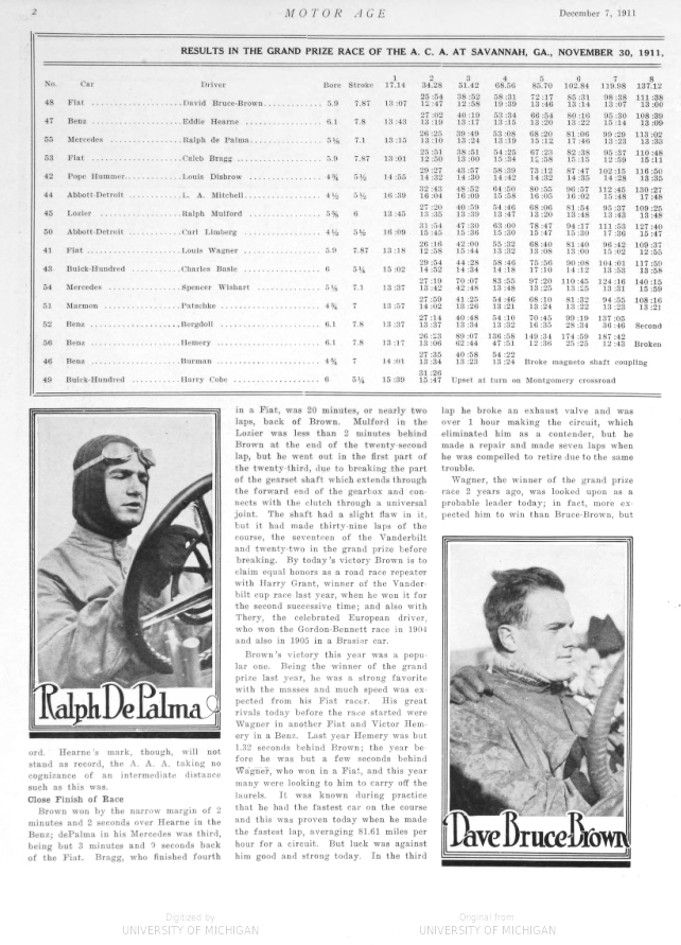
Page 2. Ralph De Palma – Dave Bruce Brown
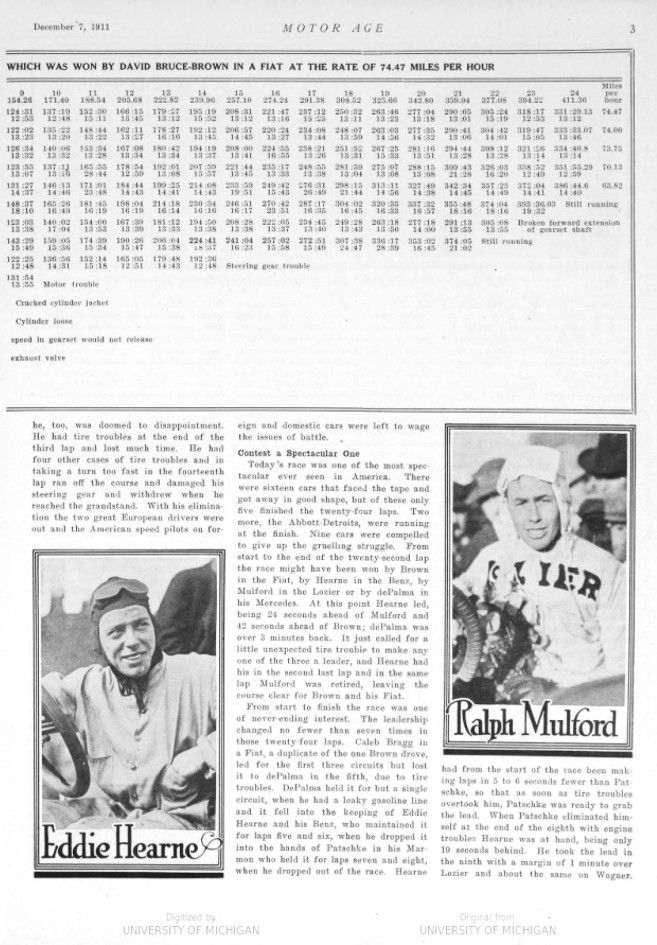
WHICH WAS WON BY DAVID BRUCE-BROWN IN A FIAT AT THE RATE OF 74.47 MILES PER HOUR
Page 3. Eddie Hearne – Ralph Mulford
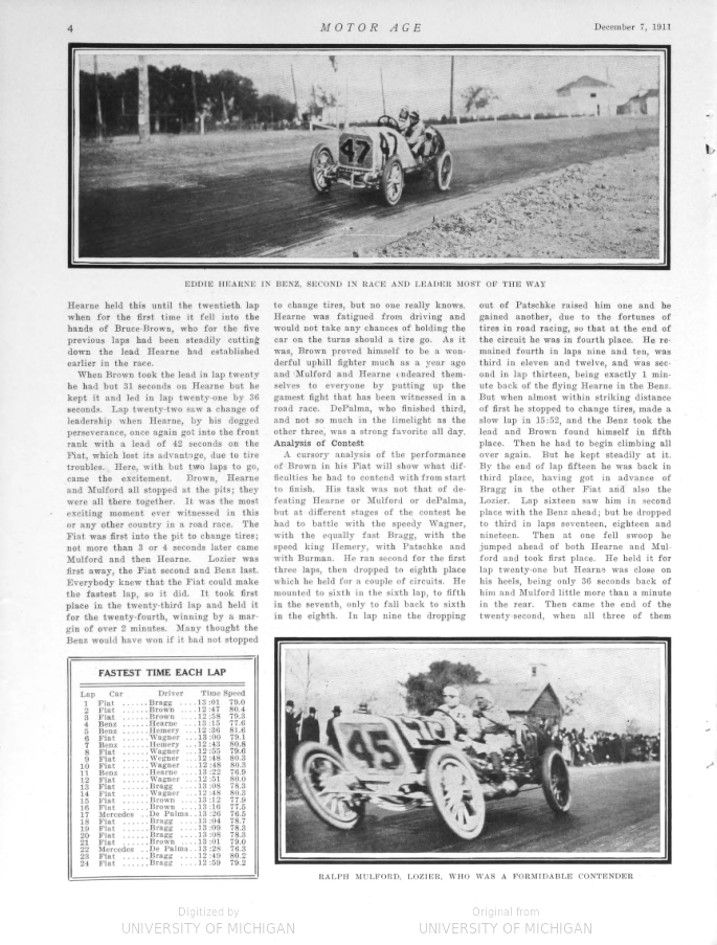
Page 4. EDDIE HEARNE IN BENZ, SECOND IN RACE AND LEADER MOST OF THE WAY – RALPH MULFORD, LOZIER, WHO WAS A FORMIDABLE CONTENDER – FASTEST TIME EACH LAP
Page 5. CALEB BRAGG, WHO DROVE HIS FIAT INTO FOURTH PLACE IN THE GRAND PRIX – RALPH DE PALMA, MERCEDES, THIRD IN THE BIG RACE – THEIR FASTEST LAPS