By courtesy of hathitrust.org. Text and photos compiled by motorracingistory.com
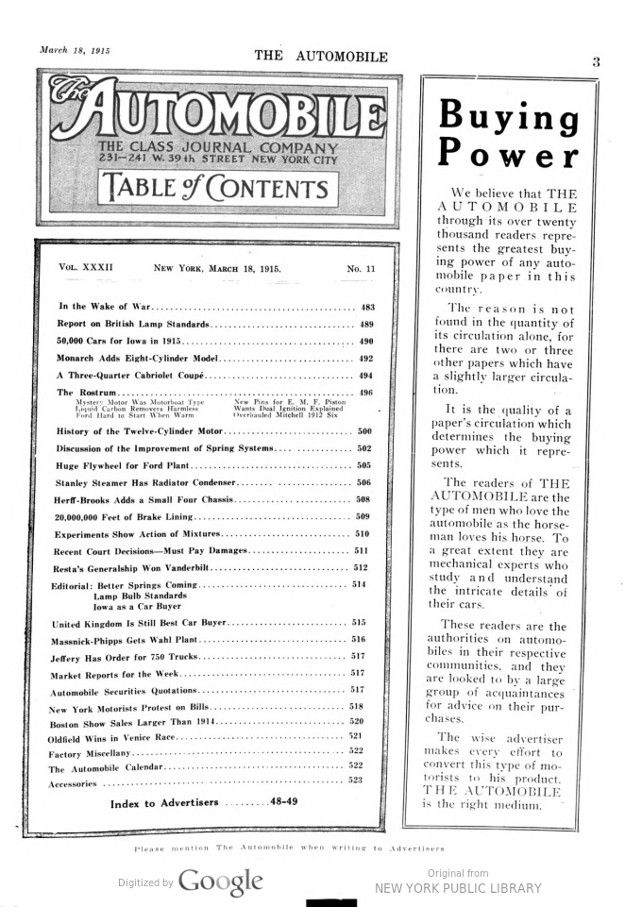
THE AUTOMOBILE Vol. 32, Jan-March 1915, No. 11, March 18, 1915, pages 512 – 513
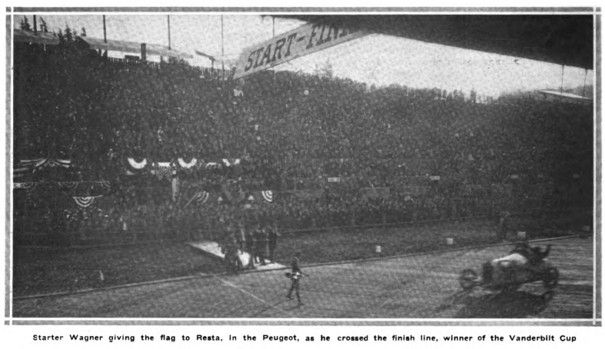
Resta’s Generalship Won Vanderbilt
Rough Course Kept Speed Low but Brings Out Skill of the Drivers
Police Work Well Done
By A. G. Waddell
SAN FRANCISCO, CAL., March 8 – For the seventh time a foreign built car has won the Vanderbilt Cup. The course, with its rough planks and sharp turns, provided a thorough test for both driver and car, and Resta and his Peugeot are deserving of much praise. While the Grand Prize, raced over the same course last Saturday, was more a race of drivers’ endurance than of the speed of machines, the Vanderbilt combined both. The distance called out every ounce of pluck and fight in the drivers, and the speed attained gave an opportunity for the carefully-wrought mechanism to show its worth.
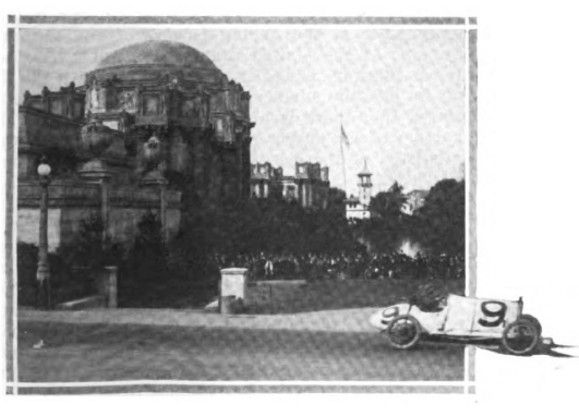
Compared to the 87.8 miles per hour averaged by Pullen in the Corona road race last November, the 67.3 miles averaged by Resta looks puny. But even those who have seen nothing but a map of the course realize that to attain this speed the drivers must have been forced to travel at close to 80 miles an hour on the straightaways. And when it is known that the longest of these is less than a mile, some conception of what 67 miles an hour means can be had. Add to this two right-angle turns, a sharp loop around a status, a 45-degree turn following a straightaway and some thousands of bumpy planks which floor a hairpin curve and you have a fair geometrical picture of the Exposition track.
Someone said that the course was the finest in America for the reason that it required great skill on the part of the driver. But it requires more than mere skill. Any skilful driver could get around the course without trouble if he took his time, but if he made the round at a 50-mile an hour pace he would have to add to skill a dash of daredeviltry. The man who mentally pictures smash-ups when his car begins to skid has no place on the Exposition course. barest whisper of fear in the mind of the driver would be cause for an accident.
No delays or hitches discontented the spectators at the Vanderbilt. The race had been set at 12:30, instead of 10:30, early in the week. By 10 o’clock over 18,000 spectators had paid admissions to the grounds and by noon the number had risen to 50,000. Before the race was done 100,000 people had gathered along the track. Without the excellent policing furnished by the soldiers from the Presidio accidents to the spectators would have been inevitable. In place of the call of “car’s coming” and a scurrying and running to clear the track, the course was always clear and at the most dangerous corners spectators were held 15 feet from the track. The courteous, efficient work of the 348 guards was a credit to both the army and the Exposition officials.
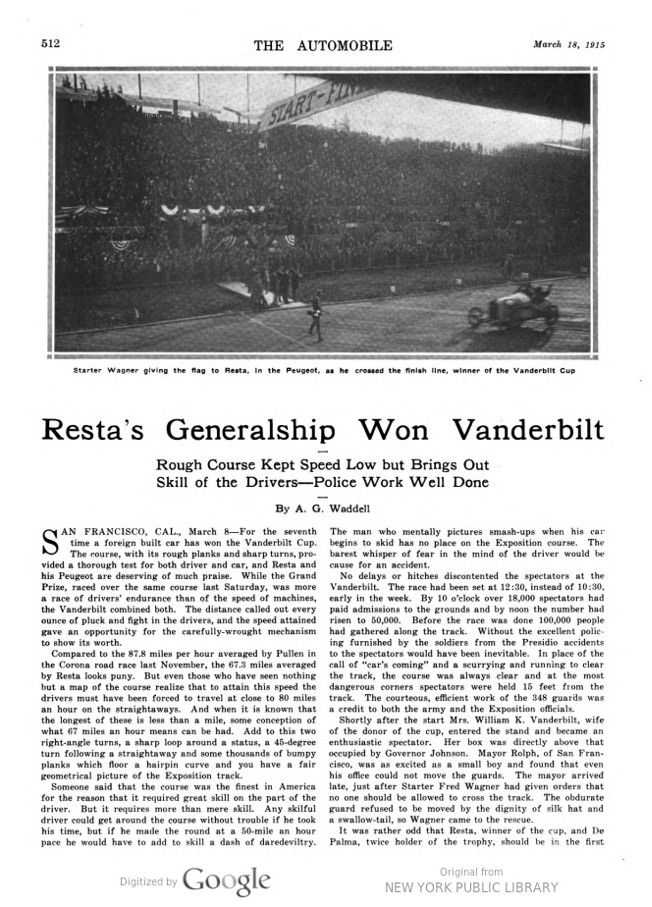
Shortly after the start Mrs. William K. Vanderbilt, wife of the donor of the cup, entered the stand and became an enthusiastic spectator. Her box was directly above that occupied by Governor Johnson. Mayor Rolph, of San Francisco, was as excited as a small boy and found that even his office could not move the guards. The mayor arrived late, just after Starter Fred Wagner had given orders that no one should be allowed to cross the track. The obdurate guard refused to be moved by the dignity of silk hat and a swallow-tail, so Wagner came to the rescue.
It was rather odd that Resta, winner of the cup, and De Palma, twice holder of the trophy, should be in the first three to start. The Chevrolet which started with them went out, but the first two of the thirty-one that started finished in the money. The pace for the first five laps was terrific. Tom Alley evidently hoped to gain a big lead and then settle down to a steady pace. To this end he tore around the course at an average of close to 75 miles an hour for five laps, or about 20 miles. The pace was too great. Alley soon found it out and settled down to a more sane speed. All this time Resta hummed along, not in the least worried over the burst of speed by the Duesenberg. He was apparently concerned with but one thing-to keep his Peugeot running steadily at an even pace. That he accomplished this may well be seen from the time reports which show Resta continually in the front after Tom Alley settled down.
Rickenbacher, in the Maxwell, also had his burst of speed at the first and then went out. He was the first to make a round of the course and for a time he and Resta engaged in a brush which provided some pretty racing on the straightaways. But Resta’s tactics were different from Rickenbacher’s. Rickenbacher was out to pass the foreign driver and to lap him; Resta was content to speed up only enough to keep himself abreast of his competitor and not to pass him. Resta appeared to drive with his eyes on a stopwatch, Rickenbacher with his eyes on the car ahead of him.
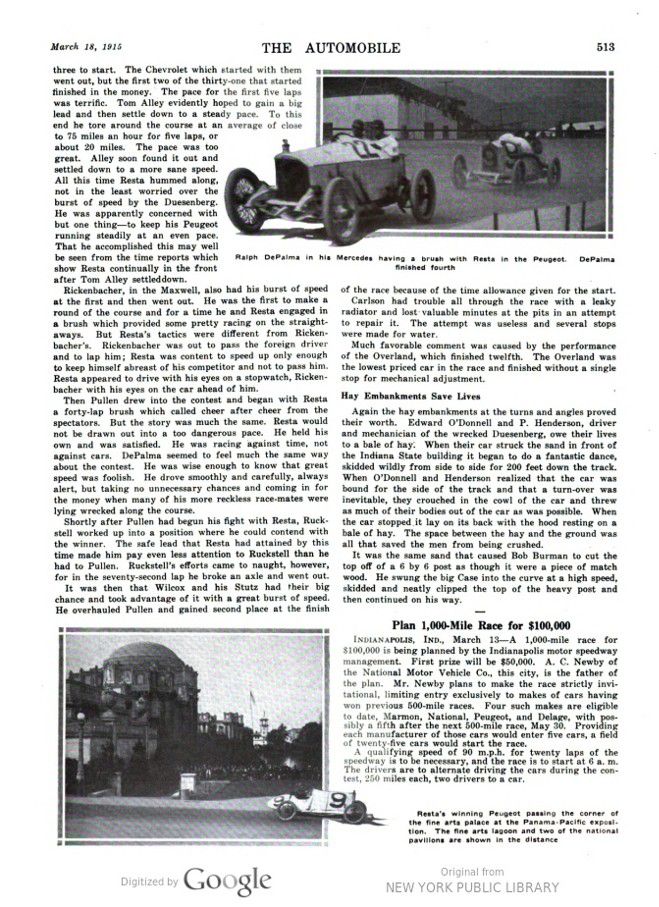
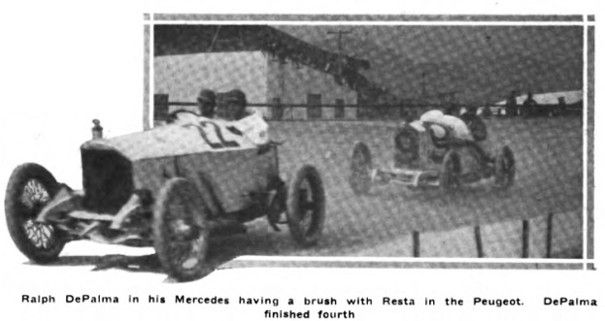
Then Pullen drew into the contest and began with Resta a forty-lap brush which called cheer after cheer from the spectators. But the story was much the same. Resta would not be drawn out into a too dangerous pace. He held his own and was satisfied. He was racing against time, not against cars. DePalma seemed to feel much the same way about the contest. He was wise enough to know that great speed was foolish. He drove smoothly and carefully, always alert, but taking no unnecessary chances and coming in for the money when many of his more reckless race-mates were lying wrecked along the course.
Shortly after Pullen had begun his fight with Resta, Ruckstell worked up into a position where he could contend with the winner. The safe lead that Resta had attained by this time made him pay even less attention to Ruckstell than he had to Pullen. Ruckstell’s efforts came to naught, however, for in the seventy-second lap he broke an axle and went out.
It was then that Wilcox and his Stutz had their big chance and took advantage of it with a great burst of speed. He overhauled Pullen and gained second place at the finish of the race because of the time allowance given for the start.
Carlson had trouble all through the race with a leaky radiator and lost valuable minutes at the pits in an attempt to repair it. The attempt was useless and several stops were made for water.
Much favorable comment was caused by the performance of the Overland, which finished twelfth. The Overland was the lowest priced car in the race and finished without a single stop for mechanical adjustment.
Hay Embankments Save Lives
Again the hay embankments at the turns and angles proved their worth. Edward O’Donnell and P. Henderson, driver and mechanician of the wrecked Duesenberg, owe their lives to a bale of hay. When their car struck the sand in front of the Indiana State building it began to do a fantastic dance, skidded wildly from side to side for 200 feet down the track. When O’Donnell and Henderson realized that the car was bound for the side of the track and that a turn-over was inevitable, they crouched in the cowl of the car and threw as much of their bodies out of the car as was possible. When the car stopped it lay on its back with the hood resting on a bale of hay. The space between the hay and the ground was all that saved the men from being crushed.
It was the same sand that caused Bob Burman to cut the top off of a 6 by 6 post as though it were a piece of match wood. He swung the big Case into the curve at a high speed, skidded and neatly clipped the top of the heavy post and then continued on his way.
Photos.
Page 512. START- Starter Wagner giving the flag to Resta, in the Peugeot, as he crossed the finish line, winner of the Vanderbilt Cup
Page 513. Ralph DePalma in his Mercedes having a brush with Resta in the Peugeot. DePalma finished fourth. – Resta’s winning Peugeot passing the corner of the fine arts palace at the Panama-Pacific exposition. The fine arts lagoon and two of the national pavilions are shown in the distance